


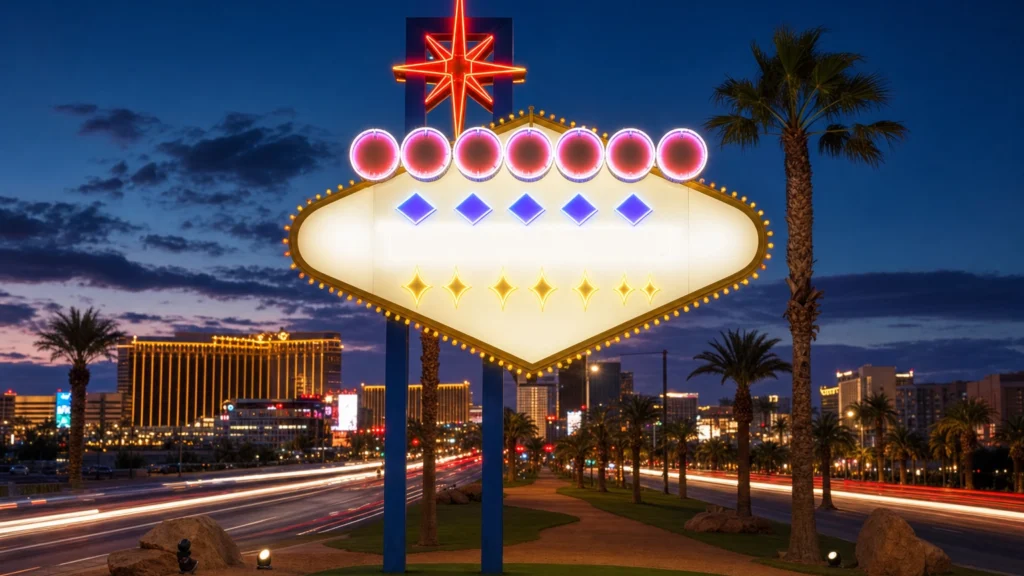
“Viva Las Vegas” means “long live Las Vegas,” or more loosely, “hooray for Las Vegas.” “Viva” is a celebratory Spanish cheer wishing something a long life, and “Las Vegas” is Spanish for “The Meadows.” Together the phrase is a toast to the city, made famous worldwide by Elvis Presley’s 1964 film.
You have seen it on marquees, heard it in the Elvis song, and probably shouted it yourself somewhere on the Strip. But “Viva Las Vegas” is not just a slogan invented by a movie studio. It is a real phrase with a real translation, built from two Spanish pieces that both tie back to the desert valley long before the neon arrived. Here is exactly what it means, where it came from, what “Las Vegas” itself translates to, and how people actually use the phrase today.
- Literal meaning: “long live Las Vegas.” “Viva” is an exclamation of celebration and long life, not the word “welcome.”
- It is Spanish. “Viva” comes from the verb “to live,” and “Las Vegas” means “The Meadows,” a name given to the valley in 1829 for its spring-fed grass.
- Elvis made it famous, not first. The 1964 film “Viva Las Vegas” and its title song turned an old cheer into the city’s unofficial anthem.
- It is a toast, not a greeting. People use it to celebrate the city, its energy, and a good time, the way you would say “long live the king.”
- Say it right: “VEE-vah lahss VAY-gus,” upbeat and easy, never “Vay-GAS.”
What’s in This Guide
What “Viva Las Vegas” Literally Means
Break the phrase into its two parts and the meaning is clear. “Viva” is an exclamation that comes from the Spanish verb “vivir,” meaning “to live.” Used on its own, it is a cheer that translates to “long live” or “hooray for.” You hear the same word in Spanish, Italian, and Portuguese celebrations: “Viva el rey” means “long live the king,” and a crowd shouting “Viva!” is just cheering.
“Las Vegas” is the second half, and it is also Spanish. It translates to “The Meadows.” So when you put the two pieces together, “Viva Las Vegas” reads literally as “long live The Meadows,” and in plain English as “long live Las Vegas” or “hooray for Las Vegas.” It is a toast to the city, not a description of it and not a greeting to visitors.
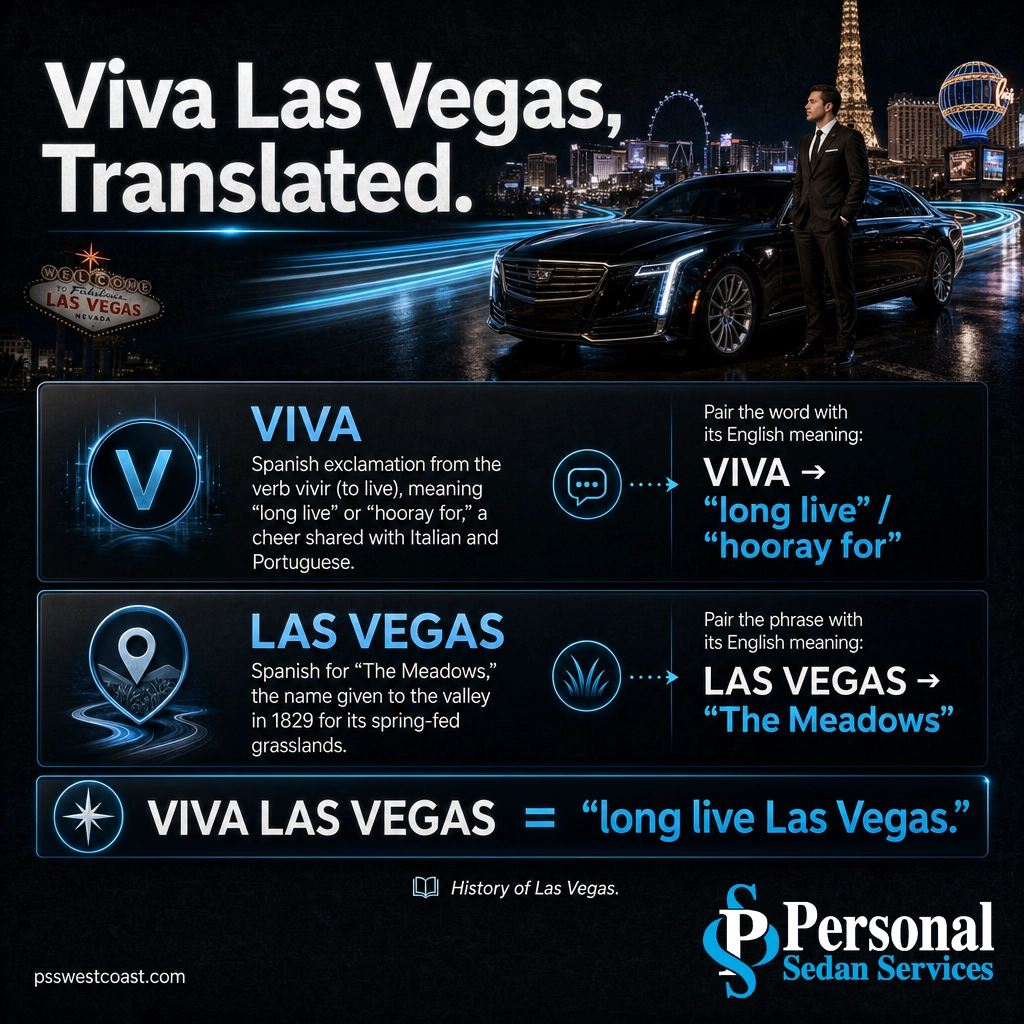
That desert-meadow origin is easy to forget today, but it is why the name exists at all. In 1829, a scout named Rafael Rivera, traveling with a Spanish trading party on the Old Spanish Trail between New Mexico and Los Angeles, left the main group to find water and came upon the valley’s artesian springs and the green grass they fed. His party recorded the spot as “Las Vegas,” The Meadows. The gambling, the resorts, and the Elvis song all came more than a century later.
Source: History of Las Vegas (Wikipedia) | Springs Preserve, Las Vegas history
“Viva Las Vegas” vs. “Las Vegas”: Clearing Up the Confusion
The single most common mix-up is treating “what does Viva Las Vegas mean” and “what does Las Vegas mean” as the same question. They are not. One asks about a cheer; the other asks about a place name. Here is the difference side by side.
| Part | Language | Literal meaning | What it does |
|---|---|---|---|
| Viva | Spanish (also Italian, Portuguese) | “long live” / “hooray for” | An exclamation of celebration and long life |
| Las Vegas | Spanish | “The Meadows” | The place name given to the valley in 1829 |
| Viva Las Vegas | Spanish phrase | “long live The Meadows” | A toast to the city, popularized in 1964 |
So the phrase is not “welcome to Las Vegas,” and it does not mean “party in Las Vegas,” even though that is the spirit people attach to it. It is closer to a raised glass: an expression of affection and excitement for the city, using a Spanish cheer in front of a Spanish name. If you only remember one thing, remember that “viva” is the celebration and “Las Vegas” is the subject being celebrated.
Where the Phrase Really Comes From
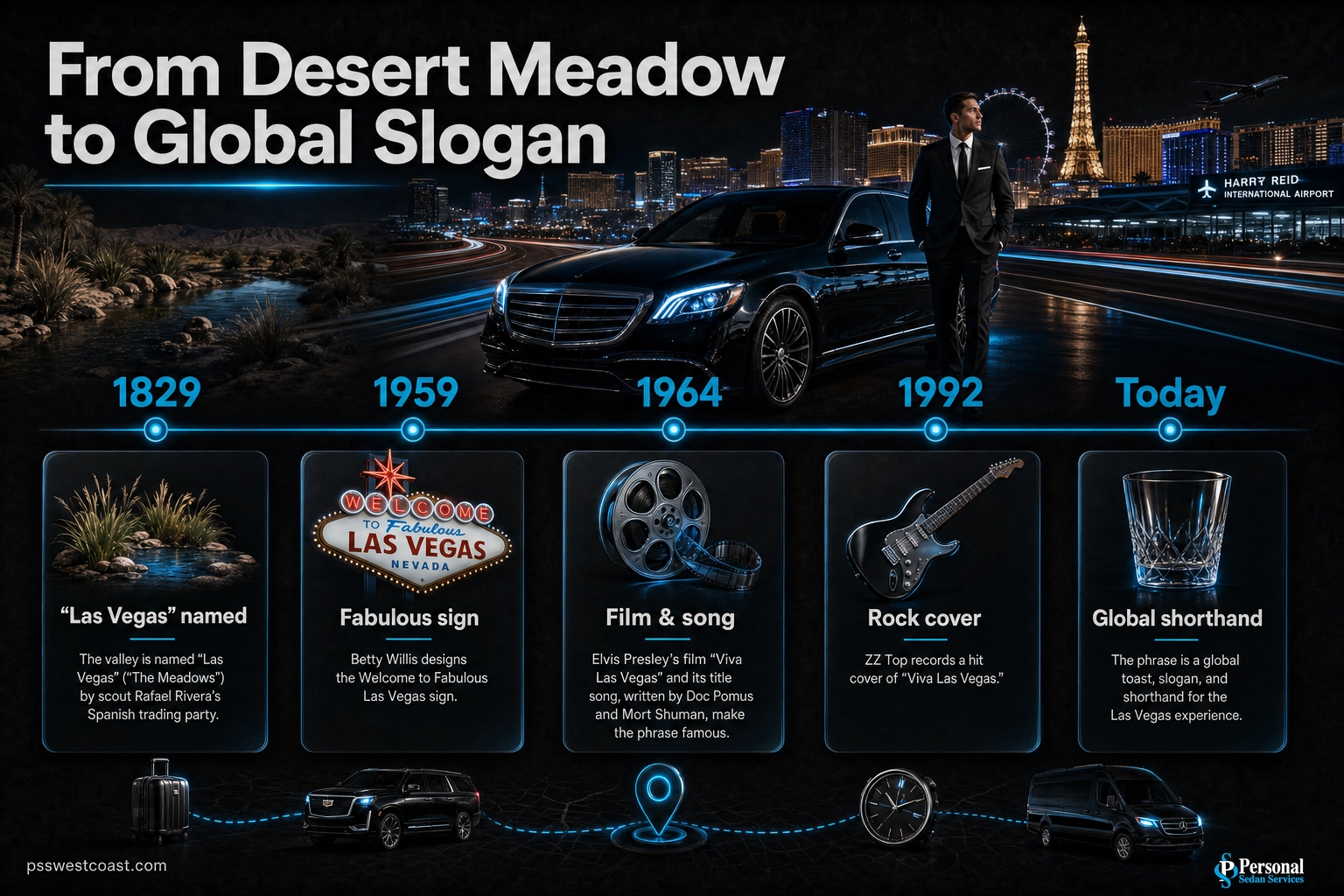
Most people first heard “Viva Las Vegas” through Elvis Presley, and for good reason. In 1964, Elvis starred in a musical film titled “Viva Las Vegas” alongside Ann-Margret. The movie’s title song, written by the songwriting team of Doc Pomus and Mort Shuman, became one of Presley’s most enduring numbers and, over time, the city’s unofficial anthem. If a phrase can have a launch date into global pop culture, “Viva Las Vegas” got one in 1964.
Myth: Elvis, or the movie studio, invented the phrase. Not true. “Viva” as a shout of acclaim goes back centuries, long before Las Vegas was a city and long before Elvis was born. The 1964 film did not coin “Viva Las Vegas,” it popularized it. The words were already meaningful Spanish; the movie gave them a melody and a global audience.
The phrase kept its momentum after Elvis. The rock band ZZ Top recorded a well-known cover of “Viva Las Vegas” in 1992, introducing it to a new generation, and the line has since been borrowed by casinos, festivals, merchandise, and countless marquees. The imagery most tied to the phrase is the famous “Welcome to Fabulous Las Vegas” sign, designed by Betty Willis in 1959, which sits at the south end of the Strip and has become the backdrop for the “Viva Las Vegas” feeling even though the sign itself uses different words.
The sign sits on a median at 5100 Las Vegas Boulevard South, south of Mandalay Bay, with its own small parking lot. It is a favorite first or last stop for visitors, and because it sits in the middle of a busy boulevard, it is one of those photo stops that is far easier with a driver who can wait while you hop out for pictures.
Source: Viva Las Vegas (song), Wikipedia | Welcome to Fabulous Las Vegas sign, Wikipedia

How “Viva Las Vegas” Is Used Today
Today the phrase works as a celebration, a toast, and a shorthand for the whole Las Vegas experience. People raise a glass and say it at the start of a bachelor or bachelorette weekend. It gets shouted at the tables after a good hand, printed on shirts, and used as a caption on every Strip photo ever posted. When someone says “Viva Las Vegas,” they are channeling excitement about the city rather than making a literal statement.
A few of the ways you will see it used:
- As a toast: a cheer to kick off a trip, a birthday, or a night out, the same way you would say “here’s to Vegas.”
- As an exclamation: a burst of celebration after a win, a great show, or the moment of arriving in town.
- As branding: the title of the Elvis film, songs, events like the annual “Viva Las Vegas” rockabilly weekender, and endless merchandise.
- As a mood: shorthand for glamour, nightlife, and the feeling that anything can happen on the Strip.
In other words, the phrase has grown far beyond its translation. The literal “long live Las Vegas” is still correct, but in everyday use it means something closer to “let’s celebrate this city and everything it stands for.”
How to Say It, and Live It, Like a Local
Pronounce it “VEE-vah lahss VAY-gus.” The stress falls on the first syllable of “viva,” and locals keep “Vegas” soft and casual, never a hard “Vay-GAS.” Because it is a cheer, it is meant to sound upbeat, so there is no wrong way to say it enthusiastically.
Living the phrase is the fun part, and it is where a little local knowledge goes a long way. The “Viva Las Vegas” spirit is really about enjoying the city without the friction: no parking hunts, no surge-priced rideshare at 2 a.m., no worrying about who drives after the celebration. That is exactly what a licensed, professional chauffeur handles for you. Personal Sedan Services is Las Vegas’s top-rated luxury transportation, with a perfect 5.0 Google rating from more than 900 reviews, so you can toast the city and leave the driving to someone who knows every route on it.
Explore Our Las Vegas Car Service
Whether you are heading to the Welcome sign for photos, hopping between shows and dinners on the Strip, or arriving from the airport ready to celebrate, a professional chauffeured car service turns the logistics into part of the experience. For visitors landing at Harry Reid International, skipping the taxi line with a pre-booked airport pickup is the easiest way to start a trip on a high note. And if you want the deeper local picture before you come, our honest look at the state of Las Vegas in 2026 and our roundup of the best day trips from Las Vegas are good places to plan from.
Source: Viva Las Vegas (film), Wikipedia
Frequently Asked Questions
What does “Viva Las Vegas” mean?
Is “Viva Las Vegas” Spanish?
What does the name “Las Vegas” mean?
Did Elvis Presley create the phrase “Viva Las Vegas”?
How do you pronounce “Viva Las Vegas”?
Related Las Vegas Terms and Guides
- The Meadows: the English translation of “Las Vegas,” from the Spanish “vegas” (fertile lowland meadows). Read more in our Las Vegas city guides.
- The Strip: the roughly four-mile stretch of Las Vegas Boulevard South lined with major resorts, and the backdrop most tied to the “Viva Las Vegas” feeling.
- Welcome to Fabulous Las Vegas sign: the 1959 Betty Willis landmark at the south end of the Strip, the city’s most photographed greeting.
- Sin City: the popular nickname for Las Vegas, referring to its casinos and nightlife, distinct from the official “The Meadows” translation.
- Fabulous Las Vegas: the phrase on the welcome sign, often confused with “Viva Las Vegas” but a separate slogan.
- Getting around: see our local Las Vegas transportation and luxury car service options for living the phrase in style.
Sources and Methodology
How we sourced this explainer
Translations and etymology in this article follow standard Spanish-language meaning and established Las Vegas history. Cultural facts about the phrase, the 1964 film, and the title song are drawn from primary encyclopedic and historical references rather than secondary blog write-ups. We did not invent dates, figures, or attributions.
- History of Las Vegas and the Springs Preserve (the 1829 naming of the valley by Rafael Rivera, “Las Vegas” meaning “The Meadows”).
- Viva Las Vegas (song) and Viva Las Vegas (film) (1964 release, Doc Pomus and Mort Shuman songwriting credit, Ann-Margret co-star, ZZ Top 1992 cover).
- Welcome to Fabulous Las Vegas sign (Betty Willis, 1959, location at 5100 Las Vegas Boulevard South).
The perfect 5.0 Google rating from more than 900 reviews cited for Personal Sedan Services reflects the company’s Google Business Profile at the time of writing.