


Vegas odds are the numbers a sportsbook attaches to every outcome, and they do two jobs at once: they show how likely that outcome is and how much a winning bet pays. A minus sign marks the favorite, a plus sign marks the underdog, and a small built-in margin called the vig is how the book makes its money.
- Odds show both probability and payout. Favorites are negative (how much you risk to win $100), underdogs are positive (what a $100 bet wins).
- Three formats say the exact same thing: American (moneyline), decimal, and fractional. United States sportsbooks default to American.
- The standard -110 price on spreads and totals hides the vig: each side implies about 52.4%, and the two sides add up to roughly 104.8%, which is the book’s edge.
- The three core bets are the moneyline (who wins), the point spread (the margin), and the total (combined score, over or under).
- Oddsmakers open a line with power ratings and data, then move it as money, injuries, and news come in, aiming to balance the action and bank the vig.

What’s in This Guide
- What “Vegas Odds” Actually Means
- The Three Ways Odds Are Written
- How to Read American Odds: Favorites vs. Underdogs
- The Vig: Why a Bet Is Not a Fair Coin Flip
- The Three Main Bets: Moneyline, Spread, and Totals
- How Sportsbooks Actually Set the Line
- Where the “Vegas Line” Comes From
- Common Questions About Vegas Odds
- Related Betting and Vegas Terms
- Sources & Methodology
What “Vegas Odds” Actually Means
Walk up to any sportsbook counter on the Strip and you will see a wall of glowing numbers next to team names. Those numbers are the odds, and they are really a price list. The sportsbook is selling you a chance on an outcome, and the odds tell you what that chance costs and what it pays.
Vegas odds are the figures a sportsbook sets for each possible result of an event. They express two things at once: the implied probability that the result happens, and the payout a winning wager returns. The favorite carries a minus sign, the underdog a plus sign.
A helpful way to think about it: the odds are a price tag, and the sportsbook is the store. Just like a store marks up what it sells so it earns a profit on every sale, the book prices every bet so it keeps a margin no matter which side you pick. Understand the price tag and the markup, and the whole wall of numbers stops looking like code.
Legal sports betting is now big business, and the prices above are what drive it. Americans wagered nearly $150 billion with legal sportsbooks in 2024, and those books kept a record $13.71 billion in revenue, up from $11.04 billion the year before, according to the American Gaming Association.
Source: ESPN, reporting American Gaming Association 2024 data
The Three Ways Odds Are Written
The same bet can be written three ways. The format changes, but the underlying probability and payout do not. If you can read one, you can convert to the others.
- American (moneyline) odds use a plus or minus and a number based on $100. This is the default at every Las Vegas sportsbook and almost every United States app.
- Decimal odds show the total return per $1 staked, including your stake. They are common in Europe and easy to multiply.
- Fractional odds show profit relative to stake, like 3/2. They are the traditional format at horse tracks and British bookmakers.
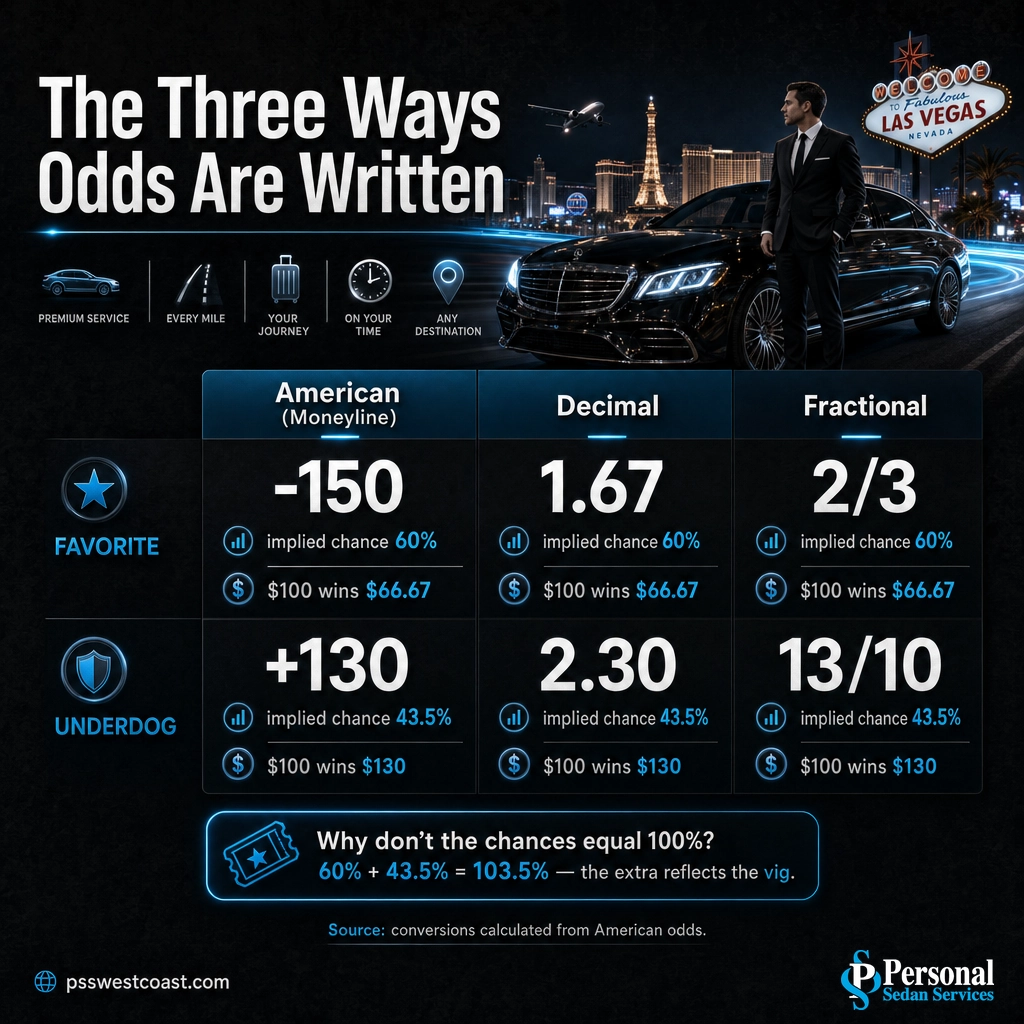
Here is one favorite and one underdog shown in all three formats, plus the probability each price implies and what a $100 bet pays:
| The bet | American | Decimal | Fractional | Implied chance | $100 bet wins |
|---|---|---|---|---|---|
| Favorite | -150 | 1.67 | 2/3 | 60.0% | $66.67 |
| Underdog | +130 | 2.30 | 13/10 | 43.5% | $130.00 |
| Standard spread price | -110 | 1.91 | 10/11 | 52.4% | $90.91 |
Notice the favorite and underdog’s implied chances in that example add up to more than 100% (60.0% plus 43.5% is 103.5%). That extra slice is not an error. It is the vig, and we will break it down below.
Quick conversions: For a negative American price, decimal = 1 + (100 / the number), so -150 becomes 1 + (100 / 150) = 1.67. For a positive price, decimal = 1 + (the number / 100), so +130 becomes 1 + (130 / 100) = 2.30. Implied probability for a favorite = the number / (the number + 100); for an underdog = 100 / (the number + 100).
Source: Gambling.com betting odds overview
How to Read American Odds: Favorites vs. Underdogs
American odds are the ones you will actually see in Las Vegas, so this is the format worth mastering. There is one rule for each sign.
Minus means favorite. The number is how much you have to bet to win $100. A -150 favorite means you risk $150 to win $100 in profit (you get $250 back if it wins: your $100 profit plus your $150 stake). The bigger the number, the heavier the favorite. A -400 team is a strong favorite; you would bet $400 to win $100.
Plus means underdog. The number is what a $100 bet wins. A +130 underdog pays $130 in profit on a $100 bet ($230 back). The bigger the number, the longer the shot. A +600 team is a big underdog; a $100 bet would win $600.
You do not have to bet in $100 units. The $100 is just the reference point for the math. On a -150 favorite you can bet $30 to win $20, or $15 to win $10. The ratio stays the same no matter the stake. Every sportsbook ticket and app shows your exact payout before you confirm.
Source: OnlineGambling.com guide to Las Vegas odds
The Vig: Why a Bet Is Not a Fair Coin Flip
This is the single most important thing to understand, and it is the part most casual bettors miss. The sportsbook is not betting against you as an equal. It builds a margin into every line, called the vig, the juice, or the vigorish.
Look at the most common price in sports betting: -110 on both sides of a point spread or total. At -110 you risk $110 to win $100. A price of -110 implies a 52.38% chance (110 divided by 210). Both sides are priced at 52.38%, so together they add up to 104.76%. A fair, no-margin market would add up to exactly 100%. That extra 4.76% is the book’s edge, and it is why a sportsbook can profit whether the home team or the away team covers.
A true coin-flip game almost never pays even money. When two teams are evenly matched, you would expect a 50/50 bet to pay 1-to-1. In reality that “pick’em” is still priced around -110 on both sides. You risk $110 to win $100 either way, so the book keeps its margin regardless of the result. Genuine even-money odds (+100) are rare, because the vig has to live somewhere.
This is also why beating sports betting over time is hard: you are not just predicting winners, you are predicting them often enough to overcome the vig. The margin is small on any one bet and relentless across thousands of them, which is exactly how the house stays ahead.

Source: BettingUSA vigorish explainer
The Three Main Bets: Moneyline, Spread, and Totals
Almost every wager on that wall of numbers is one of three types. Once you know these, the rest (parlays, props, futures) are just combinations and variations.
1. Moneyline: who wins, straight up
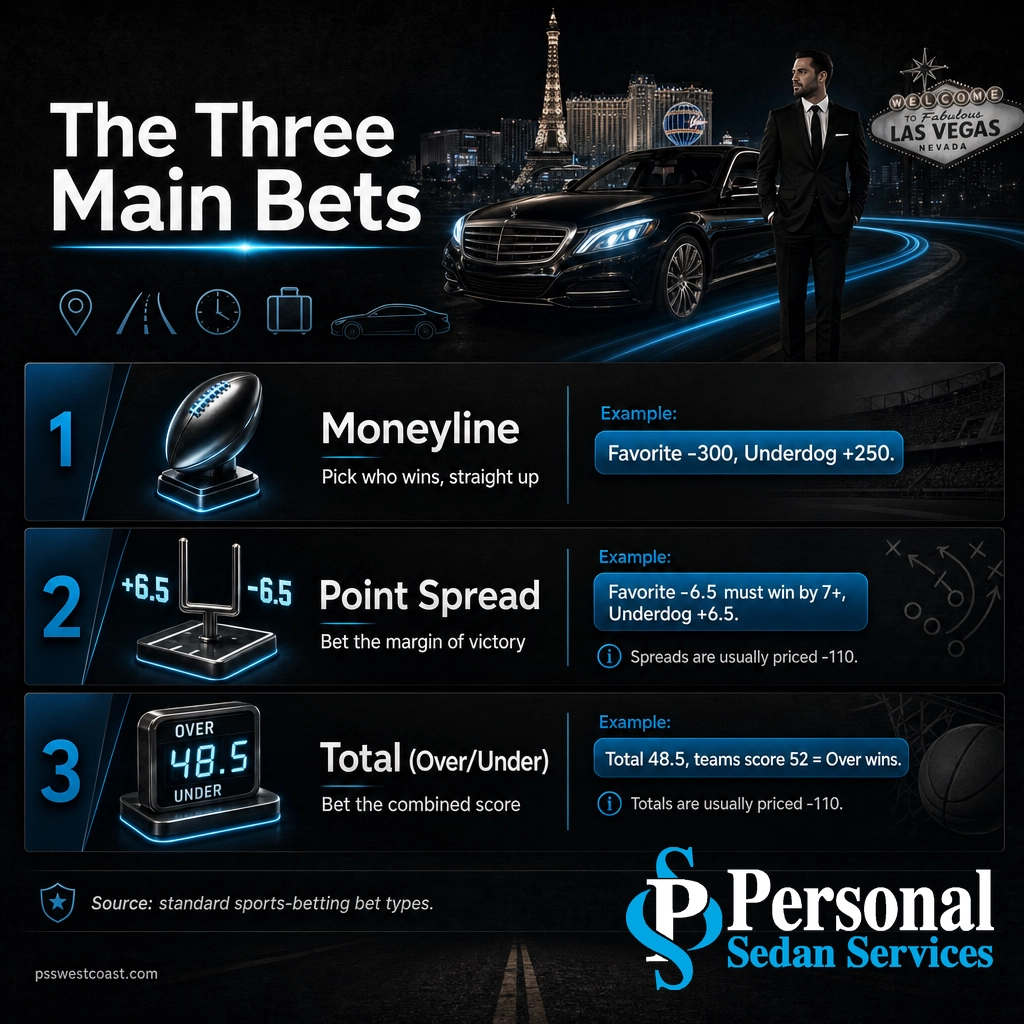
The simplest bet. You pick the winner, full stop, and the odds reflect how likely each side is. A heavy favorite might be -300 (risk $300 to win $100), while its opponent sits at +250 (a $100 bet wins $250). The margin of victory does not matter. The team only has to win.
2. Point spread: the margin of victory
The spread is the great equalizer. The favorite “gives” points and the underdog “gets” them, so a lopsided game becomes a roughly even bet. If the favorite is -6.5, it must win by 7 or more to “cover.” Back the +6.5 underdog and you win if that team wins outright or loses by 6 or fewer. Both sides are usually priced at -110, which is where the vig lives.
3. Totals (over/under): the combined score
Here you ignore who wins entirely. The sportsbook posts a number for the combined final score of both teams, and you bet whether the real total goes over or under it. If the total is 48.5 and the teams combine for 52 points, the over wins. Like spreads, totals are typically priced at -110 per side.
Two terms you will hear constantly: A bet covers when it beats the spread. A push is a tie against a whole-number line (for example, a -7 favorite that wins by exactly 7); on a push, your stake is simply refunded. Half-point lines like -6.5 and 48.5 exist specifically to prevent pushes.
Source: Basketball Insiders betting odds guide
How Sportsbooks Actually Set the Line
The odds do not fall from the sky, and no single building in Las Vegas dictates them to the world. Here is the real sequence.
Step one: the opening line. Oddsmakers build a first number using power ratings (a numerical strength rating for each team), statistical models, historical results, and situational factors like home advantage, rest, travel, and injuries. At this stage the goal is accuracy. They want the opening line to reflect the true matchup as closely as possible.
Step two: the market reacts. Once the line is public, money starts coming in. The sportsbook’s ideal is balanced action, roughly equal money on both sides, because then it collects the vig and carries no risk on the outcome. When too much money lands on one side, the book nudges the line or the price to make the other side more attractive.
Step three: the line moves. A spread can slide from -6.5 to -7.5, or the juice can shift from -110 to -120, as the book rebalances. Sharp (professional) money, public money on popular teams, and breaking news like a star sitting out all push the number. By kickoff, the closing line often reflects the sharpest available estimate of the game.

Source: CBS Sports 2024 sports betting review
Where the “Vegas Line” Comes From
People say “the Vegas line” even when they are betting from a couch in another state. The phrase is a holdover from history. For decades, Nevada was effectively the only place in the country where you could legally bet on a single game, so the number posted in Las Vegas became the national reference point.
That changed when the Supreme Court struck down the federal ban (PASPA) in May 2018, opening the door for dozens of states to legalize sports betting. Today the lines you see are set by each operator, often off shared data feeds and models, not handed down from one Las Vegas authority. Still, the big Nevada books remain a center of gravity for serious bettors, and Las Vegas is where the ritual of betting in person lives on.
If you are visiting and want the full experience, the city’s marquee sportsbooks are the destination. Circa Sports downtown runs a three-story book it bills as one of the largest in the world, the Westgate SuperBook has long been famous for its giant screens, and nearly every major resort on the Strip, from Caesars Palace to the MGM Grand, has its own book. For a closer look at the resorts themselves, see our guide to the best casinos in Las Vegas.
There is one catch to a proper Las Vegas betting day: the best sportsbooks are spread across the Strip and downtown, and a good session usually involves a few drinks. Driving yourself means parking garages, surge-priced rideshares, and the risk of getting behind the wheel after a celebration. The easy fix is a chauffeur for the whole outing. Personal Sedan Services runs a licensed, professional fleet across the valley, so you can book-hop from the SuperBook to downtown and back without a single parking stress. It pairs naturally with our Las Vegas attractions transportation and door-to-door professional chauffeur service.
Source: Murphy v. NCAA, U.S. Supreme Court (2018)
Common Questions About Vegas Odds
What does a minus sign mean in Vegas odds?
What does +200 mean in betting odds?
What is the vig in sports betting?
Do Las Vegas sportsbooks set the odds for the whole country?
What is the easiest way to get around to Las Vegas sportsbooks?
Related Betting and Vegas Terms
A few more words you will hear around a sportsbook, in plain English:
- Handle: the total amount wagered at a book over a period. Nevada’s annual handle runs around $8 billion.
- Hold: the percentage of the handle the sportsbook actually keeps after paying out winners.
- Pick’em (PK): a game with no favorite, where the spread is zero and you simply pick the winner, still priced with vig.
- Parlay: a single bet that links multiple picks; all must win, and the payout multiplies (as does the hidden vig on each leg).
- Cover: when a team beats the point spread, not just wins the game.
- Sharp vs. square: a “sharp” is a professional or highly informed bettor; a “square” is a casual one who often bets favorites and overs.
- Getting around to the books: the smart play for a full day of betting is a group ride with a chauffeur so no one has to drive.
Sources & Methodology
How we built this guide
Odds formats, reading rules, and bet-type definitions are standard sports-betting mechanics, cross-checked against multiple published betting guides. All conversion figures (decimal, fractional, and implied probability) are calculated directly from the American odds using the standard formulas shown in the article, not estimated.
Industry figures are drawn from primary and major-outlet reporting: the American Gaming Association’s 2024 results (via ESPN), Nevada Gaming Control Board handle figures (via CBS Sports), and the United States Supreme Court’s 2018 PASPA decision (Murphy v. NCAA). No statistics, payouts, or claims were invented.
This article is educational and does not constitute betting or financial advice. Personal Sedan Services provides luxury transportation, not gaming services. Please gamble responsibly.
Sources:
ESPN / American Gaming Association |
CBS Sports |
BettingUSA |
Oyez: Murphy v. NCAA
Ride Across the Valley With Personal Sedan Services
