


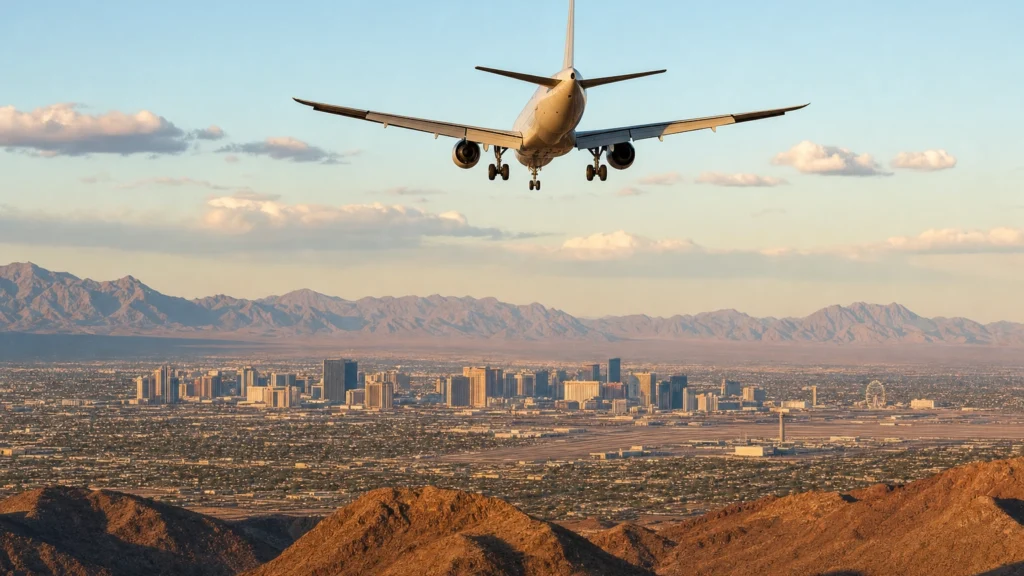
Quick answer: A nonstop flight from Denver (DEN) to Las Vegas (LAS) takes about 1 hour 55 minutes on average and covers 628 miles. Expect roughly 1 hour 50 minutes to 2 hours 15 minutes of actual air time depending on winds, plus taxi and climb. Book a connecting itinerary instead and your total travel time jumps to 4 hours or more.
If you are planning a Denver to Las Vegas trip, the flight itself is the easy part. Nonstop service runs under two hours, several airlines compete on the route, and departures leave Denver International all day long. This guide gives you the real numbers: the average flight time, the exact air distance, which carriers fly nonstop, why your flight time can shift by twenty minutes or more, and the one part of the journey most travelers underestimate, which is the ground ride once you land at Harry Reid International.
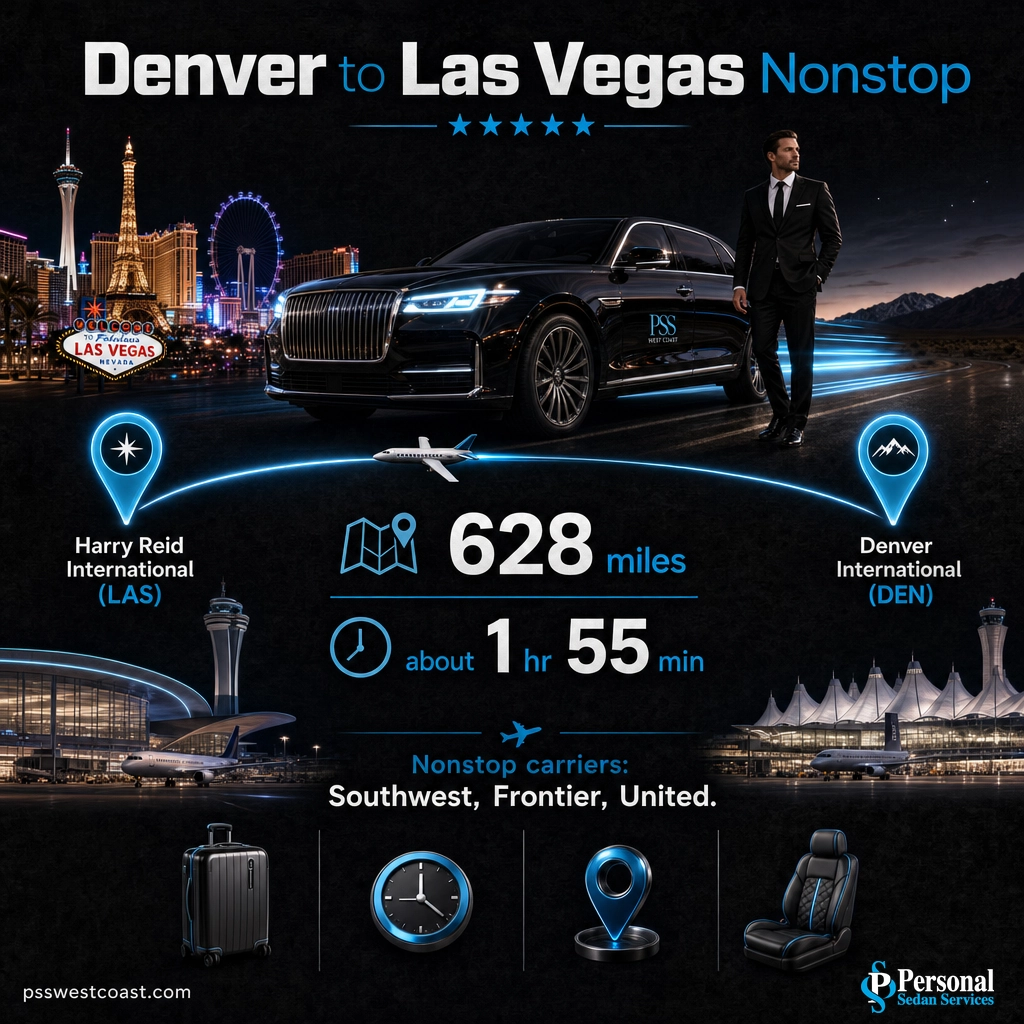
- Nonstop flight time: about 1 hour 55 minutes on average between Denver (DEN) and Las Vegas (LAS).
- Air distance: 628 miles, a short regional hop that most jets cover without ever reaching full cruise for long.
- Nonstop carriers: Southwest, Frontier, and United all fly it direct, with Southwest alone running roughly 156 flights a week.
- Winds matter: the westbound trip to Las Vegas often runs a touch longer than eastbound, and connections push total time past 4 hours.
- Fly, do not drive: the road trip is about 750 miles and 11 to 13 hours, so flying saves most of a day each way.
- The last 5 miles count: Harry Reid International is only about 10 to 15 minutes from the Strip, and a prearranged ride turns a long travel day into a smooth arrival.

What’s in This Guide
- How Long Is the Flight from Denver to Las Vegas?
- Flight Distance vs. Driving Distance
- Which Airlines Fly Nonstop from Denver to Las Vegas?
- Why Your Flight Time Varies
- Denver International vs. Harry Reid International
- After You Land: Getting to Your Hotel
- Frequently Asked Questions
- Related Las Vegas Travel Guides
How Long Is the Flight from Denver to Las Vegas?
A nonstop flight from Denver to Las Vegas takes about 1 hour 55 minutes on average, according to Southwest Airlines’ own route data for the pairing. That figure is the scheduled gate-to-gate block time, which includes taxiing out at Denver International, the climb, cruise, descent, and taxiing to the gate at Harry Reid International. The time your wheels are actually off the ground is a little shorter, usually in the 1 hour 40 minute to 2 hour range.
Because this is a short regional route, the aircraft spends a surprising share of the trip climbing and descending rather than cruising. Denver sits at 5,434 feet of elevation, so a jet leaving DEN is already a mile closer to its cruise altitude than one leaving a sea-level airport, which helps keep the block time tight. The table below shows what to expect for a nonstop versus a one-stop connection.
| Itinerary | Typical total time | What it means |
|---|---|---|
| Nonstop (average) | ~1 hr 55 min | Scheduled gate-to-gate block time on Southwest, Frontier, and United. |
| Nonstop (air time) | ~1 hr 40 min to 2 hr | Wheels-up to wheels-down, varies with winds and routing. |
| One-stop connection | ~4 to 6 hr | Adds a layover, often through Phoenix, Salt Lake City, or Dallas. |
| Time zone note | Clock “gains” 1 hr | Denver is Mountain Time, Las Vegas is Pacific, so you land 1 hr earlier on the clock. |

Our take: because the Denver to Las Vegas leg is so short, the flight is rarely the part of the trip that goes wrong. Delays and stress almost always come from the edges, the TSA line in Denver and the scramble for a ride once you land. The travelers who arrive relaxed are the ones who planned the ground transportation before they ever boarded.
Source: Southwest Airlines: Denver to Las Vegas route
Flight Distance vs. Driving Distance
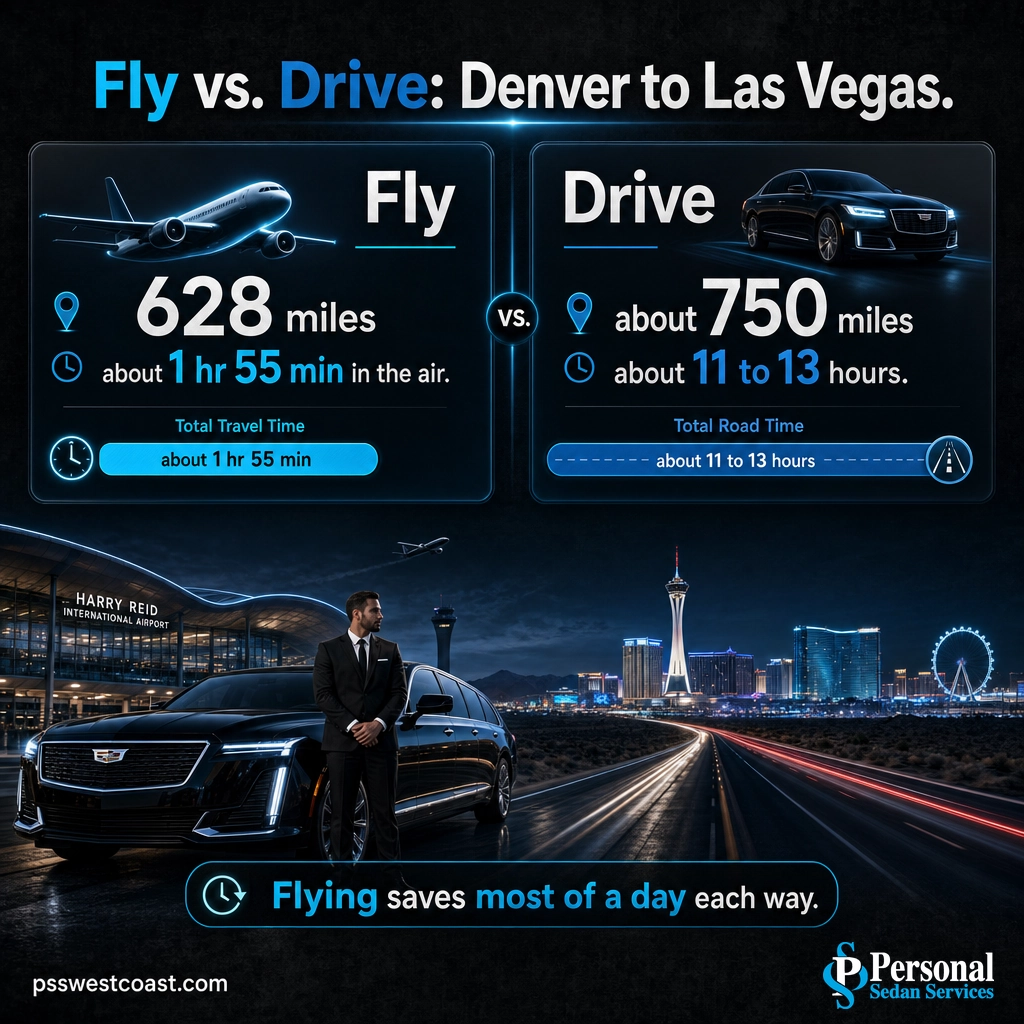
The straight-line air distance from Denver to Las Vegas is 628 miles, per Southwest’s route page. That is the great-circle distance a jet flies more or less directly. The drive is a different story: by road the trip stretches to roughly 750 miles, because highways have to bend around the southern Rockies and follow the US-93 and I-15 corridors through the high desert. Google Maps puts that drive at about 11 to 13 hours of steady driving before any stops.
In other words, the plane covers the gap in under two hours while the car eats an entire day. The comparison below makes the tradeoff clear.
| Mode | Distance | Time | Best for |
|---|---|---|---|
| Fly (nonstop) | 628 air miles | ~1 hr 55 min in the air | Almost everyone, especially a weekend or business trip. |
| Drive | ~750 road miles | ~11 to 13 hours | A scenic road trip, or when you need your own car in Nevada. |
If the drive tempts you, our full Salt Lake City to Las Vegas drive-time breakdown covers the same I-15 corridor you would use on the back half of a Denver road trip, including fuel stops and seasonal mountain conditions.
Source: Southwest Airlines: Denver to Las Vegas route

Which Airlines Fly Nonstop from Denver to Las Vegas?
Denver to Las Vegas is one of the busier short-haul routes in the western United States, and three major carriers fly it nonstop: Southwest, Frontier, and United. All three operate hubs or large focus-city bases at Denver International, so you will find departures from early morning until late at night, which keeps fares competitive and schedules flexible.
| Airline | Nonstop DEN to LAS | Notes |
|---|---|---|
| Southwest Airlines | Yes | About 156 flights a week; the highest-frequency carrier on the route. |
| Frontier Airlines | Yes | Denver-based ultra-low-cost carrier; budget fares, fees for extras. |
| United Airlines | Yes | Denver is a United hub; mainline jets and full connecting network. |
Schedules shift by season and by airline, so always confirm current nonstop availability directly with the carrier before you book. Fares on this route can swing widely, and an ultra-low-cost ticket that looks cheap can match a mainline fare once you add bags and seat selection.
Source: Southwest Airlines: Denver to Las Vegas route | United Airlines official site | Frontier Airlines official site
Why Your Flight Time Varies
The “about two hours” answer is an average, and a few real forces push your actual flight time up or down. Understanding them helps you set a realistic schedule, especially if you have a show, a dinner reservation, or a connection waiting in Las Vegas.
Winds aloft. The prevailing winds over the western United States generally blow from west to east. That means the eastbound trip back to Denver often gets a tailwind push, while the westbound leg to Las Vegas can face a mild headwind and run a few minutes longer. On a windy day the difference between the two directions can be ten to fifteen minutes.
Routing and traffic. Air traffic control does not always send a jet in a perfectly straight line. Weather over the Rockies, military airspace, and arrival sequencing into busy Harry Reid International can all add a few miles to the path.
Ground time at Denver. Denver International is one of the largest and busiest airports in the country by land area, and taxi times from the gate to the runway can be long during peak banks. That time counts toward your scheduled block even though you are not in the air yet.
Do not assume the flight is always a flat two hours. Winter storms over the Colorado Front Range are the single biggest cause of Denver delays, and they can cascade across an airline’s whole day. If you are flying between November and March, build in a buffer and avoid booking the last possible connection.
Denver International vs. Harry Reid International
You will depart from Denver International Airport (DEN), the enormous facility northeast of downtown Denver with its distinctive white peaked roof. On the other end you arrive at Harry Reid International Airport (LAS), the Las Vegas airport renamed in 2021 from McCarran International in honor of the late Nevada senator. Harry Reid International has two main terminals, Terminal 1 and Terminal 3, connected by shuttle, so it helps to know which terminal your airline uses before you land.
Southwest, Frontier, and United all operate out of Terminal 1 at Harry Reid International for domestic flights, which is also where the main rideshare, taxi, and car-service pickup zones are organized. If you are tracking a specific carrier, our Las Vegas airport terminal guide and the full Harry Reid International Airport guide walk through terminals, gates, and the layout you will meet on arrival.
The single best thing you can do before a Las Vegas trip is know exactly how you are getting from the gate to your hotel, because that is where a smooth travel day is won or lost. Our breakdown of the best way from the Las Vegas airport to the Strip compares every option side by side.
After You Land: Getting from Harry Reid Airport to Your Hotel
Here is the part most flight-time articles skip. Your two-hour flight ends the moment you step off the jet bridge, but your trip is not over until you are checked in. Harry Reid International sits about 5 miles from the center of the Strip, which is a 10 to 15 minute drive in light traffic and longer during convention weeks, fight weekends, or a Raiders or Golden Knights game.
Your realistic options from the airport are taxi, rideshare, the shared hotel shuttle, or a prearranged private car. Taxis and rideshare both involve walking to a designated pickup zone and often a line; shared shuttles are the cheapest but stop at multiple hotels before yours. A private chauffeur is the option that removes the uncertainty entirely: your driver tracks your flight, meets you after baggage claim, and takes you straight to your hotel door in a clean, late-model vehicle.
Flying in late? Harry Reid International stays busy well past midnight, and rideshare surge pricing climbs with it. If your Denver flight lands at night, booking a ride in advance locks your price and guarantees a driver is waiting, instead of joining a long queue at 1 a.m. Our guide to late-flight car service at the Las Vegas airport covers exactly how that works.
For groups flying in from Denver together, whether it is a bachelor party, a conference team, or a family, a single vehicle large enough for everyone and the luggage beats splitting across multiple rideshares that may not arrive together. Personal Sedan Services runs sedans, SUVs, sprinter vans, and larger shuttles, all chauffeured by licensed, background-checked drivers, with a perfect 5.0 Google rating from more than 900 reviews.
See our Las Vegas airport car service
When you already know your flight details, you can lock in your pickup in a couple of minutes and skip the arrival-hall scramble altogether.
Prefer to see the vehicles first? Browse the full fleet, from executive sedans to group sprinters, and match the ride to your party size before you land.
Frequently Asked Questions
How long is the flight from Denver to Las Vegas?
How many miles is it from Denver to Las Vegas by air?
Which airlines fly nonstop from Denver to Las Vegas?
Is it faster to fly or drive from Denver to Las Vegas?
How do I get from Harry Reid Airport to the Las Vegas Strip?
Related Las Vegas Travel Guides
- Is there a free shuttle from the Las Vegas airport to hotels? – the budget arrival option, explained.
- The best ways to get around Las Vegas – every transport option compared once you are in town.
- How early you should get to the Las Vegas airport – timing your return flight to Denver.
- Taxi, rideshare, or chauffeur at the Las Vegas airport – the honest cost and time tradeoffs.
- How far Phoenix is from Las Vegas – a common connecting-flight stop on the route.
Sources and Methodology
Flight distance (628 miles) and average nonstop flight time (1 hour 55 minutes), plus the figure of about 156 Southwest flights per week, are from Southwest Airlines’ official Denver to Las Vegas route page. Actual air time and connection times are typical ranges that vary with winds, routing, air traffic, and schedules, and should be confirmed with each airline at booking. Nonstop carrier service by Southwest, Frontier, and United reflects published route operations; schedules change seasonally. Driving distance and time are approximate, based on Google Maps directions along the US-93 and I-15 corridors. Denver’s elevation (5,434 feet) is per the City and County of Denver. Harry Reid International Airport details, including the 2021 renaming from McCarran, are from the airport’s official operator, the Clark County Department of Aviation.
