


The SEMA Show is the automotive specialty-equipment industry’s largest annual trade show, held every November at the Las Vegas Convention Center. Run by the Specialty Equipment Market Association, it is where manufacturers, buyers and media launch new aftermarket parts, accessories and custom vehicle builds. It is a business-only event, not a public car show.
If you are in Las Vegas in early November and see tow rigs hauling wrapped show cars, closed-off convention halls, and 150,000 badge-wearing professionals filling every hotel on the Strip, you are watching the SEMA Show take over the city. SEMA (the Specialty Equipment Market Association) runs the single largest gathering of the automotive aftermarket on the planet, and it has called the Las Vegas Convention Center home since 1977. This guide explains exactly what the show is, who actually gets in, how big it really is, how it differs from the AAPEX show running the same week, and the one logistical detail that trips up almost everyone who travels here for it.
- What it is: the automotive specialty-equipment industry’s flagship trade show, run by the Specialty Equipment Market Association at the Las Vegas Convention Center.
- 2026 dates: November 3 to 6, 2026, as it has been held in Las Vegas every year since 1977.
- Who gets in: it is trade-only. Qualified industry professionals only, with one public-access day on the final Friday.
- How big: 153,000-plus attendees from 140 countries and roughly 2,300 exhibiting brands in 2025.
- Not AAPEX: a separate aftermarket trade show runs the same week, focused on repair and replacement parts rather than customization.

What’s in This Guide
What the SEMA Show Actually Is
SEMA stands for the Specialty Equipment Market Association, the trade group that represents the companies making the parts, accessories and upgrades that go onto a vehicle after it leaves the factory. That world, the specialty-equipment or “aftermarket” industry, covers everything from performance engine parts and lift kits to wheels, audio systems, wraps, lighting and off-road gear. The SEMA Show is that industry’s yearly trade exhibition: the place where those companies show their newest products to the buyers, retailers and installers who will stock and sell them.
Think of it less like a consumer auto show and more like a giant ordering floor. A retailer who sells truck accessories in Texas, a distributor sourcing new wheel brands, a shop owner comparing paint-protection film, and a journalist covering the latest builds all walk the same halls, meet the manufacturers, and write orders for the year ahead. SEMA itself describes the event as “the global gathering point for the automotive aftermarket.” The show floor is organized into focused sections so buyers can find their niche, including racing and performance, trucks and off-road, restyling and accessories, wheels and tires, mobile electronics, and a growing powersports and lifestyle area.

The other signature of the show is the vehicles. Builders and brands debut hundreds of custom cars, trucks and off-road rigs, many revealed for the first time at SEMA to generate buzz and press. Those builds are marketing, not merchandise: they exist to showcase what a company’s products can do. For an operator that moves people around Las Vegas, the practical takeaway is simpler. For four days, the Las Vegas Convention Center and the surrounding resort corridor turn into one of the busiest, most logistically demanding events on the city’s calendar.
Source: SEMA 2026 Show press release
SEMA Show vs. AAPEX: Clearing Up the Confusion
The single most common mix-up is between the SEMA Show and AAPEX, because both run in Las Vegas during the same first week of November. They are not the same event, they are not in the same building, and they are owned by different organizations. Together they make up what the industry calls Automotive Aftermarket Industry Week, and many professionals attend both back to back.
The clean way to remember the difference: SEMA is about what you add to a vehicle, and AAPEX is about what you fix on one. The SEMA Show, at the Las Vegas Convention Center, centers on specialty equipment, accessories, performance and customization. AAPEX, the Automotive Aftermarket Products Expo (co-owned by the Auto Care Association and the Automotive Aftermarket Suppliers Association), centers on replacement parts, tools, service and repair technology. Both are trade-only.
| SEMA Show | AAPEX | |
|---|---|---|
| Focus | Specialty equipment, accessories, performance, customization | Replacement and repair parts, tools, service technology |
| Run by | Specialty Equipment Market Association | Auto Care Association + Auto Care Suppliers Association |
| Las Vegas venue | Las Vegas Convention Center | A separate venue across town |
| Open to the public? | Trade-only (one public Friday) | Trade-only |
| When | Early November, same week | Early November, same week |
Source: AftermarketNews on SEMA Show and AAPEX | SEMA 2026 Show press release
Who Can Attend? Trade-Only Access and the Public Day
This is where most first-timers get caught. The SEMA Show is a trade-only event, meaning you have to qualify as an automotive-industry professional to receive a badge. According to SEMA’s own attendee rules, if you are a hobbyist, a collector, a car-club member, a general enthusiast, retired, or unemployed, you do not qualify for standard registration. There is no general-admission ticket to buy the way you would for a public auto show, and badge holders generally cannot bring a guest onto the floor.
The myth: “SEMA is a big car show I can buy a ticket to and walk around like any other Vegas attraction.” For most of the week, that is not true. The main show days are closed to the general public, and SEMA verifies industry credentials during registration. Plan on proving your business connection to the automotive trade if you want standard access.
There is one real exception. In recent years SEMA has opened the final Friday to the public through a separate “SEMA Show Friday” ticket sold at SEMAFest.com, letting enthusiasts walk the floor for that one day only. That public Friday is tied to SEMA Fest, the consumer-facing festival and concert that SEMA has built alongside the trade show. Note the two tickets are separate: a SEMA Fest concert ticket does not get you onto the show floor, and a trade badge does not get you into SEMA Fest. For 2026, that public day falls on Friday, November 6.
For qualified attendees, SEMA opened 2026 registration in May with a discounted early badge (fifty dollars through late June), after which pricing rises, so the industry crowd books early. Between early-registering attendees and exhibitors reserving booths nearly a year out, the surrounding demand for hotels and transportation spikes well before the doors open.

Source: SEMA Show official site | SEMA 2026 registration release
How Big Is the SEMA Show? By the Numbers
The scale is what makes SEMA matter to the whole city, not just the auto industry. The 2025 show, held November 4 to 7, drew more than 153,000 attendees from 140 countries and regions, with roughly 2,300 exhibiting brands (including about 500 first-time exhibitors) and over 2,500 members of the global media. The exhibits fill essentially the entire Las Vegas Convention Center campus, indoor halls and outdoor space alike.
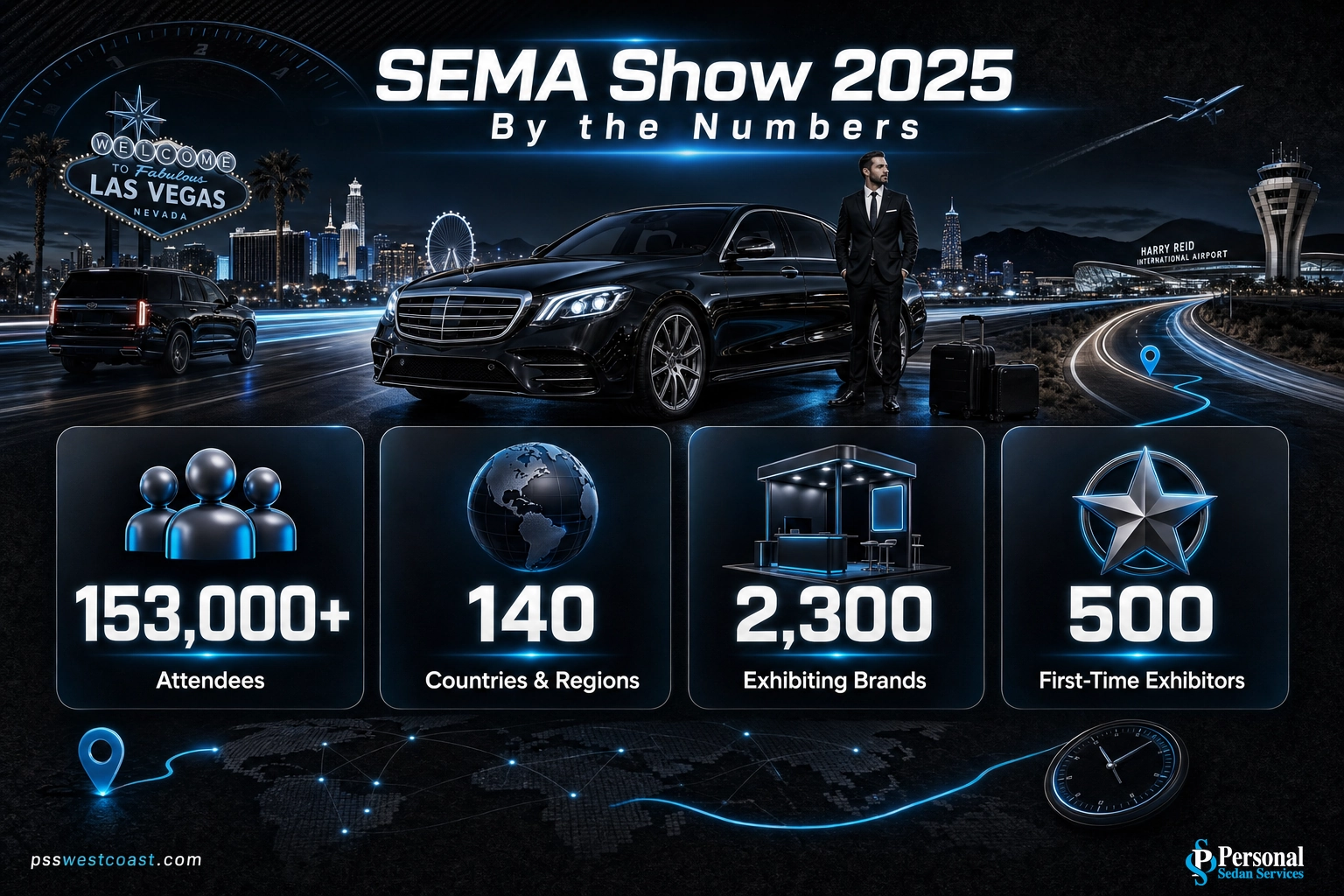
To put that in local terms: a single event bringing 150,000-plus professionals into Las Vegas for four days rivals the city’s biggest conventions, and it lands in the same window as AAPEX, which adds tens of thousands more aftermarket professionals across town. Hotel blocks, airport pickups at Harry Reid, and ground transportation all run tight that week. If you want the full picture of how much convention business flows through the city, our Las Vegas convention statistics breakdown has the numbers.
Here is the planning lesson behind the headline numbers. SEMA is not a “show up and figure it out” event. With six-figure attendance concentrated into four days and a parallel show running the same week, the resources everyone needs at once, hotel rooms, airport transfers, and reliable ground transportation, get scarce fast. The professionals who have the smoothest week are the ones who lock in their lodging and their rides weeks ahead, not the ones hailing a rideshare in the convention-center surge.

Source: 2025 SEMA Show post-show report
A Short History of the SEMA Show
The association came first. SEMA was founded in 1963, originally as the Speed Equipment Manufacturers Association, by a group of Southern California hot-rod and performance-parts makers who wanted to set standards and legitimize their young industry. As the business grew beyond pure speed equipment, the name evolved into the Specialty Equipment Market Association it carries today.
The first official SEMA Show was held in January 1967, under the grandstands at Dodger Stadium in Los Angeles, a modest gathering compared to today’s event. As the show outgrew its early California homes, SEMA moved it to the Las Vegas Convention Center in 1977, drawn by the room to grow, dependable weather, and a destination that could absorb a fast-expanding trade event. It has been a Las Vegas fixture ever since, growing into the global show it is now.
Source: SEMA association history | SEMA Show Timeline
Getting Around Las Vegas During SEMA Week
This is the part of “what is the SEMA Show” that matters most once you are actually booked to attend. The show lives at the Las Vegas Convention Center, just east of the Strip, and during SEMA week the entire corridor between the airport, the convention center and the resort hotels is moving at capacity. Rideshare surge pricing climbs, taxi lines stretch, and parking near the halls fills early. For an exhibitor hauling booth staff and gear, or a company bringing a buyer team, improvising transport is where the week goes sideways.
Las Vegas Convention Center
3150 Paradise Rd, Las Vegas, NV 89109
That is the gap Personal Sedan Services fills for SEMA attendees. Instead of fighting the surge, companies book transportation ahead and let a licensed, professional chauffeur handle the timing. A few ways it plays out during the show:
- Airport transfers: scheduled pickups from Harry Reid International (LAS) to your hotel or straight to the convention center, so arrival day does not start in a taxi line. Our taxi, rideshare, or chauffeur comparison lays out the tradeoffs.
- Group and team transport: Sprinter vans, mini coaches and charter buses to move booth crews or buyer groups together on a fixed schedule rather than in scattered cars.
- Executive and corporate service: black-car pickups for executives, clients and VIP guests between meetings, dinners and the floor.
- Destination management: for larger exhibitors and corporate attendees, coordinated logistics across the whole week, which is exactly what a destination management company handles.
Planning around headcount and cost helps too: our guides on charter bus pricing and Sprinter van rental costs give a realistic starting budget for moving a group during a peak convention week.
Book luxury group transportation for SEMA week
Arrange executive and corporate car service
Source: SEMA Show official site
Common Questions About the SEMA Show
What is the SEMA Show?
Is the SEMA Show open to the public?
When and where is the SEMA Show in 2026?
What is the difference between the SEMA Show and AAPEX?
How many people attend the SEMA Show?
Related Terms
- Specialty equipment (automotive aftermarket): the parts and accessories added to a vehicle after purchase, the industry SEMA represents.
- AAPEX: the Automotive Aftermarket Products Expo, the repair-and-replacement-parts trade show that runs the same Las Vegas week.
- Trade show: an industry-only exhibition where businesses show products to buyers, media and partners, not the general public.
- Las Vegas Convention Center: the venue that hosts the SEMA Show and much of the city’s convention business.
- Destination management company: a local partner that coordinates transportation and logistics for events, explained in what is a destination management company.
- Corporate event transportation: organized ground transport for business groups, central to planning corporate events in Las Vegas.
Plan your SEMA event transportation with Personal Sedan Services
Methodology and Sources
Figures in this guide come from SEMA’s own materials and established industry trade coverage, not secondary aggregators. The 2026 dates, venue and registration details are from SEMA’s official 2026 Show press release. The 2025 attendance (153,000-plus from 140 countries and regions), roughly 2,300 exhibiting brands, about 500 first-time exhibitors, and 2,500-plus media are from SEMA’s 2025 post-show report as reported in industry trade press. Trade-only access rules and the public-Friday exception are from the SEMA Show’s official site and SEMAFest.com. Historical dates (association founded 1963, first show in January 1967 at Dodger Stadium, move to the Las Vegas Convention Center in 1977) are from SEMA’s own Show Timeline and the SEMA association record. The SEMA versus AAPEX distinction reflects each organization’s stated focus. Attendance and exhibitor counts vary across pre-show projections and post-show totals, so this guide uses the post-show figures where available. Confirm current dates, pricing and public-ticket details on the official SEMA sites before you travel.
Last Updated: October 2026
