



Quick answer: The Raiders officially became the Las Vegas Raiders on January 22, 2020, and played their first season in Las Vegas that fall. NFL owners had approved the relocation from Oakland on March 27, 2017, in a 31-1 vote. The team’s new home, Allegiant Stadium, opened in 2020.
If you are heading to a game and wondering how recently your seats became a Las Vegas tradition, the short version is this: the Raiders are one of the newest major-league franchises in town. The move was years in the making, though, stretching from quiet meetings in 2015 to a packed, sold-out opener in 2021. Here is the full timeline, with every date sourced, plus what it means for anyone trying to reach Allegiant Stadium on game day.
- The Raiders officially became the Las Vegas Raiders on January 22, 2020.
- NFL owners approved the move on March 27, 2017, in a lopsided 31-1 vote.
- The team’s final Oakland season was 2019; their first Las Vegas season was 2020.
- Allegiant Stadium opened in 2020, but the first home game with fans was September 13, 2021.
- Nevada backed the stadium with 750 million dollars in public funding from a hotel-tax increase.
What’s in This Guide
The Short Answer
People ask “when did the Raiders move to Las Vegas?” and expect a single date, but the honest answer has a few layers. The clearest milestone is January 22, 2020, when the franchise was formally renamed the Las Vegas Raiders during a ceremony at their new stadium. That is the day “Oakland Raiders” officially became “Las Vegas Raiders.”
If you mean when the move was decided, that was March 27, 2017, the day NFL team owners voted 31-1 to approve the relocation. And if you mean when the team actually played its first season in town, that was the 2020 NFL season. So the move spanned three key years: approved in 2017, made official in 2020, and celebrated with a full crowd in 2021.
Source: NFL official relocation timeline | Raiders relocation history
The Full Timeline: Raiders to Las Vegas (2015 to 2021)
The relocation was not a snap decision. It grew out of a long stalemate over a new stadium in Oakland and a bold pitch from Nevada. Here is how it unfolded, step by step, from the first exploratory meetings to a roaring, sold-out crowd.
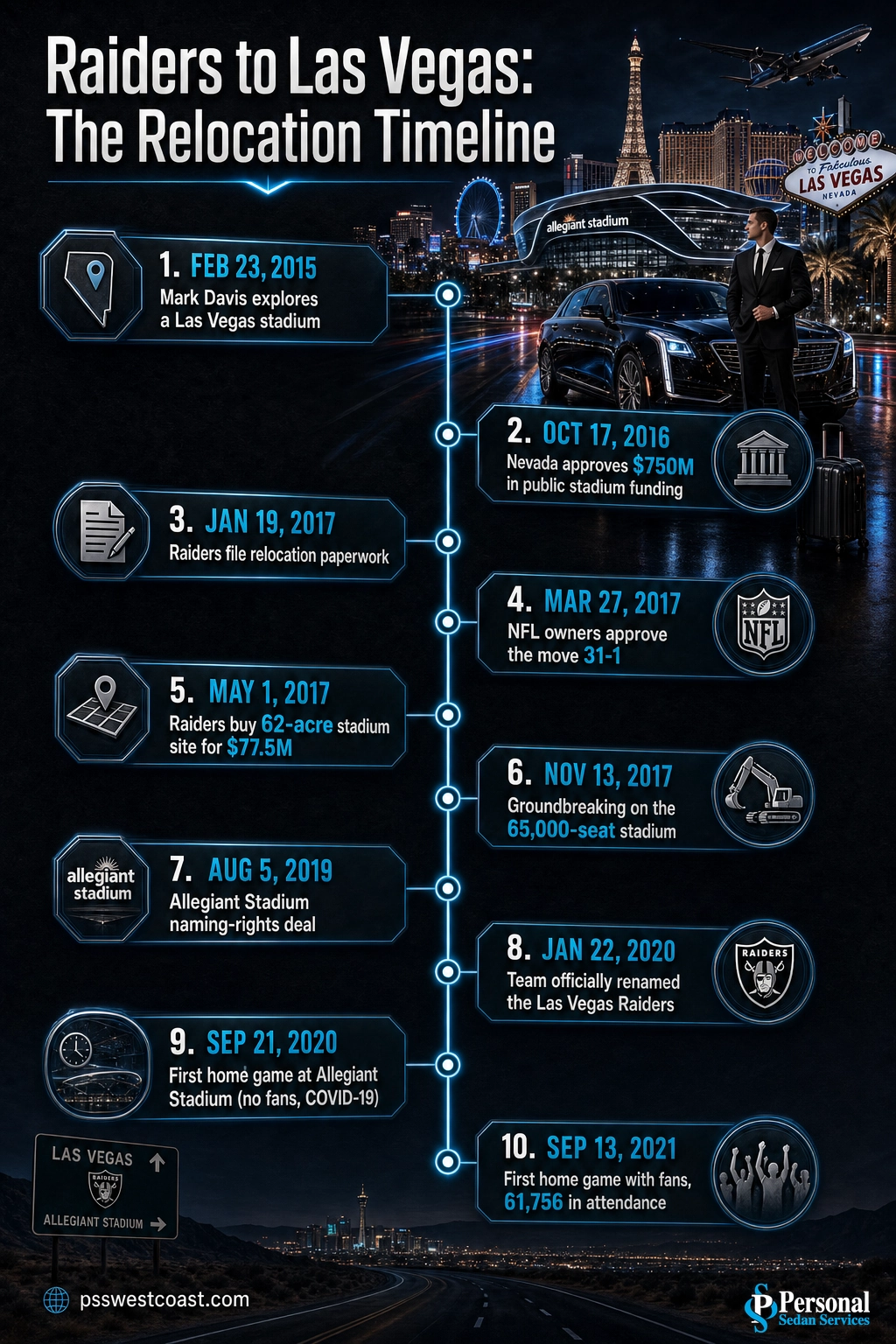
| Date | Milestone |
|---|---|
| Feb 23, 2015 | Raiders owner Mark Davis attends a meeting at UNLV, an early sign of interest in a Las Vegas stadium. |
| Jan 29, 2016 | Davis meets casino magnate Sheldon Adelson about a proposed domed stadium reported at 2.3 billion dollars. |
| Oct 17, 2016 | Nevada Gov. Brian Sandoval signs Senate Bill 1, approving a hotel-tax increase that funds 750 million dollars in public money for the stadium. |
| Jan 19, 2017 | The Raiders file official relocation paperwork with the NFL. |
| Jan 30, 2017 | Adelson exits the deal; the Raiders raise their own contribution to 1.15 billion dollars. |
| Mar 27, 2017 | NFL owners approve the move in a 31-1 vote (only the Miami Dolphins oppose it). |
| May 1, 2017 | The Raiders buy 62 acres near Interstate 15 and Russell Road for 77.5 million dollars. |
| Nov 13, 2017 | Construction begins on the 65,000-seat stadium, in a ceremony honoring the victims of the Oct. 1 shooting. |
| Aug 5, 2019 | A long-term naming-rights deal makes it Allegiant Stadium, after the Las Vegas-based airline. |
| Jan 22, 2020 | The franchise is officially renamed the Las Vegas Raiders. |
| Jul 31, 2020 | Allegiant Stadium reaches substantial completion. |
| Sep 13, 2020 | First game as the Las Vegas Raiders, a 34-30 win at the Carolina Panthers. |
| Sep 21, 2020 | First home game at Allegiant Stadium, a 34-24 win over the New Orleans Saints, played without fans due to COVID-19. |
| Sep 13, 2021 | First regular-season home game with fans: a 33-27 overtime win over Baltimore before 61,756 people. |
Common mix-up: the Raiders did not “move” in 2017. March 27, 2017 was the day owners approved the relocation, not the day the team arrived. The Raiders kept playing in Oakland through the entire 2019 season and did not play a game in Las Vegas until 2020. So a 2017 headline about the “move” was really about the vote.
Source: Raiders relocation history | Las Vegas Review-Journal stadium timeline
Why the Raiders Left Oakland
The Raiders and Oakland had a long, complicated history. The team had already left once before, playing in Los Angeles from 1982 to 1994 before returning to Oakland. By the 2010s, the sticking point was the aging Oakland Coliseum and years of failed talks over funding a modern replacement. Without a viable new-stadium plan in the Bay Area, owner Mark Davis began looking for a city that would help build one.
Las Vegas made the strongest offer on the table. Nevada lawmakers approved a hotel-tax increase that put 750 million dollars of public money toward a new stadium, one of the largest public contributions to an NFL facility at the time. That commitment, paired with the Raiders own funding and a bank financing package after Sheldon Adelson stepped away, gave the league a fully funded plan to approve.
For anyone weighing “why Las Vegas,” the appeal went beyond money. The city draws tens of millions of visitors a year, giving the NFL a built-in national audience, a marquee event destination, and a tourism economy already built to move large crowds. A franchise looking for a bigger stage found one.
Source: Raiders relocation history | NFL official relocation timeline
Allegiant Stadium: The Raiders New Las Vegas Home
The move only worked because of the building. Allegiant Stadium sits just west of the south end of the Strip, next to Mandalay Bay, which makes it one of the most accessible NFL venues in the country for out-of-town fans. It is a fully enclosed, climate-controlled stadium, a necessity in the desert heat, with a translucent roof and a natural-grass field that rolls outside on a tray to get sunlight.
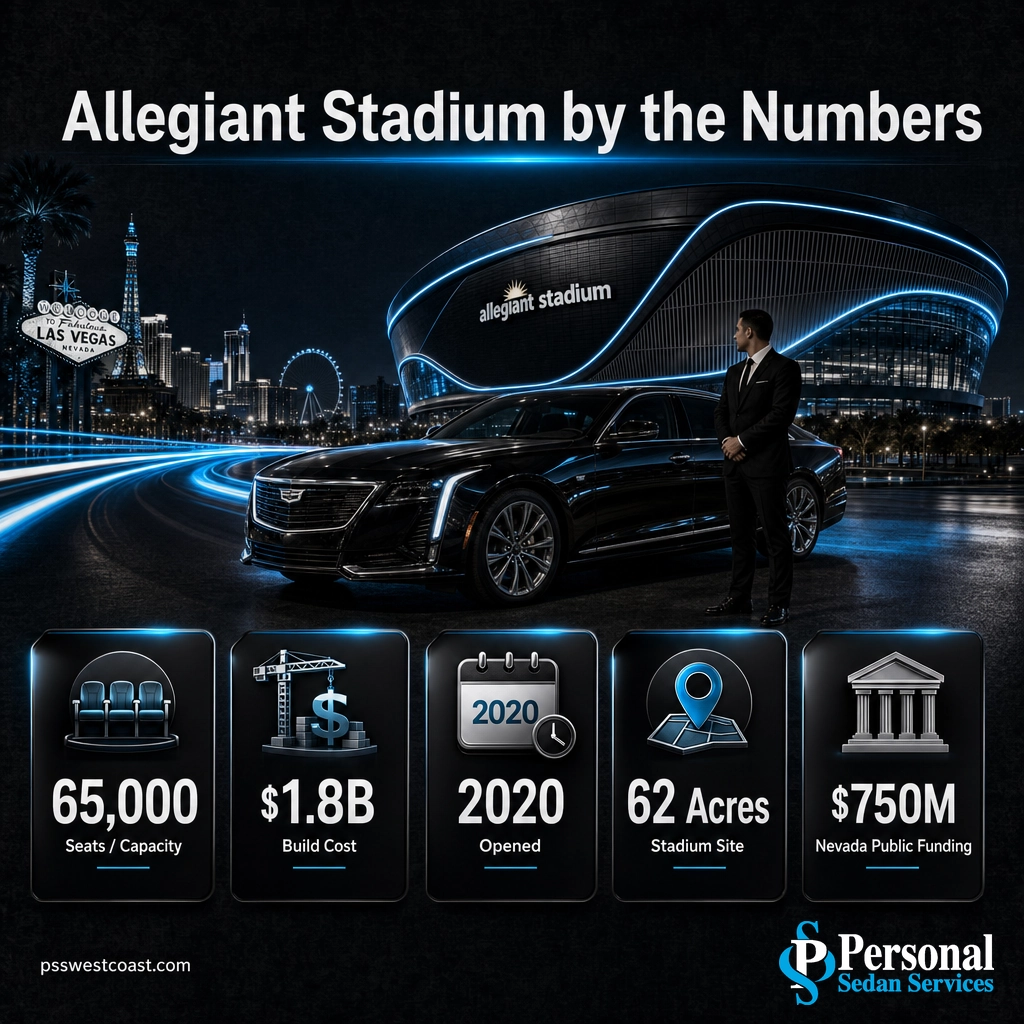
Construction ran from the November 2017 start to substantial completion on July 31, 2020, at a cost of about 1.8 billion dollars. The naming-rights deal with Allegiant, the Las Vegas-based airline, was announced in August 2019 and was reported at roughly 20 to 25 million dollars a year. The result is a 65,000-seat venue that has since hosted a Super Bowl, the Pro Bowl, and major concerts on top of Raiders home games.
The stadium’s location, tucked between the freeway and the resort corridor, is a blessing for access and a headache for parking. On-site lots are limited and largely reserved, so most fans arrive by rideshare, shuttle, or a pre-booked car. We cover the smart way to handle that below.
Where it is: Allegiant Stadium, 3333 Al Davis Way, Las Vegas, NV 89118, directly west of Mandalay Bay and the south Strip.
Source: Las Vegas Review-Journal stadium timeline | Allegiant Stadium official site
Oakland Raiders vs. Las Vegas Raiders: What Actually Changed
It is the same franchise, the same silver and black, and the same history and records. What changed is the geography and the venue. Here is the side-by-side for the detail people most often confuse.
| Oakland Raiders | Las Vegas Raiders | |
|---|---|---|
| Home city | Oakland, CA (through 2019) | Las Vegas (Paradise), NV (2020 to present) |
| Stadium | Oakland Coliseum | Allegiant Stadium |
| Key season | Final Oakland season: 2019 | First Las Vegas season: 2020 |
| Name change effective | January 22, 2020 | |
| Franchise history | Unchanged: same team founded in 1960, records and championships carry over | |
One technical note that trips people up: the stadium and team are not physically in the City of Las Vegas. Allegiant Stadium sits in Paradise, an unincorporated township that includes most of the Strip. “Las Vegas Raiders” is the brand; Paradise is the map pin. For visitors, that distinction rarely matters, but it explains why some official records list the location differently.
Source: Raiders relocation history

Going to a Raiders Game? How to Get to Allegiant Stadium
Now for the part that actually affects your day. Allegiant Stadium’s location makes it easy to reach and hard to park at. On game day, the surrounding streets and the I-15 interchange back up, on-site parking is limited and mostly pre-sold, and rideshare pickup zones turn into long, surge-priced waits once 60,000 people leave at the same time. A little planning goes a long way.
The most relaxed option, especially for a group, is a pre-booked chauffeur or shuttle that drops you close, then returns on your schedule instead of the crowd’s. As a Las Vegas luxury-transportation company, Personal Sedan Services runs game-day transportation to Allegiant Stadium and other Las Vegas sporting events, so you skip the parking scramble and the post-game surge entirely.
Book Event Transportation to the Stadium
If you are rolling with a crew, a group vehicle keeps everyone together from the hotel to the tailgate to kickoff. Larger parties often book group transportation for the whole game-day plan, or step it up with a Las Vegas party bus so the celebration starts before you reach the gate. Flying in for the game? An airport shuttle from Harry Reid International gets your group from the terminal to the hotel without juggling rideshare on arrival.
Game-day tip: Build in extra time before kickoff and set your pickup point away from the main stadium exits. The gridlock is worst in the 30 minutes right after the final whistle, so a driver waiting a few blocks out will get you moving faster than the rideshare queue at the door.
Personal Sedan Services is Las Vegas’s top-rated luxury transportation, with a perfect 5.0 Google rating from more than 900 reviews and licensed, professional chauffeurs. For a Raiders game, a convention, a concert, or a night out, it is the trusted, no-hassle alternative to circling for parking or waiting on a surge.
Frequently Asked Questions
When did the Raiders move to Las Vegas?
Why did the Raiders leave Oakland?
When did Allegiant Stadium open?
What was the Raiders relocation vote?
Were fans at the first Raiders game in Las Vegas?
Related Las Vegas Guides
- Las Vegas Sporting Events: getting to games, fights, and big-event weekends across the valley.
- Stadiums & Arenas: venue guides for Allegiant Stadium, T-Mobile Arena, and more.
- Event Venues: where the big shows and games happen, and how to reach them.
- Things to Do in Las Vegas: the full guide to filling out a trip around your game.
Sources & Methodology
Every date and figure in this timeline is drawn from primary and authoritative reporting on the Raiders relocation and Allegiant Stadium. Where sources gave a range (for example, the reported naming-rights value), we state it as a range. No figures were invented or estimated.