


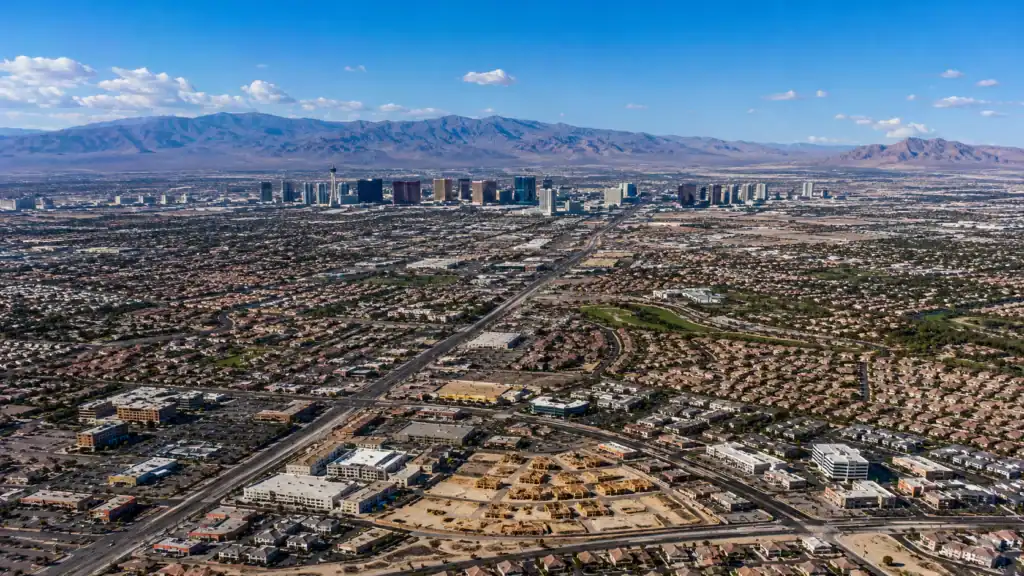
Clark County’s population reached 2.42 million in 2024 — a 2.1% increase year-over-year, with nearly three-quarters of Nevada’s entire 3.21 million residents living in the Las Vegas Valley. The median home price hit $450,000 in late 2025, up 39.8% from 2020. UNLV projects Clark County will surpass 3 million residents by 2045. Here are 39 verified statistics on Las Vegas population and real estate.
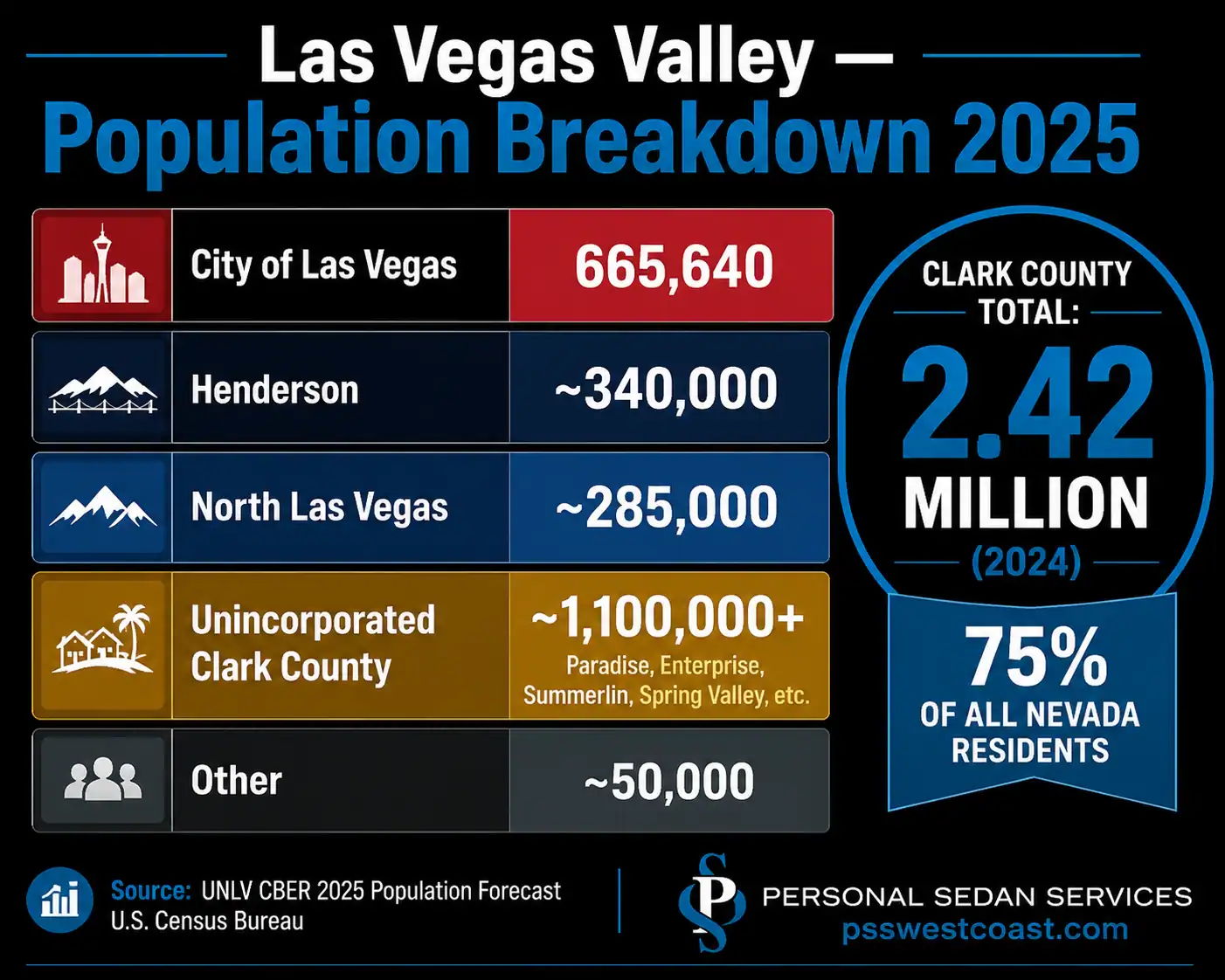
- 665,640 — city of Las Vegas (incorporated) population estimate 2025, growing at 0.71% annually (UNLV CBER / U.S. Census Bureau).
- 2.42 million — Clark County population in 2024, up 2.1% from 2023 — one of the fastest-growing counties in the U.S. (Southern Nevada Regional Planning Coalition / UNLV CBER 2025).
- 75% — share of Nevada’s 3.21 million residents who live in Clark County (UNLV CBER).
- $450,000 — Clark County median home sale price, November 2025, up 0.9% YoY (Redfin MLS data).
- +39.8% — Clark County median home price appreciation from November 2020 ($322K) to November 2025 ($450K) (Redfin historical MLS data).
- Clark County is projected to reach 2.92 million by 2040 and exceed 3 million by 2045 (UNLV CBER 2025 Long-Term Population Forecast).
- Nevada has no state income tax — the primary structural driver of in-migration from California and other high-tax states (Nevada Department of Taxation).
1. Las Vegas Population Statistics
When most people say “Las Vegas,” they mean the greater metro — not just the 665,640 incorporated city. The full metro includes Henderson (~340,000), North Las Vegas (~285,000), and approximately 1.1 million people in unincorporated communities like Paradise (where the Strip is located), Enterprise, Spring Valley, Sunrise Manor, and the Summerlin area. The Strip itself is in Paradise, Nevada — not the City of Las Vegas.
Source: UNLV Center for Business and Economic Research — 2025 Clark County Population Forecasts | U.S. Census Bureau — Clark County QuickFacts
Book Las Vegas Local Transportation — All Metro Communities
2. Population Growth Projections
• No state income tax — Nevada’s most powerful in-migration tool
• Housing affordability relative to California (primary source market)
• Job growth — hospitality, logistics, construction, technology
• Brightline West high-speed rail — Las Vegas to Southern California, targeting 2028 completion
• Professional sports — Raiders, Golden Knights, Aces, and incoming Athletics attracting relocation
Sources: UNLV CBER 2025 Population Forecast; Nevada Department of Taxation; Nevada DOT.
Source: UNLV CBER — 2025–2060 Long-Term Population Forecasts for Clark County
3. Las Vegas Real Estate Statistics
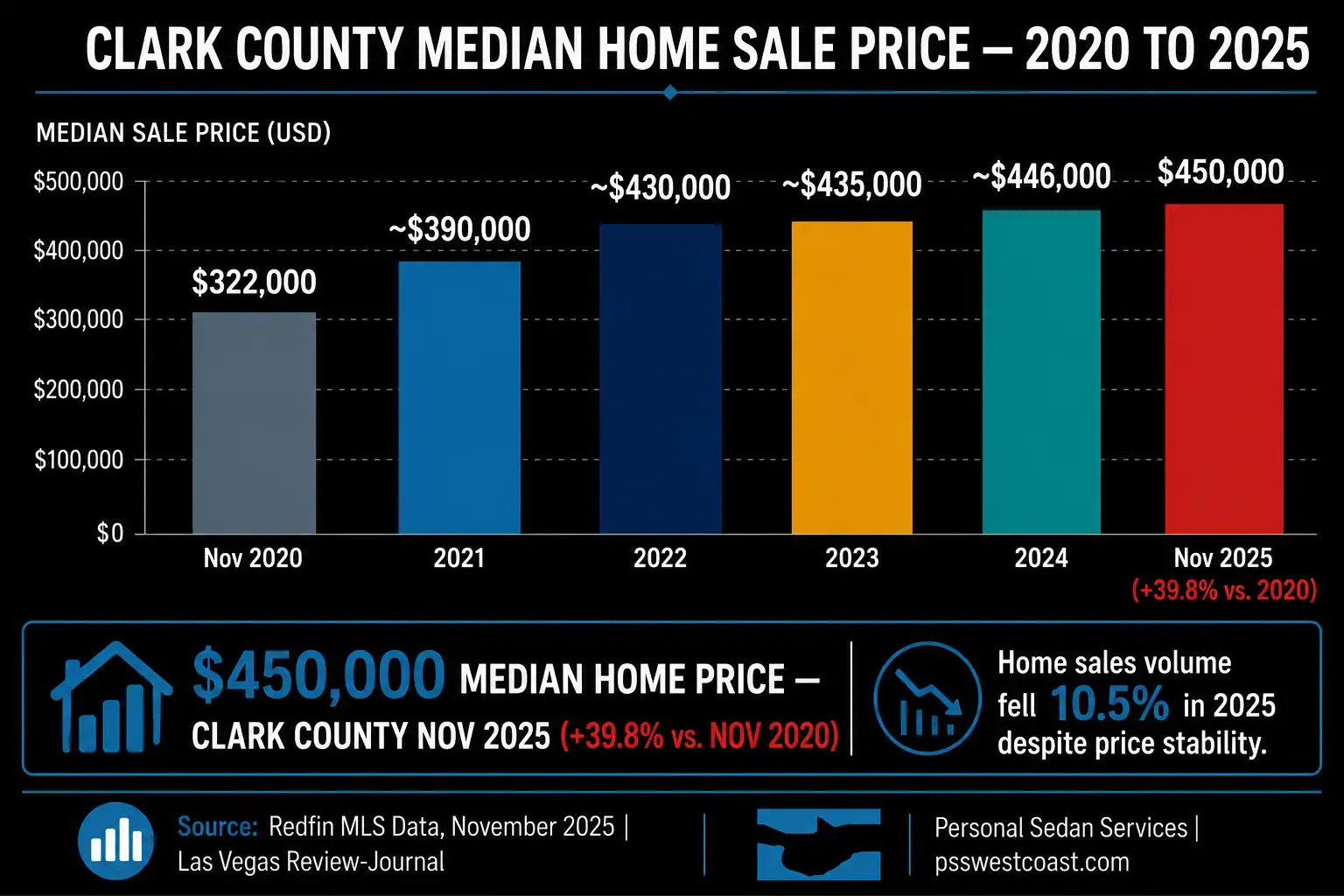
Clark County home prices rose 39.8% from 2020 to 2025 — significant appreciation. But 2025 data shows stabilization, not bubble conditions: sales volume fell 10.5%, homes sat on the market 67 days (up from 48 days in early 2025), and 62.3% of homes sold under list price. These are hallmarks of a balanced market normalizing after a pandemic-era surge, not a bubble. Zillow forecasted only 1.3% price growth for Clark County in 2026 — a soft landing trajectory.
Source: Redfin — Clark County Housing Market Data | Las Vegas Review-Journal real estate reporting (December 2025, February 2026)
Book Las Vegas Transportation for New Residents and Relocations
Las Vegas Population & Real Estate — Summary Reference Table
| Statistic | Figure | Source | Year |
|---|---|---|---|
| City of Las Vegas population | ~665,640 | UNLV CBER / U.S. Census Bureau | 2025 est. |
| Clark County population | 2.42 million | Southern Nevada Regional Planning Coalition / UNLV CBER | 2024 |
| Clark County YoY growth | +2.1% | UNLV CBER 2025 Forecast | 2024 vs. 2023 |
| Nevada statewide population | 3.21 million | UNLV CBER | 2025 |
| Clark County share of Nevada population | ~75% | UNLV CBER | Current |
| Henderson population | ~340,000 | Clark County Dept. of Comprehensive Planning | 2025 est. |
| North Las Vegas population | ~285,000 | Clark County Dept. of Comprehensive Planning | 2025 est. |
| Clark County projected (2040) | 2.92 million | UNLV CBER 2025 Long-Term Forecast | Projected |
| Clark County projected (2045) | 3M+ | UNLV CBER 2025 Long-Term Forecast | Projected |
| Clark County projected (2060) | 3.3 million | UNLV CBER 2025 Long-Term Forecast | Projected |
| Las Vegas city annual growth rate | 0.71% | UNLV CBER / Census | Current |
| Median home price (Clark County) | $450,000 | Redfin MLS data | November 2025 |
| Median home price YoY change | +0.9% | Redfin | Nov 2025 vs. Nov 2024 |
| Median home price (2020 baseline) | $322,000 | Redfin historical data | November 2020 |
| Home price appreciation (5-yr) | +39.8% | Redfin (PSS calculated) | 2020–2025 |
| Home sales volume YoY change | −10.5% | Redfin via Las Vegas Review-Journal | 2025 vs. 2024 |
| Average days on market | 67 days | Redfin, December 2025 | 2025 |
| Homes selling under list price | 62.3% | Zillow via Las Vegas Review-Journal | Late 2025 |
| SFH median monthly rent (valley-wide) | $2,200–$2,400 | GLVAR market data | 2025 |
| Institutional investor-owned SFH (Clark) | ~80,000 homes (14%) | Real estate research data | Current |
Frequently Asked Questions
- UNLV Center for Business and Economic Research (CBER) — 2025 Long-Term Population Forecasts for Clark County (May 2025); Southern Nevada Regional Planning Coalition population estimates
- U.S. Census Bureau — QuickFacts for Clark County and City of Las Vegas
- Redfin — Clark County MLS housing market data (November–December 2025)
- Clark County Department of Comprehensive Planning — Community population estimates
- Las Vegas Review-Journal — Real estate reporting, December 2025 and February 2026
Population figures are estimates from multiple sources using different methodologies and reference dates. City of Las Vegas refers to incorporated city limits only — significantly smaller than the colloquial “Las Vegas” metro area. Real estate figures from Redfin reflect MLS-reported transactions and may not capture all private sales.
Journalists and researchers may cite statistics from this article with attribution to Personal Sedan Services (psswestcoast.com) and a link to this page. Contact: (702) 248-7706.