


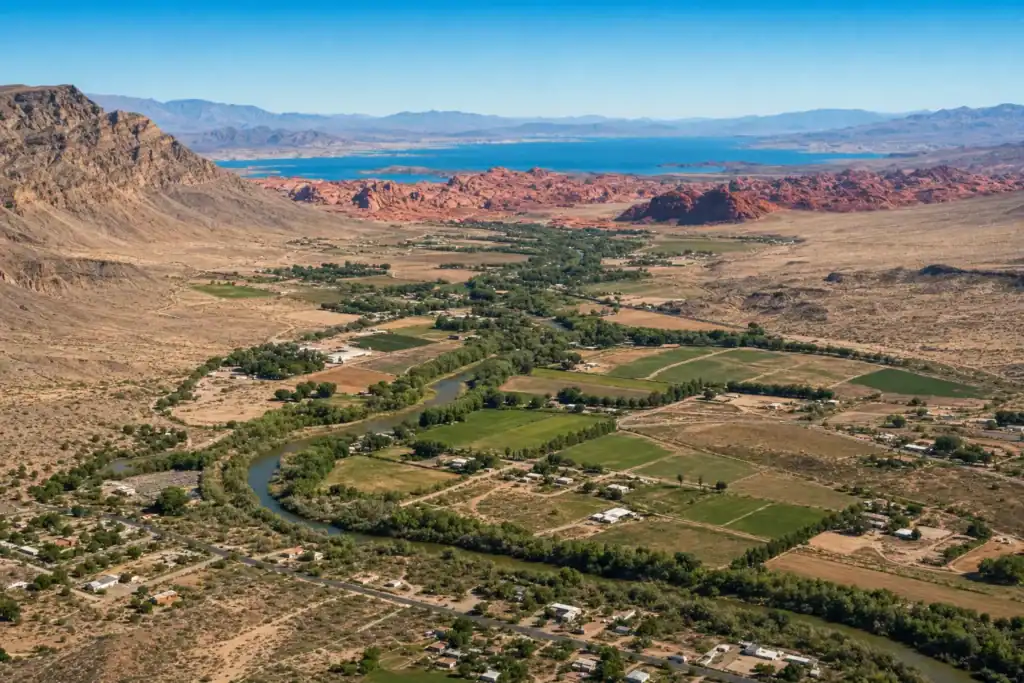
Moapa Valley is the green, quiet, history-rich corner of southern Nevada that most Las Vegas visitors never see. About an hour northeast of the Strip, this string of small farming communities along the Muddy River, Overton, Logandale, Moapa, and Glendale, serves as the gateway to Valley of Fire State Park, Lake Mead’s Overton Arm, and a Native American heritage stretching back nearly two thousand years. This guide covers what Moapa Valley is, its remarkable history, what to see, and how to visit.
What’s in This Guide
- Moapa Valley is a cluster of rural communities, mainly Overton and Logandale, along the Muddy River about 60 miles northeast of Las Vegas.
- It is the gateway to Valley of Fire State Park, Nevada’s oldest and largest state park, famous for red Aztec sandstone and ancient petroglyphs.
- The valley has been farmed for nearly 2,000 years, from Ancestral Puebloans to 1860s Mormon pioneers.
- Overton’s Lost City Museum preserves Ancestral Puebloan artifacts recovered before Lake Mead flooded the region.
- Outdoor draws include Lake Mead’s Overton Arm, the Logandale Trails, and the Warm Springs Natural Area.
- The pioneer town of St. Thomas, flooded by Lake Mead in the 1930s, has re-emerged at low water.
- It makes an ideal day trip or quiet overnight base from Las Vegas.
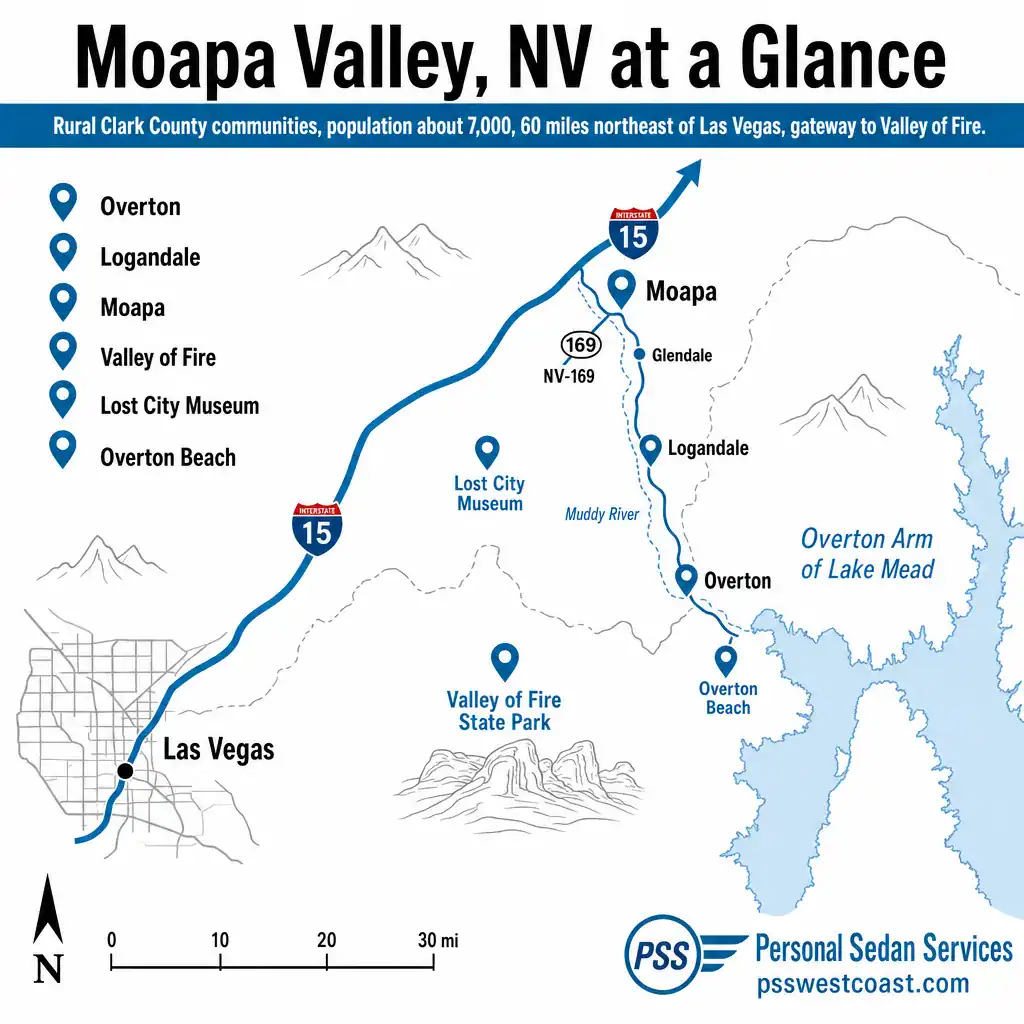
Moapa Valley at a Glance
Moapa Valley is one of the last genuinely rural pockets of Clark County: a verdant agricultural ribbon following the Muddy River through an otherwise stark desert, ringed by red mesas and big skies. Where Las Vegas is loud and fast, Moapa Valley is quiet, slow, and rooted in farming and ranching, with some of the few remaining working farms in the county.
For visitors, the valley plays two roles. It is a destination in its own right, with deep history, a distinctive museum, and small-town charm. And it is the practical gateway to two of southern Nevada’s natural showpieces, Valley of Fire State Park at its doorstep and the Overton Arm of Lake Mead just beyond. Together they make the area an outsized draw for such a small population.
Communities: Overton, Logandale, Moapa, Glendale
Population: about 7,000
Distance from Las Vegas: about 60 miles northeast, roughly an hour via I-15
Known for: Valley of Fire gateway, Lost City Museum, Lake Mead access, farming heritage
Source: Travel Nevada on Moapa Valley | Moapa Valley overview
The Communities: Overton, Logandale & Moapa
Moapa Valley is not a single town but a chain of small communities strung along NV-169 (Moapa Valley Boulevard). Overton is the largest and the cultural anchor, home to the Lost City Museum, most of the valley’s restaurants and shops, and the closest services to Valley of Fire. Logandale, just to the north, is known for the Clark County Fairgrounds and the vast Logandale Trails system. Smaller Moapa and Glendale sit nearer the I-15 junction at the valley’s upper end.
Although Overton and Logandale officially merged into the single unincorporated town of Moapa Valley in 1981, each community kept its own identity, post office, and sense of place. The vibe throughout is agricultural and tight-knit: working farms and ranches, horse properties, local rodeos, and community festivals like the Pomegranate Festival and the fall corn maze. It is small-town Nevada in a way that has nearly vanished elsewhere in the county.
Because the valley is unincorporated, it is governed by Clark County rather than any city government, with local town advisory boards representing residents. That rural, self-reliant character is a big part of the appeal for both residents and visitors.
Source: Moapa Valley community organization
A Valley with Deep History
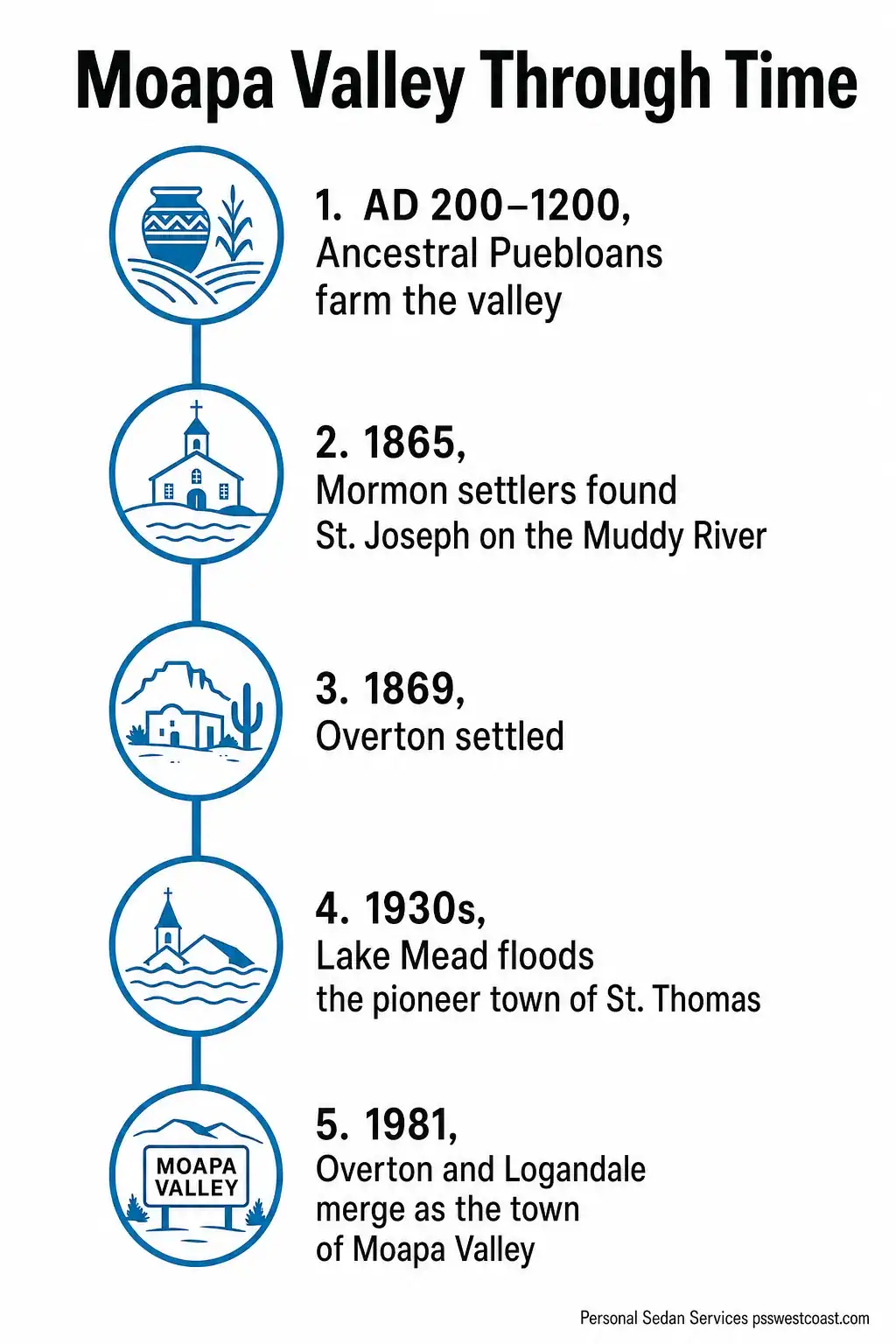
Few places in Nevada have a longer human story than this one. The Muddy River’s reliable water made the valley an oasis, and Ancestral Puebloan peoples farmed here from roughly AD 200 to 1200, building a network of settlements later dubbed the “Lost City,” or Pueblo Grande de Nevada. Southern Paiute people lived in the region for centuries after.
In 1865, Mormon settlers spreading out from Utah founded St. Joseph on the Muddy River, and Overton was settled in 1869, part of a string of farming towns the church established along the Muddy and Virgin rivers. The pioneers built adobe homes, a grist mill, and irrigation works, though a tax dispute with Nevada in 1871 briefly drove many back to Utah before the communities took permanent hold.
The valley’s most dramatic chapter came with Hoover Dam. As Lake Mead filled in the 1930s, its rising water flooded the pioneer town of St. Thomas, forcing residents out and submerging the settlement for generations. In recent years, lower lake levels have exposed the ruins again, and visitors can now hike among the foundations of a town that spent decades underwater, a haunting, tangible link to the valley’s past.
Source: National Park Service, St. Thomas
Valley of Fire State Park
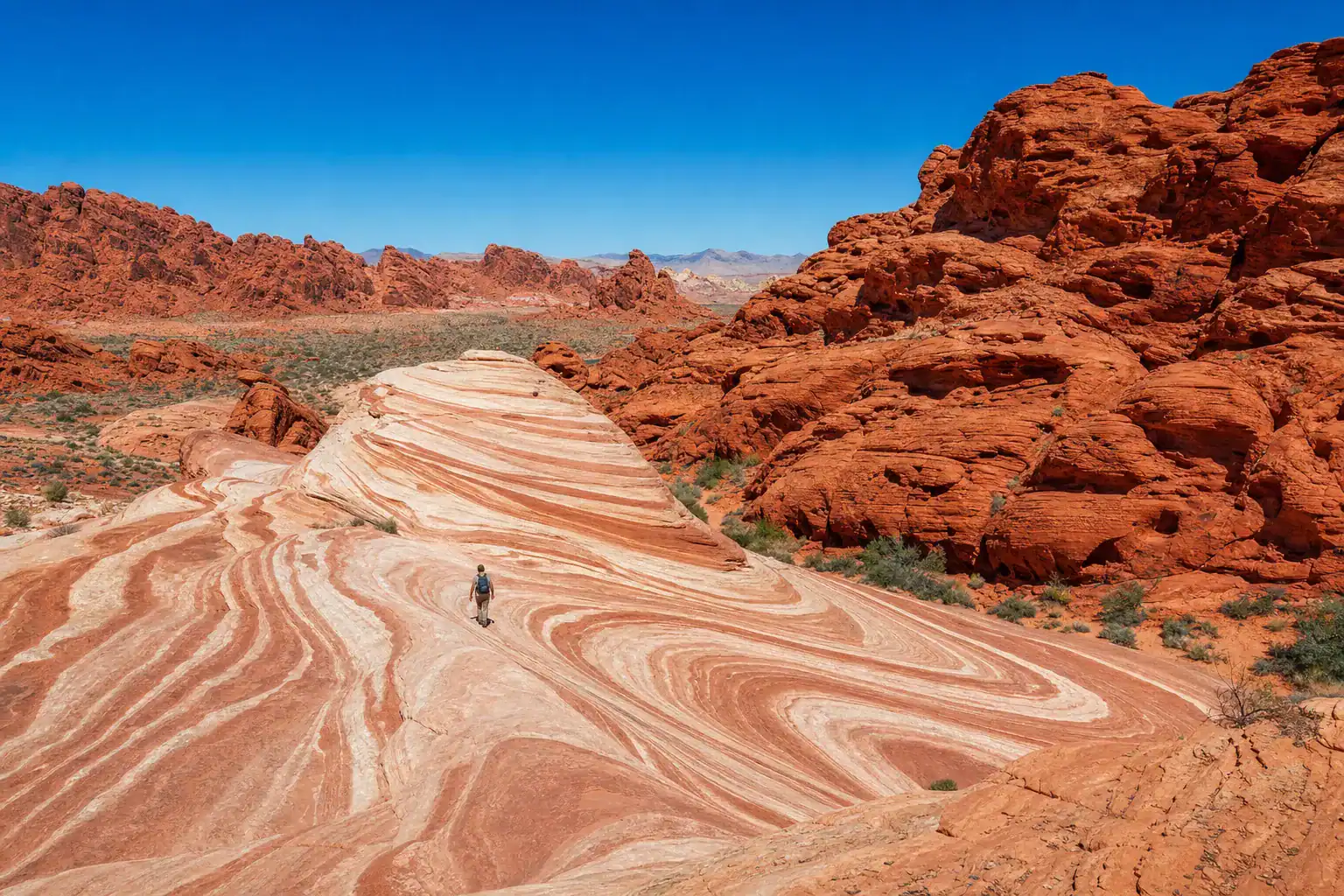
The headline attraction at Moapa Valley’s doorstep is Valley of Fire State Park, Nevada’s oldest and largest state park, dedicated in 1935. Its roughly 40,000 acres of brilliant red Aztec sandstone, sculpted over 150 million years, glow almost supernaturally at sunrise and sunset. Overton is the closest town, only about 11 to 15 miles away, which is why the valley is the natural base for a visit.
The park’s highlights are world-class. The Fire Wave, a swirl of red-and-beige striped slickrock, is the iconic hike. Mouse’s Tank (Petroglyph Canyon) and Atlatl Rock showcase Native petroglyphs estimated at over 2,000 to 3,000 years old. White Domes, Rainbow Vista, the Seven Sisters, and the central scenic drive round out a remarkably compact, explorable park. It is also a favorite for photographers and filmmakers, and has stood in for other planets on screen.
Timing matters here more than almost anywhere. For visitor safety, many of the park’s trails, including the Fire Wave, White Domes, and Pastel Canyon, are closed annually from May 15 through September 30 because of extreme summer heat and a history of rescues. Plan your visit for October through April, go early in the day, and always carry far more water than you think you will need.
Source: Nevada State Parks, Valley of Fire
Book Valley of Fire Transportation
The Lost City Museum
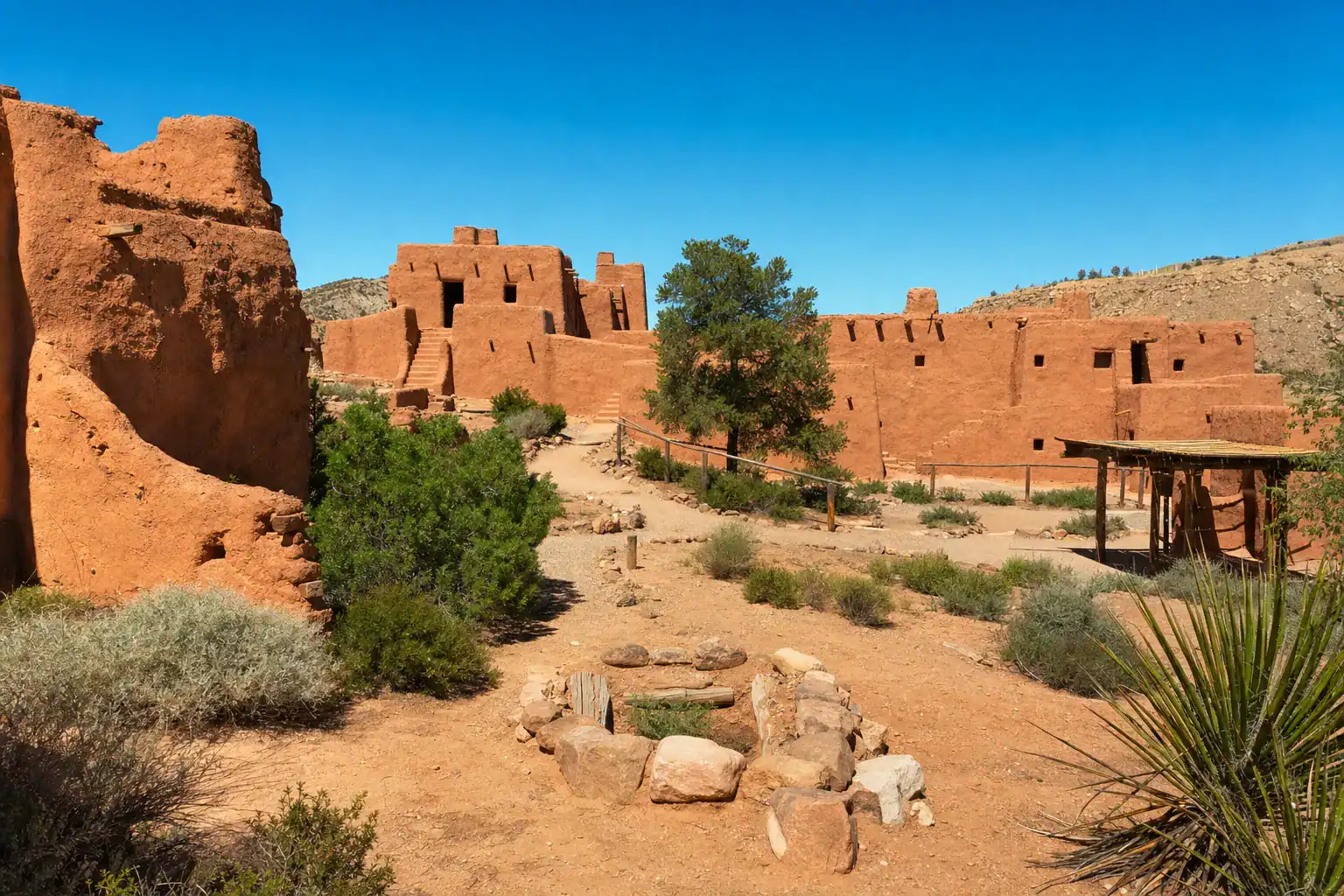
To understand the people who came before, visit the Lost City Museum in Overton. Built by the Civilian Conservation Corps in the 1930s, partly to house artifacts being rescued before Lake Mead flooded the archaeological sites, the museum sits on an actual Ancestral Puebloan site. Its collections include pottery, basketry, jewelry, and tools recovered from the valley, alongside reconstructed adobe pueblo dwellings you can walk through on the grounds.
It is one of Nevada’s most distinctive museums, giving real historical context to the petroglyphs and ruins you see out on the land. An hour here pairs naturally with a Valley of Fire visit and deepens the whole trip. The museum is in Overton on Moapa Valley Boulevard; hours run several days a week and can vary by season, so confirm before you go.
Source: Lost City Museum official site
Lake Mead & the Outdoors
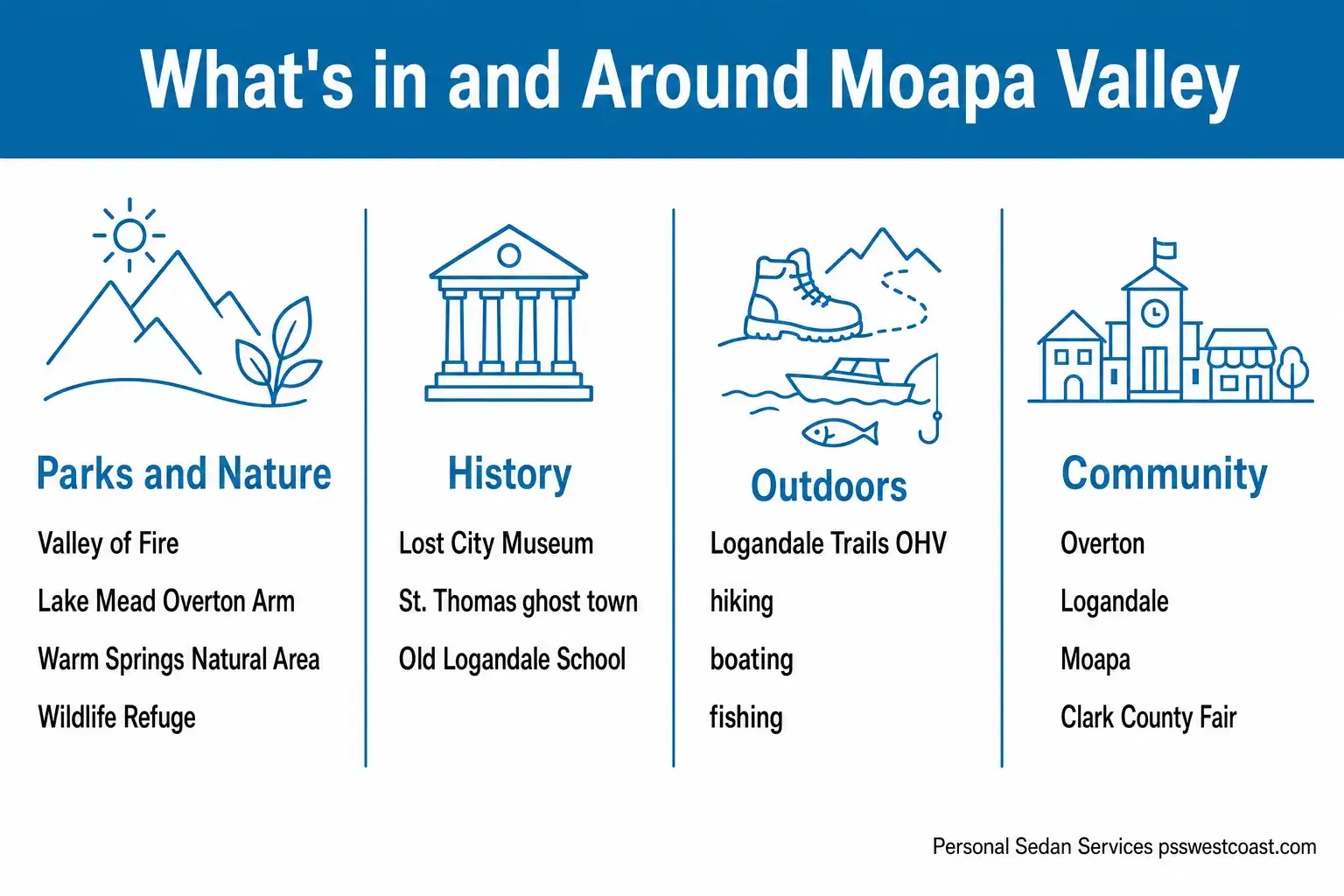
Beyond Valley of Fire, Moapa Valley is an outdoor playground. The Overton Arm of Lake Mead, the northern reach of the huge reservoir, lies just east of the valley and offers boating, fishing, paddling, and shoreline camping, often far less crowded than the lake’s southern marinas. Overton Beach and the Northshore corridor are the main access points.
On land, the BLM-managed Logandale Trails system spreads across more than 200 miles of routes for off-highway vehicles, horseback riding, mountain biking, and hiking through colorful sandstone country. The Warm Springs Natural Area and the nearby Moapa Valley National Wildlife Refuge, home to the endangered Moapa dace fish, protect rare desert wetlands fed by warm springs, with easy interpretive trails. And the Clark County Fair and Rodeo each April in Logandale is one of the largest community events in southern Nevada.
As with everything in this region, summer heat is the limiting factor. The prime season for hiking, OHV riding, and lake time runs roughly October through May, when temperatures are mild and the trails and water are at their best.
Source: Lake Mead National Recreation Area
Getting to and Around Moapa Valley
Moapa Valley sits about 60 miles northeast of Las Vegas, roughly an hour up Interstate 15 to the Logandale and Overton exits, then onto NV-169 through the communities and down to Valley of Fire. There is no public transit to speak of, and the attractions, Valley of Fire, the Lost City Museum, Lake Mead’s Overton Arm, the Logandale Trails, are spread across many miles of rural highway, so a vehicle is essential.
This is exactly the kind of trip a private car transforms. Personal Sedan Services runs Moapa Valley and Valley of Fire day trips from any Las Vegas hotel at pre-confirmed fixed rates with no surge pricing, so you can watch the desert roll by, photograph the Fire Wave at golden hour, and explore the Lost City Museum without driving the long desert highway yourself or worrying about parking, fuel, or fatigue. Bring a group in a Sprinter, a small group in an SUV, or a couple in a sedan.
Related Resources
Continue planning with these Personal Sedan Services guides and pages:
- 10 Best Things to Do in Moapa Valley, the activity companion to this guide
- Boulder City Nevada Guide, the other gateway to Lake Mead and the dam
- Attractions Transportation, for Valley of Fire and day-trip service
External resources: Nevada State Parks, Valley of Fire, Lake Mead National Recreation Area, and Travel Nevada’s Moapa Valley page.
Quick-Reference Summary
| Topic | Detail |
|---|---|
| Region | Northeastern Clark County, Nevada |
| River | Muddy River (Virgin / Colorado system) |
| Communities | Overton, Logandale, Moapa, Glendale |
| Population | About 7,000 |
| Distance from Las Vegas | About 60 miles northeast |
| Drive time | About 1 hour via I-15 |
| Town merger | Overton + Logandale, 1981 |
| Earliest farming | Ancestral Puebloans, ~AD 200 |
| Mormon settlement | St. Joseph 1865, Overton 1869 |
| Flooded town | St. Thomas (Lake Mead, 1930s) |
| Valley of Fire | ~40,000 acres, dedicated 1935 |
| Signature park hike | Fire Wave (closed mid-May to Sep 30) |
| Petroglyph sites | Mouse’s Tank, Atlatl Rock |
| Lost City Museum | Overton, Ancestral Puebloan artifacts |
| Lake access | Overton Arm, Overton Beach |
| OHV trails | Logandale Trails, 200+ miles |
| Wetlands | Warm Springs Natural Area, Wildlife Refuge |
| Major event | Clark County Fair & Rodeo (April) |
| Best season | October through May |
| Best for | Day trip or quiet overnight base from Las Vegas |
Frequently Asked Questions
Where is Moapa Valley, Nevada?
What towns make up Moapa Valley?
What is Moapa Valley known for?
How far is Moapa Valley from Las Vegas?
Is Valley of Fire in Moapa Valley?
What happened to the town of St. Thomas?
Is Moapa Valley worth visiting?
Methodology and Sources
This guide combines public information from Nevada State Parks, the National Park Service, Travel Nevada, and local community sources with Personal Sedan Services operational knowledge of Valley of Fire and Lake Mead day trips. Population is approximate and rounded. Park trail closures, museum hours, and the accessibility of the St. Thomas ruins change with season and lake levels, so confirm current conditions before visiting. Distances and drive times are approximate. Last updated May 2026. This guide is reviewed and refreshed annually.
Press and media: journalists and writers are welcome to reference or link to this guide. For data or quotes, contact Personal Sedan Services at (702) 248-7706.