



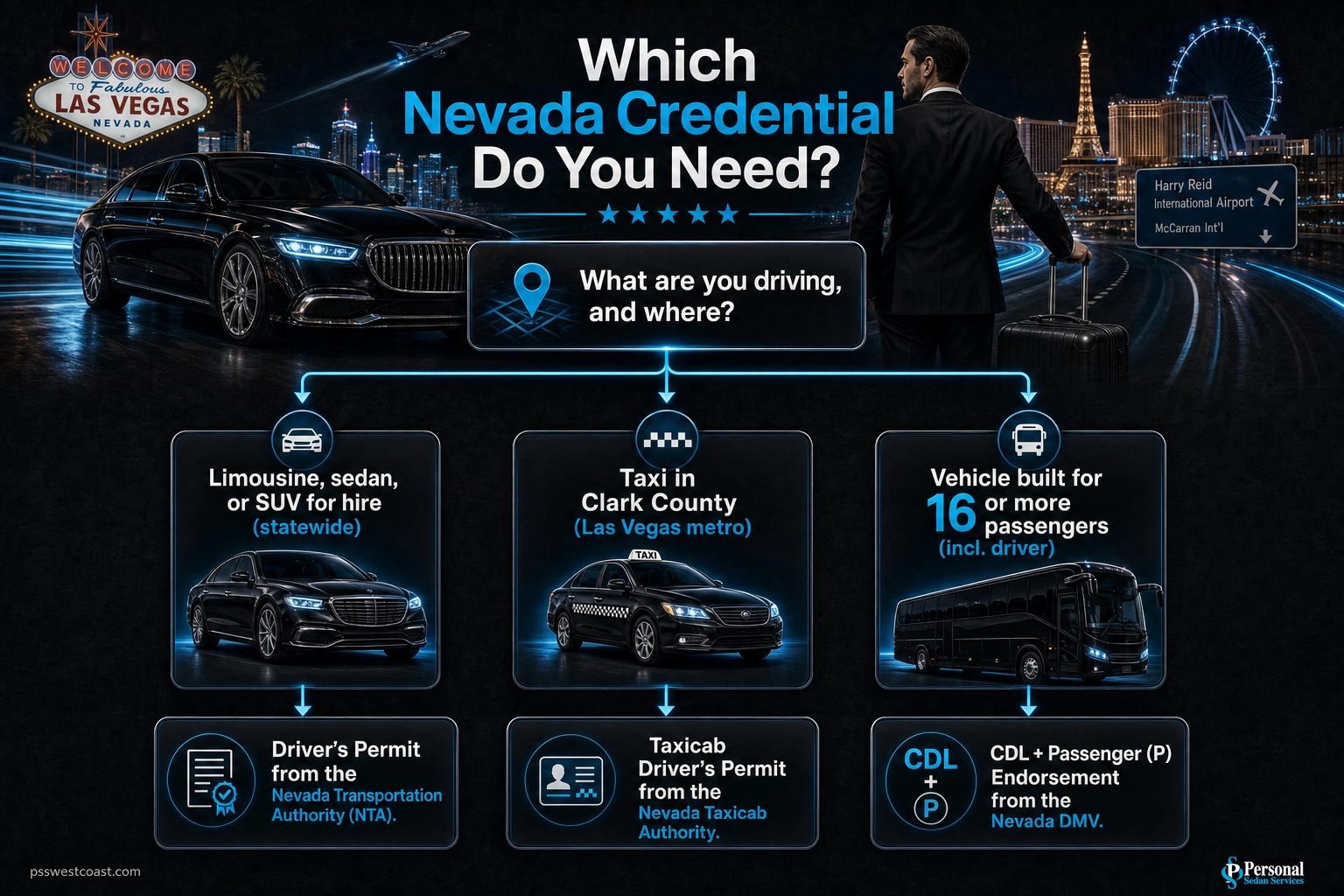
In Nevada there is no single “chauffeur license” you pick up at the DMV. Which credential you actually need depends on two things: the vehicle you drive and where you drive it. A limousine driver needs a permit from the Nevada Transportation Authority, a Las Vegas taxi driver needs a permit from the Nevada Taxicab Authority, and anyone behind the wheel of a vehicle built for 16 or more passengers needs a commercial driver license with a passenger endorsement. Get the wrong one and you cannot legally carry a paying passenger, so the first job is matching the credential to the job. This guide walks through every requirement, test, and fee, in order.
Before You Begin
Line these up before you start any application. Missing one of these is the most common reason a permit stalls:
- Age: at least 21 for a limousine or livery driver’s permit.
- License: a valid Nevada Class C driver’s license (or qualifying border-state status for some taxi applicants).
- Driving record: a three-year DMV history print-out, clean of DUI, reckless driving, hit-and-run, and failure-to-appear convictions.
- Employer: a certificated carrier willing to refer you. Permits are employer-referred, not issued directly to the public.
- Medical fitness: the ability to pass a Department of Transportation physical.
- Clean background: the ability to pass a fingerprint-based criminal background check.
Key Takeaways
- Nevada has no standalone DMV chauffeur license. You need a driver’s permit from the correct regulator, and sometimes a CDL.
- Limousine and livery drivers are permitted by the Nevada Transportation Authority (NTA).
- Taxi drivers in the Las Vegas / Clark County area are permitted by the Nevada Taxicab Authority.
- A CDL with a passenger (P) endorsement is required only for vehicles designed for 16 or more passengers, including the driver.
- Every path shares the same backbone: age and license check, a DOT physical, a clean record, testing, and a fingerprint background check.
What’s in This Guide
- What a “Chauffeur License” Actually Means in Nevada
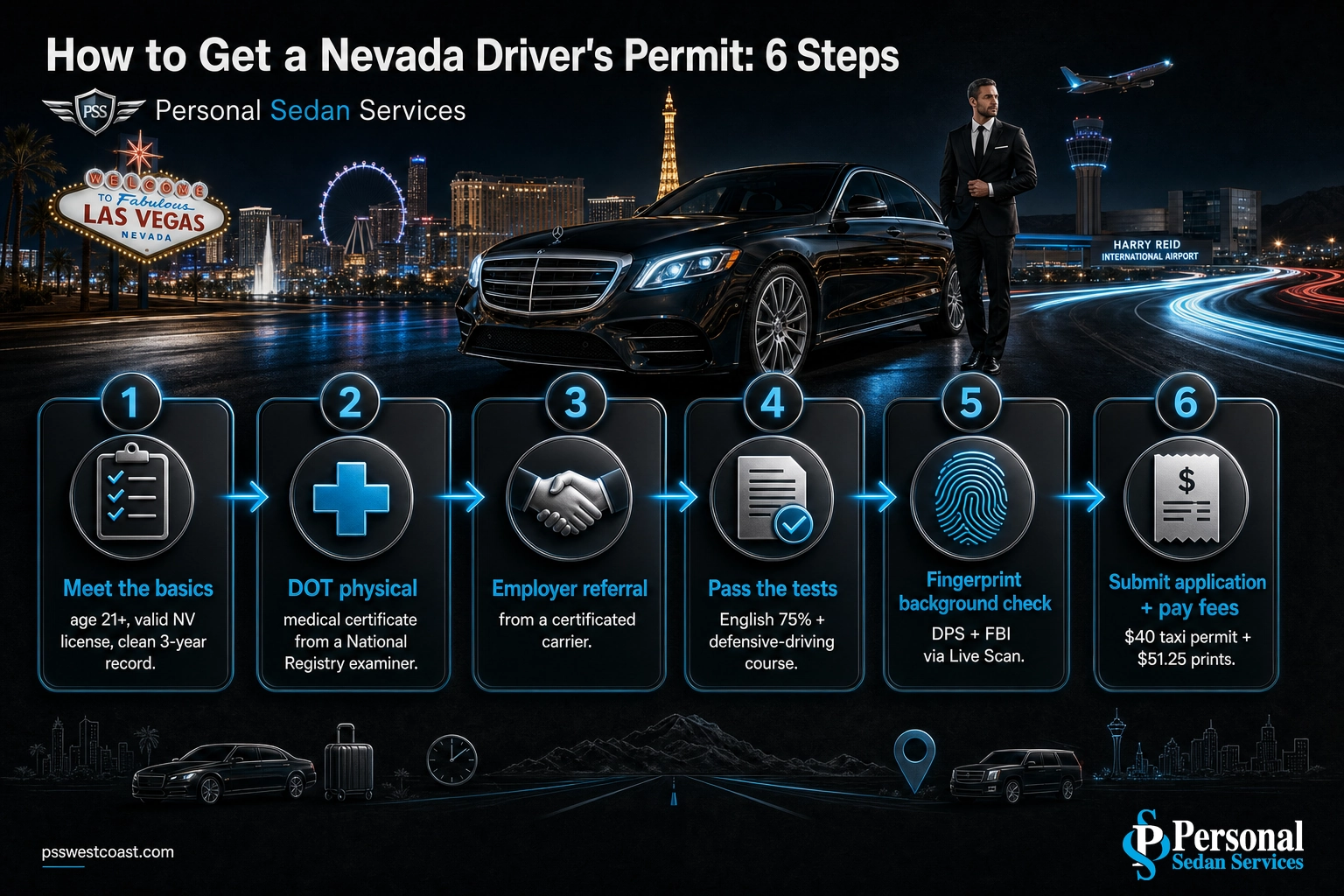
- Step 1: Confirm You Meet the Basic Requirements
- Step 2: Get a DOT Physical and Medical Certificate
- Step 3: Get an Employer Referral
- Step 4: Pass the Required Tests
- Step 5: Complete Fingerprinting and a Background Check
- Step 6: Submit Your Application and Pay the Fees
- When You Need a CDL With a Passenger Endorsement
- When You Do Not Need a License at All
- Troubleshooting Common Problems
- Maintain and Renew Your Permit
- Frequently Asked Questions
What a “Chauffeur License” Actually Means in Nevada
Plenty of states issue a “chauffeur’s license” as a class printed right on the driver license. Nevada does not. The DMV issues a standard Class C license and, separately, commercial driver licenses. The authority to drive people for money comes from a for-hire driver’s permit issued by whichever agency regulates your vehicle type. Understanding that split is what saves you weeks of chasing the wrong document.
There are three credentials, and most drivers need exactly one of them:
| Credential | Who it is for | Issued by | Core requirements |
|---|---|---|---|
| Driver’s Permit (limousine / livery) | Limousine, sedan, and SUV for-hire drivers statewide | Nevada Transportation Authority | Age 21+, valid NV license, DOT physical, clean 3-year record, carrier referral, fingerprints |
| Taxicab Driver’s Permit | Taxi drivers in Clark County (Las Vegas metro) | Nevada Taxicab Authority | NV Class C license, DOT physical, defensive-driving course, English test, fingerprints |
| CDL + Passenger (P) Endorsement | Any driver of a vehicle built for 16+ passengers | Nevada DMV | CDL knowledge and skills tests, passenger endorsement test, DOT medical certificate |
A driver who runs Strip pickups in a black sedan or SUV needs the NTA permit. A cab driver working the Las Vegas valley needs the Taxicab Authority permit. A driver moving a wedding party or a convention group in a 24-passenger shuttle needs the CDL with a passenger endorsement. Some professional drivers hold more than one over a career, but you only need the credential that matches the vehicle you are about to drive.
Source: Nevada Administrative Code Chapter 706 | Nevada Taxicab Authority driver permit requirements
Step 1: Confirm You Meet the Basic Requirements
Before you spend a dollar, confirm you clear the baseline. For a limousine or livery driver’s permit, Nevada Administrative Code 706.229 requires you to be at least 21 years old and hold a valid Nevada driver’s license. Your DMV driving history must show no convictions in the past three years for driving under the influence, reckless driving, failing to stop at the scene of an accident, or failure to appear in court.
Why this step matters: the record check is the first gate the regulator applies, and a recent disqualifying conviction stops the application cold, before any fees or fingerprints. Pull your own three-year DMV history first so there are no surprises.
One nuance worth planning around: the legal minimum is 21, but many transportation companies and their insurers set a higher internal floor, commonly 25, because commercial passenger insurance is priced on driver age and experience. So the state may let you drive at 21 while the company hiring you asks for 25. If you are between those ages, ask the carrier directly before you apply.
Taxi applicants in Clark County have a similar baseline with one extra wrinkle: you must be a Nevada resident, or a resident of an adjoining state (Arizona or California), and you submit a three-year Nevada DMV driving history dated within the last 30 days.
Source: NAC 706.229 driver qualification rule | Taxicab Authority permit requirements
Step 2: Get a DOT Physical and Medical Certificate
Every for-hire passenger path in Nevada requires proof you are physically fit to operate a commercial motor vehicle. That proof is a Department of Transportation (DOT) physical, performed by a medical examiner listed on the FMCSA National Registry of Certified Medical Examiners.
For a Clark County taxi permit, the regulator is specific: you need a full five-page physician’s certificate from a National Registry examiner licensed in Nevada, who issues the federal medical forms (MCSA-5875 and MCSA-5876) confirming you meet the Federal Motor Carrier Safety Regulations. Limousine drivers under the Transportation Authority provide the same type of physician’s certificate of commercial fitness.
What success looks like: you walk out of the exam with a signed medical certificate in hand. Book with a certified examiner specifically, not just any clinic, because a physical from a provider who is not on the National Registry will not be accepted.
Source: FMCSA National Registry of Certified Medical Examiners
Step 3: Get an Employer Referral From a Certificated Carrier
This is the step that surprises first-time applicants: you generally cannot walk into the regulator and request a permit on your own. Nevada driver’s permits are employer-referred. A carrier that already holds a state certificate sponsors your application.
For a limousine or livery permit, you obtain a referral application from the Nevada Transportation Authority, tied to the certificated limousine company that intends to employ you. For a taxi permit, a licensed Clark County taxicab company completes a referral form (the Taxicab Authority’s Form TA142) that goes into your application packet.
Why this step matters: it means your job search and your licensing are the same process. Line up the employer first, and the referral, the defensive-driving course, and often help with the paperwork come with it.
Which employer, which regulator?
- Hired by a limousine or luxury car service? Your permit runs through the Nevada Transportation Authority.
- Hired by a Las Vegas taxicab company? Your permit runs through the Nevada Taxicab Authority.
- Hired to drive a 16+ passenger shuttle or coach? You will also need a CDL with a passenger endorsement from the DMV (see below).
Source: Nevada Transportation Authority official site
Step 4: Pass the Required Tests
Once your carrier has referred you, the testing begins. The exact battery depends on the regulator, but two elements are common.
English-language proficiency. Clark County taxi applicants take an electronic English test and must score at least 75 percent. You have to read, speak, and understand English well enough to serve passengers and follow traffic and dispatch instructions. The Transportation Authority likewise administers an electronic test as part of the limousine permit process.
Defensive driving and safety training. Taxi applicants complete a defensive-driving and safety course, provided by the taxicab company and dated within 30 days of application, sometimes referred to as the Drivers Awareness Program. This is where you learn local rules, passenger-safety expectations, and the professional standards the regulator enforces.
What success looks like: passing scores on file and a course-completion certificate dated inside the required window. If a certificate goes stale (older than 30 days for the taxi course), you may have to retake it, so time this close to your submission.
Source: Taxicab Authority testing and training requirements
Step 5: Complete Fingerprinting and a Background Check
Every for-hire driver in Nevada clears a fingerprint-based criminal background check. You submit fingerprints through an approved Live Scan vendor, and the prints are run through the Nevada Department of Public Safety and the FBI. You pay the fingerprint cost yourself.
Convictions that can disqualify you
A permit can be refused for cause. Common disqualifiers across the taxi and limousine rules include:
- Felony sexual-offense convictions.
- Certain traffic violations within the past three years (DUI, reckless driving, hit-and-run).
- Drug-related offenses.
- For limousine drivers, a record of repeatedly violating Authority regulations (more than five times), failing to appear at Authority hearings, or unpaid fines.
If you have a conviction in your history, disclose it and ask the regulator or a certificated carrier how it will be weighed before you pay for fingerprints. Honesty on the application matters: listing all prior convictions and pending cases is itself a requirement.
What success looks like: your Live Scan form and photo submitted, and clearance returned without a disqualifying hit. Because the check involves both state and federal databases, this is usually the slowest single step, so start it as early as your packet allows.
Source: Taxicab Authority background-check requirements | NAC Chapter 706 driver disqualifications

Step 6: Submit Your Application and Pay the Fees
With your documents assembled, you submit the completed application and pay. For a Clark County taxi permit, the application must be filled out at the Authority office and cannot be taken off-site, so plan to finish it in person.
The Clark County taxi driver permit fees are straightforward:
| Item | Fee |
|---|---|
| Driver-permit application | $40.00 |
| Fingerprint processing | $51.25 |
| Renewal, replacement, or change of listed employer | $10.00 |
For a limousine or livery permit, the Transportation Authority process runs in sequence: obtain the referral application, take the required electronic test, pay the fees on passing, submit the completed permit application, get your Live Scan fingerprints and photo, and return the Live Scan form and photo to the Authority. The medical certificate, background clearance, and carrier sponsorship all feed into that packet.
What success looks like: an issued driver’s permit you carry while working. Keep a copy for your own records, because you will need it at renewal.
Source: Taxicab Authority fee schedule | Nevada Transportation Authority permit process
When You Need a CDL With a Passenger Endorsement
Everything above covers sedans, SUVs, and standard limousines, vehicles that seat fewer than 16 people. The moment the vehicle is designed to carry 16 or more passengers including the driver, federal and Nevada rules require a commercial driver license (CDL) with a passenger (P) endorsement. That covers shuttle buses, mini-coaches, motorcoaches, and larger group vehicles.
The passenger endorsement has its own knowledge test. In Nevada it is a 20-question exam, and you must answer at least 16 correctly to pass. The endorsement attaches to a Class A, B, or C CDL depending on the vehicle, and you still hold a DOT medical certificate on top of it. If you plan to drive group transportation, budget time for CDL testing well before your first assignment.
This is exactly the tier of driver a company fields for large groups. When Personal Sedan Services moves a convention block or a wedding party, the drivers behind those larger vehicles carry the CDL and endorsement the law requires. If you are researching this to build a career on the group side, that is the credential to aim for. If you are a client planning group logistics, it is the credential to confirm your provider actually holds.
See how professional group transportation is staffed and run
Source: Nevada DMV CDL self-certification and license classes
When You Do Not Need a License at All
Here is the honest handoff, at the point most readers actually need it. If you found this guide because you want to get somewhere in Las Vegas, not because you want to drive for a living, you do not need any of these credentials. You need a driver who already holds them.
That distinction is the whole point of a licensed car service. A permitted chauffeur has already passed the DOT physical, cleared the fingerprint background check, and satisfied the training and record standards the state requires. It is the structural difference between a professional chauffeur and an app-dispatched stranger: the licensing, the vetting, and the accountability are built in before you ever step into the car.
Personal Sedan Services runs on exactly that standard. Every chauffeur is licensed, background-checked, and professionally trained, which is why Las Vegas residents and visitors who do not want to gamble on a rideshare driver book a real car service instead. If a proper credential is what you were checking for, it is already handled.
Ride with a licensed, background-checked Las Vegas chauffeur
For business travelers, that same vetting is why companies route executives and clients through a corporate car service rather than a gig app, and why discreet VIP black car service is a licensed-driver product from end to end.
Troubleshooting Common Problems
Most stalled applications trace back to a handful of issues. Here is how to clear them.
| Problem | What to do |
|---|---|
| A DUI, reckless-driving, or hit-and-run conviction in the last three years | You are inside the disqualifying window. Wait until the conviction ages past three years, or ask the regulator in writing how your specific record will be weighed before paying fees. |
| You live in another state | Clark County taxi permits accept residents of adjoining states (Arizona or California). Otherwise, establish Nevada residency first. Limousine drivers need a valid Nevada license. |
| You have no employer referral yet | Get hired or sponsored by a certificated carrier first. Permits are employer-referred, so the job comes before the permit, not after. |
| Your medical certificate or course completion expired | Both are time-sensitive. The taxi defensive-driving course must be dated within 30 days. Redo whichever document lapsed before you submit. |
| You failed the English-proficiency test | Retake it. The taxi test requires a 75 percent minimum, so review and sit it again once you are ready. |
Maintain and Renew Your Permit
A driver’s permit is not a one-time achievement, it is a status you keep current. Limousine drivers under the Transportation Authority update their documents annually, and the certificated carrier that employs you retains copies of your qualification records for at least three years after your employment ends.
Practically, that means three habits keep you working without interruption: keep your DOT medical certificate from lapsing, keep your driving record clean (the same disqualifying convictions that block a new permit can cost you an existing one), and renew on time. A Clark County taxi renewal or employer change is a $10 filing, cheap insurance against a lapse that pulls you off the road.
Myth: Nevada issues a dedicated “chauffeur’s license.”
It is a common assumption, and it sends applicants to the wrong counter. The Nevada DMV does not print a “chauffeur” class on the driver license the way a few other states do. Your authority to carry paying passengers comes from a driver’s permit issued by the Nevada Transportation Authority or the Nevada Taxicab Authority, plus a CDL with a passenger endorsement only when the vehicle seats 16 or more. Chase the permit and, if needed, the CDL, not a DMV “chauffeur license” that does not exist.
Source: NAC 706.229 annual update and record-retention rule
Frequently Asked Questions
Does Nevada have a special chauffeur’s license from the DMV?
How old do you have to be to drive a limousine in Nevada?
Do limo drivers need a CDL in Nevada?
How much does a Nevada taxi driver permit cost?
How long does it take to get a chauffeur permit in Nevada?
Sources and Methodology
Requirements, tests, and fees in this guide are drawn from Nevada primary sources current as of 2026. Rules change, and individual carriers and insurers may add their own conditions. Confirm the latest requirements with the relevant Nevada agency before applying.
Ready to ride with a chauffeur who already holds every credential above? Book a licensed, background-checked driver in Las Vegas today.