



Are there mosquitoes in Las Vegas? Yes, but far fewer than in wetter cities. The valley is a dry desert, so mosquitoes cluster around standing water and are busiest in the warm months from about June through October. Most Strip visitors never get bitten, yet West Nile virus is a real local risk worth understanding.
It is a fair question for a city sitting in the middle of the Mojave Desert. Las Vegas gets barely four inches of rain a year, so you might assume mosquitoes could not survive here. They can, and they do. Irrigation, decorative water features, backyard pools, summer monsoon storms, and natural wetlands all give them the standing water they need to breed. The good news is that your odds of being bitten depend heavily on where you are and when, and the risk is easy to manage once you know what to expect. Here is the honest picture: which mosquitoes live here, what the latest local numbers show, the real health risk, and exactly how to enjoy the valley without getting eaten alive.
- Short answer: yes, Las Vegas has mosquitoes, but the dry desert keeps numbers low outside of standing-water areas and the warm season.
- Season: roughly June through October, with the summer monsoon the busiest stretch.
- Two that matter: Culex mosquitoes spread West Nile virus and bite at dawn and dusk; the invasive Aedes aegypti arrived in 2017 and bites aggressively during the day.
- Real risk: Clark County recorded 26 human West Nile cases in 2024, the most since 2019. Dengue and Zika remain travel-related, with no local spread reported.
- On the Strip: fountains and canals are treated and circulated, so most hotel-based visitors never see a mosquito.
- Avoiding bites: EPA-registered repellent, cover up at dawn and dusk, drain standing water, and skip standing outdoors by riding in a climate-controlled private vehicle.

What’s in This Guide
- Are There Mosquitoes in Las Vegas?
- Which Mosquitoes Live in Las Vegas?
- The Growing Mosquito Problem: What the Numbers Show
- West Nile Virus and Your Real Risk
- When and Where Mosquitoes Are Worst
- How to Avoid Mosquito Bites in Las Vegas
- Getting Around in Mosquito Season
- Frequently Asked Questions
- Related Las Vegas Travel Guides
Are There Mosquitoes in Las Vegas?
Yes. Despite the desert climate, mosquitoes are an established part of the Las Vegas valley. The Southern Nevada Health District runs a year-round mosquito surveillance program precisely because the insects are here in large enough numbers to matter. The reason they survive a place this dry comes down to one thing: people add water. Golf-course ponds, resort water features, residential irrigation, neglected swimming pools, storm-drain basins, and the valley’s natural washes all hold the still water that mosquito larvae need.
What keeps the problem smaller than in a humid city is that standing water here is patchy and often managed. Mosquitoes cannot travel far, so an area with no nearby breeding site stays nearly bite-free, while a neighborhood backing up to a green space or a stagnant pool can be noticeably buggy on a summer evening. That is why the honest answer is not just “yes” or “no” but “it depends on where you are and the time of year.”
So the takeaway for a visitor or new resident is simple. Mosquitoes exist in Las Vegas, the local health district takes them seriously, and the odds of encountering them rise sharply near water and during the warm season. Everywhere else, and in winter, they are rarely a factor.
Source: Southern Nevada Health District Mosquito Surveillance Program
Which Mosquitoes Live in Las Vegas?
Clark County is home to several mosquito species, but two are worth knowing by name because they behave very differently and carry different risks. Telling them apart changes how, and when, you protect yourself.
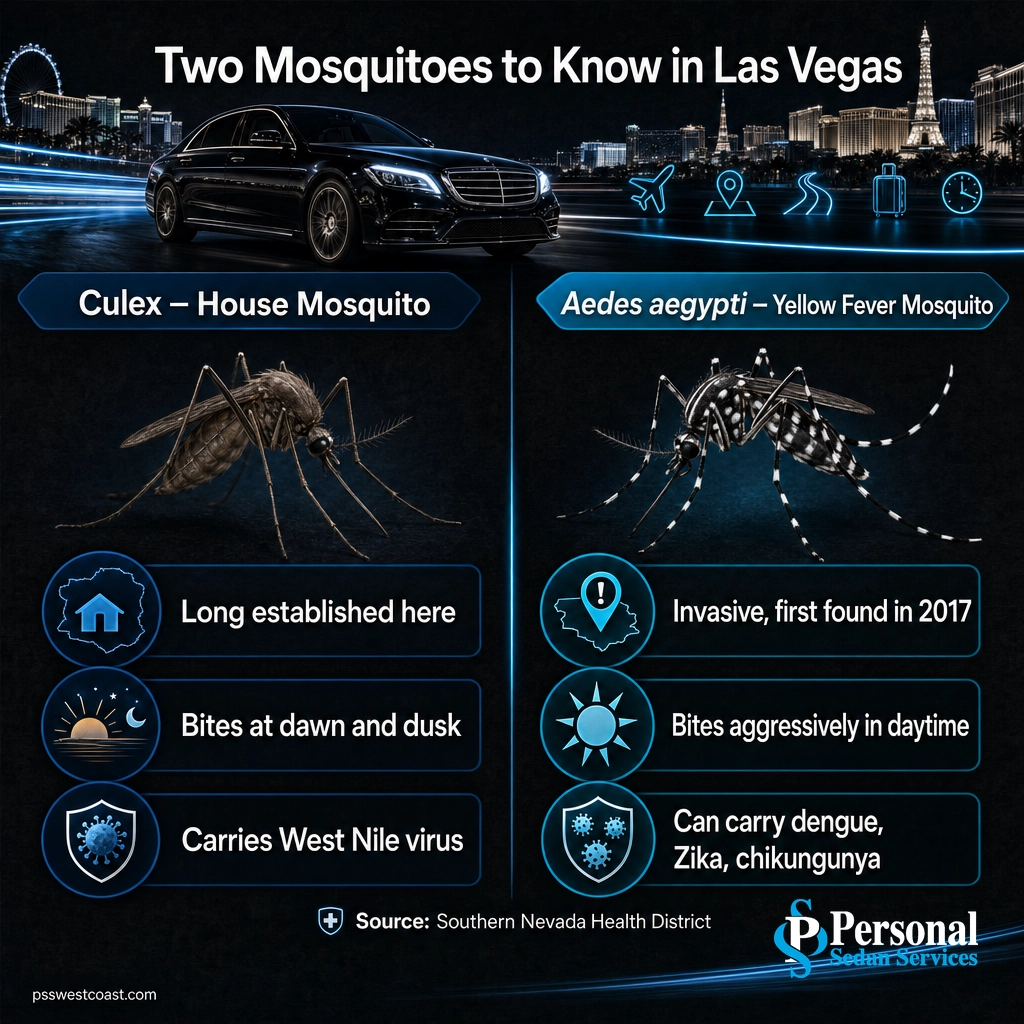
The long-established group is Culex, the common house mosquito. Culex mosquitoes bite mostly at dawn and dusk and are the main carriers of West Nile virus in the region. The newer arrival is Aedes aegypti, the yellow fever mosquito, an invasive, black-and-white-striped species first detected in Clark County in 2017. Unlike Culex, Aedes aegypti is an aggressive daytime biter that thrives in small containers of water around homes and yards, and it is the species public-health officials watch most closely.
| Culex (house mosquito) | Aedes aegypti (yellow fever mosquito) | |
|---|---|---|
| Status here | Long established | Invasive, first found in 2017 |
| When it bites | Dawn and dusk | Daytime, aggressively |
| Where it breeds | Washes, ponds, storm drains, stagnant pools | Small containers in yards and neighborhoods |
| Main concern | West Nile and St. Louis encephalitis viruses | Can carry dengue, Zika, chikungunya (no local spread to date) |
Genetic research published in the Journal of the American Mosquito Control Association traced the valley’s Aedes aegypti most likely to Southern California, with Interstate 15 traffic a probable route of introduction. Since then, local reporting has tracked its rapid spread, from a handful of ZIP codes in 2022 to dozens across the valley by 2023. The health district now treats it as the region’s top emerging mosquito-borne disease threat.
The “it’s too dry for mosquitoes here” myth. A lot of people assume the desert is mosquito-proof. It is not. Las Vegas has enough irrigation, decorative water, and seasonal rain to support breeding, and an invasive daytime biter has now established itself across the valley. The desert suppresses mosquito numbers, it does not eliminate them, so skipping repellent near water in summer is a mistake.
Source: Journal of the American Mosquito Control Association, origin of Aedes aegypti in Clark County | Las Vegas Review-Journal reporting on local mosquito spread
The Growing Mosquito Problem: What the Numbers Show
Local headlines in recent years have called the valley’s mosquitoes a growing problem, and the surveillance data backs that up, with one important caveat: the numbers swing a lot from year to year with the weather. The clearest signal is human West Nile virus cases reported by the Southern Nevada Health District.
Human West Nile Virus Cases in Clark County, by Year
Clark County reported zero human West Nile cases in 2021, 2022, and 2025 (preliminary). 2024’s 26 cases were the most since 2019. Source: Southern Nevada Health District.
In other words, 2024 was a bad mosquito year by local standards, the worst in half a decade, which is what drove the “ticking time bomb” news coverage. Then 2025 was quiet again, with zero human cases reported as of early November. That whiplash is normal for a desert: a wet, warm year produces far more breeding habitat than a dry one.
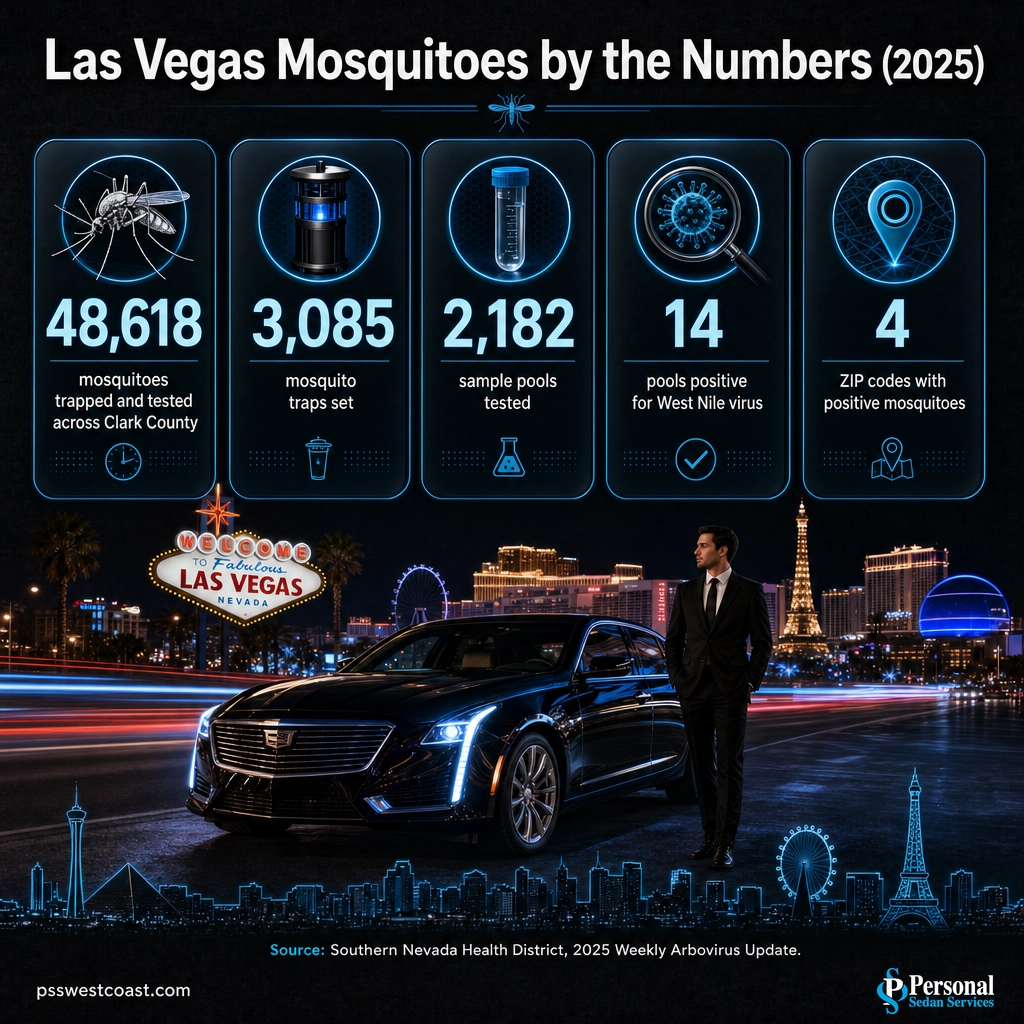
On the mosquito-testing side, the 2025 season tells the same measured story. The health district submitted 2,182 sample pools representing those 48,618 mosquitoes, and only 14 pools, about 0.6 percent, tested positive for West Nile virus, across four ZIP codes on the valley’s south and central east side. Testing is weighted toward Culex species because they are the ones that actually carry the virus.
Source: Southern Nevada Health District West Nile virus news release
West Nile Virus and Your Real Risk
West Nile virus is the one mosquito-borne illness that is actually transmitted locally in Las Vegas, so it deserves a clear-eyed look rather than either panic or dismissal. It is spread by the bite of an infected Culex mosquito, which picks up the virus from infected birds. It does not spread from person to person.
Here is the part that keeps the risk in perspective. According to the Centers for Disease Control and Prevention, most people who are infected never feel it at all. Only about one in five develop a fever and flu-like symptoms, and fewer than one in 150 develop the serious, sometimes life-threatening illness that affects the nervous system. Older adults and people with weakened immune systems are the most vulnerable to the severe form.
The practical message from both the CDC and the Southern Nevada Health District is the same: the single best protection is avoiding bites, because there is no vaccine for West Nile virus in humans. That is entirely within your control, and the next sections cover exactly how. The invasive Aedes aegypti raises a separate, longer-term concern because it can carry dengue, Zika, and chikungunya, but to date those illnesses in Clark County have all been travel-associated, picked up elsewhere, with no documented local transmission.
Source: CDC West Nile virus symptoms and risk | Southern Nevada Health District arbovirus guidance

When and Where Mosquitoes Are Worst
Mosquito risk in Las Vegas is highly seasonal and highly local. Get the timing and the geography right and you can cut your exposure to almost nothing.
When: The season runs roughly June through October, mirroring the CDC’s national mosquito season. The busiest stretch is the mid-to-late summer monsoon, when thunderstorms drop sudden rain that pools in low spots and the heat speeds up the breeding cycle. By late fall the first cool nights thin the population out fast, and winter in the valley is effectively mosquito-free.
Where: Follow the standing water. The highest-exposure spots are the valley’s natural and landscaped wet areas, where it pays to bring repellent on a summer visit:
- Clark County Wetlands Park and the Las Vegas Wash, the valley’s largest natural water corridor and its most predictable mosquito habitat.
- Lake Mead and the lower Colorado River shoreline, about 30 miles east, where still coves hold mosquitoes on warm evenings.
- Golf courses, resort lagoons, and neighborhood retention basins, especially at dusk.
- Residential yards with neglected pools or standing containers, the classic Aedes aegypti breeding ground.
By contrast, the Strip and downtown are low-risk. Casino fountains and the Venetian’s canals are chlorinated and constantly circulated, which does not give larvae the still water they need. Most hotel-based visitors who never venture out to a park or a lake go a full trip without a single bite, which is why reputable Las Vegas travel guides rightly tell tourists not to worry much about mosquitoes.
Source: CDC on mosquito season and habitat
How to Avoid Mosquito Bites in Las Vegas
Prevention here is straightforward, and it is mostly the same advice the Southern Nevada Health District gives residents through its Fight the Bite campaign. A few habits handle almost all of the risk.
- Use an EPA-registered repellent with DEET, picaridin, or oil of lemon eucalyptus when you are outdoors near water or in the evening. This is the single most effective step.
- Cover up at dawn and dusk, when Culex mosquitoes are most active. Light, loose long sleeves beat heavy clothing in the heat.
- Drain standing water weekly wherever you are staying, no matter how small the amount, from planter trays to buckets to a forgotten cooler lid. This is the number-one way to stop breeding at the source.
- Watch the daytime biter. Because Aedes aegypti bites during the day, repellent is not just an evening thing in neighborhoods where it is active.
- Report problems. Residents can report day-biting mosquitoes or stagnant green pools to the health district’s Mosquito Surveillance Program at (702) 759-1633.
For visitors, the realistic version is even simpler: pack a small bottle of repellent if you plan any outdoor time near water or any evening activities away from the Strip, and you are covered. You do not need to rearrange a trip or avoid the outdoors to dodge mosquitoes in Las Vegas.
Source: Southern Nevada Health District Fight the Bite guidance
Getting Around in Mosquito Season
This is where a local car service quietly earns its keep in summer. Mosquitoes bite hardest at dawn and dusk and congregate where people wait outdoors, which is exactly the situation you are in when you are standing at a curb in the evening heat waiting for a rideshare that may be minutes away and surging in price. A pre-booked, climate-controlled private vehicle means you step out of an air-conditioned lobby and straight into the car, with no open-air waiting during peak biting hours.
It matters most for the trips that take you toward the water and the outdoors, the very places mosquitoes love. If your plans include a sunrise hike, an evening at Lake Mead, a round of golf, or a day exploring the wetlands and desert parks, a private ride gets your whole group there and back without the exposure of waiting outside. Personal Sedan Services is Las Vegas’s top-rated luxury transportation, with a perfect 5.0 Google rating from more than 900 reviews, and our licensed, professional chauffeurs know the valley, the routes, and the timing in every season.
Book a ride to the parks, lakes, and attractions
For everyday travel during the busy summer stretch, a reliable local ride keeps you out of the evening heat and the mosquitoes that come with it. Heading to an early tee time? Our golf course transportation handles the dawn pickups so you are not waiting in the dark.
Explore our luxury transportation options
Frequently Asked Questions
Are there a lot of mosquitoes in Las Vegas?
When is mosquito season in Las Vegas?
Do Las Vegas mosquitoes carry disease?
Are there mosquitoes on the Las Vegas Strip?
How do I avoid mosquito bites in Las Vegas?
Related Las Vegas Travel Guides
- Does it snow in Las Vegas? – the other side of the desert’s weather, and where to find real snow nearby.
- Cost of living in Las Vegas – a real monthly budget breakdown for anyone thinking about moving.
- Best day trips from Las Vegas – the drives worth taking, including the lakes and parks near the valley.
- Best hikes near Las Vegas – where to go for morning trail time before the heat and the bugs pick up.
See our Las Vegas attractions transportation
Sources and Methodology
Mosquito surveillance figures, West Nile virus case counts, and species information come from the Southern Nevada Health District’s Mosquito Surveillance Program, including its 2025 Weekly Arbovirus Update (3,085 traps, 2,182 sample pools representing 48,618 mosquitoes, 14 West Nile-positive pools across four ZIP codes) and its reported human case totals (26 cases in 2024, 43 in 2019, 2 in 2023, and zero in 2021, 2022, and 2025 as of early November). West Nile virus symptom and risk statistics (about 8 in 10 infected people have no symptoms, about 1 in 5 develop fever, fewer than 1 in 150 develop severe illness) come from the U.S. Centers for Disease Control and Prevention. The 2017 first-detection and origin of the invasive Aedes aegypti come from a study in the Journal of the American Mosquito Control Association, and its local spread is drawn from Las Vegas Review-Journal reporting. Mosquito season timing follows CDC guidance. Figures are current as of the 2025 season and are preliminary where noted by the health district.
