


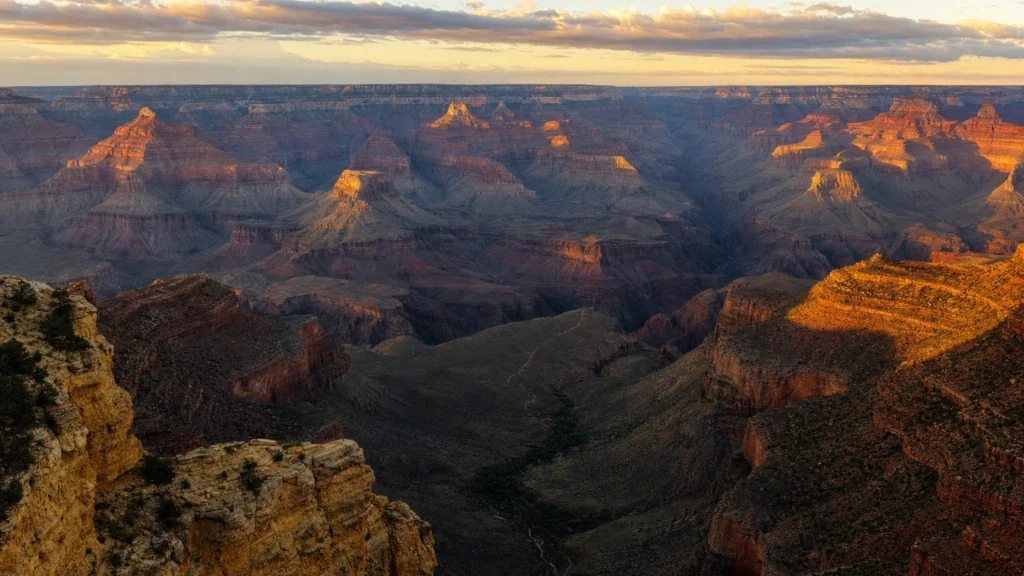
The best time to visit the Grand Canyon is spring (March through May) and fall (September through November), when rim temperatures are comfortable, the crowds thin out from their summer peak, and nearly everything is open. Summer brings the heaviest crowds and dangerous inner-canyon heat, with July averaging about 106°F on the canyon floor and monsoon thunderstorms rolling in most afternoons. Winter is quiet, snowy, and inexpensive, with the South Rim open every single day while the North Rim is closed. This month-by-month guide breaks down the real weather, the crowd patterns, the narrow North Rim season, and exactly how to time a Grand Canyon trip from Las Vegas, where the closest rim is only about two and a half hours away.
- Best overall months: September, May, and October deliver the sweet spot of mild rim weather, manageable crowds, and full access.
- Busiest month: July, at roughly 531,000 recreation visits, according to National Park Service data.
- Quietest month: January, at about 169,000 visits, or under a third of July’s traffic.
- Hottest reading: the inner canyon (Phantom Ranch) averages 106°F in July, while the South Rim averages 84°F at the same time.
- Monsoon window: July through early September brings afternoon lightning, downpours, and flash-flood risk.
- North Rim season: roughly May 15 to mid-October; for 2026 it reopened May 15 as day-use only, with no overnight lodging inside the park.
- South Rim access: open 24 hours a day, 365 days a year, so winter viewing is always possible.
- From Las Vegas: Grand Canyon West is about 125 miles (2 to 2.5 hours); the South Rim is about 280 miles (4.5 hours).
- Entrance fee: 35 dollars per vehicle for seven days at the national park; Grand Canyon West is priced separately by the Hualapai Tribe.
What’s in This Guide
- The Best Time to Visit, in Short
- How Grand Canyon Weather Really Works
- Best Time of Day: Sunrise, Sunset & Golden Hour
Month by month, season by season:
- Spring: March, April, May
- Summer: June, July, August
- Fall: September, October, November
- Winter: December, January, February
Plan the trip:
The Best Time to Visit the Grand Canyon, in Short
If you want one answer, here it is: aim for the shoulder seasons. Late spring (April and May) and early fall (September and October) hand you the widest gap between comfort and crowds. Daytime temperatures on the South Rim sit in the 60s and 70s, the light is gentle at sunrise and sunset, and the wall-to-wall summer traffic has either not arrived yet or has already started to fade. Rangers, guides, and seasoned canyon travelers tend to name the same handful of months, and the data backs them up.
The Grand Canyon is not a quiet park. In 2024 it recorded roughly 4.92 million recreation visits and ranked as the third most-visited national park in the country, behind Great Smoky Mountains and Zion. What makes it unusual is how spread out that traffic is. Because the South Rim never closes, visitation stays high across the entire warm half of the year rather than spiking for a few weeks. Every month from April through October runs above 80 percent of the July peak, so “off-season” at the Grand Canyon really means late fall and winter.
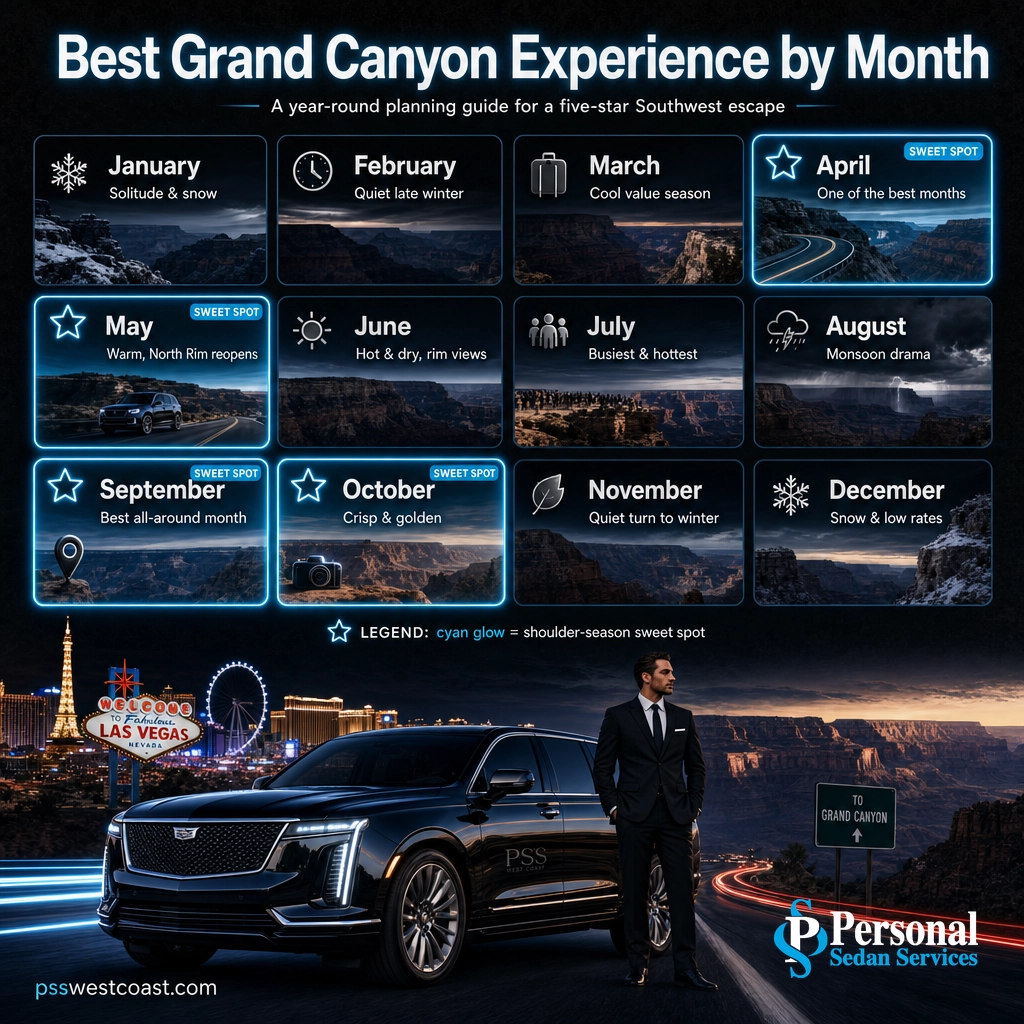
That gives you two honest strategies. If you want the friendliest weather, target the shoulder months and accept moderate crowds. If you want solitude and you do not mind the cold, winter is a genuinely spectacular and underrated time, with snow dusting the red rock and viewpoints you can have nearly to yourself. Both are good trips. They are just different trips.
Concierge tip: “Best time” depends on your priority. Chasing mild weather? Go May, September, or October. Chasing empty overlooks and the lowest lodging rates? Go December through February. Traveling from Las Vegas and want the easiest drive? The cool months from October to April keep the desert route pleasant and the rim comfortable.
Source: National Park Service visitation data | Grand Canyon operating hours
How Grand Canyon Weather Really Works (Three Rims, One Big Elevation Swing)
The single most important thing to understand about Grand Canyon weather is that it is not one climate. It is three, stacked vertically. The South Rim sits at about 7,000 feet. The North Rim is higher still, near 8,200 feet. The Colorado River at the bottom, near Phantom Ranch, is only about 2,480 feet. That vertical drop of nearly a mile creates temperature differences of 20 to 25 degrees between the rim and the river on any given day.
The practical result: a pleasant 70-degree afternoon on the South Rim can be a brutal 90-plus degrees on the canyon floor. Hikers routinely underestimate this. You descend in cool morning air, feeling great, then climb back out in the afternoon into heat that has built the whole time you were down there. That is the mechanism behind most summer heat emergencies in the park.
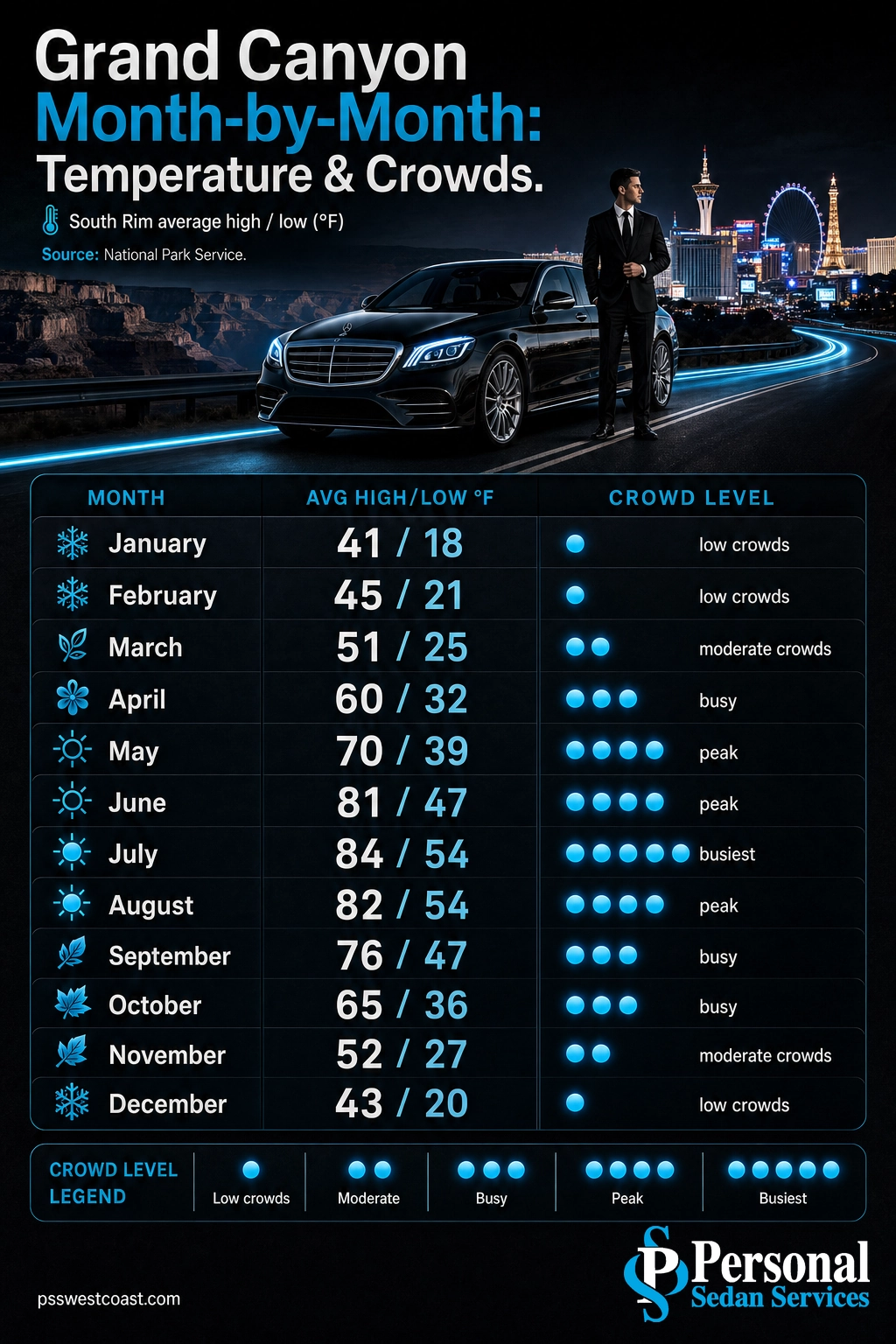
Here is the full year on the South Rim, along with the inner-canyon highs at Phantom Ranch so you can see the swing for yourself. These are National Park Service climate averages.
| Month | South Rim High | South Rim Low | Inner Canyon High (Phantom Ranch) |
|---|---|---|---|
| January | 41°F | 18°F | 56°F |
| February | 45°F | 21°F | 62°F |
| March | 51°F | 25°F | 71°F |
| April | 60°F | 32°F | 82°F |
| May | 70°F | 39°F | 92°F |
| June | 81°F | 47°F | 101°F |
| July | 84°F | 54°F | 106°F |
| August | 82°F | 54°F | 103°F |
| September | 76°F | 47°F | 97°F |
| October | 65°F | 36°F | 84°F |
| November | 52°F | 27°F | 68°F |
| December | 43°F | 20°F | 57°F |
The July column tells the whole story of why summer inner-canyon hiking is risky. Look at the gap on a single midsummer day between the rim you start on and the floor you are climbing back out of.
Average July High by Location (°F)
Source: National Park Service Grand Canyon climate data. The rim is comfortable in July; the canyon floor is not.
The heat myth that gets people hurt: “It felt fine on the rim, so the hike will be fine.” It will not. The inner canyon can run 20 or more degrees hotter than the rim, there is little shade, and the hardest part of any canyon hike (the climb out) happens in the afternoon when the floor is at its hottest. In summer, the National Park Service urges visitors not to hike below the rim between 10 a.m. and 4 p.m. Save inner-canyon hiking for the cooler months, start before dawn, or stay on the rim.
Source: National Park Service, Grand Canyon weather and climate
Best Time of Day: Sunrise, Sunset, and Golden Hour at the Grand Canyon
Timing a Grand Canyon trip is not only about the month. The hour you stand at the rim changes the experience just as much. The canyon is a mile-deep landscape of buttes, temples, and side canyons, and it comes alive when the sun is low. Midday, with the sun directly overhead, the canyon flattens out: shadows disappear, the reds and oranges wash to a hazy tan, and the depth that makes the view so overwhelming is hard to read. At sunrise and sunset, low-angle light rakes across those formations, throwing long shadows that reveal the three-dimensional shape of the canyon and igniting the rock in deep red and gold.
So the single best time of day to see the Grand Canyon is the golden hour, the roughly 60 minutes after sunrise and before sunset. These are also the coolest and least crowded hours, which matters enormously in summer. In July and August, being on the rim for sunrise means comfortable temperatures and soft light before the heat and the tour-bus traffic build. In winter, the low sun means the golden light lasts much of the short day.
Sunrise and sunset times swing widely across the year, and that affects how you plan a day. In midsummer, sunrise at the canyon comes very early (around 5:15 a.m. in late June) and sunset stays late (near 7:45 p.m.), giving long days but demanding an early alarm for that dawn light. In midwinter, sunrise is much later (around 7:30 a.m. in December and January) and sunset is early (near 5:20 p.m.), so the whole day is compressed but the golden light is easy to catch without a pre-dawn start. Always check the exact times for your travel dates, since they shift week to week.
Where you stand matters too. On the South Rim, east-facing viewpoints such as Mather Point, Yaki Point, and the Desert View Watchtower are classic sunrise spots, while west-facing overlooks like Hopi Point, Pima Point, and Yavapai Point are favorites for sunset. Because the canyon is so wide, most rim viewpoints deliver a strong sunrise and sunset, so you rarely need to fight for a single “perfect” spot. Arrive 20 to 30 minutes early, dress warmer than you expect (the rim is cold before dawn and after dusk in every season), and give yourself time to watch the light change rather than snapping one photo and leaving.
Dark-sky bonus: Grand Canyon National Park is a certified International Dark Sky Park. If you stay for full darkness after sunset, especially on a clear, moonless winter night when the sky darkens early, the stargazing is exceptional. Pairing a sunset visit with an hour of stargazing turns a single evening at the rim into two experiences.
The practical planning takeaway: no matter which month you choose, build your day around sunrise or sunset rather than midday. If you are coming from Las Vegas, that usually means either an early departure to catch morning light or timing the return drive after sunset, which is one more reason many visitors prefer to let someone else handle the road.
Source: National Park Service, Grand Canyon sunrise and sunset viewpoints
Spring at the Grand Canyon: March, April, May
Spring is when the park wakes up. The deep-winter cold breaks, the days lengthen, and by May the South Rim is genuinely warm and every rim trail is comfortable. Spring is also when crowds ramp fast, climbing from the moderate traffic of March to full peak-season levels by May, so the earlier in spring you go, the more room you will have.
March: Cool, Quiet, and Shoulder-Season Value
March is a transition month. South Rim highs average around 51°F with lows near 25°F, so mornings are cold and afternoons are crisp. Snow is still possible at rim elevation, and some inner-canyon trails can be icy near the top. What you get in exchange is space: March averages about 358,000 visits, well below the May-through-August peak, and lodging is easier to book. The North Rim is still closed. March suits travelers who prioritize quiet and value over warmth.
April: One of the Best Months of the Year
April is widely considered one of the best times to visit, and for good reason. South Rim highs climb to around 60°F with lows near 32°F, the weather is more stable than in winter, and conditions are favorable for both rim walking and inner-canyon routes (the floor averages a manageable 82°F). Wildflowers begin along the rim. The tradeoff is that crowds arrive in force, with April already running near peak visitation. Go early in the month or midweek to soften it.
May: Warm Days, Full Access, Peak Crowds Begin
May is the sweet spot for warmth without brutal heat. South Rim highs reach about 70°F, the inner canyon is warm but not yet dangerous at around 92°F, and, critically, this is when the North Rim reopens (May 15 in 2026), unlocking the whole park. May is also when visitation hits its stride at roughly 506,000, so you are trading solitude for near-perfect conditions. If you want mild weather and you can tolerate company at the overlooks, May is hard to beat.
Source: National Park Service climate data | Grand Canyon North Rim
Plan a Grand Canyon day with our Las Vegas attractions car service
Summer at the Grand Canyon: June, July, August
Summer is the most popular time to visit and, for inner-canyon travel, the most dangerous. The rim stays tolerable, but the canyon floor becomes an oven, afternoon monsoon storms arrive in July, and the park is at its most crowded. Summer is a fine time to see the Grand Canyon from the rim. It is a poor time to hike deep into it unprepared.
June: Hot, Dry, and Crowded
June is the driest of the summer months and the start of serious heat. South Rim highs hit about 81°F, but the inner canyon averages 101°F, so below-rim hiking already demands a pre-dawn start and real water discipline. Skies are usually clear and blue, which makes June a strong month for rim photography and long-distance views. Crowds are heavy at roughly 501,000 visits. Come for the rim; respect the heat below it.
July: The Hottest and Busiest Month
July is the peak of everything: peak heat, peak crowds, and the arrival of the monsoon. The South Rim averages 84°F, the inner canyon averages 106°F, and July is the single busiest month of the year at about 531,000 visits. It is also the wettest stretch of summer, with dramatic afternoon thunderstorms. If July is your only option, plan rim activities for the morning, carry more water than you think you need, and keep an eye on the sky.
August: Monsoon Peak and Dramatic Skies
August stays hot (South Rim 82°F, inner canyon 103°F) and is often the rainiest month of all as the monsoon peaks. Those storms are a double-edged sword: they bring the risk of lightning and flash floods, but they also produce the most dramatic light, rainbows, and cloud-filled canyon views of the year. Crowds ease slightly from July to about 477,000. For photographers who respect the weather, a stormy August afternoon on the rim can be unforgettable.
Monsoon season is real, and it is not just rain. From July through early September, the National Park Service warns of torrential rains, frequent lightning, and sudden flash floods. Storms usually build in the afternoon. Stay off exposed points and promontories when lightning threatens, never enter a slot canyon or dry wash with rain in the forecast, and treat afternoon thunderheads as a signal to head back to the rim.
Source: National Park Service, monsoon and weather safety

Crowds by Month: When the Canyon Is Packed and When It Empties Out
Weather is only half of timing a Grand Canyon trip. The other half is crowds, and the pattern here is unusual. Because the South Rim operates year-round, the Grand Canyon has a flatter visitation curve than most national parks. The busiest month is only about three times the quietest, which means even the “quiet” months still see plenty of visitors, and the peak months are busy but rarely gridlocked at the scale you might fear.
Here is how a typical year breaks down, using National Park Service visitation averages. July leads, the warm months from April through August cluster near the top, and the true lull comes from November into February.
Average Monthly Recreation Visits (representative months)
Source: National Park Service visitation averages. July is the busiest month; January is the quietest.
The takeaway for planning: if you want to feel like you have the place to yourself, aim for December, January, or February. If you want the shoulder-season blend of decent weather and lighter traffic, March and November are your friends. And if you are locked into summer, go early in the day, since tour buses and day-trippers tend to arrive mid-morning and thin out by late afternoon.
Source: National Park Service, Grand Canyon visitation statistics
The North Rim Season: The Narrow Window Most Visitors Miss
About 90 percent of Grand Canyon visitors go to the South Rim, and one big reason is access. The North Rim, higher and greener at 8,200 feet, is only open for part of the year. Heavy snow closes State Route 67 and shutters North Rim facilities for roughly half the calendar. The standard season runs from May 15 through mid-October, after which the road and services close for winter even though the rim itself remains (inaccessibly) there.
If you are drawn to the North Rim’s cooler temperatures, quieter overlooks, and different perspective on the canyon, you have to time it to that window. Go too early in May or too late in October and you may find the road gated. And there is an important wrinkle for the current season.
2026 North Rim status: The North Rim reopened to day-use visitors at 6 a.m. on May 15, 2026, but overnight lodging is not available inside the park for the 2026 season following damage from the 2025 wildfire. Paved roads (Highway 67, Cape Royal, and Point Imperial) reopened, and the North Kaibab Trail reopened for foot traffic, but anyone planning a North Rim visit in 2026 should treat it as a day trip or arrange lodging outside the park at places like Jacob Lake. Always confirm the current status with the National Park Service before you go, because conditions and dates can change.
For most travelers, and for nearly everyone coming from Las Vegas, the North Rim is not the practical choice. It is the farthest rim from the city and the shortest in season. But if you value solitude above all and you can hit the summer-to-early-fall window, it rewards the effort.
Source: National Park Service, 2026 North Rim season access | Status of the North Rim
South Rim vs. West Rim: Which Grand Canyon Should You Visit from Las Vegas?
Here is the piece most month-by-month guides skip, and it matters enormously if you are starting in Las Vegas: the “Grand Canyon” is not a single destination. The three rims are hours apart, and the one nearest Las Vegas is not even part of the national park. Choosing the right rim for your time and season is as important as choosing the right month.
Grand Canyon West, home of the glass Skywalk, sits on Hualapai tribal land and is the closest rim to Las Vegas by a wide margin. The South Rim of the national park is the iconic, classic Grand Canyon, but it is a much longer drive. Here is how they compare for a trip that starts on the Strip. If you want the exact numbers, we break down how far the Grand Canyon is from Las Vegas in a dedicated guide.
| Feature | Grand Canyon West (Skywalk) | South Rim (National Park) | North Rim (National Park) |
|---|---|---|---|
| Distance from Las Vegas | ~125 miles | ~280 miles | ~265 miles (much longer by road) |
| Drive time | 2 to 2.5 hours | ~4.5 hours | ~4.5 to 5 hours |
| Realistic as a day trip? | Yes, easily | Yes, but a long day | No, best as overnight |
| Managed by | Hualapai Tribe | National Park Service | National Park Service |
| Admission | Hualapai packages (separate) | 35 dollars per vehicle, 7 days | Same national park fee |
| Open year-round? | Yes | Yes (24/7/365) | No (approx. May 15 to mid-Oct) |
| Signature draw | Skywalk, closest views to Vegas | Classic vistas, village, trails | Solitude, cooler forested rim |
| Best for | Short trips, first-timers on a schedule | The full, iconic experience | Repeat visitors chasing quiet |
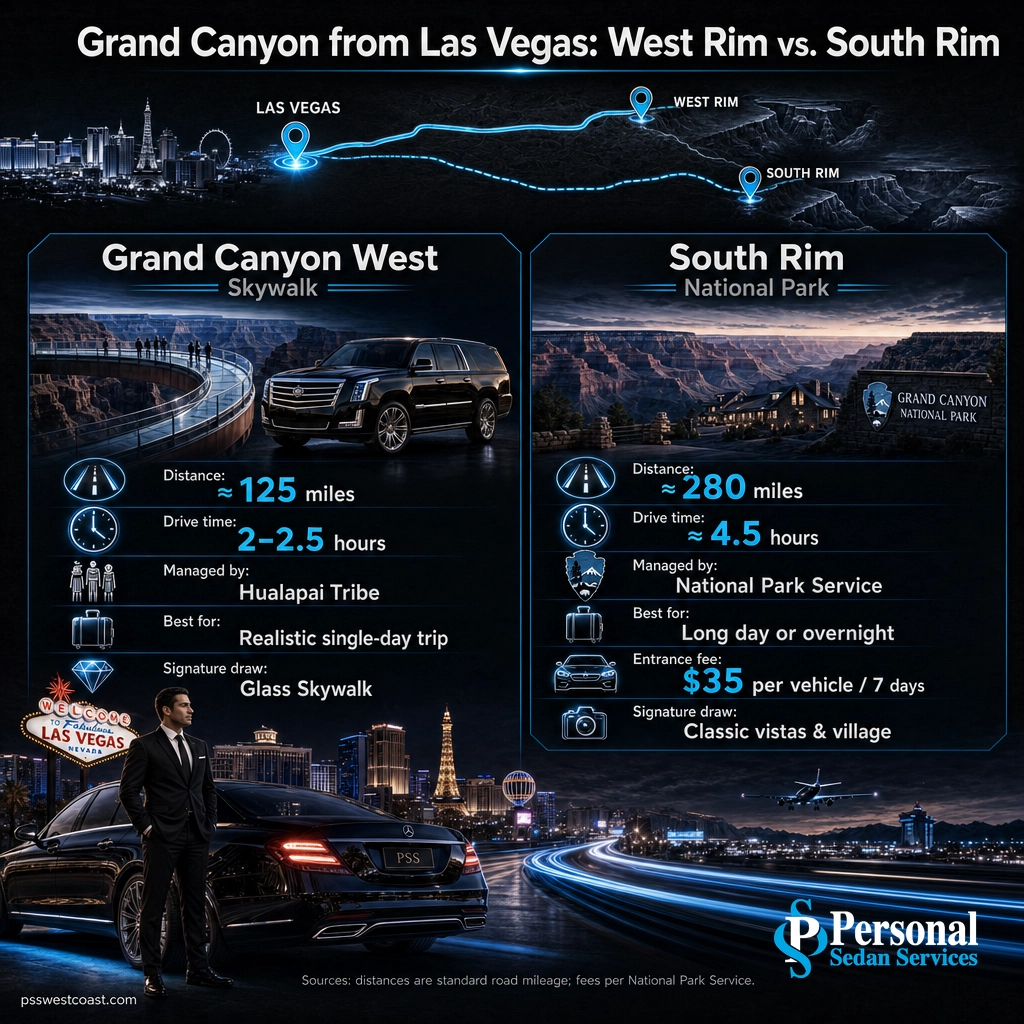
The route from Las Vegas to Grand Canyon West runs southeast past the Hoover Dam and into the Arizona desert. If you are building a bigger day, the dam is a natural stop, and we cover the drive to the Hoover Dam as well. Here is the West Rim route at a glance.
For most Las Vegas visitors, the decision comes down to time. If you have a single day and want to stand at the edge, Grand Canyon West is the efficient choice. If you have a full long day or an overnight and want the postcard Grand Canyon, the South Rim is worth the extra drive. Either way, the seasonal advice in this guide applies: the desert route and the rim are far more pleasant from October through April, and summer means both heat and monsoon risk on the road. For a fully guided option, see our overview of Grand Canyon tours from Las Vegas.
Book group transportation to the Grand Canyon
Source: National Park Service, Grand Canyon fees
Best Time to Visit the Grand Canyon by Activity
The “best” month also depends on what you actually want to do. Rim-viewing is comfortable most of the year; serious inner-canyon hiking has a much narrower safe window; and rafting and mule trips have their own calendars. Match the month to the activity.
| What you want to do | Best months | Why |
|---|---|---|
| Rim viewing and sightseeing | April, May, September, October | Mild rim temperatures and long, clear days without deep-summer heat. |
| Hiking below the rim | April, May, September, October | The inner canyon is survivable; midsummer floor temperatures over 100°F make deep hikes dangerous. |
| Colorado River rafting | May through September | The commercial rafting season; warm days and manageable river conditions. |
| Mule rides | Spring and fall | Comfortable for both riders and animals; book months ahead as spots are limited. |
| Photography | Late summer and winter | Monsoon storms bring dramatic light; winter snow on red rock is striking and uncrowded. |
| Stargazing | Year-round, best on clear winter nights | Certified Dark Sky park; crisp winter air and early sunsets mean more dark-sky time. |
| Avoiding crowds | December, January, February | Visitation drops to roughly a third of the summer peak. |
Notice how many rows point to the same shoulder-season answer. Spring and fall are not just the most comfortable time to be on the rim; they are also the safest window for going below it. That overlap is the core reason those months top almost every “best time” recommendation.
Source: National Park Service, Grand Canyon hiking safety
Fall at the Grand Canyon: September, October, November
Fall is, for many people, the best season of all. The summer heat breaks, the monsoon fades, crowds thin from their peak, and the light turns golden. If you want one season that balances everything, this is it.
September: The Best All-Around Month
September is arguably the finest month to visit. South Rim highs settle around 76°F, the inner canyon cools to a still-warm but far safer 97°F, the monsoon is winding down, and visitation eases to about 429,000 from the summer crush. Kids are back in school, so midweek days in particular feel calmer. If you can only pick one month sight unseen, pick September.
October: Crisp, Golden, and Comfortable
October keeps the good conditions going. South Rim highs drop to a crisp 65°F with cool 36°F mornings, the inner canyon returns to a comfortable 84°F, and the light is superb. This is the tail end of the North Rim season (it typically closes mid-month), so an early-October trip can still catch both rims. Crowds are moderate. October is a photographer’s and hiker’s month.
November: The Quiet Turn Toward Winter
November is when the park exhales. South Rim highs fall to about 52°F with lows near 27°F, snow becomes possible, and visitation drops to roughly 327,000. The North Rim is closed. What you get is a quiet, moody, shoulder-season canyon with real elbow room at the overlooks and easier lodging. Bring layers and you will have a beautiful, uncrowded trip.
Source: National Park Service climate data
Winter at the Grand Canyon: December, January, February
Winter is the Grand Canyon’s best-kept secret. Yes, it is cold, and yes, the North Rim is closed. But the South Rim stays open every single day, snow on the red-and-white canyon walls is genuinely breathtaking, crowds all but vanish, and lodging is at its cheapest. For travelers who dress for it, winter delivers the most peaceful version of the park.
December: Snow, Solitude, and Low Rates
December brings South Rim highs around 43°F and lows near 20°F, with real potential for snow at rim elevation. Visitation falls to about 298,000, and holiday weeks aside, the overlooks are quiet. Roads can close briefly during storms and some services run reduced hours, but the classic viewpoints stay open. A dusting of snow on the canyon is one of the great sights in the American Southwest.
January: The Quietest Month of the Year
January is the calmest month on the calendar, with roughly 169,000 visits, under a third of July’s traffic. South Rim highs average 41°F with cold 18°F mornings. Trails near the rim can be icy, so traction devices are smart. In exchange, you get crystal-clear winter air, the longest dark-sky nights of the year, and viewpoints you may have entirely to yourself. For solitude seekers, nothing else comes close.
February: Late Winter, Still Peaceful
February eases slightly, with South Rim highs near 45°F and lows around 21°F, and visitation still low at about 181,000. Snow is common, but days begin to lengthen and the harshest cold starts to loosen. Late February can be a wonderful time to catch the quiet of winter with a hint of the spring thaw coming. The North Rim remains closed until May.
Winter driving reality check: at 7,000 feet, the South Rim gets snow and ice, and the desert approach can hit winter storms. Roads occasionally close during and after storms, and some park roads require or recommend tire chains. If you are driving yourself in winter, check road conditions before you leave and carry chains. If you would rather not manage icy mountain roads, a professional chauffeured trip removes that variable entirely.
Source: National Park Service, seasonal hours and conditions
Book your chauffeured Grand Canyon trip
Visiting the Grand Canyon from Las Vegas, Season by Season
Las Vegas is the most popular launch point for a Grand Canyon trip, and Personal Sedan Services runs these routes constantly, so here is the season-by-season reality of doing it from the Strip. The month you choose changes not just the canyon experience but the drive itself.
Spring and fall (March to May, September to November): the ideal windows. The desert route is comfortable, the rim is mild, and the roads are dry. This is the easiest time to plan a smooth day trip or overnight, whether you are heading to the closer West Rim or committing to the South Rim.
Summer (June to August): plan around the heat and the monsoon. The drive across the Mojave and into Arizona runs well over 100°F, and afternoon monsoon storms from July into early September can bring downpours and even flash flooding on desert roads. Leave early, keep the day’s outdoor time to the morning, and treat afternoon thunderheads as your cue to head back. A comfortable, air-conditioned vehicle with a professional driver takes a lot of the misery and risk out of a peak-summer canyon run.
Winter (December to February): gorgeous but weather-dependent. The canyon is stunning under snow and blissfully empty, but the higher-elevation approach to the South Rim can ice over, and storms occasionally close roads. This is the season where handing the driving to someone who knows the routes pays off most.
Because a Grand Canyon trip from Las Vegas is a real distance (well documented in our guide to the best day trips from Las Vegas), the vehicle matters. For couples, a sedan is perfect. For families and groups, an SUV like the Cadillac Escalade or a Mercedes Sprinter keeps everyone together and comfortable for the long desert miles. And if your Grand Canyon day is one piece of a bigger Las Vegas itinerary, our team can handle the whole schedule end to end.
Let a destination manager handle the logistics
Why chauffeured beats self-driving for this trip: the Grand Canyon from Las Vegas is a multi-hour desert drive each way. A professional chauffeur means no fatigue on the return leg after a full day on your feet, no worrying about summer heat or winter ice on unfamiliar roads, and no rideshare uncertainty for a route most drivers will not take. You watch the scenery; we handle the road. Personal Sedan Services holds a perfect 5.0 Google rating from more than 900 reviews.
What to Do Next: Your Grand Canyon Planning Roadmap
Turn the timing advice above into an actual plan. Here is a simple, priority-ordered roadmap from decision to departure.
| Action | Priority | Timeline | Relevant Service |
|---|---|---|---|
| Pick your month using the weather and crowd data above | High | First | This guide |
| Choose your rim (West Rim for a short day, South Rim for the full experience) | High | Same day | Grand Canyon tours from Las Vegas |
| Reserve lodging, mule rides, or rafting if your dates depend on them | High | 2 to 6 months out | Destination management |
| Book your round-trip transportation from Las Vegas | High | 2 to 6 weeks out | Las Vegas attractions car service |
| Confirm North Rim status if that is your target (seasonal) | Medium | 2 weeks out | National Park Service |
| Check road and weather conditions, especially in summer and winter | Medium | Day before | Chauffeur services |
| Pack layers, water, and sun protection for the elevation and heat swing | Medium | Day before | This guide |
Explore luxury transportation options
Related Resources
Keep planning your Grand Canyon trip and the rest of your Las Vegas visit with these guides and official sources.
- How far is the Grand Canyon from Las Vegas?
- Grand Canyon tours from Las Vegas
- How far is the Hoover Dam from Las Vegas?
- The best day trips from Las Vegas
Official planning sources:
The Grand Canyon Month-by-Month: Complete Summary Table
One master reference for the whole year. Use it to match your priorities (weather, crowds, or access) to the right time. Temperatures are National Park Service South Rim averages; crowd levels reflect National Park Service visitation.
| Period | South Rim High / Low | Crowds | Grand Canyon Verdict |
|---|---|---|---|
| January | 41°F / 18°F | Quietest | Cold, snowy, and empty; the solitude month. |
| February | 45°F / 21°F | Very low | Still peaceful; late-winter snow, low rates. |
| March | 51°F / 25°F | Moderate | Cool shoulder-season value; North Rim closed. |
| April | 60°F / 32°F | Busy | One of the best months; mild and stable. |
| May | 70°F / 39°F | Peak | Warm, full access, North Rim reopens. |
| June | 81°F / 47°F | Peak | Hot and dry; great rim views, harsh below. |
| July | 84°F / 54°F | Busiest | Peak heat, peak crowds, monsoon begins. |
| August | 82°F / 54°F | Peak | Monsoon peak; dramatic skies, flash-flood risk. |
| September | 76°F / 47°F | Busy | The best all-around month; mild and easing. |
| October | 65°F / 36°F | Busy | Crisp and golden; North Rim closes mid-month. |
| November | 52°F / 27°F | Moderate | Quiet turn to winter; layers needed. |
| December | 43°F / 20°F | Low | Snow, solitude, and the lowest lodging rates. |
| North Rim season | ~10°F cooler than South Rim | Light | Approx. May 15 to mid-October only. |
| Monsoon window | Summer | N/A | July to early September; lightning and flash floods. |
| Peak visitation | July | ~531,000 | The single busiest month of the year. |
| Lowest visitation | January | ~169,000 | Under a third of July’s traffic. |
| Best rim hiking | Apr to May, Sep to Oct | Busy | Safe inner-canyon temperatures and mild rim days. |
| Best river rafting | May to September | N/A | The commercial Colorado River season. |
| Best value lodging | Dec to Feb | Low | Lowest rates and easiest availability. |
| Best from Las Vegas | Oct to Apr | Varies | Cool drive, comfortable rim, no monsoon. |
Frequently Asked Questions
What is the best overall month to visit the Grand Canyon?
What is the hottest month at the Grand Canyon?
When is the Grand Canyon least crowded?
Is the North Rim of the Grand Canyon open all year?
When is monsoon season at the Grand Canyon?
Is the South Rim open in winter?
What is the best time to visit the Grand Canyon from Las Vegas?
How much is the Grand Canyon entrance fee?
Do I need reservations to visit the Grand Canyon?
Methodology & Sources
How we built this guide
Temperature figures are National Park Service climate averages for the South Rim (about 7,000 feet), the North Rim (about 8,200 feet), and the inner canyon at Phantom Ranch (about 2,480 feet). Monthly visitation figures are National Park Service recreation-visit averages. North Rim season dates and the 2026 access details come directly from National Park Service news releases and the North Rim status page. Entrance fees and operating hours reflect current National Park Service information. Distances and drive times from Las Vegas are standard road-mileage figures for Grand Canyon West and the South Rim. Because seasonal dates, road conditions, and North Rim access can change, always confirm current conditions with the National Park Service before you travel.
Primary sources:
- National Park Service, Grand Canyon Weather and Climate
- National Park Service, Grand Canyon Visitation Statistics
- National Park Service, 2026 North Rim Summer Season Access
- National Park Service, Status of the North Rim
- National Park Service, Operating Hours and Seasons
- National Park Service, Grand Canyon Fees and Passes
Last Updated: August 2026