



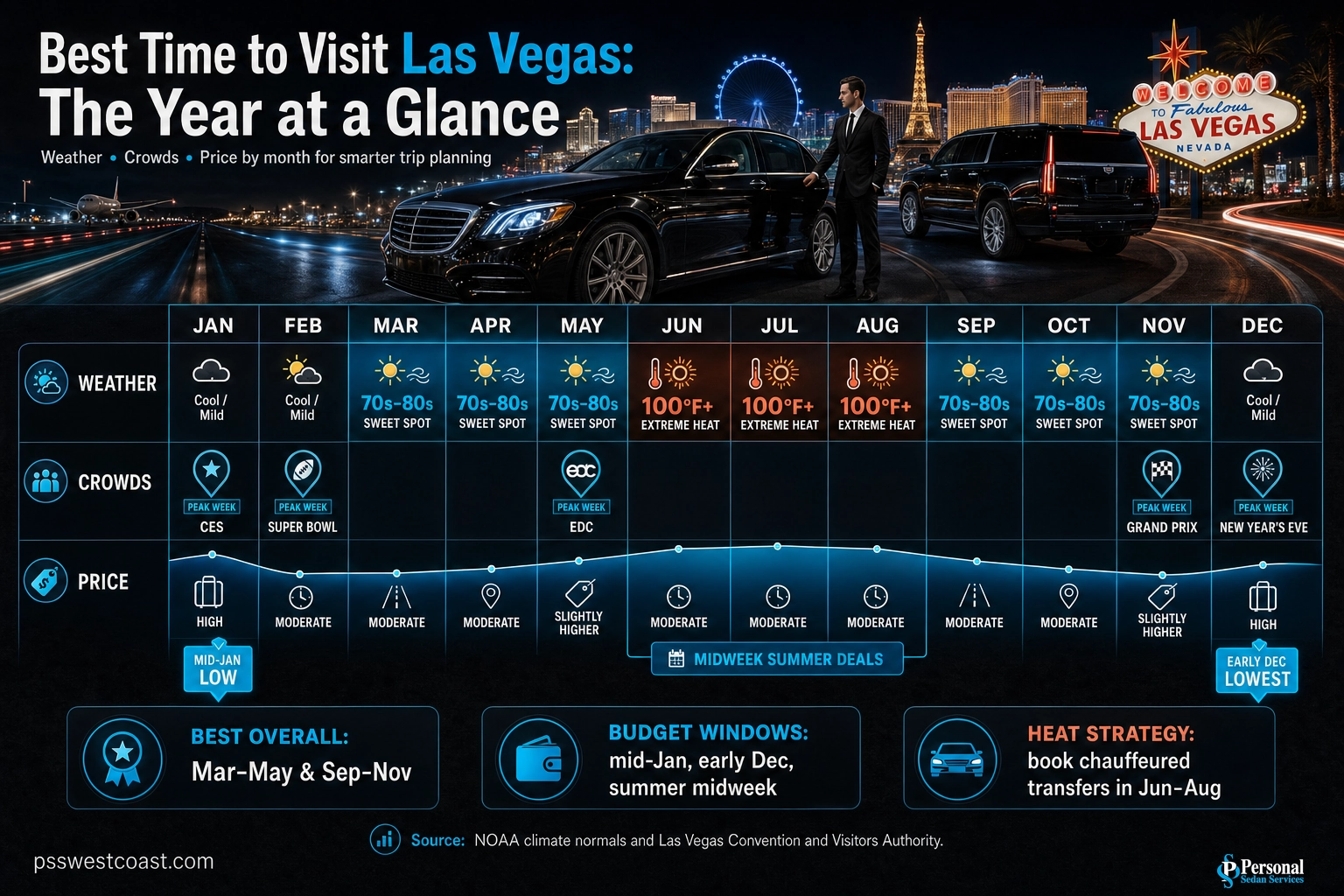
The best time to visit Las Vegas is mid-March through May and mid-September through November, when daytime highs settle into the comfortable 70s and 80s, pools are open, and hotel rates land between the winter holiday peaks and the deep summer bargains. That is the short answer. The real answer depends on why you are coming: the cheapest week, the biggest event, the best pool weather, and the calmest crowds all fall in different months. This month-by-month guide breaks down Las Vegas weather, crowd levels, hotel prices, and the marquee events for all twelve months, using real data from NOAA and the Las Vegas Convention and Visitors Authority, so you can pick the window that fits your trip.
- Best overall weather: mid-March to May and mid-September to November, with highs in the 70s and 80s.
- Cheapest windows: the deep summer heat (July and August) and quiet winter weeks (early December, mid-January), plus any midweek stay.
- Busiest dates: New Year’s Eve, National Finals Rodeo (December), CES (January), the Las Vegas Grand Prix (November), and EDC (May).
- Hottest months: July normally hits 105°F and August 103°F, with overnight lows still in the low 80s.
- Pool season: roughly late April through September for the full dayclub scene.
- Steady crowds: Las Vegas drew about 41.7 million visitors in 2024, and monthly volume rarely dips below 3.3 million, so the city is never truly quiet.
- Rain is rare: just 4.18 inches fall in an average year, with February the wettest month and a short monsoon in July and August.
- Getting around matters more in peak weeks: event-week traffic and summer heat make pre-booked, air-conditioned transport the difference between a smooth trip and a stressful one.
What’s in This Guide
- The Short Answer: The Best Time to Visit
- Las Vegas Weather Month by Month
- Best Time for Good Weather: Spring and Fall
- Cheapest Time to Visit Las Vegas
- When Las Vegas Is Busiest: Crowds and Big Events
- Best Time for Pool Season and Summer Trips
- Best Time for the Lowest Crowds
- The Month-by-Month Breakdown
- Getting Around Las Vegas Whatever Month You Visit
- What to Do Next: Trip-Planning Roadmap
- Related Resources
- The Best Time to Visit, at a Glance
- Frequently Asked Questions
- Methodology and Sources
The Short Answer: The Best Time to Visit Las Vegas
If you want one recommendation with no caveats, come to Las Vegas between mid-March and May, or between mid-September and November. These two shoulder seasons are the sweet spot: the desert has warmed up or cooled down enough that you can walk the Strip comfortably, sit at a pool, and eat dinner outdoors, without fighting the 105-degree afternoons of July or the 40-degree nights of December. Hotel rates in the shoulder months sit below the winter event peaks and only a little above the deep-summer bargains, so you get good weather without paying the top of the market.
The catch is that “best” is not the same for every traveler. A visitor chasing the cheapest possible room will happily trade comfort for a July bargain. A pool-and-dayclub crowd wants the very heat that others avoid. A couple planning an outdoor wedding cares about photo light and low wind, while a convention attendee has no choice at all: they come when the show is booked. Before you lock a date, decide which of these matters most to you, because Las Vegas rewards travelers who match their trip to the right window.
One thing rarely changes: Las Vegas is busy in every month. The city welcomed roughly 41.7 million visitors in 2024, and monthly visitor volume stays remarkably flat, generally between 3.3 and 3.5 million people. There is no true off-season where you have the Strip to yourself. What changes month to month is the mix of weather, price, and which events are pulling the biggest crowds, and that mix is exactly what the rest of this guide maps out.
- Best weather: April, October, and early November.
- Best value: early December, mid-January, and midweek summer.
- Best for pools and nightlife: May through September.
- Fewest hassles and thinnest crowds: the first two weeks of December and the weeks right after New Year’s.
| If your top priority is… | Aim for… | Why |
|---|---|---|
| Comfortable weather | Apr, Oct, early Nov | Highs in the 70s and 80s, low rain, warm evenings |
| Lowest hotel rates | Early Dec, mid-Jan, midweek summer | Demand dips between the big event weeks |
| Pool and dayclub season | Late Apr to Sep | Reliable 80s to 100s; full dayclub calendar |
| Big events and energy | Jan (CES), May (EDC), Nov (Grand Prix), Dec (NFR, NYE) | Peak crowds and peak atmosphere |
| Thin crowds | First half of Dec, weeks after New Year’s | Between marquee events, cooler and quieter |
| Weddings and photos | Mar to May, Oct to Nov | Kind light, low wind, comfortable temperatures |
Source: Las Vegas Convention and Visitors Authority Research Center
Las Vegas Weather Month by Month
Las Vegas has a hot desert climate, which means two things for your trip. First, the summers are genuinely extreme, not merely warm. Second, the humidity stays low all year, so the heat feels different from a humid coastal city and the evenings cool off fast. The table below shows the normal high and low temperatures and the average precipitation for every month, drawn from NOAA’s 1991 to 2020 climate normals for the Las Vegas area.
| Month | Avg High (°F) | Avg Low (°F) | Avg Precip (in) | How it feels |
|---|---|---|---|---|
| January | 59 | 41 | 0.56 | Cool, crisp days, cold nights |
| February | 63 | 44 | 0.80 | Mild, the wettest month |
| March | 71 | 51 | 0.42 | Pleasant spring, breezy |
| April | 79 | 57 | 0.20 | Ideal, warm and dry |
| May | 89 | 66 | 0.07 | Warm days, pool weather begins |
| June | 99 | 76 | 0.04 | Hot and very dry |
| July | 105 | 82 | 0.38 | Peak heat, monsoon possible |
| August | 103 | 81 | 0.32 | Extreme heat, monsoon possible |
| September | 95 | 72 | 0.32 | Still hot, cooling late |
| October | 81 | 60 | 0.32 | Excellent, warm and dry |
| November | 67 | 47 | 0.30 | Cool, comfortable days |
| December | 57 | 40 | 0.45 | Cool days, cold nights |
The pattern is clear once you see the numbers side by side. From November through February the daytime highs are pleasant but the nights are genuinely cold for a desert, dropping into the low 40s and occasionally lower. March and April warm quickly into the most comfortable stretch of the year. Then the heat climbs steeply: May is warm, June is hot, and July and August are the two months when the afternoon sun becomes a real planning constraint rather than a background detail.
Normal Daily High Temperature by Month (°F)
Selected months, NOAA 1991 to 2020 climate normals. July is the hottest month; December the coolest.
Rain almost never disrupts a Las Vegas trip. The city averages only 4.18 inches of precipitation a year. February is the wettest month at 0.80 inches, and the late-summer monsoon can push brief, dramatic thunderstorms into July and August, occasionally causing flash flooding in the valley. The rest of the calendar is dry and sunny, which is a large part of the city’s appeal.
Source: National Weather Service, Las Vegas | NOAA U.S. Climate Normals
Best Time for Good Weather: Spring and Fall Shoulder Seasons
When travel writers say “shoulder season,” they mean the weeks between the extremes, and in Las Vegas those weeks deliver the best weather of the year. Spring runs roughly from mid-March through May, and fall from mid-September through November. In both windows the daytime highs land in the 70s and 80s, the evenings are warm enough for an outdoor dinner or a rooftop lounge, and the desert sun is strong without being punishing.
Spring has a particular charm because the whole city feels like it is waking up. Pools begin opening in March and are in full swing by late April, the surrounding desert is briefly green, and day trips to Red Rock Canyon, Valley of Fire, and the national parks are at their most pleasant before the summer heat arrives. April is arguably the single best weather month of the year: a normal high of 79°F, a low of 57°F, and only 0.20 inches of rain.
Fall is the mirror image and, for many repeat visitors, the better of the two. By October the summer heat has broken, highs settle into the low 80s, and the humidity from the monsoon is gone. October and early November give you warm, dry, stable days that are ideal for walking the Strip, golfing, or exploring the neighborhoods beyond the resorts. If you want to build a trip around comfortable outdoor time, this is the window to target. For ideas on where to go once the weather cooperates, our roundup of the best day trips from Las Vegas pairs naturally with a spring or fall visit.
Source: National Weather Service, Las Vegas
Cheapest Time to Visit Las Vegas
Las Vegas pricing is driven by demand, and demand is driven by events and the day of the week far more than by the season. Across all of 2024 the average daily hotel room rate was $193.16, with citywide occupancy at 83.6 percent, according to the Las Vegas Convention and Visitors Authority. But that annual average hides enormous swings. A room that costs $120 on a quiet Tuesday in early December can cost several times that on a Formula 1 Saturday or Super Bowl weekend.
The clearest way to see how much events move prices is to compare months. In February 2024, when the Super Bowl came to town, the average daily room rate pushed above $248. Compare that to April 2024 at roughly $182 and June 2024 at about $176, and you can see that a single marquee weekend can lift an entire month’s average by 40 percent or more.
Average Daily Room Rate by Month, 2024 (selected months)
Las Vegas Convention and Visitors Authority monthly Executive Summary, 2024. February’s rate was lifted by Super Bowl LVIII.
So where do the real bargains live? Two windows stand out. The first is deep summer, July and August, when the extreme heat softens leisure demand and rates ease even though the city stays busy. The second is the quiet winter weeks: the first two weeks of December before the National Finals Rodeo, and the stretch in January after New Year’s when the holiday crowds have gone home and CES has not yet arrived. In both windows you trade either heat or cold for a materially cheaper room.
Whatever month you choose, the biggest single lever on price is the day of the week. Las Vegas is one of the country’s favorite weekend getaways, so Friday and Saturday nights carry a heavy premium. Shift your stay to Sunday through Thursday and you will often pay a fraction of the weekend rate for the identical room, with easier restaurant reservations and shorter pool lines as a bonus. Our companion guide to the cheapest time to go to Las Vegas digs deeper into the exact weeks and booking tactics.
Source: Las Vegas Convention and Visitors Authority, Visitor Statistics

When Las Vegas Is Busiest: Crowds, Conventions and Big Events
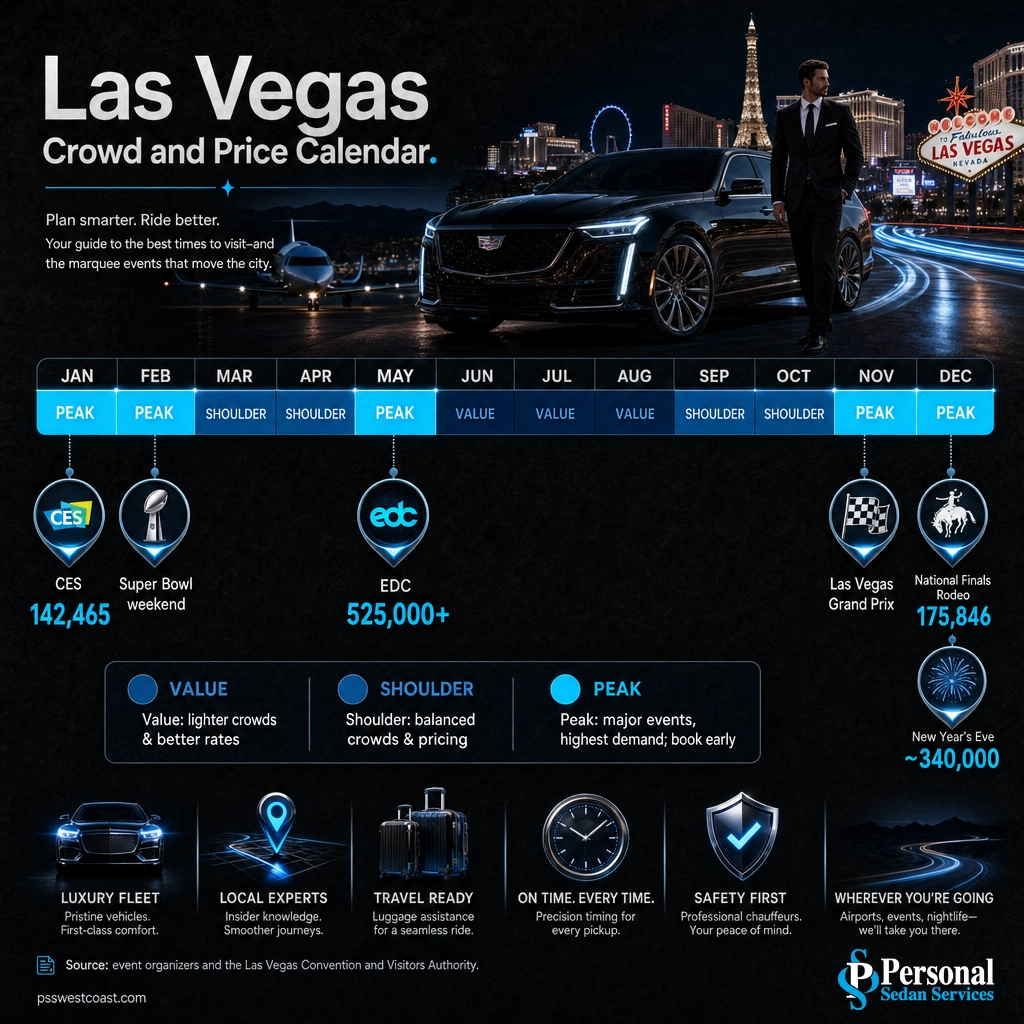
Because monthly visitor volume is so steady, the crowd you actually feel is set by events, not by the calendar season. On a normal week the Strip is lively but manageable. On a marquee weekend the same few blocks host hundreds of thousands of extra people, and everything changes: hotels sell out, restaurant reservations disappear weeks ahead, rideshare surge pricing climbs, and the drive from the airport to your hotel can double or triple in time. Knowing the big dates lets you either lean into the energy or deliberately avoid it.
Here are the events that move the needle most, with attendance figures from each organizer. These are the weeks when planning ahead stops being optional.
Beyond these, the fall and winter also bring the Las Vegas Grand Prix in November, a Formula 1 night race that closes parts of the Strip and lifts hotel rates to some of the highest of the year, plus a steady stream of championship fights, residencies, and stadium concerts. Spring adds March Madness weekends, when sportsbooks overflow, and spring break traffic. If you are coming specifically for a concert or game, our guide to events, seating and transportation at T-Mobile Arena covers one of the city’s busiest venues in detail.
The practical takeaway is simple. If you want maximum atmosphere, book one of these weeks far in advance and expect to pay for it. If you want a calmer, cheaper trip, look them up first and steer around them. Either way, on a big event week the smartest move is to lock your ground transportation before you arrive, because event surge pricing and closed roads hit rideshare hardest.
Source: Consumer Technology Association, CES | Wrangler National Finals Rodeo
Best Time for Pool Season and Summer Trips
For a large share of visitors, the pool is the point. Las Vegas built an entire dayclub economy on the desert heat, and if that is your trip, the very months other travelers avoid are the ones you want. Most resort pools and dayclubs run from roughly March through October, with the prime stretch from late April through September, when highs are reliably in the 80s, 90s, and 100s and the pool decks are open all day.
May, June, and July are the heart of pool season. The tradeoff is obvious from the weather table: you get guaranteed warmth, but you also get the year’s most extreme afternoons. The way to enjoy a summer trip is to work with the heat instead of against it. Take the pool in the morning and again in the late afternoon, move indoors during the fiercest midday hours for a show, a spa, or a long lunch, and keep water on you at all times. Handled that way, a July trip can be fantastic value, since summer rooms are among the cheapest of the year.
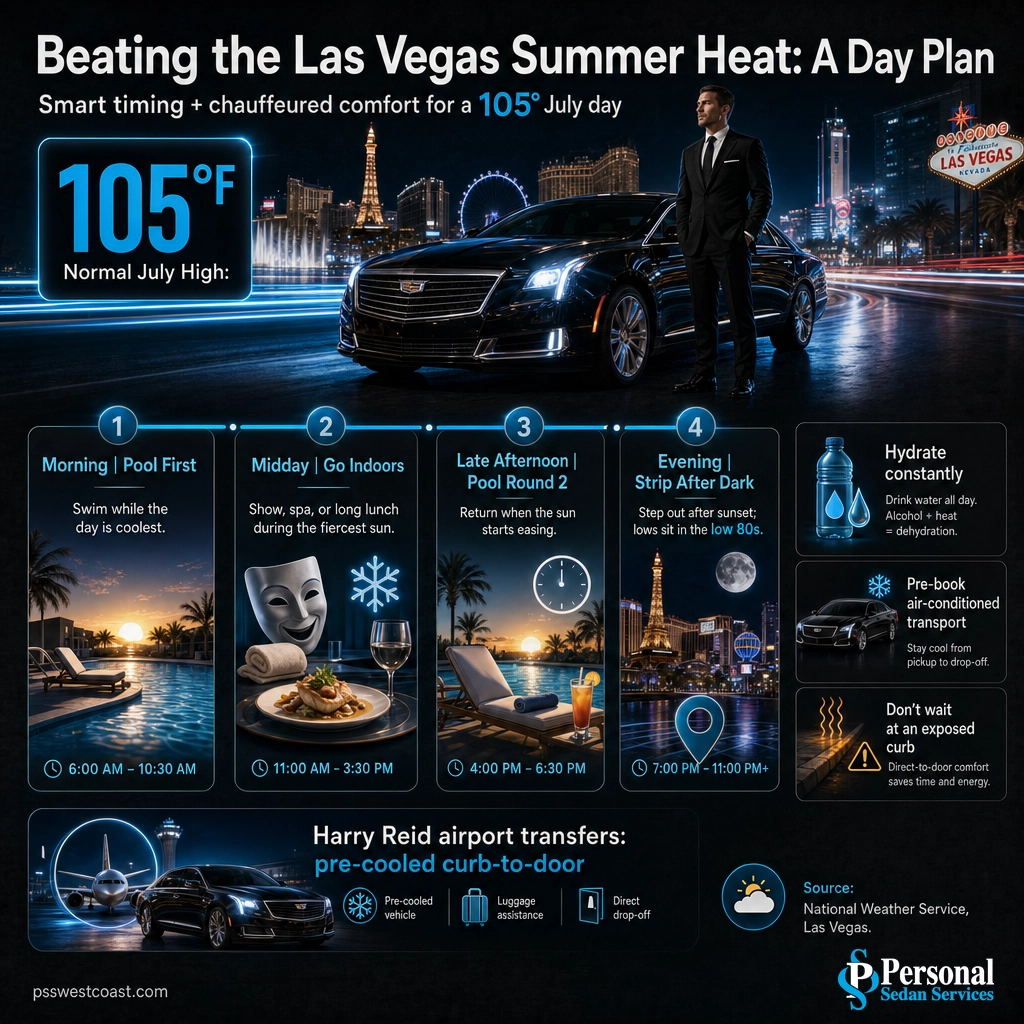
Two summer weather quirks are worth planning around. The first is the monsoon: in July and August, moisture can build into sudden afternoon thunderstorms with lightning, high winds, and flash flooding that clears streets in minutes. The second is that the heat does not break at night the way it does in many climates, with overnight lows still in the low 80s, so evenings stay warm and pools stay comfortable well after dark. If you are timing a summer trip, our upcoming guides on when pools open in Las Vegas and when monsoon season hits go deeper on both.
Summer is also the season when groups travel together most, whether for a bachelor or bachelorette weekend, a birthday, or a family reunion. If you are moving six or more people between a hotel, a pool, and a dinner reservation in triple-digit heat, the difference between one comfortable vehicle and a scramble of separate cars is the difference between a smooth day and a miserable one.
Source: National Weather Service, Las Vegas
See Group Transportation Options
Best Time for the Lowest Crowds
There is no week when Las Vegas empties out, but there are clearly calmer stretches, and they are easy to find once you know the event calendar. The quietest, most relaxed windows are the weeks that sit between the marquee events, when the weather is cool enough to keep the pool crowds home but not so cold that the city feels closed.
The single best low-crowd window is the first two weeks of December. The holiday travel wave has not started, the National Finals Rodeo and New Year’s Eve are still ahead, and daytime highs in the upper 50s are cool but comfortable. Hotel rates in early December are among the lowest of the year, restaurant reservations open up, and you can actually move through the casinos and attractions without a wall of people. The weeks immediately after New Year’s, once the holiday crowds leave and before CES arrives in the second week of January, are a close second.
Late August into early September is another quieter pocket. Families head home for the school year, the worst of the summer heat is starting to ease, and while the city is still warm, the crowds thin noticeably compared to the peak summer weekends. If you can tolerate lingering heat in exchange for smaller crowds and lower prices, this is a smart value window.
Source: Las Vegas Convention and Visitors Authority Research Center
The Month-by-Month Breakdown
Here is the quick verdict on every month, combining the weather, the crowd level, the typical hotel pricing, and what each month is best for. Use it to match your priorities to a specific window.
January
Cool and quiet once the New Year’s crowds leave, with highs near 59°F and cold nights around 41°F. The first two weeks are a genuine value window. Then CES arrives in early January and floods the city with more than 140,000 convention attendees, spiking midweek rates and filling restaurants. Come early in the month for calm and low prices, or come for CES and book far ahead.
February
Mild days near 63°F and the wettest month of the year at 0.80 inches, though that is still barely any rain. February pricing swings hard on events: Super Bowl weekend and Valentine’s Day drive some of the highest rates of the year, while the quieter weeks are reasonable. A romantic long weekend works well here if you avoid the peak dates.
March
One of the most pleasant months, with highs climbing to 71°F and the pools starting to open. March also brings spring break energy and March Madness weekends, so the sportsbooks are packed and weekends are lively. Great weather, moderate-to-busy crowds, and rising but not peak prices.
April
Arguably the best all-around month. Highs of 79°F, lows of 57°F, only 0.20 inches of rain, and pools in full swing by late April. The weather is close to perfect for walking the Strip, day trips, and outdoor dining. Prices are moderate, held down between the winter peaks and the summer pool rush. If you can only pick one month sight unseen, pick this one.
May
Warm and firmly into pool season, with highs near 89°F. Mid-May brings EDC, the city’s largest music festival at over half a million attendees, which spikes hotel rates and books out the Strip for that weekend. Outside the festival window, May offers warm, dry, festival-city energy with strong pool weather.
June
Hot and extremely dry, with highs near 99°F and the lowest rainfall of the year at 0.04 inches. Pool season is at its peak and summer room rates begin to ease, making June a good value month for pool-focused travelers who do not mind the heat. Plan indoor time for the middle of the day.
July
The hottest month, with a normal high of 105°F and overnight lows still in the low 80s. The monsoon can bring brief, intense thunderstorms. This is peak heat and often peak value: rooms are among the cheapest of the year. A July trip works beautifully if you build the day around the pool and air conditioning, and treat transport and hydration as priorities, not afterthoughts.
August
Nearly as hot as July at 103°F, with continued monsoon potential. Late August quiets down as families head back for the school year, opening a value pocket with slightly easing heat and thinner crowds. Same summer rules apply: mornings and evenings outdoors, midday indoors.
September
Still hot early, near 95°F, but cooling steadily through the month and shedding the summer crowds after Labor Day. September is an underrated value window: warm enough for the pool, but with fall shoulder-season prices starting to appear. A strong choice for travelers who want warmth without the peak-summer premium.
October
Excellent weather and one of the best months overall. Highs settle into the low 80s, the humidity is gone, and the days are warm and stable. October is busy with conventions and festivals precisely because the weather is so reliable, so book ahead, but the comfort is worth it. Ideal for weddings, golf, and long days outdoors.
November
Cool, comfortable days near 67°F and cold evenings, a lovely time to walk the city. The wild card is the Las Vegas Grand Prix in mid-November, a Formula 1 night race that closes parts of the Strip and drives hotel rates to some of the year’s highest for that weekend. Outside the race, November is pleasant and reasonably priced.
December
A month of two halves. The first two weeks are cool, calm, and among the cheapest of the year, one of the best low-crowd windows on the calendar. Then the National Finals Rodeo and the run-up to New Year’s Eve, which draws roughly 340,000 people to the Strip and Fremont Street, turn the back half of December into one of the busiest and most expensive stretches of the year. Choose your December carefully.
Source: National Weather Service, Las Vegas | Las Vegas Convention and Visitors Authority
Getting Around Las Vegas Whatever Month You Visit
The month you pick changes the weather and the crowds, but it also changes how you should get around, and that is the part most trip guides skip. Las Vegas is more spread out than it looks from a hotel map. The distance between two resorts on the Strip can be a mile or more, Harry Reid International Airport sits just southeast of the Strip, and the neighborhoods, venues, and day-trip destinations worth visiting are scattered across a wide valley. How you handle that changes with the season.
In summer, the heat makes exposed waiting and long walks genuinely risky, so pre-arranged, air-conditioned pickup that meets you at the door matters far more than it would in a mild climate. During peak event weeks, closed roads and surge pricing make on-demand rideshare unreliable exactly when you need it most, and a booked vehicle with a professional driver who knows the alternate routes saves the day. In the cooler months, the challenge shifts to evenings, when a comfortable ride back from a late dinner or show beats standing in a cold desert night waiting for a car.
This is where local knowledge earns its keep. Personal Sedan Services is Las Vegas’s top-rated luxury transportation provider, with a perfect 5.0 Google rating from more than 900 reviews, and our licensed, background-checked chauffeurs run the airport, the Strip, and the valley every day in every season. We track your flight for airport pickups, we plan around event closures and convention traffic, and we move groups of any size in a single vehicle rather than a scramble of separate cars. Whether you land in the January cool or the July heat, the ride is climate-controlled, on time, and driven by someone who knows the city.
For visitors weighing how to move a group, our comparison of a sedan versus an SUV for Las Vegas car service helps you match the vehicle to your party size and luggage, and our guide to tipping a chauffeur in Las Vegas answers the question every first-time visitor asks. If a scenic day trip is on your list, the cooler shoulder months are also the best time to visit destinations like Death Valley, an easy drive from Las Vegas.
Source: Harry Reid International Airport
What to Do Next: Trip-Planning Roadmap
Once you have chosen your window, here is the order to lock things in. Move top to bottom, and handle the high-priority items as soon as your dates are set, because the best rooms, reservations, and transport sell out first during peak weeks.
| Action | Priority | Timeline | Relevant Service |
|---|---|---|---|
| Choose your week for weather, your nights for price | High | As soon as dates are flexible | Trip planning |
| Check the event and convention calendar for your dates | High | Before booking the hotel | Trip planning |
| Book the hotel, favoring Sunday to Thursday nights | High | 2 to 6 months out for peak weeks | Trip planning |
| Arrange airport pickup with flight tracking | High | 1 to 4 weeks out | Airport shuttle |
| Reserve show, dinner, and pool bookings | Medium | 3 to 8 weeks out | Trip planning |
| Line up group or event transportation | Medium | 2 to 4 weeks out | Event and group transport |
| Plan any day trips around the cooler shoulder months | Low | 1 to 2 weeks out | Chauffeured day trips |
| Pack for the month: layers in winter, sun protection in summer | Low | Days before | Trip planning |
The two items that most reward early action are the hotel and the transportation. During a marquee week, rooms and reliable ground transport both tighten fast, and the travelers who book early get the better rate and the smoother arrival. During a quiet week, you have more room to improvise, but pre-booking airport pickup still turns a tiring travel day into an easy one.
Source: Las Vegas Convention and Visitors Authority Research Center
Related Resources
Keep planning with these companion guides. Several go deeper on the specific windows this pillar summarizes.
- Is Las Vegas Dying? What the 2026 Data Actually Shows
- Best Day Trips from Las Vegas: 10 Drives Worth Taking
- T-Mobile Arena Las Vegas: Events, Seating, Parking and Transportation
- How Far Is Death Valley from Las Vegas? Drive Time, Route and Best Time to Visit
- SUV vs Sedan for Las Vegas Car Service: Which Fits Your Group?
Authoritative external resources: for planning your own dates, the Las Vegas Convention and Visitors Authority research center publishes monthly visitor and hotel data, the National Weather Service Las Vegas office covers current conditions and heat advisories, and Harry Reid International Airport posts terminal and arrival information.
The Best Time to Visit Las Vegas, at a Glance
This master table combines every factor for quick reference. The top twelve rows cover the months; the bottom rows flag the specific event weeks that override the normal month pattern.
| Month or event | Weather | Crowds | Typical pricing | Best for |
|---|---|---|---|---|
| January | Cool days, cold nights (59/41) | Low early, high during CES | Low early, spikes for CES | Value trips before CES |
| February | Mild, wettest month (63/44) | High on event weekends | Peaks for Super Bowl and Valentine’s | Romantic getaways off-peak |
| March | Pleasant spring (71/51) | Busy weekends | Moderate, rising | Great weather, sports fans |
| April | Ideal, warm and dry (79/57) | Moderate | Moderate | Best all-around weather |
| May | Warm, pool season (89/66) | High mid-May (EDC) | Spikes for EDC | Pools and festivals |
| June | Hot, very dry (99/76) | Moderate | Easing summer rates | Pool value |
| July | Peak heat (105/82) | Moderate | Among the lowest | Pool trips on a budget |
| August | Extreme heat (103/81) | Eases late | Low, especially late | Late-month value |
| September | Cooling, still warm (95/72) | Thins after Labor Day | Good value | Warmth without peak prices |
| October | Excellent (81/60) | Busy, convention season | Moderate to high | Weddings, golf, outdoors |
| November | Cool, comfortable (67/47) | High during Grand Prix | Spikes for F1 | Comfortable sightseeing |
| December | Cool days, cold nights (57/40) | Low early, huge late | Cheap early, peaks for NFR and NYE | Value early, events late |
| CES week (Jan) | Cool | Very high | High | Tech and business travelers |
| Super Bowl weekend (Feb) | Mild | Very high | Highest of winter | Sports and party crowds |
| March Madness (Mar) | Pleasant | High weekends | Elevated weekends | Sportsbook fans |
| EDC weekend (May) | Warm nights | Very high | Among the highest | Festival-goers |
| Labor Day (Sep) | Hot | High holiday weekend | Elevated | Last big pool weekend |
| Grand Prix (Nov) | Cool | Very high | Highest of the year | Motorsport fans |
| National Finals Rodeo (Dec) | Cool | Very high | High | Rodeo and country fans |
| New Year’s Eve (Dec) | Cold nights | Highest of the year | Peak | Big-party travelers |
Source: Las Vegas Convention and Visitors Authority | National Weather Service, Las Vegas
Frequently Asked Questions
What is the best time of year to visit Las Vegas?
What is the cheapest month to visit Las Vegas?
When is Las Vegas the busiest?
What months are too hot to visit Las Vegas?
When is pool season in Las Vegas?
Is it cheaper to visit Las Vegas midweek or on weekends?
How many people visit Las Vegas each year?
When does it rain in Las Vegas?
What is the best time to visit Las Vegas for a wedding or special occasion?
What should I pack for Las Vegas depending on the month?
Methodology and Sources
How we built this guide
Weather figures are NOAA National Centers for Environmental Information climate normals for the Las Vegas area, covering the 1991 to 2020 reference period, as reported by the National Weather Service. Temperatures are normal daily highs and lows; precipitation is the monthly average, with an annual total of 4.18 inches.
Visitor volume, hotel occupancy, and average daily room rate figures come from the Las Vegas Convention and Visitors Authority Research Center, including its 2024 year-end totals (about 41.7 million visitors, 83.6 percent occupancy, and a $193.16 average daily room rate) and its monthly Executive Summary reports. Occupancy and room-rate figures are derived from a survey sample representing more than 75 percent of Las Vegas hotel inventory.
Event attendance figures are from each event’s organizer: the Consumer Technology Association for CES, Insomniac for EDC, the Wrangler National Finals Rodeo, and Las Vegas Review-Journal and LVCVA reporting for New Year’s Eve crowd projections. Pricing described as “typical” reflects observed seasonal patterns, not fixed quotes; actual rates vary by property, day of week, and event calendar.
- National Weather Service, Las Vegas
- NOAA U.S. Climate Normals (1991 to 2020)
- Las Vegas Convention and Visitors Authority Research Center
- Consumer Technology Association, CES
- Wrangler National Finals Rodeo
Last Updated: August 2026. Personal Sedan Services updates this guide as new LVCVA and NOAA data is released.