


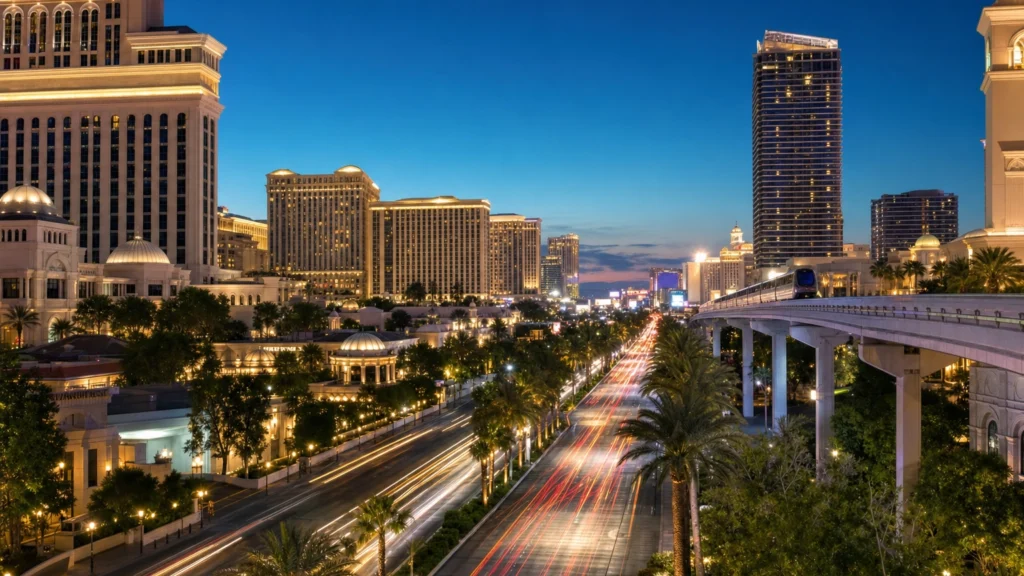
The best way to get around Las Vegas depends on where you are going, how many people you have, and what time it is. For the dense center of the Strip, walking and the free resort trams win. For cheap end-to-end travel, the Deuce bus and the monorail are hard to beat. For flexibility, rideshare and taxis. For groups, luggage, the airport, and nights out, a private car or chauffeured service is the most comfortable and predictable. This guide compares every option side by side, with real 2026 fares.
Las Vegas gives you more ways to get around than almost any city its size: two free trams, a monorail, 24-hour buses, an underground tunnel with Tesla vehicles, rideshare, taxis, rental cars, and door-to-door private car service. The trick is matching the option to the moment. Below is every option compared, what each one costs, what it is genuinely good at, and a simple way to decide which to use, from a Las Vegas transportation company that moves people around this city every day.
- No single winner: the best option changes by trip. Most visitors mix walking, trams, and a paid ride for the long hops.
- Cheapest: the RTC buses. A 24-hour Strip pass on the Deuce and SDX is $8, running 24 hours a day.
- Fastest fixed route: the Las Vegas Monorail, $6 a single ride or $15 for a one-day pass, along the east side of the Strip.
- Free: two resort trams cover useful south and center-Strip stretches at no cost.
- Walking: best for the center. The full Strip is about 4.2 miles, and summer highs average 104.5°F, so long midday walks are tough.
- Newest: the Vegas Loop tunnels, about $4.25 a resort-to-resort ride, centered on the Convention Center and still expanding.
- Most flexible: rideshare and taxis, but surge pricing and far-off pickup zones slow rideshare on busy nights.
- Best for groups, luggage, and events: a private car or chauffeured van keeps everyone together, door to door, with no surge and no pickup lines.
What’s in This Guide
- Every Option at a Glance
- Walking the Strip
- Free Resort Trams
- The Las Vegas Monorail
- RTC Buses: The Deuce and the SDX
- The Vegas Loop (Tesla Tunnels)
- Rideshare: Uber and Lyft
- Taxis
- Renting a Car (and the Parking Reality)
- Private Car Service, Limos, and Group Transportation
- Getting To and From Harry Reid Airport
- Getting Around Beyond the Strip
- Which Option Is Right for You?
- What to Do Next
- Every Option Compared: Full Table
- Related Las Vegas Guides
- Frequently Asked Questions
- Sources and Methodology
Every Option at a Glance
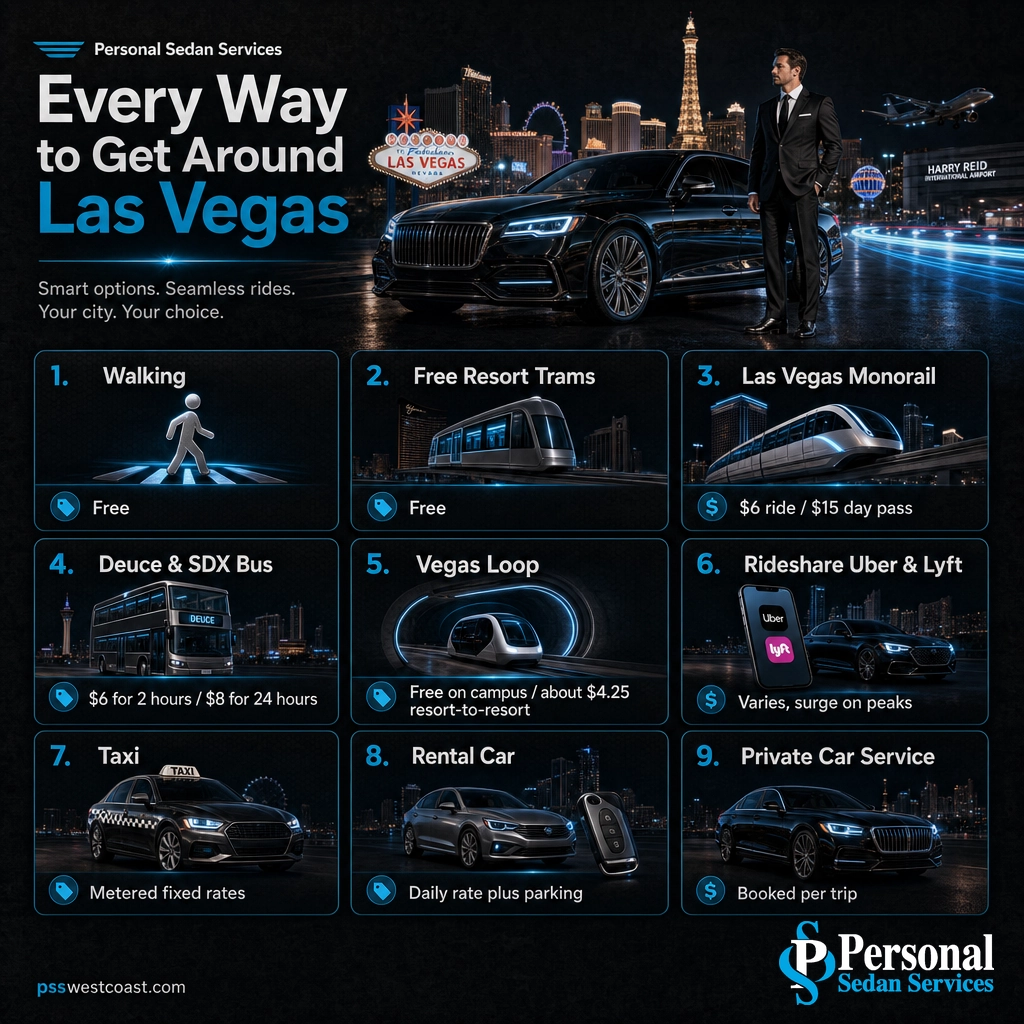
Before the details, here is the short version. Las Vegas transportation falls into three broad groups. There are the fixed-route options that follow a set path for a set price: the monorail, the RTC buses, and the free resort trams. There are the on-demand options you summon or hail: rideshare, taxis, and the Vegas Loop. And there is private transportation you book ahead: a chauffeured sedan, SUV, van, or bus that goes exactly where you want, when you want.
Most first-time visitors assume they will just walk everywhere, then discover that the Strip is longer than it looks and the buildings are enormous. Most assume rideshare will always be quick, then get caught in a surge fare and a 15-minute walk to a garage pickup point after a show lets out. The reality is that the smart traveler uses two or three of these options across a single trip, choosing by distance, group size, budget, and time of day.
This table gives you the big picture. The rest of the guide breaks each option down in full.
| Option | Typical cost | Best for | Watch out for |
|---|---|---|---|
| Walking | Free | The dense center of the Strip | Heat, scale, long end-to-end distances |
| Free resort trams | Free | Set south and center-Strip hops | Only two short stretches, limited hours |
| Las Vegas Monorail | $6 ride / $15 day pass | Fast east-side Strip travel | Stations sit behind the resorts |
| Deuce / SDX bus | $6 (2-hr) / $8 (24-hr) | Cheapest Strip and Downtown travel | Slow in traffic, can be crowded |
| Vegas Loop | Free on campus / ~$4.25 resort-to-resort | Convention Center trips | Limited stations, still expanding |
| Rideshare (Uber/Lyft) | Varies, surge on peaks | Flexible short hops, small groups | Surge pricing, far pickup zones |
| Taxi | Metered, fixed rates | Curbside on-demand rides | Can cost more than rideshare off-peak |
| Rental car | Daily rate + parking | Day trips out of town | Traffic, resort parking fees, garages |
| Private car service | Booked per trip or hourly | Groups, luggage, events, airport | Book ahead for peak weekends |
Fares are published rates for 2026 (see the Sources section). Rideshare, taxi, and private-car pricing varies by distance, time, demand, and vehicle, so those are shown as structure rather than a single figure.
Source: RTC of Southern Nevada fares | Las Vegas Monorail ticket information
Walking the Strip
Walking is the most underrated and most overestimated way to get around Las Vegas at the same time. It is the best way to actually experience the center of the Strip, where the resorts, fountains, and attractions are packed tightly together and half the fun is the crowd and the lights. It is also the option first-timers most often misjudge, because a map makes the Strip look far more compact than it is.
The full Strip runs about 4.2 miles end to end, and walking it nonstop takes most people 90 minutes to two hours before a single photo. The center cluster, roughly from Park MGM up to the Venetian, is genuinely walkable and dense with things to see. The far north and far south ends stretch out with big low-density gaps that are far less pleasant on foot. Two things trip people up: scale and heat.
Scale is the quiet one. The resorts are massive, so two hotels that look next door on a map can be a 15-minute walk apart once you account for the buildings, the setbacks from the road, and the interior distance from the casino floor to the sidewalk. Add five to ten minutes of interior walking to almost every hotel-to-hotel trip.
The mistake almost every first-timer makes: assuming “it all looks close, so we will just walk.” Heat is the reason that plan breaks in summer. Las Vegas averages a normal July high of 104.5°F, and the wide, shade-free sidewalks make a midday summer walk genuinely draining. From roughly May through September, walk the center in the early morning or after sunset, hydrate, and use a tram, the monorail, or a car for the long hops.
Use the elevated pedestrian bridges at the big intersections. At crossings like Tropicana and Las Vegas Boulevard, you cross above the traffic on escalator bridges rather than waiting at street level. They add a couple of minutes but are safer and often faster than the jammed corners below. Wear real shoes, because four miles of concrete is a lot, and this is not the night for brand-new dress shoes.
For the full breakdown of Strip distances and resort-to-resort walk times, see our guide to how long the Las Vegas Strip really is.
Source: Las Vegas Strip on Wikipedia | NOAA U.S. Climate Normals
Free Resort Trams
The best deal on the Strip is one many visitors never notice: the free resort trams. These short automated trains connect clusters of resorts under the same ownership, they cost nothing to ride, and they skip the sidewalk crowds and the heat entirely. If your plans line up with their routes, they are the single most efficient way to cover certain stretches.
Two free trams are the ones worth planning around:
- South Strip tram: links Mandalay Bay, Luxor, and Excalibur on the south end. This covers a stretch that is a hot, uninspiring walk otherwise, so it is a genuine time and comfort saver.
- Aria Express (center Strip): runs between Park MGM, Aria, Crystals, and Bellagio in the heart of the Strip. It moves you across the dense center in a few minutes without fighting the sidewalk.
How to use them well: the trams run on their own schedules, typically from mid-morning until late at night, and stations are usually inside or attached to the resorts rather than on the sidewalk. Check posted hours at the station, because they close earlier than the buses and rideshare. They are perfect for connecting to a longer trip: ride the tram to the end of its line, then pick up the monorail, a bus, or a car for the rest.
The catch is coverage. The free trams only serve two short stretches, and they connect specific resorts rather than running the length of the Strip. They are a useful piece of the puzzle, not a whole-trip solution. Pair them with one of the paid options below for anything beyond their short routes.
The Las Vegas Monorail
The Las Vegas Monorail is the closest thing the Strip has to a subway. It is a fast, weather-proof, traffic-proof train that runs along the east side of the Strip, behind the resorts, from the Sahara in the north to the MGM Grand in the south. When your stops line up with its stations, it is one of the quickest ways to cover ground on the Strip.
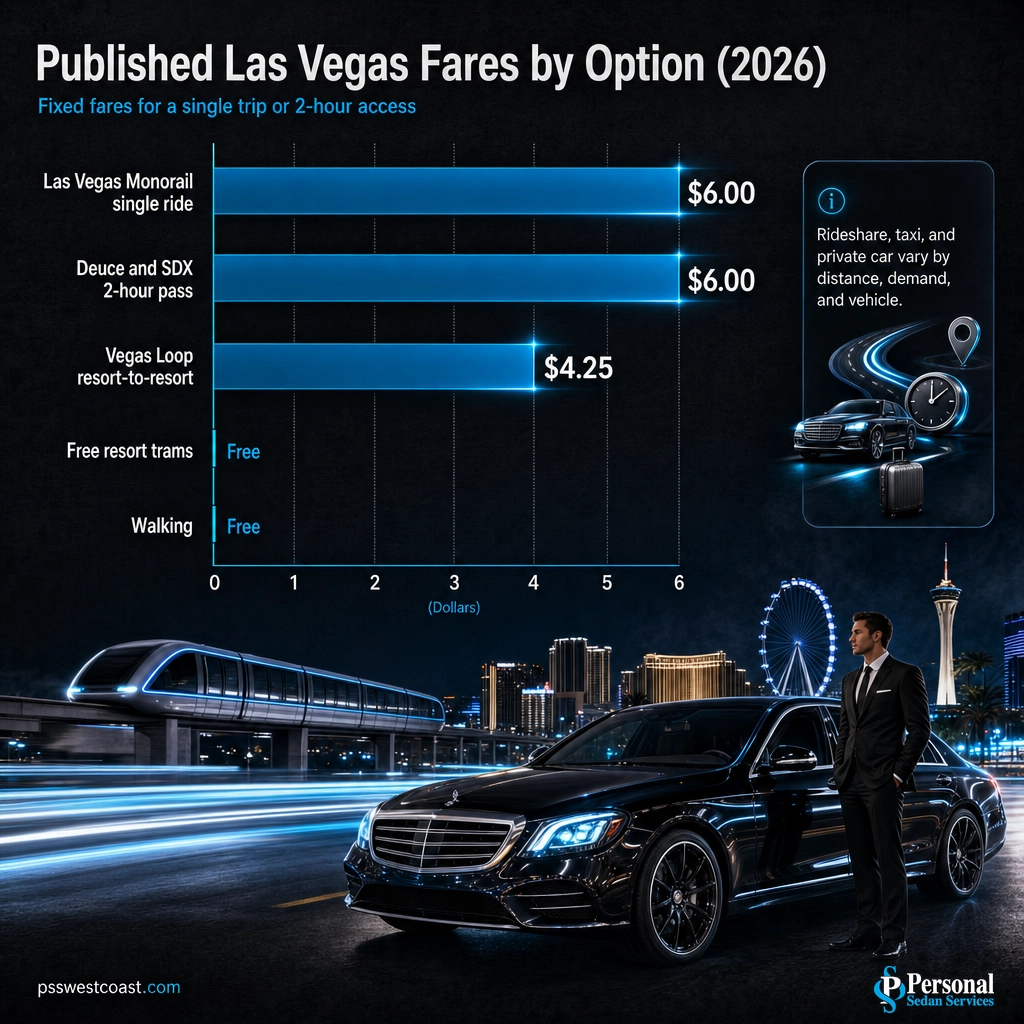
The monorail has seven stations: Sahara Las Vegas, Westgate, the Boingo station at the Las Vegas Convention Center, Harrah’s and The LINQ, Flamingo and Caesars Palace, Horseshoe and Paris, and the MGM Grand. It runs seven days a week, generally from mid-morning until midnight or later, with extended hours toward the weekend. A single ride is $6 at a station or $5.50 online, and a one-day pass is $15, so if you plan three or more rides in a day, the day pass pays for itself.
Know the geography before you rely on it. The monorail runs behind the resorts on the east side, so a station can be a long indoor walk from the actual Strip sidewalk or from a west-side hotel like Bellagio, the Venetian, or Caesars’ front entrance. It also does not serve the airport. For an east-side, convention-focused, or Strip-length trip it is excellent. For a west-side hotel or an airport run, another option will usually be faster door to door.
The monorail shines for conventions. It stops right at the Las Vegas Convention Center and connects the big east-side properties, so business travelers moving between sessions and hotels get a fast, predictable ride that never touches Strip traffic. It is also a strong pick on major event nights, when the roads crawl but the train keeps moving.
Source: Las Vegas Monorail official ticket information
RTC Buses: The Deuce and the SDX
If your priority is saving money, the public buses run by the Regional Transportation Commission of Southern Nevada (RTC) are the cheapest way to get up and down the Strip and to Downtown. Two routes matter most to visitors: the Deuce and the SDX (Strip and Downtown Express).
The Deuce is a double-decker bus that runs 24 hours a day, covering roughly 9.3 miles along Las Vegas Boulevard between the South Strip Transit Terminal and Fremont Street downtown. It stops frequently, so it is slower, but it hits nearly every major resort and it never stops running, which makes it invaluable late at night. The SDX is the express version: it makes fewer stops and uses dedicated transit lanes in places, so it moves faster between the major points, though it runs shorter hours than the Deuce.
Fares are pass-based on the Strip and Downtown routes. A 2-hour pass is $6, a 24-hour pass is $8, and a 3-day pass is $20. The passes cover both the Deuce and the SDX, so a single 24-hour or 3-day pass lets you hop on and off all day and night for one flat price. Buy passes from the machines at the stops, the RTC app, or onboard.
Published Strip fares by option (single fixed-fare trip or 2-hour access)
Published fixed fares for 2026. Rideshare, taxi, and private-car fares vary by distance, demand, and vehicle and are not fixed-fare, so they are not shown here.
The honest trade-off: the buses are the budget champion, but they pay for the low price in speed. In heavy Strip traffic or on a big event night, the Deuce can crawl, and it can get very crowded. If your top priority is cost and you are not on a tight schedule, they are excellent. If you are moving a group, carrying luggage, or trying to make a reservation on time, a faster option is usually worth the difference.
Source: RTC of Southern Nevada, fares and passes | The Deuce transit service reference
The Vegas Loop (Tesla Tunnels)
The newest and most talked-about way to get around is the Vegas Loop, an underground tunnel system built by The Boring Company. Instead of a train, passengers ride in Tesla vehicles that travel through dedicated tunnels between stations, skipping surface traffic entirely. It started as a people-mover under the Las Vegas Convention Center and has been expanding toward the resorts.
Inside the Las Vegas Convention Center campus, the Loop is free for convention attendees and moves large crowds quickly between the halls. As the network expands past the Convention Center to resort stations, paid connections have been reported at about $4.25 for a resort-to-resort ride, with airport service planned. The system has moved large event crowds, including roughly 82,000 riders during a single major trade show in early 2026, and it has carried millions of passengers within the Convention Center campus since opening.
Where it fits today: the Vegas Loop is genuinely useful if your trip centers on the Convention Center or the specific resorts already connected to it, and it is a fun, fast novelty. But it is still a growing network, not yet a Strip-wide system, so it will not replace rideshare or a car for most itineraries yet. Check the current station map before you count on it for a specific hotel, because coverage keeps changing as new stations open.
Source: Las Vegas Review-Journal coverage of the Vegas Loop | The Boring Company projects page
Rideshare: Uber and Lyft
Rideshare is the default choice for most visitors, and for good reason. Uber and Lyft are available everywhere in Las Vegas, you see the price and the driver before you commit, and you can get a car to almost any address on demand. For a small group making a short, off-peak hop, it is often the simplest option there is.
Two realities keep rideshare from being the answer to everything. The first is surge pricing. When demand spikes, at closing time, after a concert or a fight, during a convention rush, or in bad weather, fares climb, sometimes far above what the same trip cost an hour earlier. The second is the pickup zone. On the Strip, resorts route rideshare pickups to designated areas that are frequently in a parking garage, up escalators and across skybridges, a 10 to 15 minute walk from the casino floor. The ride itself may be quick, but getting to it is not always.
The event-night trap: the exact moment everyone wants a rideshare is the exact moment it is slowest and most expensive. When 20,000 people leave an arena at once, surge pricing and a mob at the pickup garage can turn a “quick” rideshare into a long, pricey wait. On big event nights, a pre-booked car with a set price and a known pickup point, or a short walk to a taxi stand, often beats opening the app and hoping.
Use rideshare for what it is best at: spontaneous short trips, two to four people, times that are not peak. Have a backup plan for the predictable crunch points. And remember that for a group of six or more, “just take two Ubers” means two separate surge fares and two cars that arrive at different times, which is where a single larger vehicle starts to make more sense.
Taxis
Taxis are the old-school option that still earns its place, especially when rideshare surge is high. Las Vegas taxis are metered and regulated, with fixed rate structures, and they line up at dedicated curbside stands outside every resort and at the airport. There is no app required and no surge multiplier: you walk to the stand, get in the next cab, and go.
The advantages are immediacy and predictability at the crunch points. When a show or a game lets out and every rideshare in town is surging, the taxi stand often has a steady line of cars at a normal metered rate. Because the cab is waiting at the front door rather than in a distant garage, the door-to-door time can beat rideshare even when the meter runs a little higher on an ordinary trip.
One local caution, the airport “long haul”: the honest, direct route from Harry Reid Airport to most Strip hotels uses the surface streets, not the tunnel and freeway loop. Ask for surface streets or the direct route, and know roughly where your hotel sits, so a short trip stays short. A metered taxi is a solid pick for a single traveler or a pair who want a curbside ride with no app and no surge, particularly late at night.
Renting a Car (and the Parking Reality)
A rental car sounds like freedom, and for the right trip it is. For a Strip-and-Downtown vacation, though, it is usually more hassle than help. The reasons are traffic, parking, and geometry.
Strip traffic is heavy and slow, and Las Vegas Boulevard itself can take a long time to cover by car at peak hours, often slower than the bus in a dedicated lane. Then there is parking. Many resorts charge for both self-parking and valet, the garages are large, and the walk from your parked car to the casino floor and your room can rival the walk you were trying to avoid. Every time you move between hotels, you park again, pay again, and walk again.
The hidden cost: a rental car’s daily rate is only the start. Add resort self-parking or valet fees at each stop, the time lost circling garages, and the fact that you cannot drink and drive, which matters in a city built around nightlife. For an in-town trip, those add up to more money and more friction than rideshare, transit, or a private car would have cost.
Where a rental car does pay off is getting out of town. If your plan includes day trips to Hoover Dam, Red Rock Canyon, Valley of Fire, or a longer drive to the Grand Canyon or Zion, having your own vehicle for the day is genuinely useful. Even then, many visitors rent only for the specific day they leave the valley, or book a chauffeured vehicle for the trip so no one has to drive. For distances and drive times on the popular routes, see our guide to the best day trips from Las Vegas.

Private Car Service, Limos, and Group Transportation
Private transportation is the option the other guides tend to skip, and it is the one that solves the problems the others create: the heat, the walking, the surge pricing, the far-off pickup garage, the group scattered across three cars. A chauffeured sedan, SUV, van, or bus picks you up at the door, waits on your schedule, and takes you exactly where you want to go for a price agreed in advance.
Personal Sedan Services is Las Vegas’s top-rated luxury transportation, a perfect 5.0 Google rating from more than 900 reviews, with licensed, background-checked, professional chauffeurs. The value is not just comfort, it is logistics. A driver who knows the city handles the timing, the routing, and the parts of a Las Vegas night that trip up visitors.
Get Around Las Vegas in Comfort: Local Car Service
Private service is the clear best choice in several common situations:
- Groups of five or more. Instead of splitting into multiple rideshares with separate surge fares and staggered arrivals, one right-sized vehicle keeps everyone together, covering Sprinter vans, mini-coaches, party buses, and charter buses.
- Luggage and airport runs. A chauffeur meets you, helps with bags, and drives straight to your hotel, no garage walk, no app, no surge.
- Events and nights out. Weddings, conventions, red-carpet nights, big games, and residency shows come with traffic and road closures. A driver who knows which routes still move gets you there on time.
- Peak-night reliability. The surge-and-crowd crunch that slows rideshare is exactly when a pre-booked car with a fixed price and a set pickup point is worth the most.
- Comfort in the heat. No four-mile walk in a 104-degree afternoon, and no standing in a rideshare line at 2 a.m.
See Group Transportation Options
The fleet ranges from executive sedans like the Volvo S90, Tesla Model S, and Mercedes-Benz S550, to SUVs like the Escalade, Suburban, and Yukon Denali, up to Sprinter vans, a Lincoln MKT limousine, party buses, and a full-size charter bus. That range is what lets one company handle a solo airport pickup, a bachelorette party, and a 50-person convention shuttle with the right vehicle each time. Browse the full fleet of sedans, SUVs, vans, and buses to match the vehicle to your group.
For complex trips, several arrivals, multiple hotels, a full itinerary of events across a weekend, destination management coordinates all of it as one plan rather than a scramble of separate bookings. That is the difference between renting a ride and hiring a team that handles the logistics.
Getting To and From Harry Reid Airport (LAS)
Almost every visitor’s first and last Las Vegas transportation decision is the airport. Harry Reid International Airport (LAS) sits just east of the south end of the Strip, close enough that the drive to a south-Strip hotel is often only 10 to 15 minutes in light traffic. That proximity is deceptive, though, because the airport is one of the busiest in the country and the pickup process can add real time.
Your main options from the terminal are:
- Rideshare and taxis from designated zones. Taxis line up curbside; rideshare pickups are routed to a specific level or lot, which can mean a walk and, at busy arrival times, a wait and a surge fare.
- Shared shuttles that carry several parties at once. They are inexpensive but make multiple hotel stops, so your ride can take a while if you are dropped off last.
- A pre-booked private car or shuttle, where a chauffeur tracks your flight, meets you, helps with luggage, and drives straight to your hotel with no line and no surge.
Why the airport is where a plan pays off most: you are tired, often carrying bags, sometimes arriving late at night, and you do not yet know the city. A scheduled pickup removes every variable, someone is waiting, the price is set, and you go straight to your room. For groups and late arrivals especially, that is the fastest and least stressful way in, which is what our Las Vegas airport shuttle service is built for: meet-and-greet pickups and group airport transfers.
Getting Around Beyond the Strip
Not everything worth doing in Las Vegas is on the Strip, and the transportation math changes once you leave it. Two areas matter: the rest of the valley, and the day trips beyond it.
Downtown and Fremont Street sit about four miles north of the Strip, inside the actual city of Las Vegas. The Deuce connects the two directly and cheaply, running all night, which makes it the classic budget link between the Strip and the Fremont Street Experience. Rideshare, a taxi, or a private car covers the same trip faster when you do not want to wait for the bus.
Neighborhoods and the wider valley, places like Summerlin, Henderson, and the residential areas where locals live and where many events and venues sit, are spread out and built for cars. Transit thins out quickly away from the resort corridor, so rideshare or a private car becomes the practical choice. For getting to a specific venue, our guide to getting to the Sphere shows how much the route and parking matter once you leave the Strip sidewalk.
Day trips out of town are their own category. Hoover Dam, Red Rock Canyon, Valley of Fire, and farther drives to the Grand Canyon or Zion are all reachable, but only by car or an organized tour, transit does not go there. This is the one clear case for a rental car, or for a chauffeured vehicle if you would rather enjoy the scenery than drive it. Our day-trip planning and our roundup of national parks near Las Vegas lay out the distances and drive times.
Which Option Is Right for You?
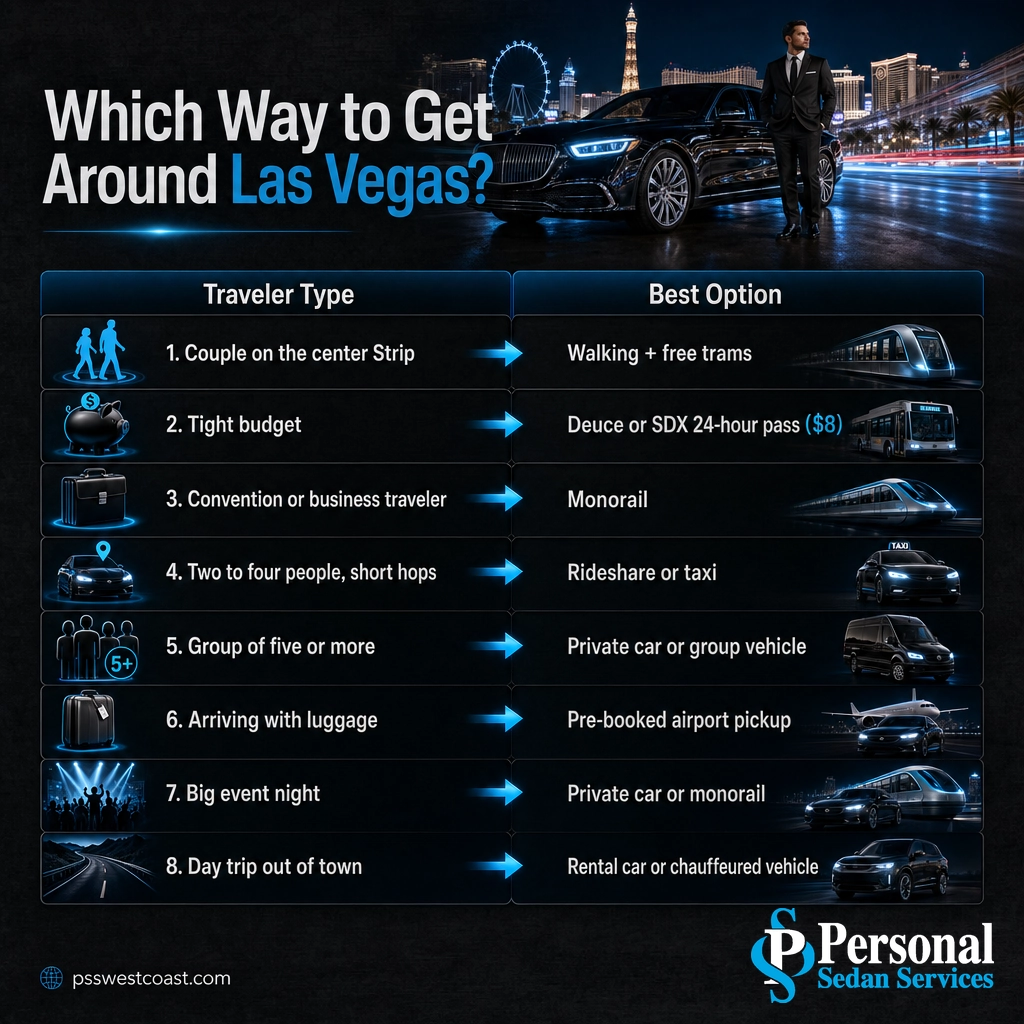
The fastest way to decide is to match the option to your trip rather than looking for one winner. Here is the concierge version of that decision, by traveler type.
| If you are… | Best primary option | Why |
|---|---|---|
| A couple on the center Strip | Walking + free trams | The center is dense and walkable; trams cover the hot gaps free |
| On a tight budget | Deuce / SDX 24-hour pass | $8 buys all-day, all-night Strip and Downtown travel |
| A convention or business traveler | Monorail | Stops at the Convention Center; fast, traffic-proof east-side route |
| Two to four people, short hops | Rideshare or taxi | On-demand and flexible; use a taxi when surge is high |
| A group of five or more | Private car / group vehicle | One vehicle, one price, everyone together, no staggered arrivals |
| Arriving or leaving with luggage | Pre-booked airport pickup | Flight tracked, curbside meet, straight to the hotel, no surge |
| Out on a big event night | Private car or monorail | Beats surge pricing and the pickup-garage crunch |
| Taking a day trip out of town | Rental car or chauffeured vehicle | Transit does not reach Hoover Dam, Red Rock, or the parks |
The pattern behind the table is simple. Distance, group size, time of day, and whether you are carrying anything are the four variables that decide the best ride. Short and central favors walking and free trams. Cheap and unhurried favors the buses. Fast and fixed favors the monorail. Flexible and small favors rideshare and taxis. Groups, luggage, events, and the airport favor a private car. Most trips use two or three of these across the week.
What to Do Next
If you are planning a trip, turn the guide above into a short plan. This roadmap lays out the moves in the order most visitors need them, with the option that fits each one.
| Action | Priority | Timeline | Best option / service |
|---|---|---|---|
| Arrange your airport arrival ride | High | Before you fly | Pre-booked airport pickup for no-surge, door-to-door |
| Plan how you will move within the Strip | High | Before you go | Walking + free trams for the center, monorail for the east side |
| Set a plan for the cheap all-day option | Medium | On arrival | Buy a Deuce / SDX 24-hour or 3-day pass |
| Book group or event transportation | High for groups | 1 to 4 weeks ahead | Group transportation, sized to your party |
| Line up a plan for big event nights | Medium | Before the night | Private car or monorail to skip surge and crowds |
| Decide on any out-of-town day trips | Medium | 1 to 2 weeks ahead | Rental car or a chauffeured vehicle for the day |
| Schedule your departure ride | High | The day before | Pre-booked pickup so you make your flight |
For anything involving a group, an event, or the airport, booking ahead is the single highest-value move. It locks in the price, guarantees the vehicle, and takes the one part of a Las Vegas trip that most often goes wrong, transportation logistics, off your plate.
Every Option Compared: Full Table
Here is every option in one place, with cost, speed, group fit, and the trip each one is built for. Use it as a quick reference while you plan.
| Option | Cost (2026) | Speed | Group fit | Runs | Best for | Main drawback |
|---|---|---|---|---|---|---|
| Walking | Free | Slow over distance | Any size | Always | The dense center Strip | Heat and long end-to-end distances |
| South Strip tram | Free | Fast, short | Any size | Daytime to late | Mandalay Bay to Excalibur | One short stretch only |
| Aria Express tram | Free | Fast, short | Any size | Daytime to late | Park MGM to Bellagio | One short stretch only |
| Monorail, single ride | $6 ($5.50 online) | Fast | Small to medium | ~Mid-morning to late | East-side Strip and conventions | Stations behind the resorts |
| Monorail, day pass | $15 ($13.45 online) | Fast | Small to medium | ~Mid-morning to late | 3+ rides in a day | No west side, no airport |
| Deuce, 2-hour pass | $6 | Slow | Any size | 24 hours | Short cheap Strip hops | Slow in traffic, crowded |
| Deuce / SDX, 24-hour pass | $8 | Slow to medium | Any size | 24 hours (SDX shorter) | Cheapest all-day travel | Frequent stops |
| Deuce / SDX, 3-day pass | $20 | Slow to medium | Any size | 24 hours (SDX shorter) | Longer budget stays | Frequent stops |
| Vegas Loop, campus | Free for attendees | Fast | Medium | Event hours | Convention Center trips | Limited to campus |
| Vegas Loop, resort | ~$4.25 | Fast | Small to medium | Expanding | Connected resorts | Few stations so far |
| Rideshare, off-peak | Varies, moderate | Fast | 1 to 4 (or XL) | Nearly always | Flexible short trips | Far pickup zones |
| Rideshare, peak | Surge, higher | Slow to board | 1 to 4 (or XL) | Nearly always | Off-peak only, really | Surge and crowds |
| Taxi | Metered, fixed rates | Fast | 1 to 4 | 24 hours | Curbside on-demand rides | Costs more off-peak |
| Rental car, in town | Daily rate + parking | Slow in traffic | Depends on car | Any | Rarely worth it on the Strip | Parking fees, garages, traffic |
| Rental car, day trips | Daily rate | Good on open road | Depends on car | Any | Hoover Dam, parks, Grand Canyon | Someone has to drive |
| Private sedan / SUV | Per trip or hourly | Fast, direct | 1 to 6 | On your schedule | Airport, nights out, comfort | Book ahead on peak weekends |
| Sprinter van / mini-coach | Per trip or hourly | Fast, direct | 7 to 24 | On your schedule | Mid-size groups, events | Book ahead |
| Party bus / limo | Per trip or hourly | Direct | 10 to 30+ | On your schedule | Celebrations and nights out | Book ahead |
| Charter bus | Per trip or hourly | Direct | Up to ~50+ | On your schedule | Conventions, large groups | Book ahead |
| Shared airport shuttle | Low, per person | Slow, multi-stop | Any size | Airport hours | Budget airport transfers | Multiple hotel stops |
Fixed fares are published 2026 rates for the RTC buses, the Las Vegas Monorail, and reported Vegas Loop pricing. Rideshare, taxi, rental, and private-car figures are shown as structure because they vary by distance, demand, vehicle, and timing.
Related Las Vegas Guides
- How Long Is the Las Vegas Strip?: the real 4.2-mile length and resort-to-resort walk times.
- How to Get to the Sphere: routes, parking, and the fastest ways in.
- Best Day Trips from Las Vegas: distances and drive times for the out-of-town runs.
- National Parks Near Las Vegas: Zion, Death Valley, and more, with drive times.
- The Best Time to Visit Las Vegas: month-by-month weather, crowds, and events.
- How Many People Fit in a Party Bus?: sizing group transportation for your party.
Frequently Asked Questions
What is the best way to get around Las Vegas?
How much does the Deuce bus cost in Las Vegas?
How much is the Las Vegas Monorail?
Do I need a rental car in Las Vegas?
Is Uber or Lyft cheaper than a taxi in Las Vegas?
What is the Vegas Loop and can tourists ride it?
What is the best way to get from the Las Vegas airport to the Strip?
How do large groups get around Las Vegas together?
Sources and Methodology
Fares and service facts are drawn from official operator sources for 2026 and published references. RTC bus pass prices ($6 for 2 hours, $8 for 24 hours, $20 for 3 days) and the Deuce route come from the Regional Transportation Commission of Southern Nevada and the referenced transit record. Monorail pricing ($6 single ride, $15 one-day pass, with online discounts) and station list come from the Las Vegas Monorail. Vegas Loop pricing and ridership figures are reported by the Las Vegas Review-Journal and The Boring Company and reflect a network that is still expanding, so current stations and fares should be confirmed before a trip. The Strip length (4.2 miles) is a published reference figure, and the July high temperature (104.5°F) is the NOAA U.S. Climate Normals average for 1991 to 2020. Rideshare, taxi, rental-car, and private-car costs are described structurally rather than as fixed figures because they vary by distance, demand, vehicle, and timing. Last Updated: August 2026.
- RTC of Southern Nevada, fares and passes
- The Deuce transit service, route and fares
- Las Vegas Monorail, ticket information and stations
- Las Vegas Review-Journal, Vegas Loop coverage
- The Boring Company, projects and Vegas Loop
- Las Vegas Strip, length and geography
- NOAA U.S. Climate Normals (1991–2020)
