


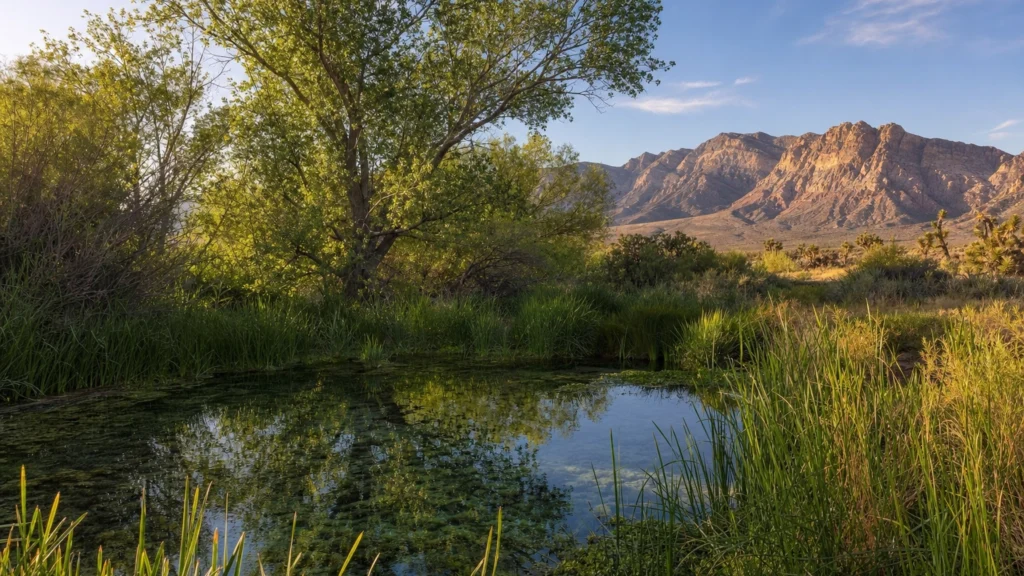
“Las Vegas” is Spanish for “The Meadows,” and the name is one of the great ironies of the American West: a city now famous for neon, concrete, and desert heat was named for cool green grass and running water. In 1829, a scout crossing the Mojave found a valley where natural springs fed wide meadows, and he called it Las Vegas. This is the full story behind the name, what the words actually mean, who chose them, and where those meadows are today.
What’s in This Guide
- “Las Vegas” is Spanish for “The Meadows.” The word vega means a fertile, water-fed meadow or plain.
- The valley was named in 1829 by Rafael Rivera, a scout with Antonio Armijo’s trading caravan on the Old Spanish Trail.
- He named it for the green meadows fed by natural artesian springs, a startling patch of green in the middle of the Mojave Desert.
- It is “Las” not “Los” because vega is a feminine Spanish noun, so it takes the feminine plural article.
- Those springs made the valley a vital water stop that later drew explorers, Mormon settlers, and the railroad that founded the modern city in 1905.
- The original springs ran dry in 1962 after decades of groundwater pumping; the site is now the Springs Preserve.
What “Las Vegas” Means in Spanish
The literal translation of Las Vegas is “The Meadows.” It comes from the Spanish noun vega, which describes a fertile, low-lying plain or meadow, usually one made green and productive by a nearby source of water. Put the plural noun vegas together with the definite article las and you get “the meadows.”
That single word carries a lot of geography. A vega is not just any grass; it is specifically the kind of rich, watered lowland that stands out against drier land around it. In a place like Spain that might be a river valley. In the middle of the Mojave Desert, it meant something close to a miracle: broad meadows of wild grass kept alive by springs bubbling up from underground. To travelers who had crossed hundreds of miles of dry country, that green was unforgettable, and it stuck as the name.

Source: Collins Spanish-English Dictionary on “vega” | Wikipedia’s history of the Las Vegas name
Why It’s “Las” Vegas, Not “Los” Vegas
One of the most common mistakes people make is writing or saying “Los Vegas.” It is always Las Vegas, and the reason is pure Spanish grammar. Every Spanish noun is either masculine or feminine, and the article in front of it has to match. Vega is a feminine noun, so its plural takes the feminine plural article las. The masculine los would be grammatically wrong, the same way “the meadow” could never become “he meadow” in English.
It is an easy slip because the far more famous “Los” city, Los Angeles, sits right next door in California, and the two are forever linked by highway and habit. But the words describe different things. Los Angeles means “The Angels” (masculine), and Las Vegas means “The Meadows” (feminine). Same Spanish roots, different genders, different articles.
| Often confused | What it actually is |
|---|---|
| “Los Vegas” | A grammar error. Vega is feminine, so it is always “Las Vegas.” |
| Las Vegas vs. Los Angeles | Both Spanish, but “The Meadows” (feminine) vs. “The Angels” (masculine). |
| Las Vegas, Nevada vs. Las Vegas, New Mexico | Two real cities. The New Mexico town predates Nevada’s and was named for the same green meadows. |
| “Las Vegas” = the lights or luck | No. The name means meadows and dates to 1829, long before gambling. |
Source: Wiktionary entry for the Spanish word “vega”
How the Valley Got Its Name in 1829
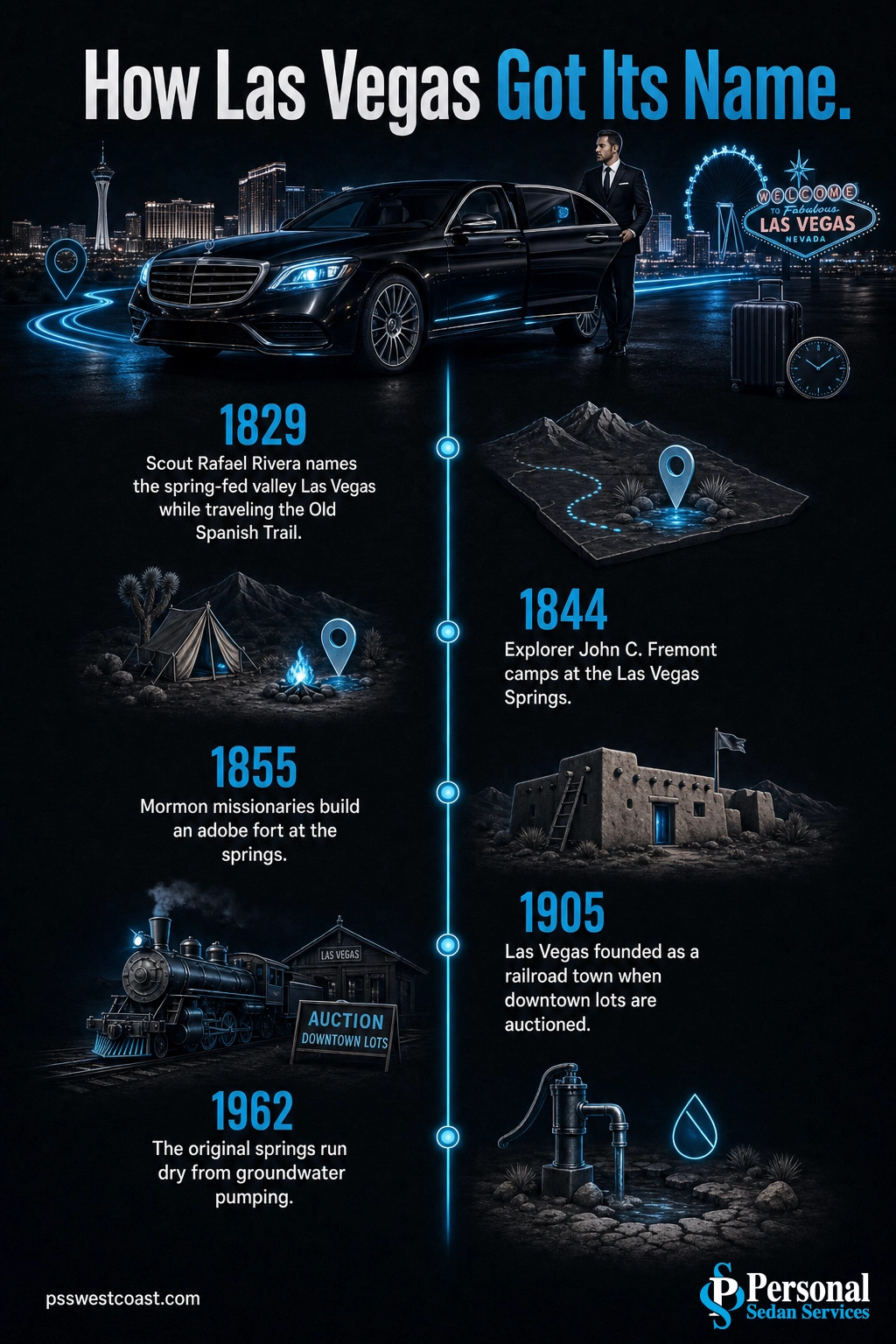
The name Las Vegas dates to 1829, decades before there was any town here. It was given by Rafael Rivera, a young scout traveling with a Mexican trading caravan led by Antonio Armijo along the Old Spanish Trail, the trade route that ran from New Mexico west to Los Angeles. As the party pushed across the desert toward California, water was the difference between life and death, and scouts rode ahead to find it.
Rivera left the main group and ventured alone into unmapped country. Within about two weeks he found what the caravan needed most: a valley of natural springs surrounded by broad green meadows. He is widely credited as the first person of European descent to enter the Las Vegas Valley, and the name he attached to it, “Las Vegas,” described exactly what he saw. The discovery did more than name a place. The reliable water there shortened the Old Spanish Trail’s route to Los Angeles and turned the valley into a regular stop for traders and travelers.
Source: Wikipedia biography of scout Rafael Rivera | Wikipedia’s account of the 1829 naming

The Meadows That Made a City
The meadows were not a mirage. Beneath the Las Vegas Valley sat artesian springs, underground water pushed to the surface under natural pressure, and they once discharged an estimated 7,500 acre-feet of water a year. That water fed wide grassy meadows in a spot the surrounding Mojave could never support, which is precisely why the valley became a landmark rather than just another stretch of trail.
Because the water was dependable, the valley kept drawing people. In May 1844, the explorer John C. Frémont camped at the Las Vegas Springs while mapping the region, and his published account helped put the valley on American maps. In 1855, a group of 29 Mormon missionaries led by William Bringhurst built a 150-foot-square adobe fort near the springs and tried to farm the meadows, though they abandoned the settlement by 1857. The real turning point came with the railroad: on May 15, 1905, 110 acres of what is now downtown were auctioned off to buyers, and the modern city of Las Vegas was born. It incorporated in 1911.
Every one of those chapters traces back to the same thing Rivera named in 1829, the water and the meadows. Without the springs, there is no trail stop, no fort, no water tower for the railroad, and quite possibly no city at all.
Source: Wikipedia on the Las Vegas Springs | National Park Service, Old Spanish Trail
Where the Meadows Are Today
If Las Vegas means “the meadows,” a fair question is: where did they go? The answer is a cautionary tale about water in the desert. As the city grew through the twentieth century, thousands of wells pulled groundwater out faster than the aquifer could refill. The pressure that had pushed the springs to the surface for thousands of years finally gave out, and in 1962 the original Las Vegas Springs ran dry.
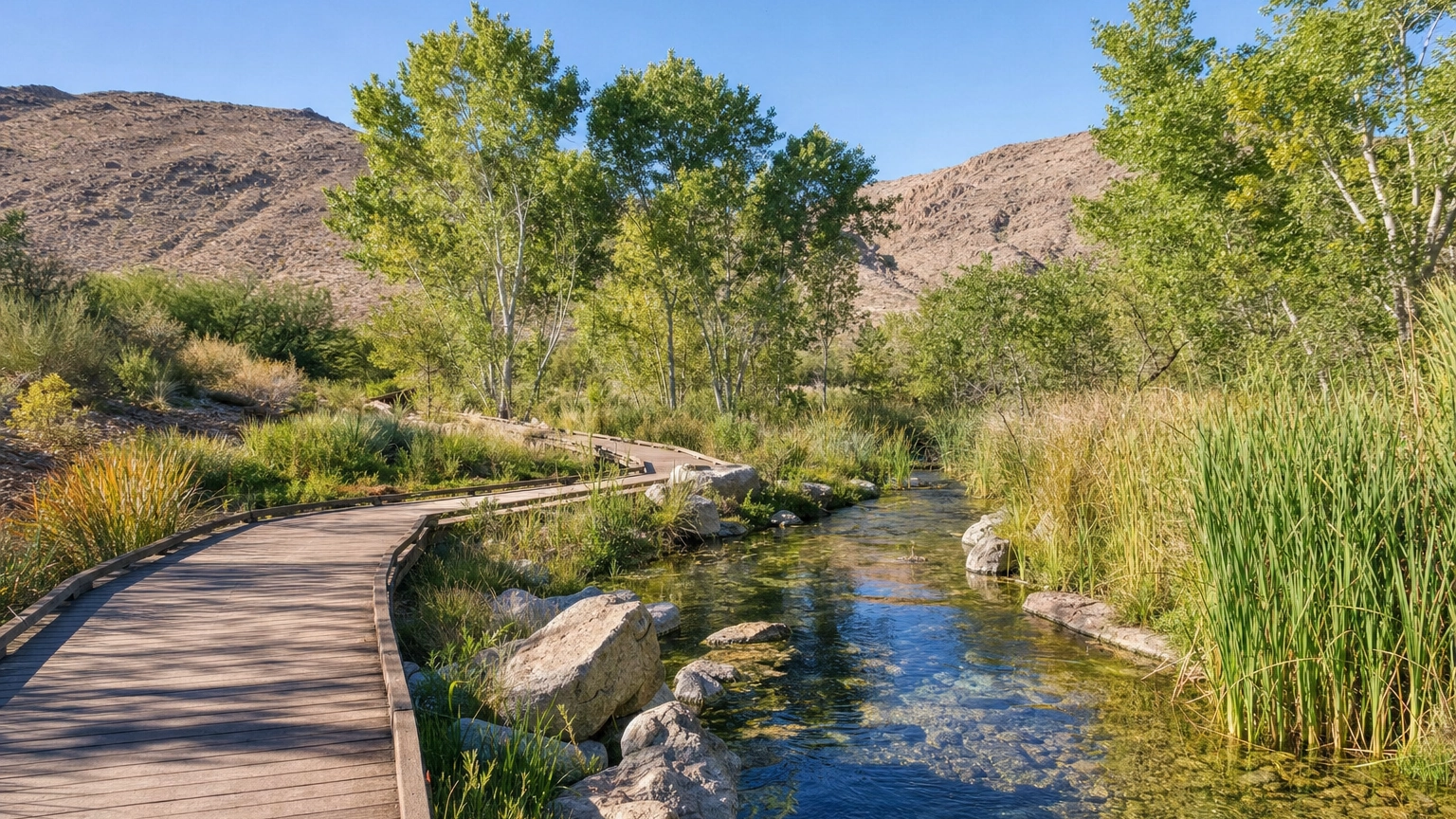
The place where it all began has not disappeared, though. The site of the original springs, about three miles west of downtown and long known as “Big Springs,” is now the Springs Preserve, a 180-acre cultural and botanical attraction listed on the National Register of Historic Places. It is billed, accurately, as the birthplace of Las Vegas. Walking its trails, museums, and restored wetlands is the closest you can come to seeing the green valley that a scout named nearly two centuries ago.
Source: Springs Preserve, mission and history | Wikipedia on the springs running dry
See the Real Las Vegas for Yourself
Knowing the name is one thing; seeing the story on the ground is another. The history of “the meadows” is scattered across the valley, from the Springs Preserve on the west side to Old Las Vegas Mormon Fort State Historic Park downtown, and the Strip most visitors come for sits well south of where any of it started. It adds up to a lot of ground to cover in a place where the summer heat is real and rideshare surge pricing has a way of appearing at the worst moment.
That is where a private car earns its keep. Personal Sedan Services runs sightseeing and history trips across Las Vegas with professional, background-checked chauffeurs and pre-confirmed flat rates, so you can trace the story of the meadows, the springs, the fort, the downtown, and the Strip, without driving unfamiliar roads, hunting for parking, or watching an app raise the fare. Book a sedan for two, an SUV for the family, or a Sprinter for the whole group.
Book Las Vegas Sightseeing Transportation
Book Your Ride
Call or Text (702) 248-7706
Related Las Vegas Terms
A few names and terms that come up alongside the meaning of Las Vegas:
- Vega: the Spanish word behind the name, meaning a fertile, water-fed meadow or lowland plain.
- The Meadows: the direct English translation of Las Vegas, and the image the name was meant to capture.
- Old Spanish Trail: the New Mexico-to-Los Angeles trade route whose scouts named and popularized the valley’s springs.
- Las Vegas Springs (Big Springs): the original artesian springs that fed the meadows, now the Springs Preserve.
- “Viva Las Vegas”: the famous phrase and Elvis song, a much later addition to the name’s story. Read what “Viva Las Vegas” means.
- Las Vegas, New Mexico: an older city that shares the name and the “meadows” meaning, often confused with the Nevada one.
- Sin City: a modern nickname for the Nevada city, unrelated to the original Spanish meaning.
Quick-Reference Summary
| Question | Answer |
|---|---|
| What does Las Vegas mean? | “The Meadows,” in Spanish |
| Root word | vega = a fertile, watered meadow or lowland plain |
| Why “Las,” not “Los” | Vega is a feminine noun, so it takes the feminine article |
| Who named it | Rafael Rivera, a scout with Antonio Armijo’s caravan |
| When | 1829, on the Old Spanish Trail |
| Why that name | Green meadows fed by natural artesian springs |
| Springs’ annual flow | About 7,500 acre-feet of water per year |
| Frémont’s visit | Camped at the springs in May 1844 |
| Mormon fort | Built 1855, abandoned 1857 |
| City founded | May 15, 1905 (railroad townsite); incorporated 1911 |
| Springs ran dry | 1962, from groundwater over-pumping |
| The meadows today | The Springs Preserve, about 3 miles west of downtown |
Frequently Asked Questions
What does “Las Vegas” mean?
Why is it “Las Vegas” and not “Los Vegas”?
Who named Las Vegas?
Were there really meadows in Las Vegas?
Is there another city named Las Vegas?
Methodology and Sources
This explainer draws on published historical records and reference sources, including Wikipedia’s histories of Las Vegas and the Las Vegas Springs, the biography of scout Rafael Rivera, the National Park Service’s material on the Old Spanish Trail, the Springs Preserve’s own history, and standard Spanish-English dictionaries for the meaning of vega. Dates and figures, including the 1829 naming, the roughly 7,500 acre-feet annual spring flow, the 1905 founding, and the 1962 drying of the springs, reflect those sources and are rounded where noted. Attribution for the first European-descent sighting of the valley is as commonly credited in the historical record. Last updated August 2026. This guide is reviewed and refreshed periodically.
Press and media: writers and journalists are welcome to reference or link to this guide. For questions, contact Personal Sedan Services at (702) 248-7706.