



Las Vegas is in the Pacific Time Zone. From roughly November to March it runs on Pacific Standard Time (PST), which is UTC-8, and during daylight saving time in spring and summer it shifts to Pacific Daylight Time (PDT), or UTC-7. That one-hour seasonal change trips up more visitors than the zone itself, so this guide covers the exact offsets, the daylight saving dates, how far ahead or behind other cities are, and the practical timing details that matter when you land at Harry Reid International Airport.
Quick answer
Las Vegas, Nevada observes Pacific Time: PST (UTC-8) in fall and winter, and PDT (UTC-7) during daylight saving time. It shares the same clock as Los Angeles, San Diego, and the rest of California all year.
Key Takeaways
- Las Vegas is on Pacific Time, the same zone as California, three hours behind the U.S. East Coast.
- PST is UTC-8; PDT is UTC-7. The city uses PDT during daylight saving (spring and summer) and PST the rest of the year.
- The clocks change twice a year. In 2026, daylight saving runs March 8 to November 1, both at 2:00 a.m. local time.
- Arizona is the tricky neighbor. Phoenix does not observe daylight saving, so Las Vegas matches Phoenix in summer but sits one hour behind it in winter.
- Nearly all of Nevada is Pacific Time, with one small exception: West Wendover, on the Utah line, runs on Mountain Time.
What’s in This Guide

What Time Zone Is Las Vegas In?
Las Vegas, Nevada sits in the Pacific Time Zone, one of the nine standard time zones the U.S. government keeps for the country and its territories. Pacific Time is the westernmost of the four zones that cover the contiguous United States, running down the coast from Washington State through Oregon, California, and most of Nevada.
The Pacific Time Zone has two faces across the year. For about four months in fall and winter it observes Pacific Standard Time (PST), set eight hours behind Coordinated Universal Time (UTC-8). For the remaining eight months it observes Pacific Daylight Time (PDT), seven hours behind UTC (UTC-7). The clock on the wall in a Strip hotel reads the same as the clock in Los Angeles or San Diego, because all of California shares the zone with Las Vegas.
If you want the exact second, the federal government publishes the official U.S. time for every zone, including Pacific, through its national time service. That is the authoritative clock airlines, courts, and broadcasters sync to, and it is the one your phone quietly pulls from when it lands in a new zone.
Source: time.gov, the official U.S. time service (NIST and USNO)
PST vs. PDT: How Daylight Saving Changes the Clock
PST and PDT are the single most confused pair in any Las Vegas time question, and the difference is simple: they are the same zone in two different seasons. PST is the standard-time setting (UTC-8). PDT is the daylight saving setting (UTC-7), which pushes the clock forward one hour so evenings stay lighter. Saying a flight lands “at 6 p.m. Pacific” is correct year-round; specifying PST or PDT just tells you which season you are in.
| PST (Pacific Standard Time) | PDT (Pacific Daylight Time) | |
|---|---|---|
| UTC offset | UTC-8 | UTC-7 |
| When Las Vegas uses it | Early Nov to mid-Mar | Mid-Mar to early Nov |
| 2026 dates | Jan 1 to Mar 8, then Nov 1 on | Mar 8 to Nov 1 |
| Behind New York by | 3 hours | 3 hours |
| Behind London by | 8 hours | 8 hours |
The switch dates are set by federal law, not by the state or the city. Daylight saving time begins on the second Sunday in March and ends on the first Sunday in November, with the change happening at 2:00 a.m. local time in each case. In the spring, clocks jump from 1:59 a.m. straight to 3:00 a.m.; in the fall, 1:59 a.m. rolls back to 1:00 a.m. The U.S. Department of Transportation governs the schedule, and the National Institute of Standards and Technology publishes the rules.
Myth: “Las Vegas doesn’t change its clocks like Arizona”
This mix-up comes from next-door Arizona, which famously skips daylight saving. Nevada does not. Las Vegas follows the same spring-forward, fall-back schedule as the rest of the Pacific Time Zone, so its clocks move twice a year. The only Nevada exception is a tiny border town, covered further down, and it is nowhere near the Strip.
Source: NIST daylight saving time rules | U.S. Department of Transportation, time zones and daylight saving

Time Difference: Las Vegas vs. Major Cities
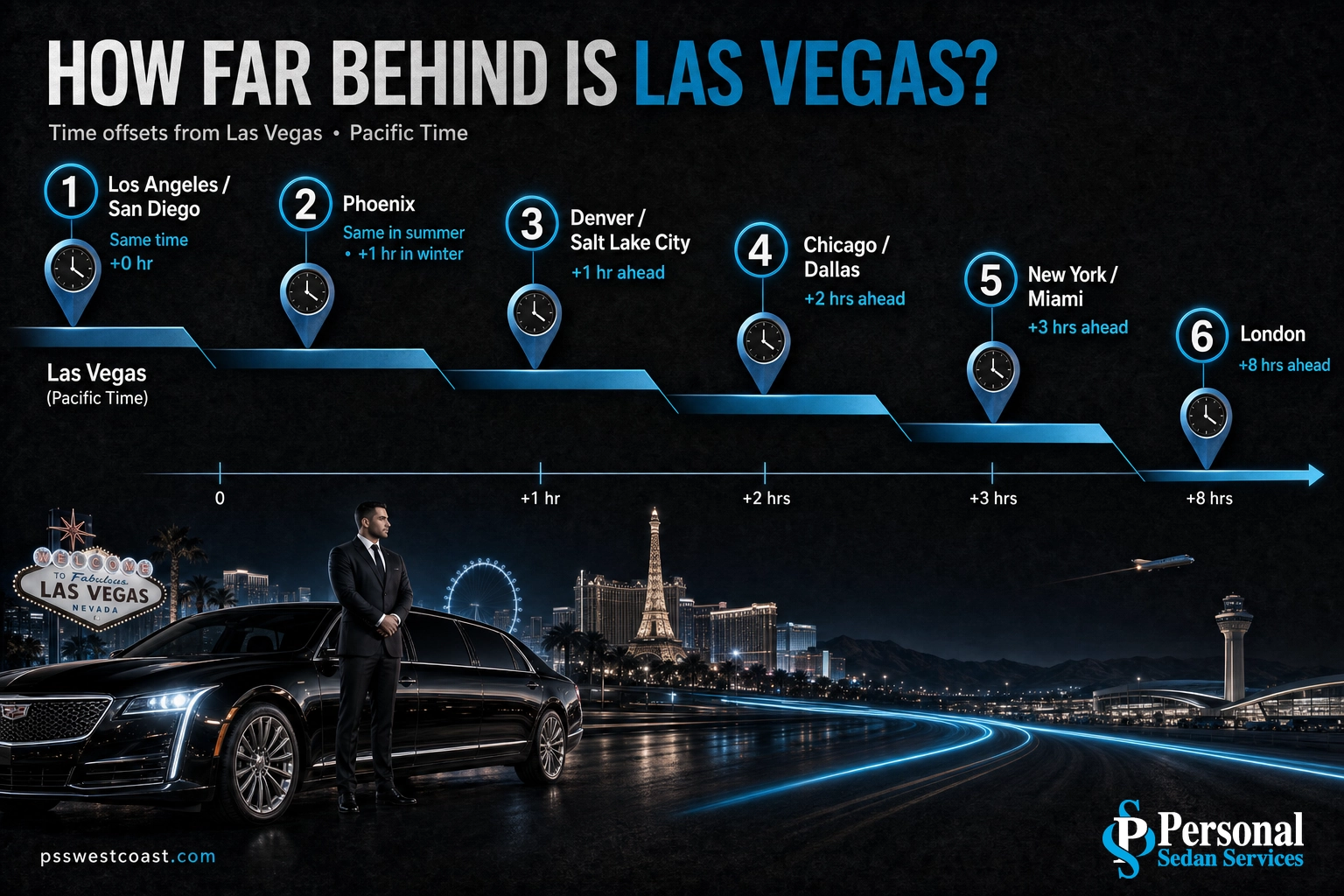
Because Pacific Time is the westernmost mainland zone, Las Vegas is behind most of the country and far behind Europe and Asia. The gaps below hold steady year-round for any city that observes daylight saving on the same U.S. schedule, and shift by an hour for the ones that do not.
| City | Its zone | Difference from Las Vegas |
|---|---|---|
| Los Angeles / San Diego | Pacific | Same time |
| Denver / Salt Lake City | Mountain | 1 hour ahead |
| Phoenix, AZ | Mountain (no DST) | Same in summer, 1 hour ahead in winter |
| Chicago / Dallas | Central | 2 hours ahead |
| New York / Miami | Eastern | 3 hours ahead |
| London | GMT / BST | 8 hours ahead |
The Arizona catch worth knowing
Arizona keeps Mountain Standard Time all year and does not spring forward. So in summer, when Las Vegas is on PDT (UTC-7), it reads the exact same time as Phoenix (also UTC-7). Come winter, Las Vegas falls back to PST (UTC-8) while Phoenix stays put, and Las Vegas ends up one hour behind. If you are timing a Phoenix to Las Vegas trip, that seasonal flip is the detail that catches people out.
California, by contrast, is easy: Los Angeles and San Diego are always on the same clock as Las Vegas, so an arrival from Los Angeles or a run up from San Diego involves no time change at all, only the drive.
How the Time Zone Affects Your Las Vegas Trip
Knowing the zone is one thing; timing your trip around it is another. A few practical points save real headaches, especially the moment you step off a plane.
Your flight lands on Las Vegas time, not your home time
Arrival times on your boarding pass are already in local Pacific Time. A red-eye that departs New York at 11:00 p.m. Eastern and shows a 1:30 a.m. arrival lands at 1:30 a.m. in Las Vegas, even though your body still thinks it is 4:30 a.m. Building your first day around the local clock, not the one you woke up on, is the fastest way to beat the shift.
Confirm your phone actually updated
Most smartphones switch to Pacific Time automatically once they connect to a local network, but it is not instant, and a phone in airplane mode or with automatic time zone turned off will not move. Glance at your lock screen against an airport clock before you rely on it for a pickup or a dinner reservation.
Coordinating a pickup across time zones
When you book a ride from out of state, the pickup time is set in Las Vegas time. That sounds obvious until a traveler in Chicago books a “3:00 p.m.” airport pickup meaning their home clock. Confirm the time in Pacific, and a good operator will track your actual flight so the car is there when you land, not when the schedule guessed. This is exactly where a professional service beats a rideshare app that only starts the clock after you have already cleared the terminal and opened your phone.
Personal Sedan Services monitors incoming flights for every airport pickup, so a delayed or early arrival does not leave you waiting or scrambling. Licensed, background-checked chauffeurs and flat, upfront pricing mean the only variable left is the tip.
Book a Las Vegas airport pickup
Corporate car service for meetings
📞 Call or Text (702) 248-7706: Book Now
Daylight saving weekends and business meetings
Twice a year the clocks move overnight, and it is easy to be an hour off the next morning if your devices did not all update together. If you are in town for a convention or an early meeting on the second Sunday of March or the first Sunday of November, double-check the time before you head out. For business travelers juggling calls with the East Coast, remember the standing three-hour gap: a 9:00 a.m. Las Vegas call is already noon in New York.
Is All of Nevada in the Pacific Time Zone?
Nearly all of it, yes. The entire state of Nevada observes Pacific Time, from Las Vegas and Reno to the rural counties, with one small, official exception.
West Wendover sits on the eastern edge of the state, pressed against the Utah border and physically next to the town of Wendover, Utah. Because its economy and daily life are tied to the Utah side, the U.S. Department of Transportation moved West Wendover into the Mountain Time Zone in 1999, so the two adjoining towns share one clock. That makes Elko County one of the rare U.S. counties split between two time zones. A handful of even smaller communities nearby keep Mountain Time informally, but they remain officially Pacific.
For anyone traveling to or within the Las Vegas metro area, none of this applies: Las Vegas, Henderson, Summerlin, North Las Vegas, and the whole valley are firmly Pacific Time. The Mountain Time pocket is more than 400 miles away.
Source: U.S. Department of Transportation, U.S. time zone boundaries
Related Terms and Guides
A few terms and neighboring guides that go with a Las Vegas time question:
- Pacific Time (PT): the umbrella term covering both PST and PDT, shared by California and most of Nevada.
- UTC: Coordinated Universal Time, the global reference the offsets (UTC-8, UTC-7) are measured against.
- Daylight Saving Time: the spring-forward, fall-back system that moves Las Vegas between PST and PDT.
- Where Las Vegas is: the city’s location, map, and geography in our guide to where Las Vegas sits.
- When to visit: season-by-season weather and crowds in our best time to visit Las Vegas guide.
- Getting around town: every transport option compared in our Las Vegas transportation guide.
Frequently Asked Questions
What time zone is Las Vegas in?
Is Las Vegas on PST or PDT right now?
Does Las Vegas change its clocks for daylight saving time?
What is the time difference between Las Vegas and New York?
Is all of Nevada in the Pacific Time Zone?
Sources and Methodology
Time zone and offset details reflect the official U.S. time published by time.gov (operated by NIST and the U.S. Naval Observatory). Daylight saving time rules and dates are from the National Institute of Standards and Technology (daylight saving begins the second Sunday in March and ends the first Sunday in November at 2:00 a.m. local time; March 8 to November 1 in 2026) and the U.S. Department of Transportation, which governs U.S. time zones and daylight saving. The DOT is also the source for the West Wendover, Nevada boundary, moved from Pacific to Mountain Time in 1999. City time differences are the standard offsets between the Pacific, Mountain, Central, and Eastern zones; Arizona figures account for its year-round Mountain Standard Time with no daylight saving.