


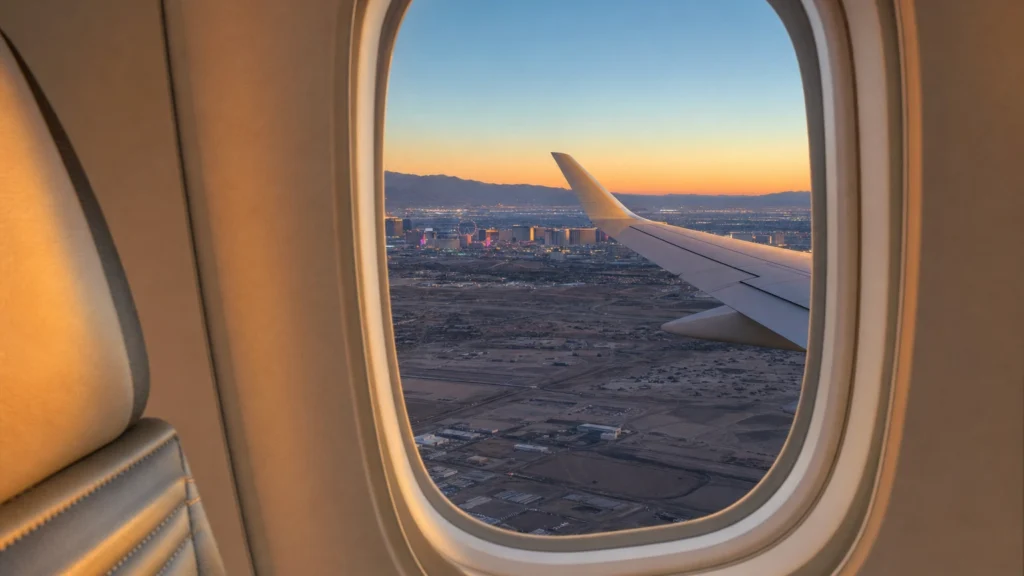
Quick answer: A nonstop flight to Las Vegas (LAS) takes about 1 hour 15 minutes from Los Angeles, roughly 1 hour 45 minutes from Denver, about 3 hours 50 minutes from Chicago, around 4 hours 10 minutes from Atlanta, and about 5 hours 15 to 5 hours 45 minutes from New York. West Coast hops are the quickest, East Coast routes the longest. Nearly everyone lands at Harry Reid International Airport, just 2 to 3 miles from the Strip.
If you are searching “how long is a flight to Las Vegas,” the real answer is a question back: where are you flying from? Las Vegas sits in the middle of the West, so a flight is a quick 75-minute hop from Southern California, a comfortable 3 to 4 hours from the middle of the country, and a solid 5 hours or more from the East Coast. This guide gives you the typical nonstop flight time to Las Vegas from every major U.S. city and a few international ones, explains what actually changes the number on your ticket, and covers the part most flight-time pages skip: the short trip from the airport to your hotel once you land.
- Shortest hops (about 1 hr 15 min): Los Angeles, Orange County, San Diego, and Phoenix, each only 230 to 260 miles from Las Vegas.
- West Coast and Mountain (1.5 to 2.5 hr): San Francisco, Sacramento, Salt Lake City, Denver, Portland, and Seattle.
- Midwest and South (3 to 4 hr): Dallas, Houston, Minneapolis, Chicago, and Atlanta.
- East Coast (about 4.5 to 5.5 hr): Washington, Philadelphia, New York, Boston, Orlando, and Miami. These are the longest domestic routes.
- Nonstop matters most: a connection can add 2 to 4 hours, so a direct flight keeps your trip near the figures above.
- The airport: everyone lands at Harry Reid International (LAS), a record 58.4 million passengers in 2024, just 2 to 3 miles from the Strip.
- Door-to-door is longer than air time: security, boarding, and ground transport add 2 to 3 hours on top of the flight, so plan your Las Vegas arrival the same way you plan the flight.

What’s in This Guide
- How Long Is a Flight to Las Vegas? The Short Answer
- Flight Times to Las Vegas from Major Cities (Full Chart)
- Nonstop vs. Connecting Flights to Las Vegas
- Flight Times from the West Coast and Southwest
- Flight Times from the Midwest and South
- Flight Times from the East Coast
- International Flights to Las Vegas
- What Changes Your Flight Time to Las Vegas
- Best Time to Fly to Las Vegas (and the Red-Eye Question)
- Harry Reid International Airport (LAS): What to Know
- After You Land: Getting from LAS to Your Hotel
- Flying In for a Big Event? Plan Extra Time
- Should You Fly or Drive to Las Vegas?
- Plan Your Las Vegas Arrival: A Simple Roadmap
- Frequently Asked Questions
- Related Las Vegas Travel Guides
How Long Is a Flight to Las Vegas? The Short Answer
There is no single flight time to Las Vegas, because the number is driven by distance, and Las Vegas is a long way from some places and a short hop from others. The quickest major routes are the Southern California hops: Los Angeles, Orange County, and San Diego are all roughly an hour and 15 minutes in the air, as is Phoenix. From the middle of the country, think 3 to 4 hours. From the East Coast, the longest domestic flights run about 5 to 5 hours 45 minutes nonstop, with New York and Boston at the top end.
Those figures are typical nonstop air times, which is the clean, apples-to-apples way to compare routes. Your airline ticket will usually show a slightly longer scheduled time, because that number is gate-to-gate “block time” that includes pushback, taxiing, and lining up for the runway. And the total time away from home is longer still once you add getting to the airport, security, boarding, baggage, and the ride to your hotel. We break all of that down below, but the air-time chart is the place to start.
One thing works in every traveler’s favor: Las Vegas is one of the best-connected leisure destinations in the country. Harry Reid International Airport handled a record 58.4 million passengers in 2024 and offers nonstop service to roughly 170 markets, so from most major cities you can fly direct and keep your trip time at or near the nonstop figure. That is a bigger deal than most people realize, because a single connection can add more time than the entire flight from the West Coast.
Source: Harry Reid International Airport, 2024 record passenger numbers
Flight Times to Las Vegas from Major Cities (Full Chart)
Here is the complete picture: typical nonstop air time to Las Vegas from the major cities people fly in from, grouped by region and ordered roughly from shortest to longest. Air times are approximate and assume a direct flight. Great-circle distances are the straight-line air miles between airports, which is why they are shorter than the driving distance for the same city.
| From | Main airport | Approx. air miles | Typical nonstop time | Nonstop? |
|---|---|---|---|---|
| Los Angeles, CA | LAX | ~236 | ~1 hr 15 min | Yes, very frequent |
| Orange County, CA | SNA | ~230 | ~1 hr 15 min | Yes |
| San Diego, CA | SAN | ~260 | ~1 hr 15 min | Yes, very frequent |
| Phoenix, AZ | PHX | ~255 | ~1 hr 15 min | Yes, very frequent |
| Salt Lake City, UT | SLC | ~370 | ~1 hr 25 min | Yes |
| San Francisco, CA | SFO | ~415 | ~1 hr 30 min | Yes, very frequent |
| Sacramento, CA | SMF | ~400 | ~1 hr 30 min | Yes |
| Denver, CO | DEN | ~630 | ~1 hr 45 min | Yes, very frequent |
| Portland, OR | PDX | ~765 | ~2 hr 10 min | Yes |
| Seattle, WA | SEA | ~867 | ~2 hr 30 min | Yes, very frequent |
| Dallas-Fort Worth, TX | DFW | ~1,055 | ~2 hr 50 min | Yes, very frequent |
| Kansas City, MO | MCI | ~1,140 | ~2 hr 55 min | Yes |
| Houston, TX | IAH | ~1,220 | ~3 hr | Yes, very frequent |
| Minneapolis, MN | MSP | ~1,300 | ~3 hr 20 min | Yes |
| St. Louis, MO | STL | ~1,375 | ~3 hr 25 min | Yes |
| New Orleans, LA | MSY | ~1,520 | ~3 hr 35 min | Yes |
| Chicago, IL | ORD / MDW | ~1,510 | ~3 hr 50 min | Yes, very frequent |
| Nashville, TN | BNA | ~1,585 | ~3 hr 55 min | Yes |
| Atlanta, GA | ATL | ~1,745 | ~4 hr 10 min | Yes, very frequent |
| Washington, DC | IAD / DCA | ~2,070 | ~4 hr 55 min | Yes |
| Orlando, FL | MCO | ~2,035 | ~4 hr 50 min | Yes |
| Miami, FL | MIA | ~2,175 | ~5 hr | Yes |
| Philadelphia, PA | PHL | ~2,175 | ~5 hr 10 min | Yes |
| New York, NY | JFK / EWR / LGA | ~2,240 | ~5 hr 15 to 5 hr 45 min | Yes, very frequent |
| Boston, MA | BOS | ~2,380 | ~5 hr 30 min | Yes |
| Vancouver, BC | YVR | ~1,000 | ~2 hr 40 min | Yes |
| Mexico City, MX | MEX | ~1,340 | ~3 hr 15 min | Yes |
| Toronto, ON | YYZ | ~2,120 | ~4 hr 45 min | Yes |
| London, UK | LHR | ~5,215 | ~10 hr 30 min | Yes, select carriers |

Read the table as a planning tool, not a stopwatch. Westbound flights to Las Vegas usually run a touch longer than the eastbound trip home, because the jet stream flows west to east across North America and adds a headwind on the way out. On a transcontinental route like New York, that difference can be 30 to 45 minutes. We cover the full set of factors below.
Source: U.S. DOT Bureau of Transportation Statistics flight data | Harry Reid International Airport
Nonstop vs. Connecting Flights to Las Vegas
The single biggest variable in how long it takes to get to Las Vegas is not the city you leave from. It is whether you fly nonstop. The chart above assumes a direct flight, and for most major cities that is a realistic assumption, because Las Vegas is a top leisure destination with heavy nonstop service. But if you book a connection, the math changes completely.
A connection adds the second flight’s air time plus a layover, which is rarely less than 45 minutes and often 1 to 2 hours, plus the risk of a missed connection or a delay that strands you at the hub. A one-stop itinerary from the East Coast can easily turn a 5 hour 30 minute nonstop into a 9 or 10 hour day of travel. From the West Coast, where the nonstop is barely over an hour, a connection can more than double your travel time.
How to read a connecting itinerary: the number that matters is “total travel time” or “total duration,” not the individual flight segments. A 2 hour 15 minute first leg plus a 1 hour 30 minute layover plus a 2 hour 30 minute second leg is a 6 hour 15 minute trip, even though neither flight is long. Always compare total duration, and when the price gap is small, the nonstop is almost always worth it for a Las Vegas trip.
The good news bears repeating: from nearly every major U.S. city, a nonstop to Las Vegas exists, often several a day. That is a direct result of how much service the airport carries, which is also why fares stay competitive. When you can fly direct, do it, and your real-world arrival time will track closely with the chart above.
Arrange your Las Vegas airport pickup
Flight Times from the West Coast and Southwest
This is Las Vegas’s backyard, and the flights show it. Everything west of the Rockies is a short, high-frequency hop, which is a big reason Las Vegas draws so heavily from California, Arizona, and the Pacific Northwest. If you are flying from here, the flight itself is the easy part of the trip.
From Southern California, Los Angeles, Orange County, and San Diego all come in around 1 hour 15 minutes of air time. These routes run so frequently that they function almost like a shuttle, with departures throughout the day. Phoenix is the same story at about 1 hour 15 minutes. Step out a little further and San Francisco and Sacramento are roughly 1 hour 30 minutes, Salt Lake City about 1 hour 25 minutes, and Denver about 1 hour 45 minutes. The Pacific Northwest is the longest hop in this group: Portland is about 2 hours 10 minutes and Seattle about 2 hours 30 minutes.
Here is how the main West Coast and Southwest routes break down, city by city:
- Los Angeles (LAX) and Orange County (SNA): about 1 hour 15 minutes. The LAX route is one of the most-served short-haul city pairs in the country, with departures nearly every hour on multiple carriers. Burbank, Long Beach, and Ontario add still more Southern California options, all in the same 70-to-80-minute range.
- San Diego (SAN): about 1 hour 15 minutes over roughly 260 miles, with frequent daily nonstops. A popular quick-getaway route for weekends on the Strip.
- Phoenix (PHX): about 1 hour 15 minutes. A major connecting hub, so you will find both nonstops throughout the day and plenty of one-stop options from smaller Southwest cities.
- San Francisco (SFO) and Sacramento (SMF): about 1 hour 30 minutes. Northern California has heavy nonstop service, especially from the Bay Area.
- Salt Lake City (SLC): about 1 hour 25 minutes over roughly 370 miles, with frequent service as a Mountain West hub.
- Denver (DEN): about 1 hour 45 minutes over roughly 630 miles, one of the busiest routes into Las Vegas and a major connecting point for the Rockies and Plains.
- Portland (PDX) and Seattle (SEA): about 2 hours 10 minutes and 2 hours 30 minutes respectively, the longest hops in this group but still comfortably under three hours, with daily nonstops from both.
Typical Nonstop Flight Time to Las Vegas (by region)
Approximate nonstop air time to Las Vegas from a representative city in each region. Source: typical scheduled nonstop times.
Because the flights are so short from here, the airport and ground portions of the trip become a larger share of your total time. A 75-minute flight from Los Angeles can be shorter than the time you spend getting to LAX, clearing security, and waiting to board, which is exactly why some Southern California travelers weigh driving instead. We tackle that fly-or-drive question directly in a later section.
Source: U.S. DOT Bureau of Transportation Statistics on-time flight data
Flight Times from the Midwest and South
From the middle of the country, a flight to Las Vegas settles into the comfortable 3-to-4-hour range: long enough to feel like a real flight, short enough for a day trip to be realistic. Texas is the quickest part of this group. Dallas-Fort Worth is about 2 hours 50 minutes and Houston about 3 hours, both with heavy nonstop service.
Move up and across the Midwest and the numbers grow with the distance. Kansas City is about 2 hours 55 minutes, Minneapolis about 3 hours 20 minutes, St. Louis about 3 hours 25 minutes, and Chicago about 3 hours 50 minutes from either O’Hare or Midway. Through the South, New Orleans is roughly 3 hours 35 minutes and Nashville about 3 hours 55 minutes. Atlanta, the busiest airport in the world, anchors the longer end of this group at about 4 hours 10 minutes, with nonstops running all day.
A few of these routes deserve a specific note:
- Dallas-Fort Worth (DFW) and Houston (IAH): about 2 hours 50 minutes and 3 hours, the quickest routes from Texas, both major hubs with nonstops running from early morning to late at night.
- Chicago (ORD and MDW): about 3 hours 50 minutes from either airport. Las Vegas is one of Chicago’s most popular leisure routes, so frequency is high and fares are competitive, which makes the nonstop the obvious choice.
- Minneapolis (MSP) and St. Louis (STL): about 3 hours 20 minutes and 3 hours 25 minutes, both well served nonstop.
- Atlanta (ATL): about 4 hours 10 minutes. As the world’s busiest airport, Atlanta offers constant nonstop service, but its size means longer taxi and congestion time on the ground, so give yourself margin on connections.
- Nashville (BNA) and New Orleans (MSY): about 3 hours 55 minutes and 3 hours 35 minutes, both popular leisure pairings with Las Vegas.
| From | Typical nonstop time | Day trip realistic? |
|---|---|---|
| Dallas-Fort Worth | ~2 hr 50 min | Yes, easily |
| Houston | ~3 hr | Yes, easily |
| Minneapolis | ~3 hr 20 min | Yes, with an early start |
| Chicago | ~3 hr 50 min | Yes, with an early start |
| Atlanta | ~4 hr 10 min | Possible, but long |
One quiet advantage for this group: the two-hour time zone gap in your favor flying west. Leave Chicago at 8 a.m. Central and you land in Las Vegas before 9 a.m. Pacific, with a full day ahead of you. That time shift is a big reason Las Vegas works so well as a quick getaway from the Midwest and South.
Source: U.S. DOT Bureau of Transportation Statistics
Flight Times from the East Coast
The East Coast gives you the longest domestic flights to Las Vegas, and this is where the nonstop-versus-connection choice matters most. These are transcontinental routes of roughly 2,000 to 2,400 air miles, so even a direct flight is a half-day commitment once you add the ground portions on both ends.
Washington, DC comes in around 4 hours 55 minutes, Orlando about 4 hours 50 minutes, and Miami about 5 hours. Philadelphia is roughly 5 hours 10 minutes. New York, from JFK, Newark, or LaGuardia, runs about 5 hours 15 minutes to 5 hours 45 minutes depending on the airport and winds, and Boston is the longest major route at about 5 hours 30 minutes. Each of these is served nonstop, often several times a day, so a connection is a choice rather than a necessity.
The East Coast routes in detail:
- Washington, DC (IAD and DCA): about 4 hours 55 minutes. Both the Dulles and Reagan National areas have nonstop options, though long-haul leisure flights more often run from Dulles.
- Orlando (MCO) and Miami (MIA): about 4 hours 50 minutes and 5 hours. Florida-to-Vegas is a heavy leisure market with frequent nonstops.
- Philadelphia (PHL): roughly 5 hours 10 minutes, with reliable daily nonstop service.
- New York (JFK, EWR, LGA): about 5 hours 15 to 5 hours 45 minutes. The range reflects the airport and the headwind. Newark and JFK carry the most nonstop frequency on this route, one of the signature transcontinental city pairs.
- Boston (BOS): about 5 hours 30 minutes, the longest of the major domestic routes, served nonstop daily.
Myth: “My ticket says 5 hours 30 minutes, so that is how long I will be traveling.” Not quite. That figure is scheduled gate-to-gate block time for the flight alone. Your real door-to-door time includes getting to the airport, the recommended 2-hour arrival window for a domestic flight, boarding, baggage claim in Las Vegas, and the ride to your hotel. On a coast-to-coast trip, plan for 8 to 9 hours door-to-door, and build in a cushion for the westbound headwind that can stretch the flight itself.
Because the flight is long and often lands late in Las Vegas thanks to the three-hour time change, the smoothest East Coast arrivals are the ones where ground transport is handled before you take off. Nobody wants to join a taxi or rideshare line at 11 p.m. local time after five and a half hours in a seat. A car waiting at your terminal turns the end of a long travel day into the easy part.
See our luxury arrival options
International Flights to Las Vegas
Las Vegas is not only a domestic draw. International service has grown fast, and the airport’s own figures show it: international passenger traffic jumped 13.6 percent in 2024, with new long-haul routes added, including nonstop service to Dublin. For flight-time planning, the international picture breaks into a few tiers.
From Canada and Mexico, times look a lot like domestic routes. Vancouver is about 2 hours 40 minutes, Mexico City about 3 hours 15 minutes, and Toronto about 4 hours 45 minutes, all with nonstop options. Transatlantic service is a different scale: London is roughly 10 hours 30 minutes nonstop, and other European gateways are in the 10-to-12-hour range. From Asia, expect very long nonstops or a connection on the West Coast.
If you are connecting through a U.S. gateway on an international itinerary, remember to budget time for customs and immigration at your first U.S. point of entry, not in Las Vegas. That clearance, plus re-checking bags and re-clearing security, is the part of an international trip that most often eats into the day, so give yourself a generous layover.
Source: Harry Reid International Airport, 2024 passenger and international traffic release
What Changes Your Flight Time to Las Vegas
Two travelers on the same route can land with different times on the clock. Here is what moves the number, so you know whether to trust the schedule or build in a buffer.
- Wind and the jet stream. The jet stream flows west to east across North America. Flying west to Las Vegas means a headwind, which lengthens the flight. Flying home east gives you a tailwind, which shortens it. On a transcontinental route, the westbound trip can be 30 to 45 minutes longer than the eastbound one.
- Nonstop versus connecting. By far the biggest factor, as covered above. A connection adds a layover and a second flight, often doubling West Coast trip times.
- Routing and air traffic. Flights rarely travel the exact straight-line distance. Air traffic control, weather reroutes, and busy arrival patterns into a 58-million-passenger airport can add a few minutes of airborne holding or a longer path.
- Departure airport and time of day. Big hubs with long taxi times and midday congestion add block time. Morning departures are the most reliable, because delays compound as the day goes on.
- Season. Summer heat in the desert can affect aircraft performance on the ground, and winter storms at your origin can delay pushback. The flight itself is rarely the issue; the ground around it is.
Pro tip: when you want to compare routes honestly, use typical nonstop air time, which is what this guide lists. When you want to know what your specific flight will do on a specific day, check the airline’s live schedule and a flight-tracking site, which reflect that day’s winds, routing, and congestion. The chart is for planning; the airline’s schedule is for your actual booking.
Source: National Weather Service Aviation Weather Center
Best Time to Fly to Las Vegas (and the Red-Eye Question)
The flight time barely moves whether you leave at 7 a.m. or 7 p.m., but the reliability of the trip and the quality of your arrival change a lot with the clock. If you want the best odds of landing on time, book a morning departure. Delays accumulate through the day as aircraft and crews fall behind, so a first-wave flight is far less likely to be pushed back than an evening one. Morning arrivals also drop you into Las Vegas with a full day ahead, which is why they are popular for quick trips.
The red-eye is the other classic Vegas play, and it is a genuine time-saver if you use it right. From the West Coast and Mountain states, an overnight or very late flight lets you squeeze an extra evening out of your origin city and arrive ready to start the next day. The tradeoff is the arrival: you touch down tired, late, and into a terminal where the taxi and rideshare lines are at their most unpredictable. A red-eye is the single best argument for arranging your ride before you fly.
Season matters for crowds and fares more than for the flight itself. Spring and fall are the sweet spot for comfortable desert weather and steady schedules. Summer brings extreme daytime heat, which occasionally affects ground operations but rarely the flight, and winter is mild in Las Vegas but can bring weather delays at your origin. The busiest and priciest travel windows line up with major events, which is a category worth planning around on its own.
Pro tip: if you are choosing between a morning flight and a red-eye, decide based on your first day. A morning flight protects an on-time arrival and a full first day. A red-eye maximizes your last night at home and your time on arrival day, but only pays off if your hotel room is ready early and your ground transport is locked in so you are not stranded at 1 a.m. For families and groups, the morning flight is usually the calmer choice.
Line up a chauffeur for your arrival
Harry Reid International Airport (LAS): What to Know
Almost every flight to Las Vegas lands at Harry Reid International Airport, code LAS, the airport formerly known as McCarran International. It is one of the busiest airports in the United States, and crucially, one of the closest to its city’s core. The airport sits about 2 to 3 miles from the south end of the Las Vegas Strip, so your ground trip is short no matter which resort you are headed to.
LAS has two passenger terminals, Terminal 1 and Terminal 3, with most domestic carriers operating out of Terminal 1 and international and some domestic flights out of Terminal 3. Both terminals feed into the same central ground-transportation setup. With a record 58.4 million passengers in 2024, the airport is well-equipped but busy, especially on weekend afternoons and around major events and conventions, which is worth remembering when you plan your pickup.

A few logistics are worth knowing before you land, because they shape how long that last leg really takes. Taxis and limousine or private-car services pick up from the terminal curb areas, the shortest walk. Rideshare pickups are routed to designated zones, which at LAS can mean a longer walk or a level change from baggage claim, and app-based rides are subject to the busiest-period waits and surge pricing. Rental cars are not at the terminal at all: a shuttle takes you to a separate consolidated rental car center a few minutes away, which adds time to that option. Knowing where your ride actually meets you is half the battle on arrival.
Because the airport is so close to the Strip and downtown, the ground portion of your trip is short in miles but can be slow in practice if you land during a rush or a big event, or if you end up in a long rideshare or taxi line. The distance is never the problem in Las Vegas; the lines and the wait are. That is the part worth planning.
Source: Harry Reid International Airport official site

After You Land: Getting from LAS to Your Hotel
This is the part most flight-time pages leave out, and it is where your arrival is actually won or lost. You can land at LAS after a smooth 75-minute hop and still spend 45 minutes getting to your room if you pick the wrong ground option at the wrong time. Here is an honest comparison of how to cover those last 2 to 3 miles.
| Option | Time to the Strip | Rough cost | Best for |
|---|---|---|---|
| Rideshare (Uber/Lyft) | 10 to 20 min, plus a walk to the pickup zone and possible wait | $ to $$ (surges on arrivals and events) | Solo travelers and couples who do not mind the walk to the rideshare area and variable pricing. |
| Taxi | 10 to 15 min | $$ metered | Curbside convenience with no app, though lines can be long at peak arrivals. |
| Shared shuttle | 30 to 60 min with multiple hotel stops | $ (lowest) | Budget solo travelers who are not in a hurry and do not mind other stops first. |
| Private car service (us) | 10 to 15 min, direct | $$ flat quote, no surge | Groups, families, late-night arrivals, business travelers, and anyone who wants a driver waiting at the terminal. |
Rideshare and taxis work, but both put you in a line at the exact moment thousands of other passengers are landing, and rideshare fares surge when demand is high, which on a Friday night or a convention arrival is precisely when you are landing. A shared shuttle is the cheapest option but trades your time for the savings, stopping at several hotels before yours. For a group, a late flight, or anyone who simply wants the trip to be easy, a private car with a professional chauffeur waiting at the terminal is the option that matches the convenience of a short airport the way it should feel.

Personal Sedan Services runs airport pickups at Harry Reid International every day, in clean, late-model sedans, SUVs, and vans, driven by licensed, background-checked chauffeurs. Your driver tracks your flight, so a delay or an early landing is handled without a frantic phone call, and meets you ready to go, which is exactly what you want after a long travel day or a late red-eye.
Book your Las Vegas airport pickup
Traveling with a group, a wedding party, a corporate team, or a convention delegation changes the ground math entirely. Splitting a large party across several rideshares is slow and unpredictable, while a single van or a coordinated set of vehicles keeps everyone together and on schedule from the curb to the hotel.
Explore group airport transportation
Flying In for a Big Event? Plan Extra Time
Las Vegas runs on events, and the big ones reshape both your flight and your arrival. When a major convention, a championship fight, a Formula 1 weekend, a Raiders game at Allegiant Stadium, or a holiday weekend lands on your travel dates, two things happen at once: flights fill up and get more expensive, and the airport and roads get far busier. The air time does not change, but everything around it does.
During a peak event, nonstops sell out earlier, so booking well ahead protects both your fare and your ability to fly direct rather than connect. On the ground, arrival halls, taxi stands, and rideshare lots can back up badly when thousands of visitors land in the same few hours, and Strip-area traffic tightens, especially around Formula 1 in November and the biggest conventions in January. A 10-minute drive from the airport can stretch well past that when a race or a convention has the corridor jammed.
Event-week reality check: the flight-time chart in this guide still holds during big events, but your door-to-door time does not. Build in a larger cushion on both ends, book your flight and your ground transport early, and expect the airport and the Strip corridor to be at their busiest. The travelers who glide through event weekends are the ones who arranged a pickup in advance instead of joining the surge-priced rideshare scramble on arrival.
This is where planned ground transportation earns its keep. A professional service tracks your flight against the day’s conditions, knows the event-week traffic patterns, and has a driver positioned to meet you, so a packed arrival hall and a jammed Strip become someone else’s problem to solve. For a group flying in for a wedding, a conference, or a game, coordinating one service beats splitting the party across unpredictable rideshares in the middle of an event-week crush.
Should You Fly or Drive to Las Vegas?
For cities within driving range, mostly Southern California, Arizona, and Utah, flying is not automatically faster once you count the whole trip. This is the fly-or-drive question, and the honest answer surprises people.
Take Los Angeles. The flight is about 1 hour 15 minutes, but add getting to LAX, the 2-hour domestic arrival window, boarding, baggage, and ground transport on both ends, and your real door-to-door time is close to the 4-hour drive straight up Interstate 15. San Diego and Phoenix tell a similar story: the flight wins on paper, but the full trip is a near-tie once airports are in the picture. For these routes, the deciding factor is usually comfort and cost, not raw speed.
| From | Nonstop flight | Drive time | Realistic verdict |
|---|---|---|---|
| Los Angeles | ~1 hr 15 min air | ~4 hr via I-15 | Near tie door-to-door; many drive or take a private car. |
| San Diego | ~1 hr 15 min air | ~5 hr | Flying edges ahead, but a chauffeured drive is popular for groups. |
| Phoenix | ~1 hr 15 min air | ~4.5 to 5 hr | Flying is faster; driving wins for flexibility and cost with a group. |
| St. George, UT | Rare, usually connect | ~2 hr | Driving wins clearly; no practical nonstop. |
When driving wins, or ties, the drive itself does not have to be a chore. A private chauffeured car turns the I-15 run into rest time: your group travels together, nobody loses a vacation day behind the wheel, and you arrive relaxed. We run these Southern California corridors every day. If you are weighing the options, our city-by-city distance guides below break down each drive in detail.
See our long-distance Las Vegas routes
Plan Your Las Vegas Arrival: A Simple Roadmap
Knowing the flight time is step one. A smooth Las Vegas arrival is the result of a few small decisions made in the right order. Here is the short version.
| Action | Priority | When | Relevant service |
|---|---|---|---|
| Book a nonstop if one exists on your route | High | At booking | Keeps trip time near the chart figure |
| Check the airline’s live scheduled time, not just air time | High | At booking | Accurate block time for your date |
| Add 2 to 3 hours to the flight for real door-to-door time | High | While planning | Sets realistic arrival expectations |
| Arrange airport pickup in advance, especially for a late or group arrival | High | 1 to 2 weeks before | Airport pickup |
| Coordinate one vehicle for groups and events | Medium | 1 to 2 weeks before | Group transportation |
| For drivable cities, compare fly vs drive honestly | Medium | While planning | Long-distance routes |
Do those six things and the flight time becomes what it should be: a planning number, not a source of stress. The flight is the part the airline handles. The arrival is the part you can make effortless.
Frequently Asked Questions
How long is a flight to Las Vegas?
What is the shortest flight to Las Vegas?
How long is the flight from Los Angeles to Las Vegas?
How long is the flight from New York to Las Vegas?
How long is a flight to Las Vegas from Chicago?
Does Las Vegas have nonstop flights from most major cities?
What airport do you fly into for Las Vegas?
How long does it take to get from the Las Vegas airport to the Strip?
Is it faster to fly or drive to Las Vegas from Southern California?
What is the best time of day to fly to Las Vegas?
Related Las Vegas Travel Guides
- How far Los Angeles is from Las Vegas – the I-15 drive that competes with the 75-minute flight.
- How far San Diego is from Las Vegas – the longer Southern California coastal route.
- How far Phoenix is from Las Vegas – a fly-or-drive near-tie for Arizona travelers.
- How far St. George, Utah is from Las Vegas – the short drive where driving clearly wins.
- Late-flight car service at the Las Vegas airport – what to do when your flight lands after midnight.
- Las Vegas car service – our full local transportation coverage once you are in town.
Sources and Methodology
Flight times in this guide are typical nonstop air times, the standard way to compare routes between two airports. They are approximate and will vary with the jet stream, routing, air traffic, the specific aircraft, and the day’s weather. A westbound flight to Las Vegas commonly runs 30 to 45 minutes longer than the eastbound return on long routes because of the headwind. Scheduled gate-to-gate times shown by airlines are generally 10 to 25 minutes longer than pure air time, and real door-to-door travel time adds getting to the airport, the recommended arrival window, boarding, baggage, and ground transport on both ends. Great-circle distances are approximate straight-line air miles between primary airports. For your exact flight, check the operating airline’s live schedule, which reflects that day’s conditions. Airport facts, including the record 58.4 million passengers and 13.6 percent international growth in 2024 and the airport’s distance from the Strip, come from Harry Reid International Airport and its newsroom. Route and on-time data reference the U.S. Department of Transportation Bureau of Transportation Statistics. Last Updated: October 2026.
