



Las Vegas taxi rates run on two separate systems, and knowing which one applies is the difference between a fair ride and a surprise bill. Trips from Harry Reid International Airport to the Strip use fixed flat-rate zones of roughly $19, $23, or $27 depending on how far north your hotel sits. Everywhere else, the cab runs on a regulated meter that starts at $3.50 and adds about $2.76 a mile. Layer on a $2 airport surcharge, a $3 card fee, a 3% tax, and a tip, and the real total is higher than the number travelers expect. This guide breaks down every fare, every fee, and exactly what to expect before you get in.
- Airport to the Strip is a flat rate, not the meter: about $19 (South Strip), $23 (Center Strip), and $27 (North Strip to The STRAT) on direct trips.
- The meter runs everywhere else: a $3.50 drop plus about $2.76 per mile, with waiting time near $32.40 an hour.
- Fees stack on top: a $2 airport pickup surcharge, a $3 credit or debit card fee, and a 3% excise tax, none of which include the tip.
- Tip 15% to 20%: it is never included in the zone fare or the meter.
- A real Center Strip ride lands near $33 to $35 all in, once fees and a tip are added to the $23 zone fare.
- Downtown and Fremont Street are metered, not zoned, and usually total about $35 to $45 from the airport.
- Taxi flat rates never surge, so they often beat rideshare during conventions, fights, and holiday weekends.
- A private car service quotes one flat price upfront, with no meter, no surge, and a licensed, background-checked chauffeur.

What’s in This Guide
- How Las Vegas Taxi Fares Actually Work
- The Las Vegas Taxi Meter, Rate by Rate
- Airport Flat-Rate Zones to the Strip
- Downtown and Off-Strip: When the Meter Takes Over
- The Fees and Surcharges That Catch Tourists Off Guard
- What a Ride Really Costs, All In
- Taxi vs Uber and Lyft in Las Vegas
- When Las Vegas Taxi Costs Spike
- Taxi vs Private Car Service
- Where to Catch a Taxi at the Airport
- How to Avoid Overpaying and Long-Hauling
- Paying and Tipping Etiquette
- Taxi Costs for Common Las Vegas Trips
- What to Do Next
- Full Rate and Fee Summary
- Frequently Asked Questions
How Las Vegas Taxi Fares Actually Work
Most cities run taxis on a single meter. Las Vegas runs two systems side by side, and the one that applies depends entirely on where your trip starts and ends. Understanding that split up front explains almost every “why was my fare so different” story travelers bring home.
The first system is the regulated meter. Every licensed cab in the valley carries the same meter rates, set by Nevada’s taxicab regulator and posted on a card inside the vehicle. The meter governs trips around town: hotel to a restaurant, the Strip to an arena, a convention center to downtown. It starts the moment you pull away and climbs by distance and by time stopped in traffic.
The second system is the airport flat-rate zone. Because the single most common taxi trip in Las Vegas is the run from Harry Reid International Airport to a Strip hotel, the regulator set fixed prices for those rides by zone. On a direct trip, the driver does not use the meter at all. You pay a set amount based on which stretch of the Strip your hotel sits on, which removes the guesswork and the incentive to pad the route.
The practical takeaway: if you are landing and heading to a Strip resort, you are almost always on a flat zone fare. For nearly everything else, you are on the meter. Both are regulated, both are legal, and both come with the same extra fees layered on top, which is where first-time riders get surprised.
One more point before the numbers: you do not choose which system you are on, your trip does. A direct ride from Harry Reid International Airport to a Strip resort defaults to a flat zone fare, while a ride to anywhere off the Strip corridor, or any trip that does not start at the airport, runs on the meter. That means the one time you get the fixed, surge-proof zone price is the single most common arrival trip, and it is also the trip where the fees stack highest because of the airport pickup surcharge. Keeping that distinction straight is what separates the travelers who budget accurately from the ones who are caught off guard at the curb.
The Las Vegas Taxi Meter, Rate by Rate
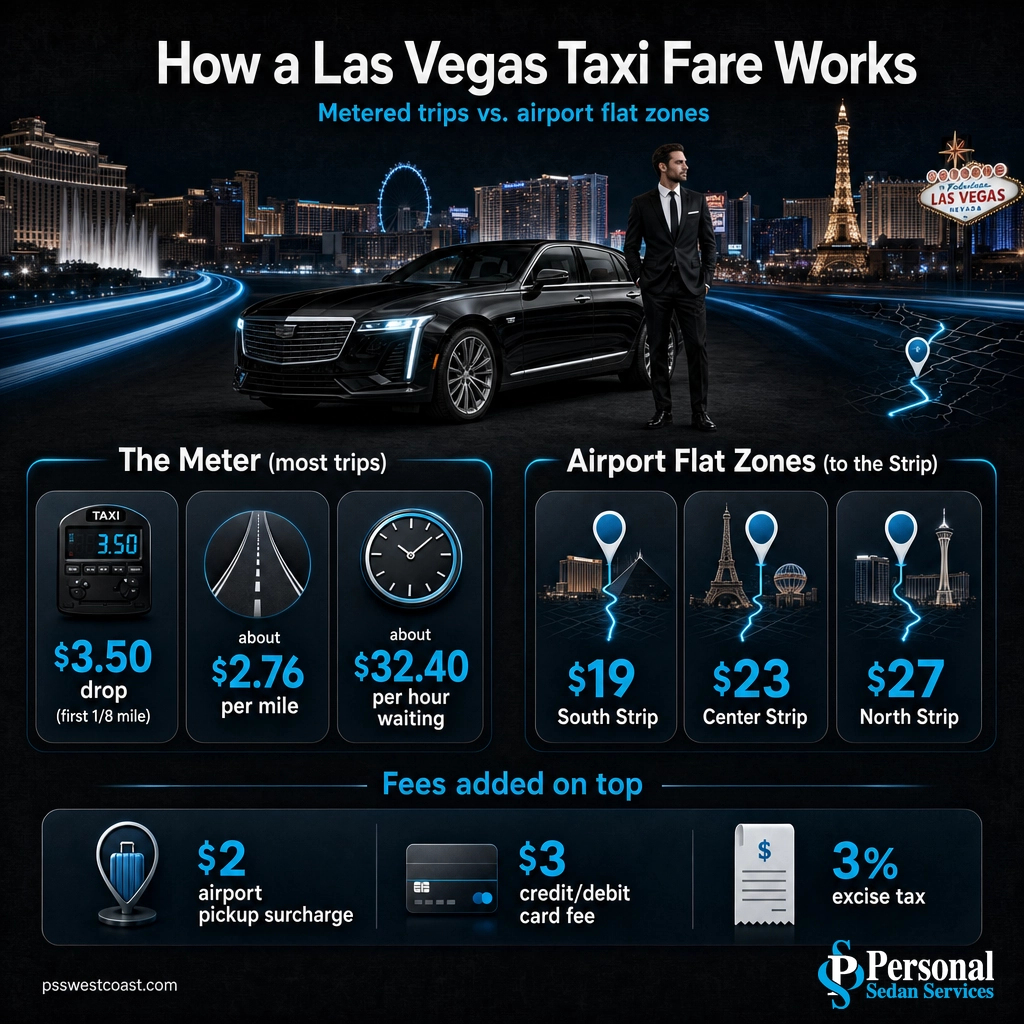
The metered rate is the backbone of every non-airport taxi trip in Las Vegas, and it has three moving parts: the drop, the distance rate, and the waiting charge. These are regulated figures, identical across every cab company, and posted inside the vehicle.
The drop, sometimes called the flag or activation charge, is $3.50 and covers the first 1/8 mile. From there the meter adds for distance at about $2.76 per mile, billed in small increments of $0.23 for each 1/12 mile so the number ticks up smoothly rather than in big jumps. When the cab is stopped or crawling in traffic, a waiting charge of roughly $32.40 per hour takes over, which is why a short trip during a Strip gridlock can cost more than a longer trip on open road.
There is no separate fuel line item on the current schedule; the cost of gas is built into the per-mile rate. That is a change from older fare cards that listed a standalone fuel surcharge, so if you see one quoted online, it is out of date.
| Meter component | Rate | What it covers |
|---|---|---|
| Drop (flag) | $3.50 | The first 1/8 mile of the trip |
| Distance | ~$2.76 / mile | Billed as $0.23 per 1/12 mile |
| Waiting / slow traffic | ~$32.40 / hour | Time stopped or crawling below walking-and-rolling speed |
| Fuel surcharge | None | Built into the per-mile rate |
A quick way to picture it: a straightforward three-mile metered trip with light traffic runs a little over $12 before fees and tip. Add real traffic, and the waiting charge is what moves the needle, not the extra miles. That is a Las Vegas-specific wrinkle. The Strip corridor and the areas around arenas and convention halls clog badly around events, show lets-out, and weekend evenings, and the meter keeps earning while the cab sits still. A one-mile crawl from one casino to the next during a concert exit can easily cost more than a three-mile run across an empty city at 2 a.m.
The other thing to understand about the meter is that it rewards the driver’s route choice, for better or worse. A direct path keeps your distance charge honest; a longer path runs it up. That incentive is exactly what the airport flat zones are designed to remove on the city’s busiest trip, and it is the main reason a metered fare can feel unpredictable while a quoted flat fare does not.
These figures are the posted schedule set by Nevada’s regulator; they are reviewed periodically and can change, so the card inside the cab is always the final word. If the meter ever starts at a number different from the drop, or jumps in large increments, that is your cue to ask the driver to point out the posted rate card.
Source: Nevada’s taxicab regulator | Las Vegas Review-Journal coverage of taxi fare rates
Airport Flat-Rate Zones to the Strip
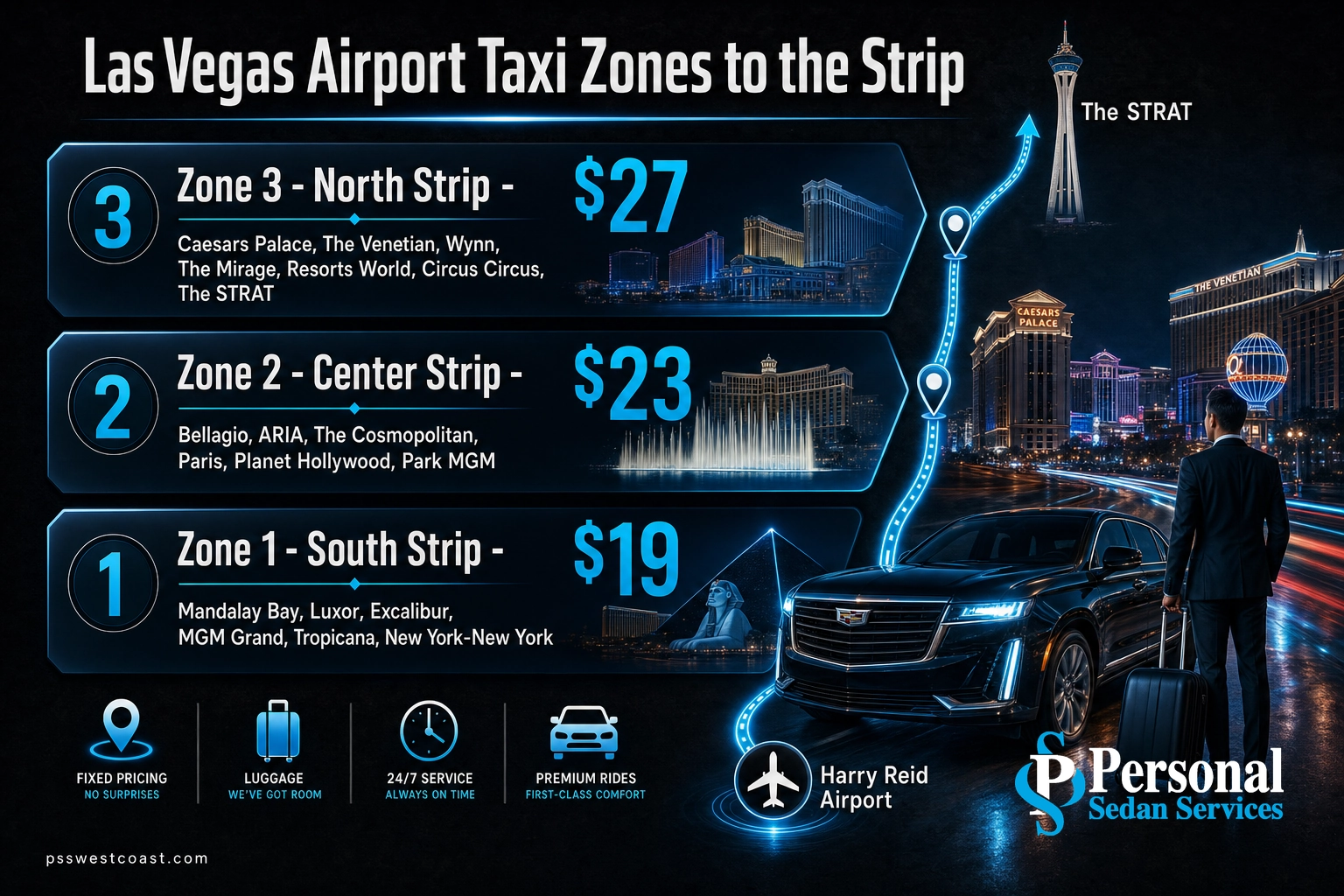
This is the number most visitors are really searching for: what a cab from the airport to their hotel will cost. On a direct trip, the answer is a flat zone fare, not a meter reading. The Strip is divided into three zones running south to north, and your hotel’s position sets the price.
Zone 1, about $19, covers the South Strip, roughly from the airport up to Tropicana Avenue. Zone 2, about $23, covers the Center Strip, from Tropicana up to Flamingo Road. Zone 3, about $27, covers the North Strip up to The STRAT. These prices are the direct-trip fare before the airport surcharge, card fee, tax, and tip are added.
Airport-to-Strip Flat-Rate Zones (direct trip, before fees and tip)
The zone system was introduced to make the airport run predictable and to compete with rideshare on the one trip visitors take more than any other. Because the price is fixed by destination zone rather than by the meter, the driver has no incentive to pad the route, and you know the base number before you get in. That certainty is the whole appeal, and it is why experienced visitors prefer the taxi line for a quick, no-app ride to a Strip hotel.
Knowing your zone before you land saves confusion at the curb. Here is where the major resorts fall.
| Zone | Flat fare | Stretch of the Strip | Example hotels |
|---|---|---|---|
| Zone 1 | ~$19 | South Strip (airport to Tropicana) | Mandalay Bay, Luxor, Excalibur, MGM Grand, Tropicana, New York-New York, Four Seasons, Delano, Virgin Hotels |
| Zone 2 | ~$23 | Center Strip (Tropicana to Flamingo) | Bellagio, ARIA, The Cosmopolitan, Paris, Planet Hollywood, Park MGM, Vdara, Waldorf Astoria, Horseshoe |
| Zone 3 | ~$27 | North Strip (Flamingo to The STRAT) | Caesars Palace, The Venetian, The Palazzo, Wynn, Encore, The Mirage, Treasure Island, Resorts World, Circus Circus, SAHARA, Harrah’s, The LINQ, Flamingo, The STRAT |
The flat-rate system exists partly to stop the padded-route problem on the busiest trip in the city, so for most arriving travelers it is the rider-friendly option. The one catch is that it only covers the Strip; anything beyond it is metered.
Source: KTNV reporting on the airport flat-rate taxi zones
Downtown and Off-Strip: When the Meter Takes Over
If your hotel is on Fremont Street, in the Arts District, or anywhere off the Strip corridor, the airport flat rate does not apply and your cab runs on the meter the whole way. This trips up visitors who assumed every airport ride had a fixed price.
A metered run from the airport to Downtown Las Vegas, including hotels like Circa, the Golden Nugget, The D, and the Plaza, typically totals around $35 to $45 depending on traffic and the route taken. That is higher than the Center Strip zone fare, even though downtown is only a few more minutes up the road, because the meter plus the waiting charge adds up across the extra distance and any slow stretches.
The same logic applies to trips to Henderson, Summerlin, the airport-area warehouses, or the suburbs: no zone, pure meter. The farther out and the heavier the traffic, the wider the range of what you might pay, which is exactly the uncertainty a quoted flat fare removes.
There is also a timing trap off the Strip. Downtown trips often involve surface streets with lights and the occasional backup near Fremont Street events, and the waiting charge keeps running through all of it. A ride that would be quick at midnight can tack on several dollars during an afternoon with traffic, and nothing about the meter tells you that in advance.
For riders who dislike that uncertainty, this is where a car service earns its keep. Our local Las Vegas transportation is quoted flat in advance, so a downtown or suburban trip costs what you were told it would, meter or no meter, with no end-of-ride surprise when traffic was worse than expected.
The Fees and Surcharges That Catch Tourists Off Guard
The zone fare and the meter are only part of the bill. Three standard fees get added on top, and none of them includes the tip. This is the single biggest reason a Las Vegas taxi costs more than the headline number.
First, there is a $2 airport surcharge on any trip that originates at Harry Reid International Airport. It is charged on pickups from the airport, not on drop-offs at the airport, so your ride back out does not carry it. Second, paying by credit or debit card adds a flat $3 fee, regardless of fare size, which is one of the only fees you can dodge by carrying cash. Third, a 3% excise tax is applied to the fare and fees.
| Fee | Amount | When it applies |
|---|---|---|
| Airport pickup surcharge | $2.00 | Only on trips starting at the airport (not drop-offs) |
| Credit / debit card fee | $3.00 flat | Any card payment; avoided by paying cash |
| Excise tax | 3% of fare | Every trip |
| Tip | 15%–20% customary | Never included in the meter or zone fare |
It is worth doing the small math on the card fee. On a $23 zone fare, paying by card adds a flat $3, which is about 13% on top of the ride before the tip even starts. On a longer metered fare the percentage shrinks, but the $3 is charged regardless of size, so it stings most on short trips. If you are taking several short taxi hops during a trip, carrying cash for those can quietly save more than travelers expect.
The airport surcharge and the excise tax, by contrast, are not optional. The $2 airport fee is built into any pickup from Harry Reid, and the 3% tax rides along on every fare. Neither is a scam or a driver add-on; both are standard, regulated line items. The point is not to fight them but to budget for them, because the quoted zone number is never the final number.
The only fee within your control is the $3 card charge, and only by paying cash. The surcharge and tax are fixed, and the tip is expected. Budget for the real total, not the sticker price.

What a Ride Really Costs, All In
Put the pieces together and the honest total comes into focus. Below is a worked example for the most common arrival, a Center Strip hotel in Zone 2, using the published fare components.
Scale that logic across the zones and you get a realistic all-in range: a South Strip arrival lands near $28 to $30, a Center Strip arrival near $32 to $35, and a North Strip arrival near $36 to $40, each depending on whether you pay cash and how you tip. Those are the numbers to budget, not the bare zone fares.
For a family or a group, multiply the comparison the other way. Four people splitting a single taxi to a Center Strip hotel each pay well under $10, which is hard to beat. But four people who need two vehicles, or a group with luggage that will not fit one cab, changes the math fast, and a single larger vehicle booked in advance becomes both cheaper per head and far less of a scramble at the curb.
The lesson for planning is simple. A taxi’s price is predictable on the Strip because of the flat zones, but the fees and tip add a consistent premium you should expect every time. If you want a single number that already includes the drive and is locked before you land, that is what a flat-rate Las Vegas airport ride provides, booked and quoted before your flight even takes off.
Book Las Vegas Airport Car Service
Taxi vs Uber and Lyft in Las Vegas
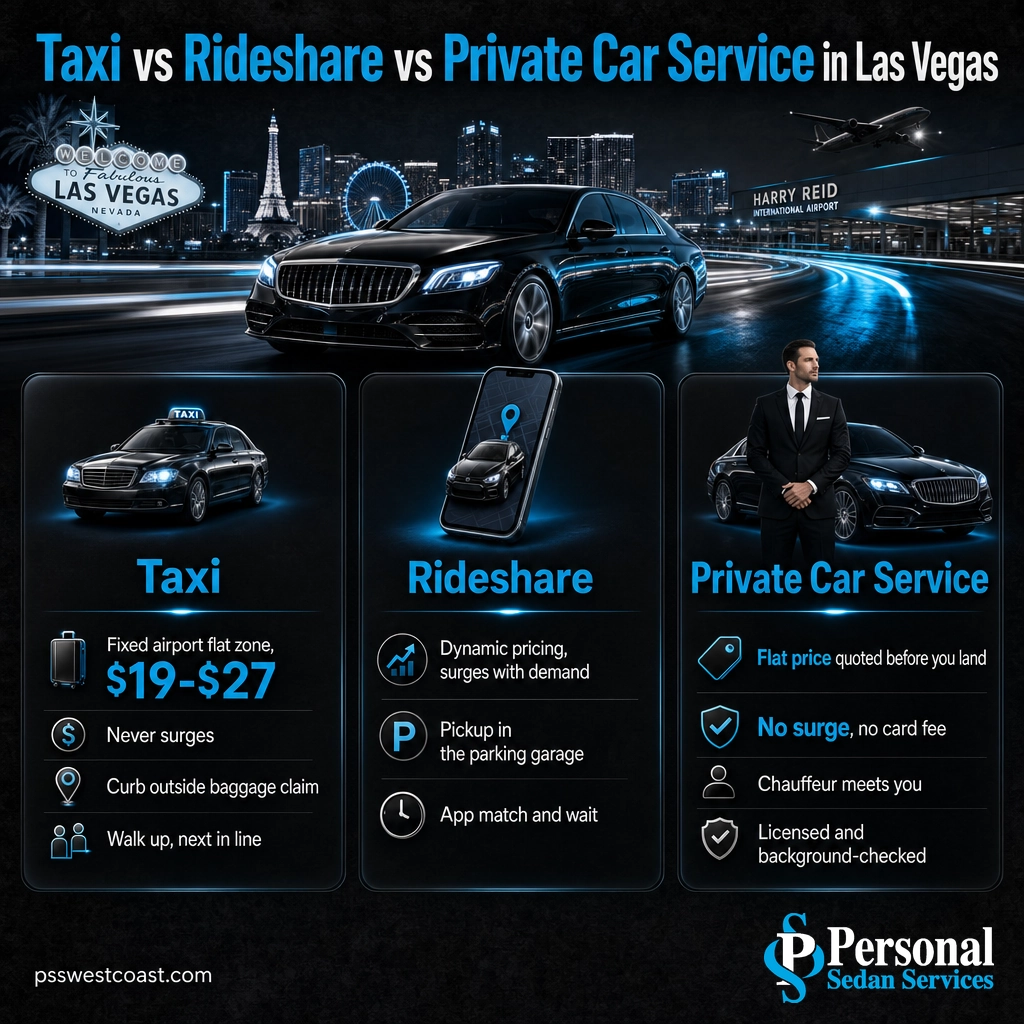
The taxi-versus-rideshare question does not have one answer in Las Vegas, because the two price in completely different ways. A taxi’s airport fare is a fixed zone rate that never changes with demand. Uber and Lyft use dynamic pricing that rises, sometimes sharply, when demand spikes.
That means timing decides the winner. On a quiet weekday afternoon, rideshare often undercuts the taxi. During a major convention, a championship fight, a festival, New Year’s Eve, or a rainy Friday night, rideshare surge pricing can climb well above the flat taxi zone fare, and the taxi becomes both cheaper and more predictable. Because Las Vegas runs on big events, those surge windows are frequent.
Pickup logistics matter too. At Harry Reid International Airport, taxis line up at the curb right outside baggage claim, while rideshare passengers have to walk into the parking garage to the designated pickup area (Level 2 at Terminal 1, the Valet level at Terminal 3). With luggage, a group, or small kids, that walk is a real factor.
| Factor | Taxi | Uber / Lyft | Private car service |
|---|---|---|---|
| Airport pricing | Fixed flat zone ($19–$27) | Dynamic, surges with demand | Flat, quoted before you land |
| Surge pricing | Never | Yes, often during events | Never |
| Airport pickup spot | Curb outside baggage claim | Parking garage pickup area | Pre-arranged meet |
| Booking | Walk up, next in line | App, wait for a match | Reserved in advance |
| Driver vetting | Licensed, regulated | Platform background check | Licensed, background-checked, professional chauffeur |
| Best for | Quick Strip trips, peak events | Off-peak, price shopping | Guaranteed price, groups, VIP, no surprises |
For a side-by-side look written specifically for arriving travelers, our guide to choosing between a taxi, rideshare, or a chauffeur at the Las Vegas airport lays out the tradeoffs in detail.
Source: Harry Reid International Airport ground transportation information
When Las Vegas Taxi Costs Spike
Las Vegas is an event city, and events are exactly when transportation gets expensive and scarce. The taxi flat zones hold steady through all of it, but the meter and rideshare both climb, and availability of any ride tightens. Knowing the calendar helps you plan the trips where price and timing matter most.
The biggest demand surges cluster around the city’s marquee weekends: the Consumer Electronics Show in January, the Las Vegas Grand Prix in November, National Finals Rodeo in December, festivals like EDC, championship fights, major conventions that fill the Las Vegas Convention Center, and every holiday weekend. During those windows, rideshare surge pricing can push a short Strip trip well past what the same trip costs on a quiet Tuesday, and finding an available car at closing time or after a headliner show can mean a long wait in a crowd.
Two things change the calculus on those nights. First, the taxi flat zone from the airport is immune to surge, so an arriving traveler on a convention weekend often pays less in a cab than in a surging rideshare, and the taxi line outside baggage claim keeps moving. Second, for anything with a schedule attached, a dinner reservation, a show, a red-eye, a corporate arrival, a pre-booked ride removes the on-demand gamble entirely. The car is reserved, the price is locked, and there is no scanning the app and watching the multiplier climb.
This is the scenario where planning pays off most. Groups heading to an arena, a convention block, or a multi-stop night out are the ones most exposed to surge and scarcity, and the ones who benefit most from booking ahead. Personal Sedan Services handles exactly these peak-demand trips with event transportation and larger-group logistics, so the busiest nights of the year do not turn into a curbside bidding war.
Source: Harry Reid International Airport, transportation options
Taxi vs Private Car Service
A taxi and a private car service solve the same problem in different ways. A taxi is a regulated, on-demand ride priced by zone or meter. A car service is a reserved ride priced as one flat quote agreed before you travel, driven by a professional chauffeur rather than a line-up driver.
The appeal of the taxi is speed and spontaneity: no booking, just join the stand. The appeal of the car service is certainty and experience. The fare is fixed regardless of traffic, there is no surge and no card fee drama, the vehicle is a clean late-model sedan or SUV, and the chauffeur tracks your flight, meets you on schedule, and helps with bags. For a group, an airport run during a busy event, a corporate arrival, or any trip where being on time matters, that reliability is the whole point.
Price-wise, a single rider on a short Strip hop will usually pay less in a taxi. As the group grows, the trip gets longer, or the timing hits a surge window, the gap narrows and the flat quote often wins on both cost and peace of mind. Where a taxi meter is an open question until the ride ends, a car service answers the price question before you book.
Personal Sedan Services runs exactly this kind of operation across the Las Vegas valley, with flight monitoring, the correct-terminal meet, and licensed, background-checked chauffeurs. For executives and event arrivals, our VIP black car service and corporate car service cover the no-surprises end of the market, and larger parties ride together with group transportation.
Where to Catch a Taxi at the Airport
Knowing the physical pickup layout saves time and avoids the wrong-level scramble that catches first-time visitors. At Harry Reid International Airport, taxis queue at the curb just outside baggage claim at both Terminal 1 and Terminal 3, with staff directing the line. You do not pre-book a standard taxi; you take the next cab in the stand.
That curbside convenience is the taxi’s edge over rideshare at the airport. Uber and Lyft pickups are up in the parking garage, Terminal 1 on Level 2 and Terminal 3 on the Valet level, reached by elevator and a short walk across. Rideshare drop-offs happen at the regular departures curbs. The airport also offers walk-up limousine service, public buses and inter-city shuttles, rental cars via the consolidated rental center, and newer options including the Vegas Loop and autonomous rides.
A couple of practical notes help at the curb. The taxi stand is staffed, so you will be directed to the next available cab rather than choosing one, and larger vehicles for bigger groups or extra luggage are dispatched as they come up in the line, which can mean a short wait at peak arrival banks. If you are traveling with a lot of bags, a car seat, or mobility needs, those are the moments the open-ended taxi line is least convenient, and a vehicle matched to your party in advance is the smoother path. Have your hotel name ready so the driver can confirm your zone before you pull away.
A pre-arranged car service skips the queue entirely: your chauffeur knows your flight and meets you at an agreed spot, so there is no line and no garage walk. If you want to know exactly where that meet happens, our guide on where to meet your chauffeur at the Las Vegas airport walks through it, and the full Harry Reid International Airport guide covers the terminal layout.
Source: Harry Reid International Airport taxi and ride share page
How to Avoid Overpaying and Long-Hauling
The most famous Las Vegas taxi pitfall is “long-hauling,” where a driver on a metered trip takes the airport connector tunnel and the freeway the long way to a Strip hotel so the meter runs higher than a direct surface-street route. It became common enough that Nevada regulators cracked down on it and posted fare and trip-time signage at the airport to inform riders.
Here is the good news: on a flat-rate zone trip, long-hauling cannot cost you anything, because your price is fixed no matter which way the driver goes. That is one of the main reasons the zones exist. The risk only lives on metered trips.
A few habits keep you protected. Confirm whether your trip is zoned or metered before you ride. Keep a rough sense of the distance so a wildly high meter stands out. Carry some cash to skip the $3 card fee. And for any trip where you would rather not manage the meter at all, a quoted flat fare removes every one of these variables at once.
Paying and Tipping Etiquette
Every regulated Las Vegas taxi takes credit and debit cards, but remember the flat $3 card fee; cash is the only way around it. Beyond that, the etiquette is straightforward and familiar to most U.S. travelers.
Tipping is customary at 15% to 20% of the fare, with a $2 to $5 minimum on a short ride. Tip toward the higher end when the driver helps load luggage, handles a group, takes a late-night run, or manages oversized bags. The tip is never built into the meter or the airport zone fare, so always plan for it on top of the quoted price.
For a deeper look at who to tip and how much across every part of a Las Vegas trip, Personal Sedan Services keeps a running guide to tipping etiquette in Las Vegas. With a pre-booked car service, gratuity is often set when you book, so there is no math at the curb and no awkward fumbling for cash on arrival.
Taxi Costs for Common Las Vegas Trips
To make the rates concrete, here are rough all-in taxi estimates for trips visitors take most. Strip-corridor airport arrivals use the flat zones; everything else is metered, so those ranges are wider and swing with traffic. All figures include the typical fees and a standard tip.
| Trip | How it’s priced | Rough all-in estimate |
|---|---|---|
| Airport to South Strip (Zone 1) | Flat zone | ~$28–$30 |
| Airport to Center Strip (Zone 2) | Flat zone | ~$32–$35 |
| Airport to North Strip / The STRAT (Zone 3) | Flat zone | ~$36–$40 |
| Airport to Downtown / Fremont Street | Meter | ~$35–$45 |
| South Strip to North Strip | Meter | ~$18–$28 |
| Strip to Las Vegas Convention Center | Meter | ~$15–$25 |
| Strip to an arena or stadium on event night | Meter (heavy traffic) | ~$20–$35 |
These are planning estimates, not quotes, and traffic is the biggest swing factor on any metered trip. The flat-zone airport fares are the only ones with a truly fixed price, which is why they are the easiest to budget.
When a trip falls outside the zones and you want a locked price, our fleet of sedans, SUVs, and larger vehicles is quoted flat for the exact route, so convention nights and event traffic do not change what you pay.
What to Do Next
If you are planning a Las Vegas trip, here is how to turn these rates into a decision, in priority order.
| Action | Priority | Timeline | Relevant option |
|---|---|---|---|
| Identify your hotel’s airport zone (1, 2, or 3) | High | Before you book flights | Flat-rate taxi zone |
| Budget the real all-in total, not the zone fare | High | Trip planning | Add fees + tip |
| Decide taxi, rideshare, or car service by group size and timing | High | Before arrival | Car service for groups / events |
| Carry some cash to skip the $3 card fee | Medium | Before you fly | Any taxi trip |
| Pre-book a flat quote for off-Strip or event trips | Medium | Days ahead | Private car service |
| Confirm zoned vs metered at the curb | Medium | At pickup | Avoid long-hauling |
For most arriving travelers the choice comes down to one question: do you want a price you can see before you land, or are you comfortable with a meter and the fees on top. If it is the former, a reserved ride answers it cleanly.
Related Resources
Keep planning with these Personal Sedan Services guides and official references:
Full Rate and Fee Summary
Every Las Vegas taxi number in this guide, in one place.
| Item | Rate / amount | Notes |
|---|---|---|
| Meter drop (flag) | $3.50 | Covers first 1/8 mile |
| Per-mile rate | ~$2.76 | Billed $0.23 per 1/12 mile |
| Waiting / slow traffic | ~$32.40 / hour | When stopped or crawling |
| Fuel surcharge | None | Built into per-mile rate |
| Airport Zone 1 (South Strip) | ~$19 | Direct trip, before fees |
| Airport Zone 2 (Center Strip) | ~$23 | Direct trip, before fees |
| Airport Zone 3 (North Strip / The STRAT) | ~$27 | Direct trip, before fees |
| Airport pickup surcharge | $2.00 | Pickups from airport only |
| Credit / debit card fee | $3.00 flat | Avoided with cash |
| Excise tax | 3% of fare | Every trip |
| Customary tip | 15%–20% | Not included anywhere |
| Center Strip arrival, all in | ~$33–$35 | $23 zone + fees + tip |
| South Strip arrival, all in | ~$28–$30 | $19 zone + fees + tip |
| North Strip arrival, all in | ~$36–$40 | $27 zone + fees + tip |
| Airport to Downtown | ~$35–$45 | Metered, not zoned |
| 3-mile metered trip | ~$12+ | Before fees and tip |
| Taxi airport pickup | Curb at baggage claim | Both terminals |
| Rideshare airport pickup | Parking garage | T1 Level 2, T3 Valet level |
| Zone trip detour | Reverts to meter | Extra stops not covered |
| Flat zone surge | Never | Fixed regardless of demand |
| Private car service | Flat, quoted upfront | No meter, no surge |
Frequently Asked Questions
How much does a taxi cost from the Las Vegas airport to the Strip?
What is the Las Vegas taxi meter rate?
Are Las Vegas airport taxi fares the same for every hotel?
Is a taxi cheaper than Uber or Lyft in Las Vegas?
What extra fees do Las Vegas taxis charge?
How much should I tip a Las Vegas taxi driver?
What is taxi long-hauling in Las Vegas and how do I avoid it?
Can I pay a Las Vegas taxi with a credit card?
Do Las Vegas taxi flat rates work for downtown or Fremont Street?
Where do I catch a taxi at Harry Reid International Airport?
Methodology & Sources
Fare figures reflect the regulated Las Vegas taxicab rate schedule and the airport flat-rate zone program in effect at publication, cross-checked against official airport ground-transportation information and published fare reporting. Metered rates and fees are set by Nevada’s taxicab regulator and posted inside every licensed cab, where the in-vehicle rate card is always the final authority. All-in totals labeled as our analysis are calculated from the published fare components and vary with your tip and payment method. Rates are reviewed periodically and can change.
Primary references:
Harry Reid International Airport, ground transportation |
KTNV, airport flat-rate taxi zones |
Nevada’s taxicab regulator |
Las Vegas Review-Journal, taxi fare coverage
Last Updated: October 2026
