


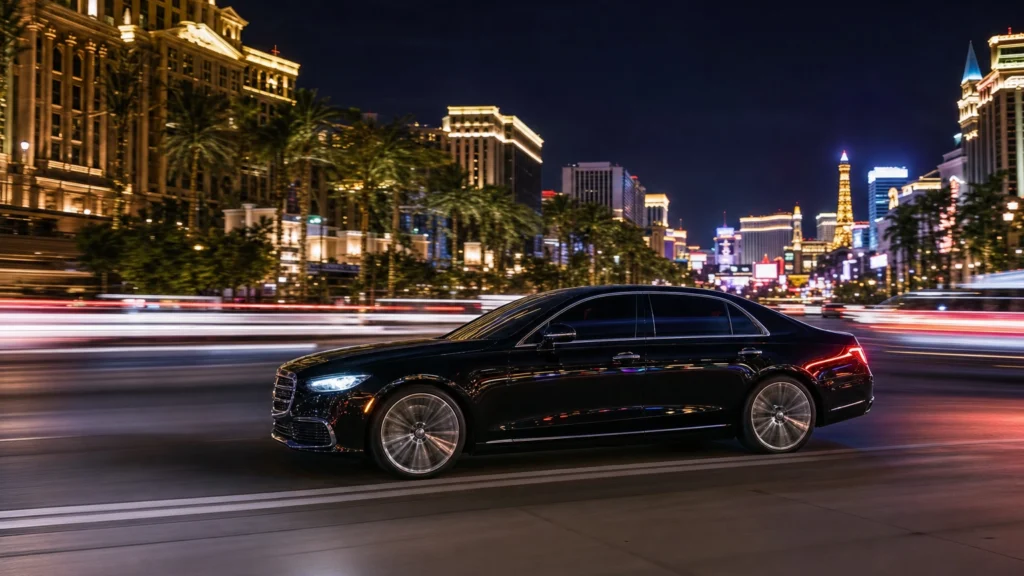
The 2026 Formula 1 Heineken Las Vegas Grand Prix takes over the heart of the Strip from Thursday, November 19 through Saturday, November 21, 2026, with the main race run under the lights on Saturday night. This guide covers what you actually need to plan a trip: how the 2026 ticket zones, grandstands, and prices break down, the race-weekend schedule at a glance, where the circuit runs, and the part most event pages gloss over, which is exactly how the Strip closes down and how to get to and from the track without getting stranded.
- Dates: The 2026 Las Vegas Grand Prix runs Thursday, November 19 to Saturday, November 21, with the Grand Prix on Saturday night, November 21.
- Race start: Lights out is scheduled for 8:00 p.m. Pacific Time on Saturday, over 50 laps of the Strip circuit (or 120 minutes, whichever comes first).
- Where: The 6.201 km (3.85 mile), 17-turn Las Vegas Strip Circuit runs down Las Vegas Boulevard past Caesars Palace, the Bellagio, the Venetian, and the Sphere.
- Tickets start low, climb fast: Single-day passes opened around $50 to $81 and three-day general admission from about $492, while premium hospitality runs into the tens of thousands.
- One zone per ticket: The circuit is split into ticketed zones, and a ticket admits you to one zone only, so pick your viewing area before you buy.
- It is huge: The 2024 race drew about 306,000 fans over three days and an estimated $934 million in economic impact, making it the city’s largest annual event.
- Dress warm: The National Weather Service normal November low in Las Vegas is near 47 degrees Fahrenheit, and the race runs after dark, so pack layers.
- Getting around is the hard part: Core Strip roads close during race week, and rideshare loses mid-Strip access while the track is live. A pre-booked private car with approved drop points is the reliable move.
- Book transportation early: Reserve race-week rides two to three months out. Premium vehicles and routing fill quickly.

What’s in This Guide
- What Is the Formula 1 Las Vegas Grand Prix?
- 2026 Dates and Race Weekend Schedule
- The Las Vegas Strip Circuit: Track, Turns, and Landmarks
- A Night Race Down the Strip: What Makes It Different
- Las Vegas Grand Prix Tickets 2026: Zones, Grandstands, and Prices
- How Much Does a Grand Prix Trip Cost?
- Getting to Las Vegas for Race Week
- Getting Around During the Race: Road Closures and Smart Transportation
- Where to Stay: Trackside Hotels and Casinos
- Weather and What to Wear for a November Night Race
- First-Timer Tips for Grand Prix Weekend
- What to Do Next: Your Grand Prix Planning Roadmap
- Related Resources
- Quick-Reference Summary Table
- Frequently Asked Questions
- Methodology and Sources
What Is the Formula 1 Las Vegas Grand Prix?
The Formula 1 Las Vegas Grand Prix is a night race run on a temporary street circuit built on the actual Las Vegas Strip. Unlike a permanent racetrack out in the desert, the course uses Las Vegas Boulevard and the roads around it, so for one week each November the most famous stretch of pavement in the city becomes a Formula 1 track. Cars run past casino marquees, the fountains at the Bellagio, and the Sphere, then open up to high speed down the Strip straight. It is one of only three Formula 1 races held in the United States, alongside Miami and the United States Grand Prix in Austin.
The modern event debuted in November 2023 after a four-decade gap since F1 last raced in Las Vegas in the early 1980s. The race is promoted by Formula 1 itself rather than a traditional local organizer, and it has quickly become an anchor event on the Las Vegas calendar. In 2025 the Las Vegas Convention and Visitors Authority approved a funding agreement that keeps the race in the city through at least 2027, so this is a fixture, not a one-off.
What makes it different from a normal Grand Prix is the setting. The whole weekend is wrapped inside the Strip’s hotels, restaurants, nightlife, and shows, which turns a three-day sporting event into a full Las Vegas trip. That is also why planning matters more here than at a purpose-built circuit: you are not just buying a race ticket, you are navigating a working resort corridor that is being partly closed for racing.
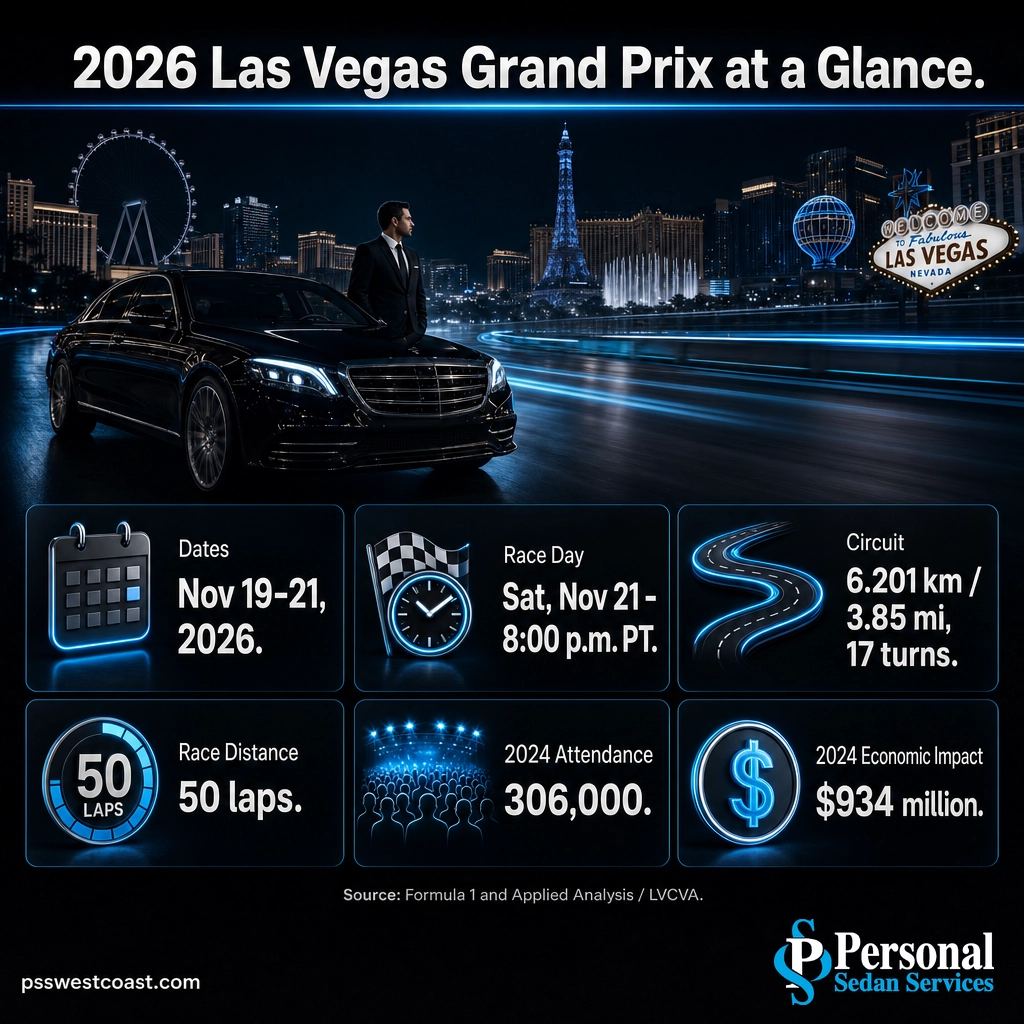
The scale is the point. A crowd this size does not simply absorb into the Strip the way a normal busy weekend does. Flights, hotels, dining reservations, and especially ground transportation all tighten weeks ahead, which is why the fans who enjoy the race most are the ones who treated the logistics as part of the plan, not an afterthought.
Source: Formula 1 official 2026 Las Vegas Grand Prix page | Applied Analysis / LVCVA economic-impact report coverage
2026 Dates and Race Weekend Schedule
The 2026 Formula 1 Heineken Las Vegas Grand Prix runs over three nights, Thursday, November 19 through Saturday, November 21, 2026. The Grand Prix itself is Saturday night, November 21, with lights out scheduled for 8:00 p.m. Pacific Time. The race is 50 laps, or 120 minutes, whichever comes first. Because of the time difference, many fans outside the Western United States will watch the finish in the early hours of Sunday morning their time.
Here is the published weekend format in local Las Vegas time. Formula 1 notes that the timetable is subject to change, so confirm session times on the official site in race week.
| Day | Session | Local time (PT) |
|---|---|---|
| Thu, Nov 19 | First Practice (FP1) | 4:30 p.m. – 5:30 p.m. |
| Thu, Nov 19 | Second Practice (FP2) | 8:00 p.m. – 9:00 p.m. |
| Fri, Nov 20 | Third Practice (FP3) | 4:30 p.m. – 5:30 p.m. |
| Fri, Nov 20 | Qualifying | 8:00 p.m. – 9:00 p.m. |
| Sat, Nov 21 | Drivers’ Parade | 6:00 p.m. – 6:30 p.m. |
| Sat, Nov 21 | Grand Prix (50 laps) | 8:00 p.m. |
The support schedule also includes F1 Academy practice, qualifying, and races across the weekend, plus a car-presentation and opening ceremony on Thursday evening. If you want the full day-by-day breakdown with every support session and the circuit facts behind the timing, see our companion post on the 2026 Las Vegas Grand Prix dates and session schedule.
Qualifying on Friday night is one of the best-value sessions of the weekend. It carries much of the drama of race day, the Strip is already lit and buzzing, and tickets and transportation are easier to secure than for Saturday. If a single night is all your schedule allows, Friday is a strong pick.
Source: Formula 1 official 2026 timetable
The Las Vegas Strip Circuit: Track, Turns, and Landmarks
The Las Vegas Strip Circuit is a 6.201 km (3.85 mile) street circuit with 17 turns, run counter-clockwise. It is one of the longer tracks on the Formula 1 calendar, and its defining feature is a long, flat-out run of roughly 1.2 miles straight down Las Vegas Boulevard. Formula 1 designed the layout for very high speeds: cars are projected to reach around 212 mph on the main straight, and in the 2023 debut the speed-trap readings climbed even higher during the race.
The lap threads directly past landmarks you already know. Drivers run the Strip straight past Caesars Palace, the Bellagio, and the Venetian, then into a slower, technical section that loops around the Sphere through Turns 6 through 9 before heading onto Sands Avenue and Harmon Avenue. For spectators, that geography matters: each grandstand looks out on a different kind of action, from flat-out speed on the straight to heavy braking and overtaking in the corners.
Because the circuit is woven through a live resort corridor, the viewing experience is unusually dense. There is no single grandstand that sees the whole track, which is exactly why the ticketing is organized into zones. Deciding which part of the lap you want to watch is the first real decision you make as a fan.
The circuit runs through the central Strip. Use the map below to orient yourself before choosing a grandstand or planning drop-off points.
Source: Formula 1, “In Numbers: the Las Vegas Grand Prix” | Sky Sports Las Vegas circuit guide
A Night Race Down the Strip: What Makes It Different
The Las Vegas Grand Prix is run at night on purpose, and that single choice changes almost everything about the experience. Daytime temperatures in November are warm enough to be hard on car and tire performance, while the evening cools the track and lets the cars run closer to their limits. Just as important, a night race lets Formula 1 use the Strip itself as the backdrop: the neon, the resort facades, and the Sphere lit up behind the cars make for a spectacle no purpose-built circuit can match. It is as much a show as it is a sporting event, which is a large part of why it sells out.
For fans, the night format has real consequences you should plan around. Sessions start in the late afternoon and the main race begins at 8:00 p.m., so you are committing to a late evening outdoors in the cold, often finishing close to or after midnight once the podium and crowd flow are done. That affects what you wear, when you eat, and, above all, how you plan to get home. A daytime event lets you drift out with the crowd. A midnight finish in 40-degree air, with roads still closed and a quarter of a million people leaving at once, rewards the fans who arranged a warm car at a known pickup point in advance.
The night timing also reshapes the rest of your day. Because the on-track action does not begin until late afternoon, you have most of the day free for everything else Las Vegas offers, from a late breakfast to a show to the pools and shopping. Smart visitors treat the Grand Prix as the headline act of a full day rather than the only thing on the schedule, and they build their transportation plan to cover the daytime plans and the late-night return in one booking.
Las Vegas Grand Prix Tickets 2026: Zones, Grandstands, and Prices
Las Vegas Grand Prix tickets work differently from a normal concert or game. The circuit is divided into separate ticketed zones for race weekend, and your ticket admits you to one zone only. You pick where on the lap you want to be, buy into that grandstand or general-admission area, and that is where you watch. There is no wandering the full 3.85 miles. So the first question is not how much, it is where.
Prices in 2026 ranged from genuinely affordable to eye-watering. Single-day passes opened in the $50 to $81 range when they first went on sale, and three-day Flamingo general admission started around $492. From there, reserved grandstand seats climbed by location, and premium hospitality moved into the tens of thousands of dollars. Single-day tickets for 2026 went on sale in mid-August, several months before the race.
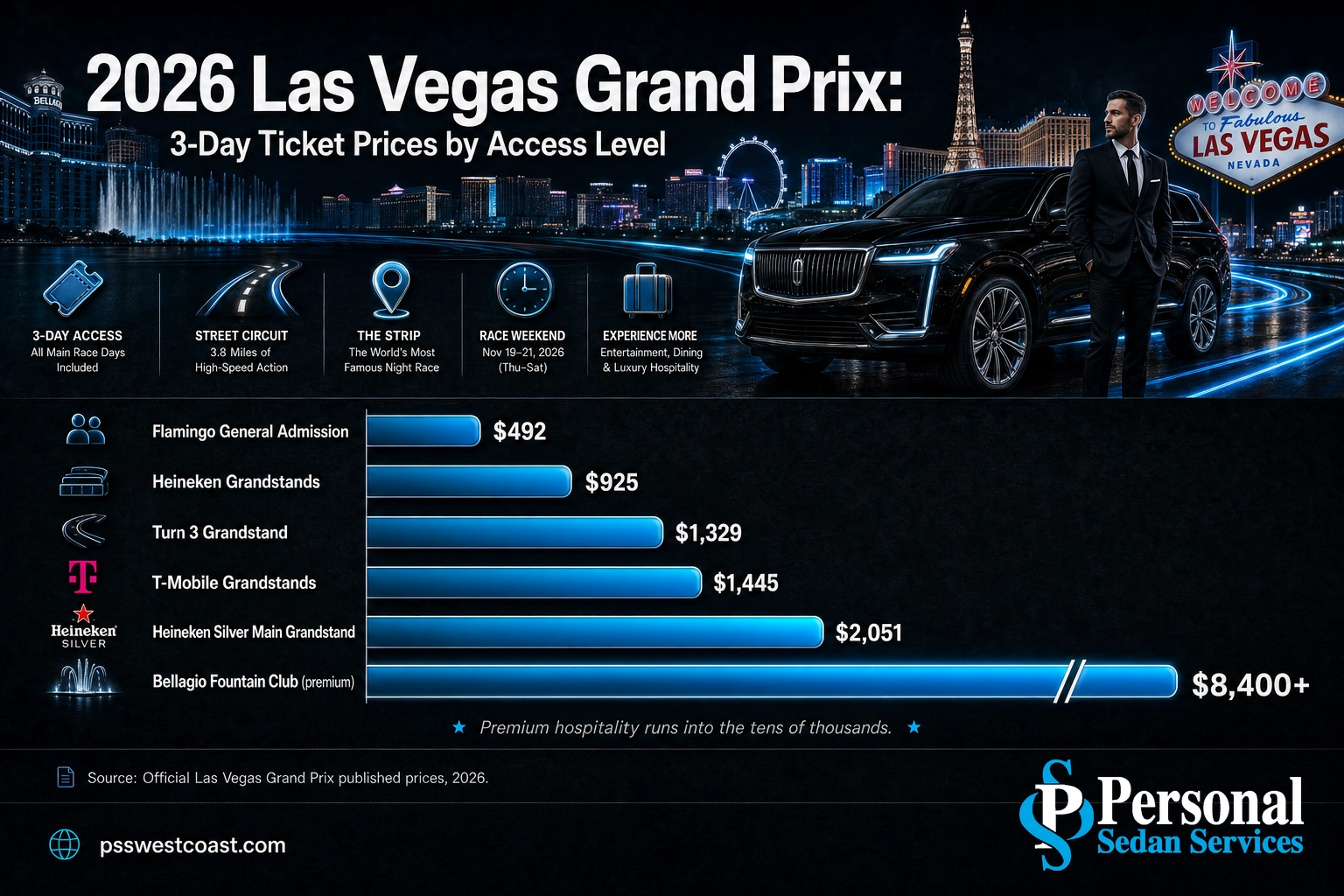
2026 three-day ticket prices by access level
These are published starting prices for three-day access, from the most affordable grandstand to premium hospitality. Prices include taxes and fees, rise as availability drops, and are best confirmed live on the official ticket site.
| Ticket type (3-day) | Starting price | Zone / view |
|---|---|---|
| Flamingo General Admission | $492 | Standing / walk-up viewing |
| Heineken Grandstands | $925 | Bleacher seating, South Koval zone near Turn 4 |
| West Harmon Grandstand | $1,012 | Reserved seats, Harmon Avenue section |
| Turn 3 Grandstand | $1,329 | Reserved seats, braking and overtaking |
| T-Mobile Grandstands | $1,445 | Reserved seats, Turns 5-9 near the Sphere |
| Heineken Silver Main Grandstand | $2,051 | Main straight, start/finish action |
| Bellagio Fountain Club (premium) | $8,400 | Hospitality overlooking the fountains |
| Gordon Ramsay at F1 Garage (premium) | $28,885 | Top-tier hospitality |
A few practical notes on choosing a zone. The Heineken Grandstands are the budget reserved option, but they are bleachers in the South Koval zone rather than individual seats. The T-Mobile Grandstands near the Sphere put you on the twisty section where overtaking happens, which many fans prefer to pure straight-line speed. The Heineken Silver Main Grandstand on the start/finish straight is the marquee view and priced accordingly. General admission is the cheapest way in, but you trade a guaranteed seat for mobility within your zone.
If general admission is your plan, arrive early to claim a good standing spot along the fence in your zone, and scout where the big screens are so you can follow the parts of the lap you cannot see directly. Single-day tickets are the right call if you only want the main event, but remember that Friday qualifying and the support races deliver a lot of the atmosphere for less, so a two- or three-day plan can be better value per hour of action than a single Saturday pass. Families and mixed groups often split the difference: a reserved grandstand for the people who want a guaranteed seat, general admission for those who would rather roam.
Be cautious with the secondary market. Resale listings appear on the usual ticket platforms, and while they can help when an official zone sells out, prices swing hard and listings are not always what they claim. Buy from the official Las Vegas Grand Prix site or an authorized reseller when you can, verify the exact zone on any resale ticket, and avoid last-minute street or social-media offers. A ticket is only useful if it admits you to the zone your transportation plan is built around.
Buy from the official Las Vegas Grand Prix ticket site or an authorized seller, and confirm the exact zone and gate before you purchase. Because a ticket is zone-locked, a great price in the wrong zone can mean a long detour on race night. Match your ticket zone to where your transportation can actually drop you.
Source: Official Las Vegas Grand Prix ticket site | Fox5 Vegas, single-day ticket on-sale report
Plan Group Transportation for Race Week
How Much Does a Grand Prix Trip Cost?
There is no single answer, because the Las Vegas Grand Prix scales from a budget weekend to a luxury blowout. But you can build a realistic picture by stacking the four big line items: tickets, hotel, ground transportation, and food and drink. Tickets alone span from roughly $50 for a single-day general-admission pass to tens of thousands for premium hospitality, as the section above shows. The rest of the trip moves with the same demand curve.
Hotels on or near the Strip spike sharply for race week, often running several times their normal nightly rate, and many trackside properties sell room-and-ticket packages. Dining and nightlife also carry premium pricing and minimums during the weekend. Ground transportation is the line item travelers most often underestimate: with the Strip partially closed, the cheap-and-easy rideshare they planned on becomes slow, expensive with surge pricing, and in some cases simply unavailable mid-Strip during live sessions.
Personal Sedan Services does not publish fixed prices because race-week transportation is quoted to the trip: the vehicle, the group size, the number of nights, and the routing around closures all change the number. What we can tell you is what drives the cost, so you can budget honestly. The biggest factors are how many people you are moving, whether you need a vehicle on standby between sessions, and how late your pickups run after the race finishes near midnight.
A common assumption is that you can just rideshare everywhere like a normal Vegas trip and sort out the cost later. During race week that backfires: surge pricing on the busiest nights of the Las Vegas year, combined with pickup zones pushed far from the closed circuit, routinely turns a short hop into a long, expensive wait. Budgeting for reliable, pre-arranged transportation up front is usually cheaper and far less stressful than paying surge rates on the night.
Source: Applied Analysis / LVCVA economic-impact report coverage
Getting to Las Vegas for Race Week
Most out-of-town fans fly into Harry Reid International Airport (LAS), which sits just south of the Strip, minutes from the south-end resorts. Race weekend is one of the airport’s busiest periods of the year, so book flights early and expect crowded terminals, especially on the Thursday arrivals and the Sunday departures after the Saturday-night race. If you can, fly out Sunday afternoon or Monday rather than first thing Sunday, when the whole city is trying to leave at once.
For fans in Southern California and the Southwest, driving is a popular alternative, and it gives you a vehicle for the parts of the trip away from the closed circuit. Personal Sedan Services also runs chauffeured long-distance routes into Las Vegas, so you can skip the drive entirely and arrive relaxed. Common race-week routes include the Los Angeles to Las Vegas run, as well as San Diego, Phoenix, and St. George. For a group traveling together, a Sprinter van or mini-coach turns the journey itself into part of the event.
However you arrive, the key is to separate the arrival plan from the race-week street plan. Getting into the city is straightforward. Moving around once the circuit goes live is the part that needs its own strategy, which is the next section.
Book an Airport Pickup from Harry Reid
Source: Formula 1 official 2026 Las Vegas Grand Prix page
Getting Around During the Race: Road Closures and Smart Transportation
This is the single most important planning topic for the Las Vegas Grand Prix, and it is the one the ticket pages spend the least time on. To build a racetrack on Las Vegas Boulevard, the city closes core sections of the Strip and the surrounding circuit roads in stages during race week, with the heaviest closures on the race nights. Roads reopen in the early morning hours after each session. Pedestrian bridges and specific crossings are also controlled. The result is that the usual ways of moving along the Strip, on foot end to end, by taxi, or by rideshare, all change at once.
Rideshare is where travelers get caught out. When the circuit is live, rideshare and taxis lose direct mid-Strip access, pickup and drop-off points are pushed to the edges of the closure zone, and surge pricing climbs on the busiest nights of the Vegas year. Fans regularly describe booking a car that cannot actually reach them, or a pickup point a long, cold walk from their grandstand gate. On a 47-degree night that ends near midnight, that is a rough way to finish the race.
A pre-booked private car with a professional chauffeur solves the problem by planning around the closures rather than against them. Your chauffeur knows the approved drop and pickup points just outside the active circuit for your ticket zone, tracks the road-closure timing, and has a set plan for the post-race crush when a quarter of a million people leave at once. You walk a short, known distance to a car that is actually there, instead of refreshing an app in the cold. For groups, a larger vehicle such as a Sprinter van or mini-coach keeps everyone together and turns the ride into part of the night.
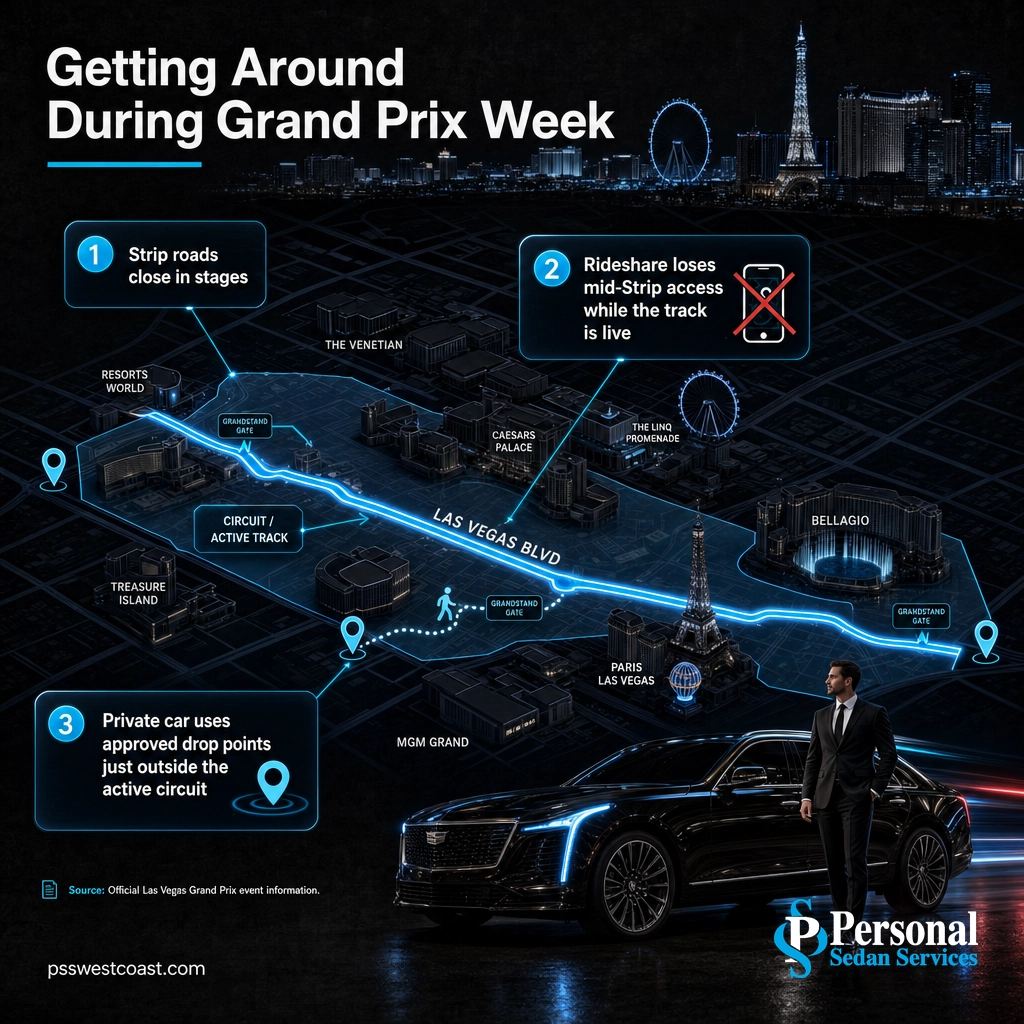
Important: Do not assume the transportation that works on a normal Vegas trip will work on race nights. Core Strip roads close, mid-Strip rideshare access disappears while the track is live, and pickup zones move. Match your ride plan to your ticket zone, confirm approved drop points before race day, and plan for a late finish. The time to solve this is before you fly in, not standing outside a closed road at midnight.

The post-race departure deserves its own plan. When the checkered flag falls near midnight, the entire crowd tries to leave at the same time, and the closed roads reopen only in stages. This is the exact moment rideshare apps surge hardest and pickup requests stack up. The fans who get home fastest are the ones whose driver is already positioned at a pre-agreed point, who know which direction to walk, and who are not negotiating with an app in the cold. If you are with a group, agree on a single meeting point before the race starts, because phones and cell networks are overwhelmed by the crowd right when you need them most.
For fans who want a vehicle and chauffeur dedicated to their weekend, event and group transportation booked in advance is the most reliable way to move. It is also the one decision that most changes how the weekend feels, from stressful and reactive to smooth and planned.
Book Chauffeured Event Transportation
Source: Official Las Vegas Grand Prix event information
Where to Stay: Trackside Hotels and Casinos
Where you stay shapes your whole weekend, because the best race-week location is one that minimizes how far you have to travel through the closures. Resorts directly on the circuit, including Caesars Palace, the Bellagio, the Venetian, Wynn, and the properties clustered around the central Strip, put you closest to the action and sometimes offer rooms with a view of the track itself. Many of these sell room-and-ticket packages, and several have trackside viewing of their own. The trade-off is price: trackside rooms command the steepest race-week premiums and sell out early.
Staying slightly off the circuit, toward the north or south ends of the Strip or just off Las Vegas Boulevard, can cut your nightly rate meaningfully while keeping you close enough that a short chauffeured transfer gets you to your gate. This is often the smartest value play: you spend a little on reliable transportation and save more on the room. The key is to pair your hotel choice with your ticket zone and your transportation plan so the three line up instead of fighting each other.
Think about the walk, not just the address. A hotel that looks close to your zone on a map can still mean a long detour on foot once the circuit fences and controlled crossings are in place, because you cannot cut straight across a live track. Before you commit to a room, check which side of the circuit it sits on relative to your ticket zone and which pedestrian crossings stay open during sessions. The goal is a short, simple path from your room to your gate that does not require crossing the course at a closed point.
Whatever you book, reserve lodging as early as you reserve tickets. Race week is the tightest hotel market of the Las Vegas year, and the convenient properties go first. If you are coordinating rooms for a group, lock the block well ahead, and plan how everyone will move between the hotel and the circuit together. A single chauffeured vehicle for the group often costs less per person than everyone chasing separate surge-priced rides, and it means the whole party arrives and leaves on one plan instead of scattering across the closure zone.
Source: Formula 1 official 2026 Las Vegas Grand Prix page
Weather and What to Wear for a November Night Race
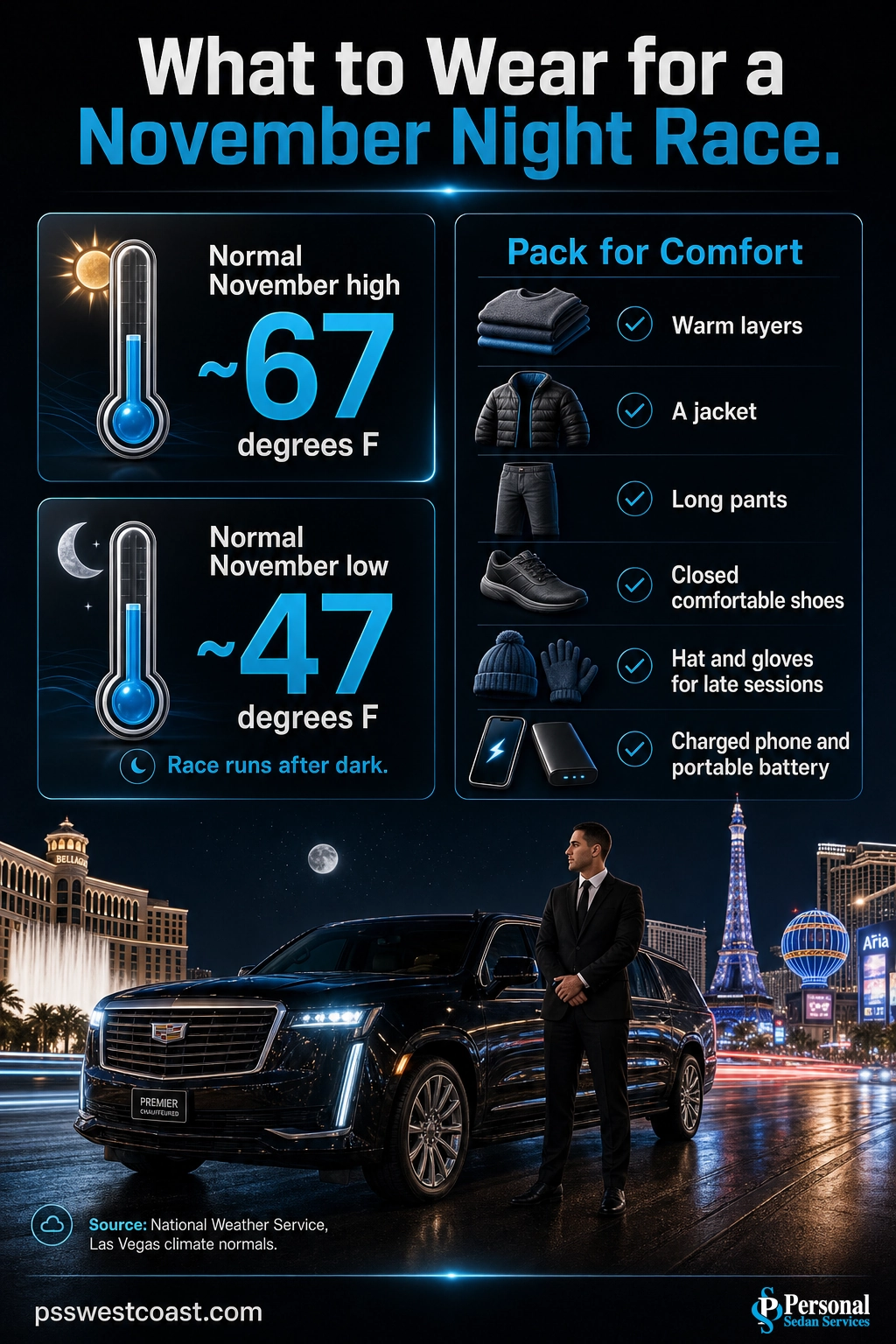
Las Vegas in November is mild by day and genuinely cold after dark, and this is a night race. According to National Weather Service climate normals for Las Vegas, the typical November high is about 67 degrees Fahrenheit and the normal low is near 47 degrees, with a monthly average around 57 degrees. By the time the Grand Prix starts at 8:00 p.m. and runs past 10:00 p.m., temperatures are usually in the 40s or low 50s, and the open grandstands along the Strip offer little shelter from the breeze.
Dress for a cold outdoor evening, not for a casino floor. Warm layers you can add as the night cools, a real jacket, long pants, and comfortable closed shoes for a lot of walking and standing are the right call. A hat and gloves are not overkill for the later sessions. Rain is uncommon in November, but a packable layer is cheap insurance.
The weather is also an argument for a planned ride home. Standing in the cold after the race while you try to summon a car from outside the closure zone is miserable. A warm vehicle waiting at a known pickup point turns the end of the night from an ordeal into the easiest part of the trip.
Source: National Weather Service, Las Vegas November climate normals
First-Timer Tips for Grand Prix Weekend
A few habits separate a smooth first Grand Prix from a chaotic one. First, arrive at your zone early. Gates, security, and the sheer crowd mean the walk from a drop point to your seat takes longer than you expect, and you do not want to be rushing while the Strip is packed. Build in a buffer, and treat the pre-race hours as part of the show rather than dead time.
Second, decide what you are there for. If it is the spectacle of cars at 200-plus mph, a straight-line grandstand delivers it. If it is racing craft, the technical section near the Sphere rewards you with braking, overtaking, and strategy. You cannot see everything from one zone, so choose deliberately and lean into it. Download the official event app for live timing and maps, bring a portable battery, and expect cell networks to be congested with a crowd this size.
Plan your food and drink ahead too. Concessions inside the zones exist but come with event pricing and long lines during peak sessions, so eat a real meal before you head to the track, and make dinner reservations for the nights you are not watching on-track as early as you book the room. Bring only what the event’s bag policy allows, carry a little cash as a backup, and layer up before you leave the hotel rather than hoping to warm up at your seat. Small logistics like these are what separate a comfortable night from a cold, hungry one.
Third, build the rest of Vegas into your trip. The Grand Prix is a three-night event wrapped inside a city full of shows, dining, and nightlife, so plan what you want to do around the sessions. Our broader guides to things to do in Las Vegas and the local Las Vegas sports scene by the numbers can help you fill the daytime hours. And if your group wants to move between dinner, a show, and the track without re-solving transportation each time, a dedicated chauffeur for the weekend is the stress-free option.
Hire a Chauffeur for the Weekend
What to Do Next: Your Grand Prix Planning Roadmap
Here is the order of operations that keeps a Las Vegas Grand Prix trip from becoming a scramble. Lock the big, scarce items first, then layer the details on top. Use this roadmap as a checklist in the months before the race.
| Action | Priority | Timeline | Relevant service |
|---|---|---|---|
| Choose your ticket zone and buy tickets | High | 3-6 months out | Official ticket site |
| Book your hotel near your chosen zone | High | 3-6 months out | Trackside / near-Strip resort |
| Reserve race-week ground transportation | High | 2-3 months out | Event / group transportation |
| Book arrival travel (flights or a route transfer) | Medium | 2-3 months out | Airport pickup / long-distance route |
| Confirm approved drop points for your zone | Medium | Race week | Chauffeur service |
| Pack cold-night layers and a charged phone | Medium | Days before | N/A |
| Plan post-race pickup for the late finish | High | Race day | Event transportation |
The thread running through every high-priority item is the same: the scarce resources, meaning tickets, convenient rooms, and reliable transportation, are gone first. Decide early, and the rest of the weekend gets easy.
Book Your Grand Prix Transportation
Related Resources
Keep planning with these guides from Personal Sedan Services and these primary sources.
More from our Las Vegas sports and events guides:
- When Is the Las Vegas Grand Prix? 2026 F1 dates and full session schedule
- Las Vegas Sports Statistics 2026: Raiders, Golden Knights, Aces and more
- When Did the Raiders Move to Las Vegas? The full timeline
- Destination management for groups and complex event logistics
- Las Vegas car service across the valley
Official and primary sources:
Quick-Reference Summary Table
| Detail | 2026 information |
|---|---|
| Event | Formula 1 Heineken Las Vegas Grand Prix |
| Race weekend | Thursday, Nov 19 – Saturday, Nov 21, 2026 |
| Grand Prix day | Saturday, November 21, 2026 |
| Race start | 8:00 p.m. Pacific Time |
| Race distance | 50 laps (or 120 minutes) |
| Thursday sessions | FP1 4:30 p.m., FP2 8:00 p.m. |
| Friday sessions | FP3 4:30 p.m., Qualifying 8:00 p.m. |
| Circuit | Las Vegas Strip Circuit |
| Circuit length | 6.201 km (3.85 miles) |
| Turns | 17, counter-clockwise |
| Top speed (projected) | Around 212 mph on the Strip straight |
| Key landmarks on course | Caesars Palace, Bellagio, Venetian, the Sphere |
| Single-day tickets from | About $50 to $81 (opening prices) |
| Three-day general admission from | About $492 (Flamingo GA) |
| Three-day grandstands from | $925 (Heineken) to $2,051 (Heineken Silver Main) |
| Premium hospitality from | About $8,400 into the five figures |
| Ticket structure | Zone-based; one ticket admits one zone |
| 2024 attendance | About 306,000 over three days |
| 2024 economic impact | Estimated $934 million (Applied Analysis / LVCVA) |
| November weather | Normal high ~67°F, normal low ~47°F |
| Nearest airport | Harry Reid International (LAS), south of the Strip |
| Race-week transportation | Book 2-3 months out; plan around Strip closures |
Frequently Asked Questions
When is the 2026 Formula 1 Las Vegas Grand Prix?
How much are Las Vegas Grand Prix tickets in 2026?
Where is the Las Vegas Grand Prix held?
Will the Las Vegas Strip be closed during the Grand Prix?
How cold does it get at the Las Vegas Grand Prix?
How big is the Las Vegas Grand Prix?
How do I get to and from the circuit during race week?
How far in advance should I book transportation for the Grand Prix?
What does a ticket zone mean at the Las Vegas Grand Prix?
Is the Las Vegas Grand Prix a night race?
Methodology and Sources
How we built this guide
This guide was compiled by Personal Sedan Services from official Formula 1 event information, the official Las Vegas Grand Prix ticket site, National Weather Service climate data for Las Vegas, and published economic-impact analysis for the event. Dates, the session schedule, circuit length, and race distance come from the Formula 1 official 2026 Las Vegas Grand Prix page, where the organizer notes the timetable is subject to change. Ticket figures are published starting prices for the 2026 event that rise as availability drops; confirm live pricing on the official ticket site before buying. Attendance and economic-impact figures are from an Applied Analysis study for the Las Vegas Convention and Visitors Authority. Transportation and road-closure guidance reflects the Personal Sedan Services team’s first-hand experience operating in Las Vegas during major Strip events. No statistics were invented or estimated.
Primary sources:
- Formula 1, Official 2026 Las Vegas Grand Prix page and timetable
- Formula 1, In Numbers: the Las Vegas Grand Prix
- Official Las Vegas Grand Prix tickets and event site
- Fox5 Vegas, 2026 single-day ticket on-sale report
- Applied Analysis / LVCVA economic-impact report coverage
- National Weather Service, Las Vegas November climate normals
- Sky Sports, Las Vegas Strip Circuit guide
Last Updated: October 2026
