


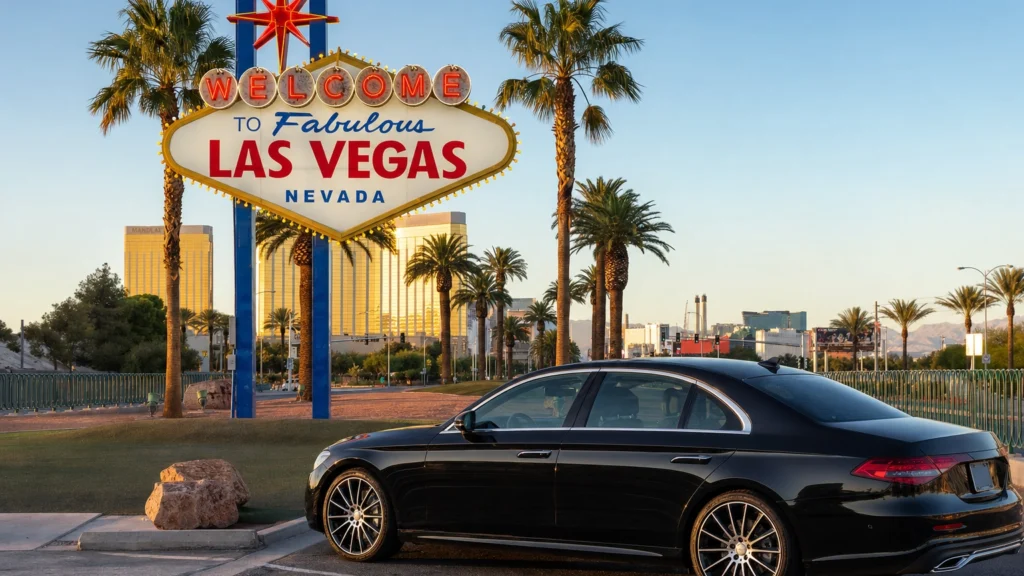
Quick answer: The “Welcome to Fabulous Las Vegas” sign stands in the median at 5100 Las Vegas Boulevard South, at the south end of the Strip just past Mandalay Bay and about 1.5 miles from Harry Reid International Airport. It has its own free parking lot, reachable only from the southbound side, and it is open 24 hours with no admission charge.
If you are asking “where is the Las Vegas sign,” you are picturing the famous neon diamond that reads “Welcome to Fabulous Las Vegas” and wondering how to actually get to it, park, and grab a photo without wasting half a morning. The location is the easy part: it sits in the median at the far south end of the Strip. The details that trip people up are the southbound-only parking lot, the line for the photo, and the fact that the sign is nowhere near the center of the action. Here is everything you need to find it, park, and shoot it right.
- Location: the median at 5100 Las Vegas Boulevard South, south end of the Strip, just past Mandalay Bay.
- City: it is technically in Paradise, Nevada (unincorporated Clark County), not inside the Las Vegas city limits.
- Parking: a free lot of roughly 30 spaces plus bus and limo loading, open 24 hours, but reachable only from the southbound lanes.
- Cost: free to visit and photograph; only the tip-based sidewalk photographers charge.
- Best time: sunrise for the shortest line, or after dark when the sign is lit; avoid weekend middays.
- The catch: from the airport or downtown you have to drive past and U-turn, which is why many visitors let a driver handle it.

What’s in This Guide
Where Is the Las Vegas Sign?
The “Welcome to Fabulous Las Vegas” sign stands in the landscaped median of Las Vegas Boulevard South, with a posted address of 5100 Las Vegas Boulevard South. It marks the historic southern gateway to the Strip, sitting just south of Mandalay Bay and a short hop north of the airport. One detail surprises almost everyone: the sign is not actually inside the City of Las Vegas. This stretch of the Boulevard is in Paradise, Nevada, an unincorporated part of Clark County, which is also where most of the famous Strip resorts legally sit.
Because it is at the far south end of the Strip, the sign is farther from the central casino corridor than visitors expect. If you are staying mid-Strip, it is a deliberate trip south, not a quick walk. Here is roughly how far it is from the places people usually start.
| Starting point | Approx. distance | Drive time (one way) |
|---|---|---|
| Mandalay Bay / south Strip | ~1 mile | ~3 to 5 minutes |
| Center Strip (Bellagio area) | ~2 miles | ~8 to 12 minutes |
| Harry Reid International Airport (LAS) | ~1.5 miles | ~5 to 7 minutes |
| Downtown Las Vegas (Fremont Street) | ~5 miles | ~12 to 18 minutes |
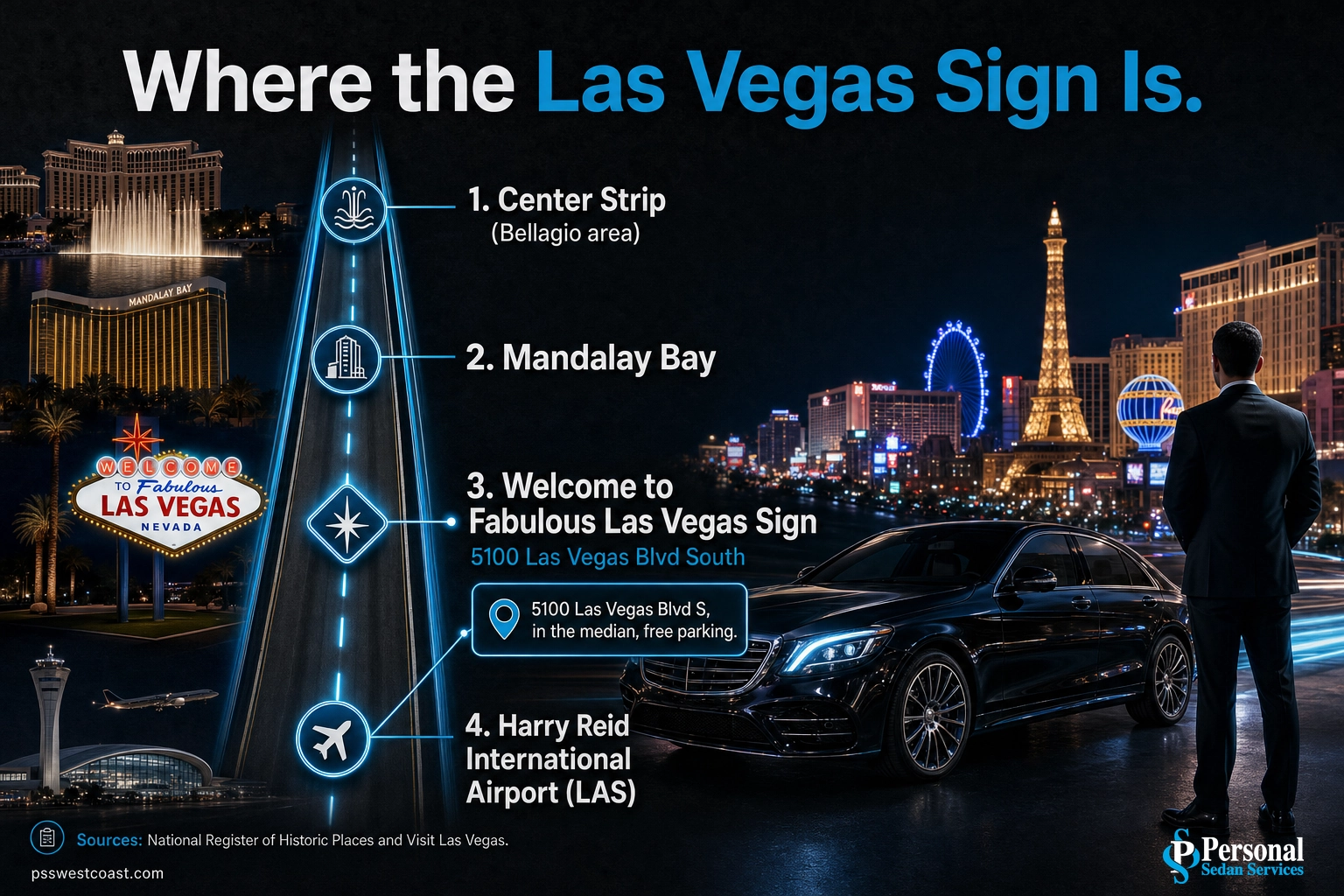
The single most useful fact for finding it: the sign faces the traffic driving into the city, so the front, the side that reads “Welcome to Fabulous Las Vegas,” is best seen from the southbound lanes. The reverse side reads “Drive Carefully Come Back Soon” and greets drivers leaving town. Drop a pin for “Welcome to Fabulous Las Vegas Sign” in any map app and it will route you to the median lot, which is the only place you are allowed to stop.
Source: National Register of Historic Places listing for the sign | Visit Las Vegas (LVCVA)
Add the sign to an airport pickup
Parking and How to Get to the Sign
The sign has its own free parking lot built right into the median, so you do not have to pay or walk from a resort garage. The catch is the access: the lot can only be entered from the southbound side of Las Vegas Boulevard. There is no left turn into it from the northbound lanes. If you are driving up from the airport or down from the central Strip in the wrong direction, you will pass the sign, make a legal U-turn (drivers commonly use the Russell Road intersection), and come back southbound to pull in.
The lot itself is small and in demand. Clark County built the original parking in 2008 and expanded it later, so today there are roughly 30 car spaces along with marked loading zones for buses and limousines. It is open around the clock and costs nothing, but on weekends, at sunset, and during big events it fills fast and cars circle waiting for a space.
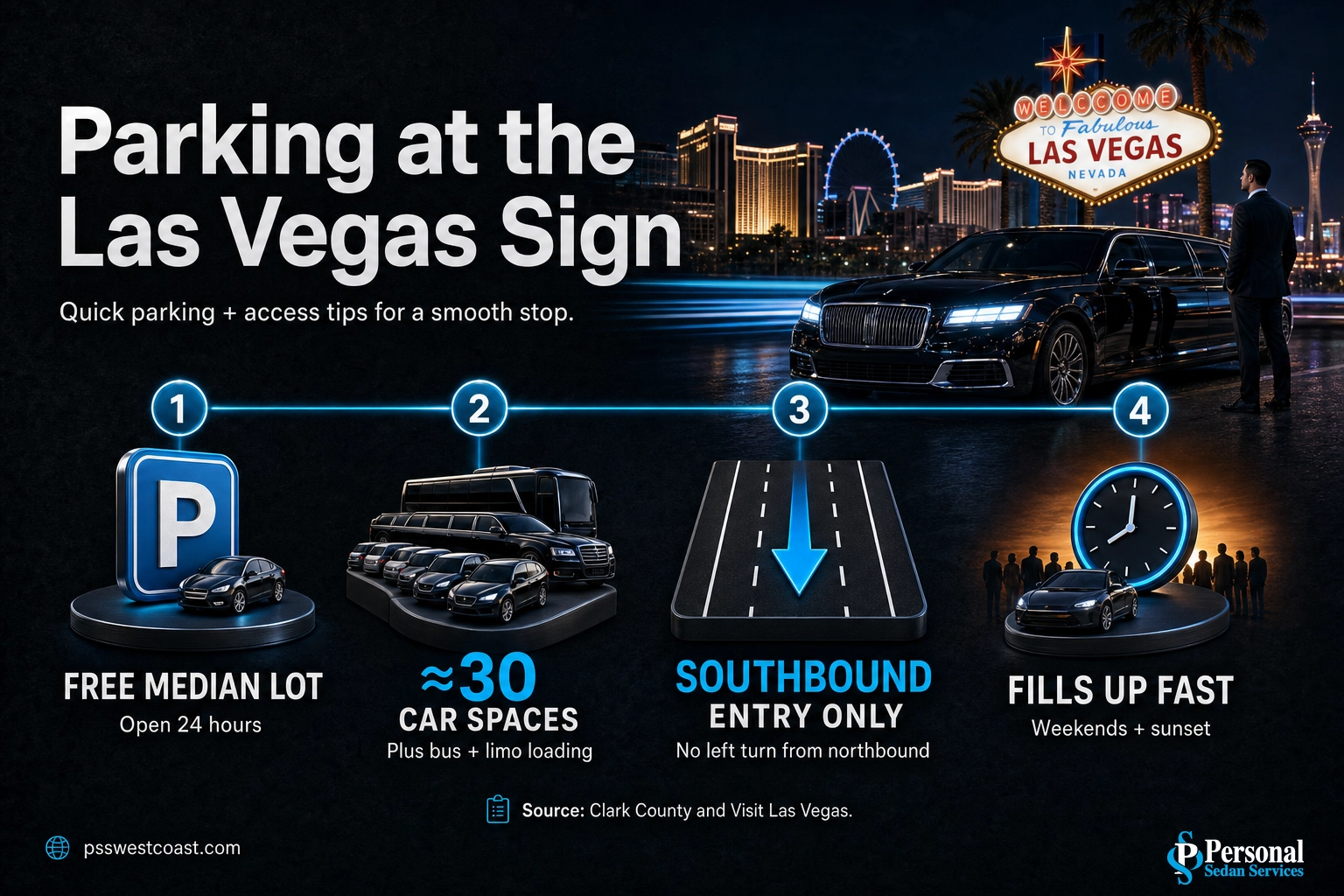
Do not stop in the travel lanes: The median lot is the only legal place to pull over. Stopping on the Boulevard itself to wait for a spot, or trying to squeeze a left turn across traffic from the northbound side, is both unsafe and against the rules. If the lot is full, loop back around rather than idling in traffic.
If you would rather skip the drive entirely, you have options. Rideshare drivers can legally drop you and pick you up at the lot, though return pickups at a busy sightseeing spot can be slow. Many visitors who are already moving around the city, between the airport, a hotel, and dinner, add the sign as a quick five-minute photo stop with a car and driver, which sidesteps the parking scramble completely.
Source: Clark County parking and site improvement history
Get around Las Vegas with a local driver

Best Time to Visit and Photo Tips
The sign is one of the most photographed objects in Las Vegas, which means the real challenge is not the light, it is the line. On a busy day a queue forms for the spot directly in front of the sign, and there is almost no shade while you wait. Timing your visit is the difference between a two-minute stop and a one-hour wait.
- Go at sunrise. Early morning is the quietest window by far. The light is soft, the lot is open, and you may have the sign nearly to yourself. It is also the coolest part of a Las Vegas summer day.
- Or go after dark. The sign is internally lit with a border of chasing bulbs, so night shots are iconic. Crowds thin later in the evening, and the glow against the dark sky is the classic postcard look.
- Avoid weekend middays. Late morning through mid-afternoon on a Friday, Saturday, or Sunday is the worst for both crowds and heat. The photo line can run up to an hour.
- Know the tip photographers. People near the front of the line often offer to take your picture. They are usually locals working for tips, not official staff, so a tip is optional and you are free to decline and shoot your own.
- Shoot both sides. After your “Welcome” photo, walk around for the “Drive Carefully Come Back Soon” back of the sign, a fun and far less crowded shot.
For groups and families, the five-minute reality of a photo stop often turns into twenty with the line and the shuffle for parking, so it helps to build it into a larger plan for the day rather than treating it as a quick dash. If you are mapping out a full itinerary, our guide to what to do in Vegas during the day and the roundup of what to do in Las Vegas with kids both pair naturally with a sign stop.
Source: Visit Las Vegas, official visitor guidance
What Is the Las Vegas Sign? A Quick History
The sign is more than a backdrop. It is a genuine piece of mid-century Americana, designed in 1959 by Betty Willis, an artist working for a local neon shop, at the request of a salesman named Ted Rogich. Clark County bought it and had it installed at the south edge of the Strip for about $4,000. Willis famously never copyrighted the design; she considered it her gift to the city, which is why the image appears on everything from souvenirs to tattoos with no licensing involved.
The design is classic Googie, the Space Age roadside style of the era. It is a double-sided, horizontally stretched diamond about 25 feet tall, internally lit, framed by a border of flashing yellow bulbs. The seven white circles spelling “WELCOME” are stylized silver dollars, a nod to Nevada’s nickname, the Silver State. In 2009 the sign was added to the National Register of Historic Places, cementing its status as an official landmark rather than just a photo op.
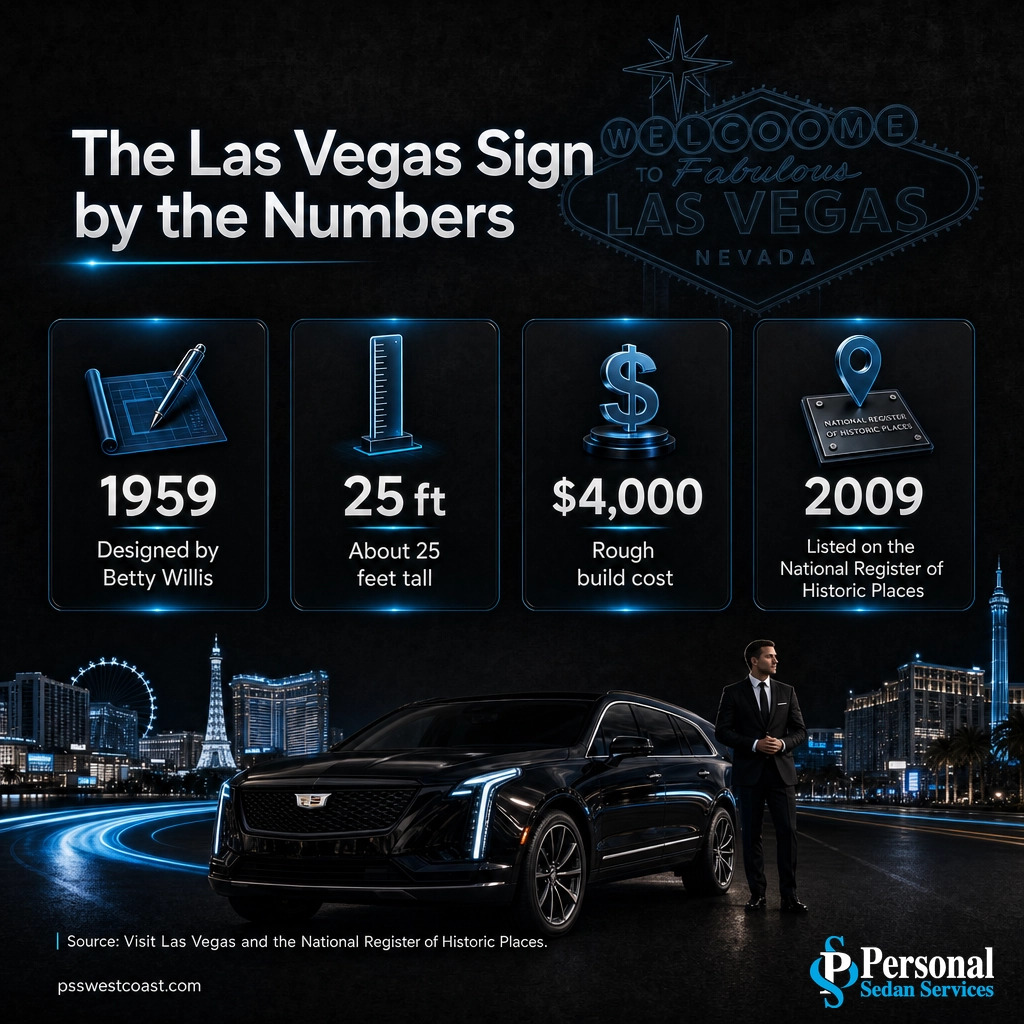
Knowing the backstory changes the stop. Visitors who understand they are standing in front of a 1959 original, one that its designer deliberately left in the public domain, tend to treat the median lot as a landmark worth ten minutes rather than a drive-by. It is the rare free attraction in Las Vegas that is genuinely historic.
Source: National Register of Historic Places, reference 09000284 | Visit Las Vegas: history of the sign
Getting There Without the Hassle
The sign itself is a five-minute photo, but the logistics around it, the southbound-only lot, the U-turns, and the full parking at peak times, are what turn a simple stop into a headache. There are three honest ways to handle it.
Drive yourself
The cheapest option if you already have a rental car. Just remember the lot is southbound-only, plan your approach from the north end of the Strip, and go early or late to find a space. The trade-off is the parking scramble and the U-turn if you misjudge the approach.
Take a rideshare
Fine for a drop-off, since drivers can use the lot. The weak spot is the return: at a busy sightseeing stop with no nearby pickup zone, your wait for a car back can be long, and surge pricing is common in peak hours.
Hire a private car with a driver
The option most visitors overlook. A professional chauffeur knows the southbound approach cold, handles the parking and timing, and waits while you shoot, so the whole group stays together and moves on without a hitch. Because the sign sits between the airport and the resorts, it slots in perfectly as a first stop on an arrival ride into Las Vegas or as one quick stop on a larger sightseeing day. For families, couples marking an occasion, and groups who want the photo without the parking fight, it is the smoothest way to do it.
See our Las Vegas attractions transportation
Frequently Asked Questions
Where is the Welcome to Las Vegas sign?
Is there parking at the Las Vegas sign?
How much does it cost to visit the Las Vegas sign?
What is the best time to photograph the Las Vegas sign?
Can you walk to the Las Vegas sign from the Strip?
Related Las Vegas Travel Guides
- What to do in Las Vegas during the day: daytime attractions and stops that pair well with a sign photo.
- What to do in Las Vegas with kids: family-friendly sights, including the free, quick sign stop.
- Las Vegas car service: how a local chauffeur gets you around the city and its landmarks.
