


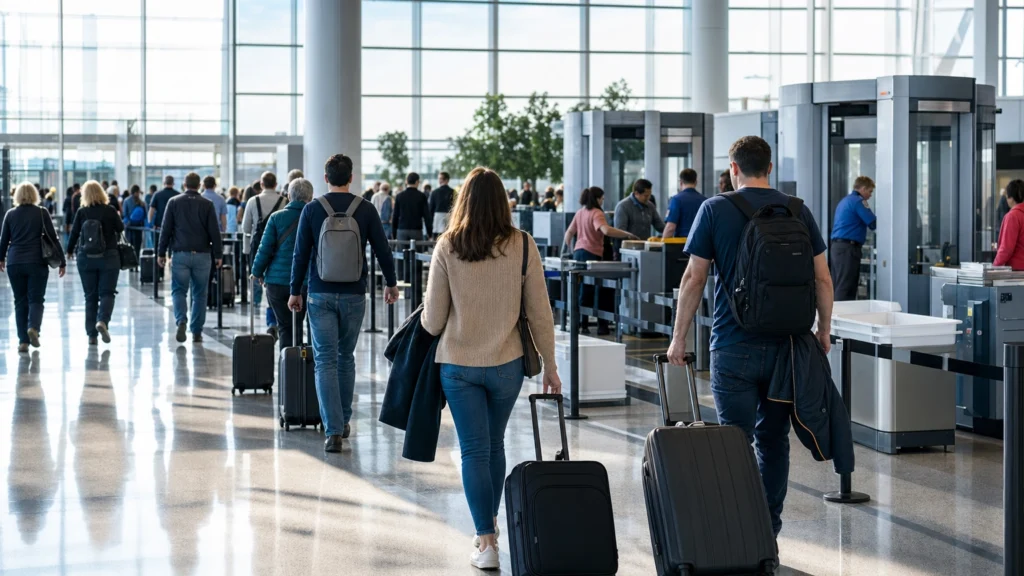
Security wait times at Harry Reid International Airport (LAS) are not one number, they are a moving target. On a quiet late night you may clear the checkpoint in minutes, while an early-morning departure bank, a Sunday-afternoon exodus, or a convention weekend can turn the standard line into a slog. This guide lays out what to actually expect: how long waits run, how early to arrive, the five checkpoints spread across two separate terminals, how TSA PreCheck and CLEAR change the math, when the airport is busiest, and how your ride to the airport quietly decides how much of a cushion you really have.
- Waits swing widely. TSA aims for about 30 minutes or less in the standard line and under 10 minutes for most PreCheck travelers, but time of day, day of week, and city events move the real number far more than any average.
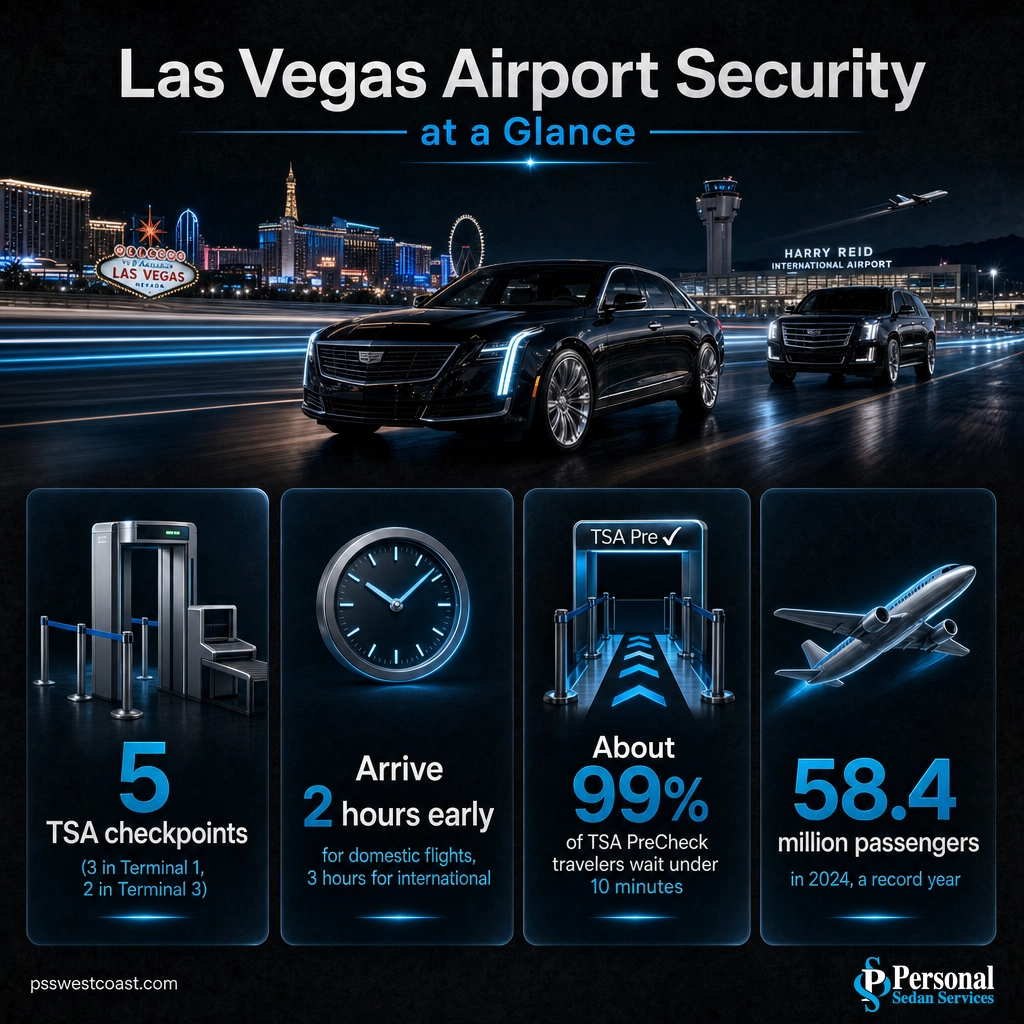
- Arrive two hours early for domestic, three for international. That is the TSA baseline. At LAS, add a cushion for morning banks, holidays, and convention weekends.
- Five checkpoints, two unconnected terminals. Three checkpoints sit in Terminal 1 and two in Terminal 3. Going to the wrong building first can cost you a flight.
- PreCheck is the single biggest time-saver. TSA reports about 99% of PreCheck passengers wait under 10 minutes, and the gap over the standard line is largest exactly when LAS is busiest.
- Las Vegas peaks are event-driven. CES in January, Formula 1 in November, and National Finals Rodeo in December stack huge departure days on top of normal weekend surges.
- Record passenger volume keeps pressure on. LAS handled a record 58.4 million travelers in 2024, so checkpoints run hot more often than they used to.
- Live tools exist, use them. New in-terminal wait-time screens, the myTSA app, and historical data help you time your arrival instead of guessing.
- Your ride sets your real buffer. A curbside drop at the correct terminal removes the parking shuttle and rideshare-lot delays that silently eat your time cushion.

What’s in This Guide
- How long are LAS security waits, really?
- Why Las Vegas security waits swing so much
- The five checkpoints and two terminals
- Security waits by time of day and day of week
- How early should you get to the airport?
- Red-eyes and late-night departures at LAS
- TSA PreCheck, CLEAR, and the fastest way through
- What to expect at the checkpoint, step by step
- Common mistakes that add time at the checkpoint
- Families, disabilities, military, and older travelers
- How to check real-time wait times at LAS
- Arriving at Harry Reid: what to expect after you land
- How your ride affects your security timing
- What to do before your next LAS flight
- LAS security at a glance
- Frequently asked questions
How long are LAS security waits, really?
The honest answer is that there is no single Las Vegas airport security wait time, because the checkpoint is a queue fed by demand that changes hour to hour. The useful way to think about it is to anchor on two published service goals and then adjust for the conditions you will actually travel in.
TSA’s stated target for the standard screening line is roughly 30 minutes or less, and for TSA PreCheck it is 10 minutes or less. Those are goals, not guarantees, and they describe a national aim rather than a measured LAS figure. In practice the standard line at Harry Reid runs well under that target on calm nights and can exceed it during the busiest surges, while PreCheck stays short far more consistently.
What makes LAS different from a typical business airport is the sheer, uneven volume. Harry Reid International is one of the busiest airports in the country, and leisure traffic clusters into intense peaks instead of spreading evenly across the day.
It also pays to know how to read the wait-time numbers you find online. Third-party sites and crowd-sourced apps publish “average” or “current” Las Vegas security waits, and they are a useful signal, but an average blends calm and chaos into a figure that may match no real moment, and a “current” reading is a snapshot that can change the instant a tour group or a convention block reaches the checkpoint. Use those numbers to spot a trend, then lean on the airport’s own live displays and your own time cushion for the decision that actually matters: when to leave for the airport.
October 2024 alone brought about 5.4 million passengers through LAS, the second busiest single month in the airport’s history, a useful reminder that even “shoulder” months now run heavy. When you plan around a worst-reasonable case rather than an average, a longer line becomes a non-event instead of a missed flight.
This airport runs on peaks, not averages. Averaging a dead 2 a.m. checkpoint with a jammed 6 a.m. bank produces a number that describes no real traveler. Plan for the peak you are actually flying in, then treat any faster result as a bonus. That single habit protects more Las Vegas flights than any shortcut through the line.
Source: Harry Reid International Airport 2024 passenger record | TSA PreCheck
Why Las Vegas security waits swing so much
Most airports serve a steady mix of business and leisure travelers whose departures spread across the day. Las Vegas does not. Demand here is bunched, event-driven, and weekend-heavy, which is exactly why the same checkpoint can feel empty on a Tuesday night and overwhelming on a Sunday afternoon.
Three forces drive the swings. First, the leisure rhythm: visitors arrive Thursday and Friday and leave Sunday and Monday, so outbound security spikes at the back half of the weekend. Second, the morning departure banks, when a wall of early flights pushes a crowd through the checkpoints between roughly 4 a.m. and 8 a.m. Third, and most uniquely, the convention and event calendar, which can drop a citywide surge of departures onto a single few days.
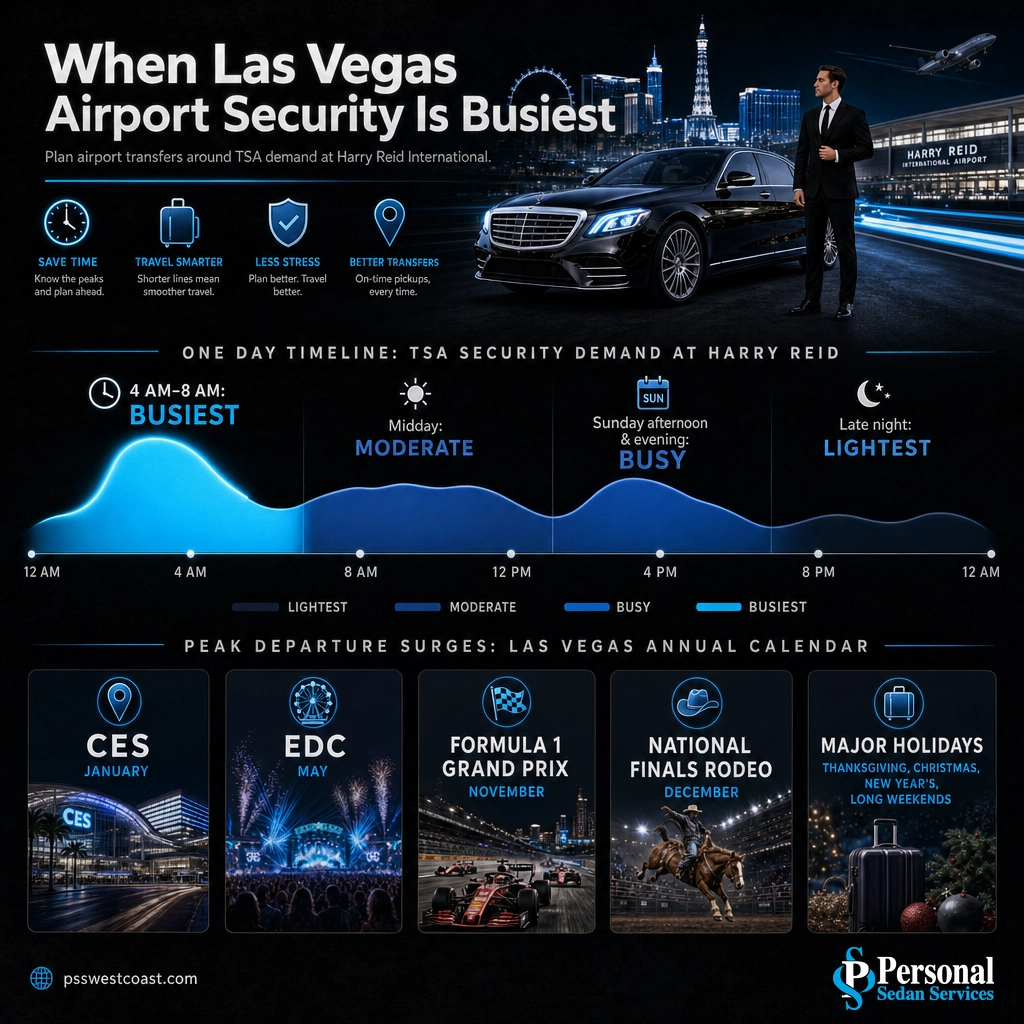
Las Vegas hosts some of the largest gatherings in the country, and the days those crowds fly home are the hardest on the checkpoints. CES in early January, the Formula 1 Las Vegas Grand Prix in November, and the National Finals Rodeo in December are among the biggest, with major fight weekends, festivals such as EDC in May, large sporting events, and holiday travel stacking on top. When one of these lands on your travel day, the normal rules of thumb go out the window.
Check the Las Vegas event calendar for your exact travel dates before you lock in your airport arrival time. A convention checkout day or the Monday after a championship fight can add substantial time to the standard line, and it is the single most common reason confident travelers still miss Las Vegas flights.
For context on just how much traffic now flows through the airport, and why the checkpoints feel busier year over year, see our Las Vegas airport statistics rundown. The short version: more travelers, sharper peaks, and a security line that rewards planning.
Source: Harry Reid International Airport, Clark County Department of Aviation
The five checkpoints and two terminals: know yours before you go
One of the most important facts about getting through security at LAS has nothing to do with the line length. Harry Reid International is built as two separate terminals, Terminal 1 and Terminal 3, each with its own check-in, baggage claim, and security. They are not connected on the landside, so you cannot clear security in one and walk to the other. Going to the wrong building first is a classic, avoidable Las Vegas time sink.
Terminal 1 serves most domestic airlines, including Southwest, which operates from the C gates. Terminal 3 handles the remaining domestic carriers plus all international flights. Before you leave, confirm your airline and terminal, because the right building is the first checkpoint you need to clear. Our Las Vegas airport terminal guide maps every airline to its terminal and gate area, and the broader Harry Reid International Airport guide covers the full layout.
Each checkpoint also keeps its own hours, which matters for very early and very late flights. The table below reflects the hours the airport has published. Hours can change, so treat them as a planning guide and confirm on the airport’s security page.
| Checkpoint | Terminal | Gates served | Published hours |
|---|---|---|---|
| A/B Gates | Terminal 1 | A and B gates | 3:15 a.m. to 1:00 a.m. |
| C Gates (Southwest) | Terminal 1 | C gates, mainly Southwest | 3:05 a.m. to 10:00 p.m. |
| C/D Gates | Terminal 1 | C and D gates connector | Open 24 hours |
| Level 2 Checkpoint | Terminal 3 | D and E gates | 3:30 a.m. to 1:30 a.m. |
| Innovation Checkpoint | Terminal 3 | D and E gates (Level Zero) | 5:00 a.m. to 1:30 p.m. |
If your flight leaves before dawn, check which checkpoint is open for your gates. In Terminal 1, the C/D Gates checkpoint runs 24 hours and is your fallback when a specific checkpoint has not opened yet. Flying Southwest means the C Gates checkpoint, which does not open until just after 3 a.m., so a 24-hour-adjacent option saves a wait at the door.
Source: Harry Reid International Airport, Security at LAS
Security waits by time of day and day of week
Because LAS runs on peaks, timing is the lever you control most easily. The patterns below are general guidance for a 24-hour, leisure-heavy airport, not a measured guarantee, so always pair them with a live wait-time check on your travel day. They do, however, line up with the published checkpoint hours and the city’s weekend rhythm.
| Window | Typical demand | What to know |
|---|---|---|
| Early morning (4 a.m. to 8 a.m.) | Busiest | The first departure banks hit all at once. Expect the longest standard lines of the day, especially Monday and Friday. |
| Midday (10 a.m. to 2 p.m.) | Moderate | Often the calmest practical window for a flexible departure. |
| Afternoon and early evening (3 p.m. to 7 p.m.) | Busy, especially Sunday | Weekend visitors head home. Sunday afternoon is one of the week’s hardest stretches. |
| Late night (after 9 p.m.) | Lightest | Lines are usually short, but confirm your checkpoint is still open for your gates. |
| Convention and event days | Peak, all day | CES, F1, NFR, big fights, and festivals override the normal pattern. Treat the whole day as a peak. |
Volume has also trended up for three straight years, which means these peaks arrive more reliably and last longer than they did a few seasons ago. The chart below shows the recent climb in total passengers, the underlying reason the checkpoints feel busier.
Harry Reid International annual passengers (record growth)
Source: Harry Reid International Airport (Clark County Department of Aviation), 2024 passenger figures.
Source: Harry Reid International Airport 2024 passenger record
How early should you get to the airport?
Start with the TSA baseline and adjust for LAS reality. TSA recommends arriving two hours before a domestic flight and three hours before an international flight. The airport echoes the same guidance on its security page. Those numbers already fold in a normal security wait, bag drop, and the walk to your gate.
At Las Vegas, treat two and three hours as the floor, not the ceiling, and add to it when any of these apply:
- A pre-8 a.m. departure: you are flying in the busiest bank of the day. Add 30 minutes.
- A Sunday or holiday-weekend return: the whole city is checking out. Add 30 to 60 minutes.
- A convention or major-event checkout day: add an hour and watch the live wait screens.
- Checked bags or a rental-car return: both add time before you ever reach the line.
- No PreCheck or CLEAR: you are in the line most exposed to the peaks, so lean toward the larger cushion.
Showing up earlier than you need means a short, calm wait and a coffee at the gate. Showing up late during a Las Vegas peak means watching the standard line snake back and doing the math on whether you will make it. Arriving early is not wasted time, it is the cheapest insurance in travel, and it is the one variable entirely within your control.
For a scenario-by-scenario breakdown, including red-eye and connection timing, see our dedicated guide on how early you should get to the Las Vegas airport.
Source: Harry Reid International Airport, Security at LAS | TSA security screening
Red-eyes and late-night departures at LAS
Las Vegas runs on a different clock than most cities, and a large share of departures leave late at night or in the small hours. For security, that cuts both ways. Late-night is usually the lightest wait window of the entire day, so if your schedule is flexible, a post-9 p.m. departure often means the shortest line you will ever stand in at Harry Reid. The catch is that not every checkpoint stays open around the clock.
Only the Terminal 1 C/D Gates checkpoint runs 24 hours. The others have published closing times: the A/B Gates checkpoint closes around 1 a.m., the C Gates (Southwest) checkpoint closes at 10 p.m., the Terminal 3 Level 2 checkpoint closes around 1:30 a.m., and the Innovation Checkpoint in Terminal 3 keeps shorter daytime hours. So a late departure that is quiet on paper can still cost you time if your usual checkpoint has shut and you have to walk to the one that is open. Confirm which checkpoint serves your gates before a very late or very early flight.
The same odd hours that make the checkpoint quiet also make the trip to the airport less predictable. Rideshare supply thins out after midnight and before dawn, surge pricing is common on the exact nights the city empties out, and a no-show at 3 a.m. is the kind of problem that turns a short security line into a missed flight anyway. This is where a scheduled, flight-monitored pickup matters most: the car is confirmed, it does not disappear at odd hours, and it drops you at the correct terminal so the open checkpoint is a short walk away.
For a red-eye, work backward from your checkpoint’s closing time, not just your departure time. If your gate’s checkpoint closes at 10 p.m. and your flight is later, plan to use the 24-hour C/D checkpoint in Terminal 1, and give yourself the walk time between concourses.
Source: Harry Reid International Airport, Security at LAS
TSA PreCheck, CLEAR, and the fastest way through
If you fly through Las Vegas more than once or twice a year, a trusted-traveler program is the highest-return way to cut your security wait. There are two separate services, they do different jobs, and they work best together.
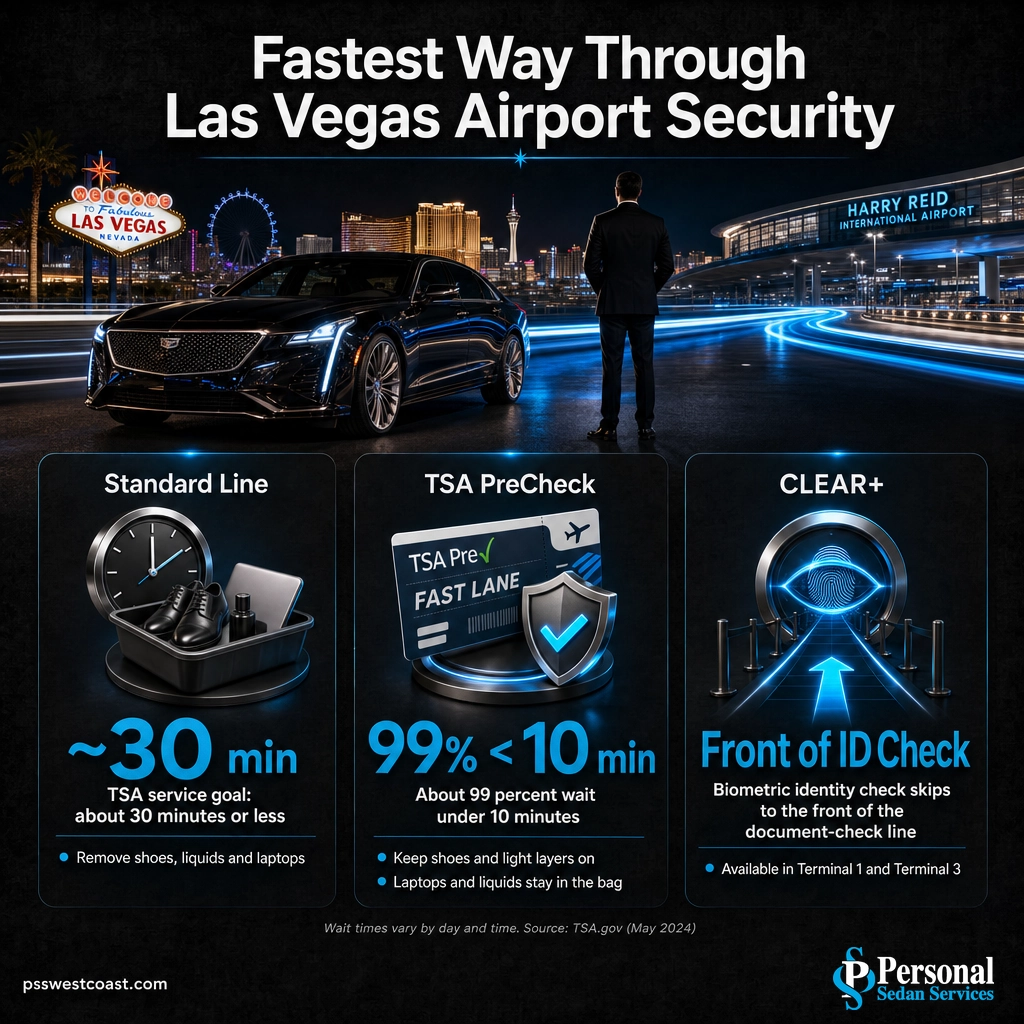
TSA PreCheck is a government program that gives you a dedicated, faster screening lane where you keep your shoes, belt, and light jacket on and leave compliant laptops and liquids inside your bag. TSA reports about 99% of PreCheck passengers wait less than 10 minutes. CLEAR+ is a private membership that verifies your identity biometrically and escorts you to the front of the document-check line. CLEAR gets you to the screening sooner, PreCheck gets you through the screening faster, and together they are the quickest combination at a busy airport like LAS.
| Option | What it does | Typical speed | Best for |
|---|---|---|---|
| Standard line | Normal screening, remove shoes, liquids, and electronics | TSA goal about 30 min or less, but most exposed to peaks | Infrequent travelers flying off-peak |
| TSA PreCheck | Expedited screening, less to remove | About 99% wait under 10 minutes (TSA) | Anyone flying more than a couple of times a year |
| CLEAR+ | Biometric ID check, skip to the front of document check | Fast through ID, then into your screening lane | Frequent flyers who want to pair it with PreCheck |
| PreCheck + CLEAR | Skip the ID line and get expedited screening | The fastest practical combination | Las Vegas regulars and road warriors |
Both programs operate at LAS. PreCheck lanes are available at the terminals’ checkpoints, and CLEAR+ lanes operate in both Terminal 1 and Terminal 3. Lane locations and hours change, so confirm on the official sites before you count on a specific lane.
Apply for PreCheck well before a trip, since appointments and background checks take time, and check whether your travel credit card reimburses the application fee, as many do. If you already have Global Entry for international travel, PreCheck is included.
Source: TSA PreCheck | CLEAR official website

What to expect at the checkpoint, step by step
Knowing the sequence keeps you from being the person holding up the line, which is a courtesy to everyone and a time-saver for you. Here is the standard-lane flow at LAS and the rules that trip travelers up most.
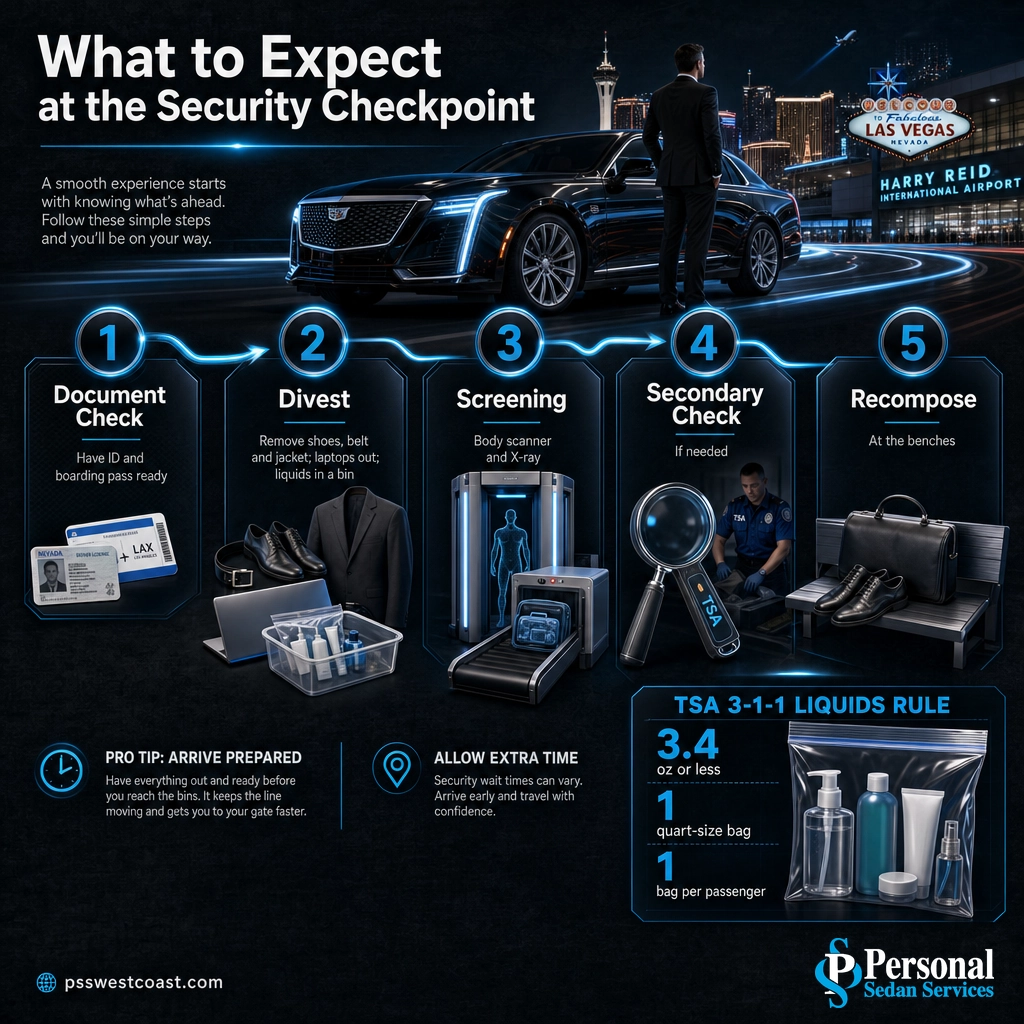
- Document check. Have your boarding pass and a valid ID ready. Adults need a REAL ID-compliant license or another acceptable ID such as a passport.
- Divest. In the standard lane, remove shoes, belts, and jackets, take laptops and large electronics out of your bag, and place your 3-1-1 liquids bag in a bin. PreCheck travelers skip most of this.
- Screening. Walk through the body scanner or metal detector while your bags go through the X-ray.
- Secondary, if needed. A bag may be pulled for a quick manual check. It is routine and usually fast.
- Recompose. Collect your belongings, step to the benches past the line, and put yourself back together there rather than at the belt.
The rule that causes the most delays is the liquids limit. The TSA 3-1-1 rule means liquids, gels, and aerosols in your carry-on must be in containers of 3.4 ounces (100 ml) or less, all fitting in one quart-size zip-top bag, one bag per passenger. Full-size bottles, that souvenir bottle of water, and oversized toiletries are the usual reasons a bag gets pulled.
Empty your water bottle before the checkpoint and fill it at a fountain past security. A full bottle is a liquid over the limit, and it is one of the most common reasons a bag is flagged and rescreened, costing you and everyone behind you time in a line you were trying to beat.
Wear slip-on shoes, move your watch and pocket items into your bag before you reach the belt, and keep your ID and boarding pass in one hand until document check is done. Small habits like these are what separate a 90-second trip through the scanner from a two-minute fumble that backs up the lane.
Source: TSA, What Can I Bring | TSA security screening
Common mistakes that add time at the checkpoint
Most of the time lost at a Las Vegas checkpoint is self-inflicted, which is good news, because it means it is avoidable. A single pulled bag or a document problem does not just cost you time, it slows everyone behind you. These are the mistakes we see cost travelers the most minutes at LAS.
- A full water bottle. The most common one. A bottle of water is a liquid over the 3.4-ounce limit, so it triggers a bag pull and rescreen. Empty it before the line and refill past security.
- The wrong terminal. Terminal 1 and Terminal 3 are separate buildings. Arriving at the wrong one means getting back out to ground transportation and over to the right building, a brutal mistake on a tight schedule.
- Not having a REAL ID (or alternative) ready. Adults need a REAL ID-compliant license or an acceptable alternative such as a passport. A document problem at the podium stops your whole line.
- Oversized toiletries and aerosols. Full-size shampoo, sunscreen, or that aerosol can over the limit is a classic Las Vegas pack-for-the-pool error that gets a bag flagged.
- Prohibited items in the carry-on. Pocket knives, large scissors, and similar items must be in checked bags. If TSA finds one, screening stops while it is resolved.
- Burying your laptop and electronics. In the standard lane, large electronics come out and go in their own bin. Digging for a laptop at the belt holds up the lane.
- Flying the morning bank without PreCheck. If you must fly in the busy 4 a.m. to 8 a.m. window, the standard line is at its longest. That is the day PreCheck earns its keep.
Do a 60-second “checkpoint check” in the car on the way to the airport: ID and boarding pass out and reachable, water bottle empty, liquids in the quart bag, laptop near the top of your bag, nothing sharp in the carry-on. Clearing those five things before you arrive is the difference between a smooth lane and a pulled bag.
Source: TSA, What Can I Bring | TSA REAL ID
Families, travelers with disabilities, military, and older travelers
Security is not one-size-fits-all, and several groups move through LAS on different rules that can make the wait easier.
Children and families. Kids 12 and under can keep their shoes on, and children 12 and under may go through the PreCheck lane with an enrolled parent or guardian. Strollers and car seats are screened separately, and formula, breast milk, and baby food are allowed in reasonable quantities beyond the 3-1-1 limit (just declare them).
Travelers with disabilities and medical needs. TSA Cares is a help line you can contact before your trip to arrange assistance through the checkpoint. Medically necessary liquids, medications, and mobility and medical devices are permitted, and you can request a passenger support specialist at the checkpoint.
Military. Active-duty service members often receive expedited screening, and some can use PreCheck lanes with their DoD ID. Service members should check current TSA guidance before traveling.
Older adults. Travelers 75 and older get some screening accommodations, including being able to leave on shoes and a light jacket in many cases.
If anyone in your party needs extra time or assistance, build it into your arrival plan rather than hoping the line is short. Reaching out to TSA Cares a few days ahead, and arriving with margin, turns a potentially stressful checkpoint into a calm one.
Source: TSA special procedures and TSA Cares
How to check real-time wait times at LAS
You no longer have to guess. Harry Reid International has started rolling out estimated TSA wait-time displays, beginning in Terminal 1 with screens near the A/B Checkpoint information booth, by the baggage-claim elevators, at the C Annex Checkpoint, and at ticketing. Officials have described it as an early pilot, with plans to expand across all Terminal 1 screens and the parking decks, then to Terminal 3, with a website to follow.
Three ways to check before and during your trip:
- In-terminal screens: look for the estimated wait-time displays in Terminal 1 when you arrive.
- The free myTSA app: shows historical and crowd-sourced wait trends by airport and checkpoint, useful for picking your arrival time days ahead.
- Airport flight information displays and the airport website: confirm your terminal and gate so you head to the right checkpoint the first time.
Treat every estimate as a starting point, not a promise. A screen reading a short wait can change in the few minutes it takes a tour group or a convention block to arrive, which is exactly why a built-in cushion still matters even when the tools say the line is light.
Source: KTNV: Harry Reid rolls out real-time TSA wait-time displays | TSA myTSA app
Arriving at Harry Reid: what to expect after you land
Security wait times are a departure concern, but half of your airport experience is the arrival, and Las Vegas has its own rhythm there too. Knowing what happens after you land helps you plan the back half of the trip, especially the handoff to your ride.
Domestic arrivals. If you land on a domestic flight, you go straight from your gate to baggage claim in your terminal. There is no security to clear on arrival. The main variables are how long bags take and how crowded the ground-transportation level is, both of which spike when several large flights land together or during a convention arrival wave.
International arrivals. International flights arrive into Terminal 3, where you clear U.S. Customs and Border Protection before collecting your bags and exiting. Allow extra time here, particularly during peak international banks, and plan your pickup knowing the process is not instant.
Getting to your ride. This is where a plan pays off. Rideshare and taxis stage in designated zones that back up at peak arrival times, and in a city built on first impressions, standing in a pickup queue after a long flight is a rough start. A pre-arranged chauffeur monitors your flight, so a delay or an early landing is already accounted for, and you are met at a set point instead of competing for a car.
If you are collecting an arriving traveler yourself, our guide to picking someone up at the Las Vegas airport covers the arrival-side logistics, where to wait, and how the cell-phone and pickup zones work.
Source: Harry Reid International Airport | U.S. Customs and Border Protection, Travel
How your ground transportation affects your security timing
Here is the part most wait-time guides skip. The TSA line is only the last step of getting to your gate. Everything before it, parking, shuttles, rideshare staging, and simply reaching the correct terminal, is where Las Vegas travelers quietly lose the cushion they thought they had. A line you timed perfectly does you no good if you are still circling the parking deck or waiting in a rideshare queue when it forms.
Consider the three common ways people get to LAS for a flight:
- Driving and parking: you add the drive, the hunt for a space, the parking shuttle or walk, and the rental-return process if applicable, all before the checkpoint.
- Rideshare: at peak times the pickup and drop-off zones and staging lots back up, and surge pricing climbs on exactly the busy days when you most need to be on time.
- A private car service: a professional chauffeur monitors your flight, drops you directly at the correct terminal’s departures curb, and handles the luggage, so the first thing you do at the airport is walk toward your checkpoint.
A car service does not shorten the TSA line, nothing short of PreCheck does that, but it removes the uncertainty stacked in front of it. On a pre-dawn departure or a convention checkout day, that reclaimed time and the confidence of a guaranteed, monitored pickup is often the margin between a relaxed walk to the gate and a sprint.
The travelers who never seem stressed at LAS are not lucky, they have simply removed variables. They hold PreCheck, they check a live wait tool, and they arrive by a means that drops them at the right terminal on time, every time. You cannot control the TSA line, but you can control almost everything that happens before it.
Personal Sedan Services runs exactly this kind of airport operation across the Las Vegas valley, with flight monitoring, the correct-terminal drop, and licensed, background-checked chauffeurs. Explore our Las Vegas airport car service, and if you are deciding between options, our comparison of taxi, rideshare, or chauffeur at the Las Vegas airport lays out the tradeoffs. Arriving? See where to meet your chauffeur, our tips on the best way from the airport to the Strip, and, for red-eyes, our late-flight airport car service.
Book Las Vegas Airport Car Service
What to do before your next LAS flight
Pull it together into a short, prioritized plan. Work down this list and the checkpoint becomes a formality instead of a risk.
| Action | Priority | When | Why it helps |
|---|---|---|---|
| Enroll in TSA PreCheck (and consider CLEAR) | High | Weeks ahead | The single biggest, most reliable cut to your wait. |
| Confirm your terminal and airline | High | Before you leave | Terminal 1 and Terminal 3 are separate buildings. |
| Check the event calendar for your travel date | High | When booking | CES, F1, NFR, and fights override normal patterns. |
| Arrange a curbside drop at the right terminal | High | A day or two ahead | Removes parking, shuttle, and rideshare-lot delays. |
| Set your arrival time (2 hr domestic / 3 hr intl, plus a cushion) | High | Travel day | Covers the realistic peak, not an average. |
| Pack to the 3-1-1 rule and empty your water bottle | Medium | Before you pack | Prevents a pulled bag and a rescreen. |
| Check a live wait-time tool | Medium | Before you head out | Lets you adjust if the line is unusually long. |
| Request TSA Cares if anyone needs assistance | As needed | A few days ahead | Arranges help through the checkpoint in advance. |
LAS security at a glance
A single reference table for the facts and rules of thumb in this guide. Confirm anything time-sensitive against the live sources before you travel.
| Topic | What to know |
|---|---|
| Airport | Harry Reid International Airport (LAS), Las Vegas, Nevada |
| 2024 passengers | 58.4 million, an all-time record and third straight record year |
| Terminals | Two separate buildings: Terminal 1 and Terminal 3, not landside connected |
| Total TSA checkpoints | Five: three in Terminal 1, two in Terminal 3 |
| Southwest Airlines | Terminal 1, C gates checkpoint |
| International flights | Terminal 3 |
| 24-hour checkpoint | Terminal 1 C/D Gates checkpoint |
| Standard-line TSA goal | About 30 minutes or less |
| PreCheck performance | About 99% wait under 10 minutes (TSA) |
| Arrive before a domestic flight | 2 hours (add a cushion at peaks) |
| Arrive before an international flight | 3 hours |
| Busiest time of day | Early morning, roughly 4 a.m. to 8 a.m. |
| Busiest day pattern | Sunday afternoon and evening (weekend checkout) |
| Lightest window | Late night, after about 9 p.m. |
| Biggest event peaks | CES (January), F1 Grand Prix (November), NFR (December), major fights, festivals, holidays |
| TSA PreCheck | Expedited lane, keep shoes and light layers on, laptops and liquids stay in the bag |
| CLEAR+ | Biometric ID check at both terminals; pairs with PreCheck |
| Liquids rule | 3-1-1: 3.4 oz containers, one quart bag, one per passenger |
| ID requirement | REAL ID-compliant license or acceptable alternative (for example, passport) |
| Live wait times | In-terminal screens (Terminal 1 pilot), myTSA app, airport website |
| Assistance | TSA Cares for travelers with disabilities or medical needs |
| Best pre-line time saver | A curbside drop at the correct terminal |
Frequently asked questions
How long are security wait times at the Las Vegas airport?
How early should I get to Harry Reid International Airport?
Does TSA PreCheck make the Las Vegas airport faster?
How many security checkpoints does the Las Vegas airport have?
What terminal do I use at the Las Vegas airport?
When is the Las Vegas airport busiest for security?
Is CLEAR available at Harry Reid International Airport?
Can I see real-time TSA wait times at the Las Vegas airport?
Does taking a car service to the airport reduce my security wait?
Methodology and Sources
This guide combines official airport and TSA information with publicly reported passenger data. Checkpoint count, terminal structure, operating hours, and arrival recommendations are drawn from Harry Reid International Airport’s security page. Passenger-volume figures are from the airport’s own 2024 reporting (Clark County Department of Aviation). TSA PreCheck performance, screening procedures, the 3-1-1 liquids rule, and special-assistance programs are from the Transportation Security Administration. Real-time wait-display information reflects local reporting on the airport’s pilot program. Time-of-day and day-of-week patterns are general guidance for a leisure-heavy, 24-hour airport and should be paired with a live wait-time check on your travel day. No wait figures were invented; where a precise, measured number was not available from a primary source, the guidance is framed as directional.
Primary sources:
- Harry Reid International Airport, Security at LAS
- Harry Reid International Airport, 2024 record passenger figures (Clark County Department of Aviation)
- TSA PreCheck
- TSA, Security Screening
- KTNV, real-time TSA wait-time displays at Harry Reid
- CLEAR
Last Updated: October 2026
