


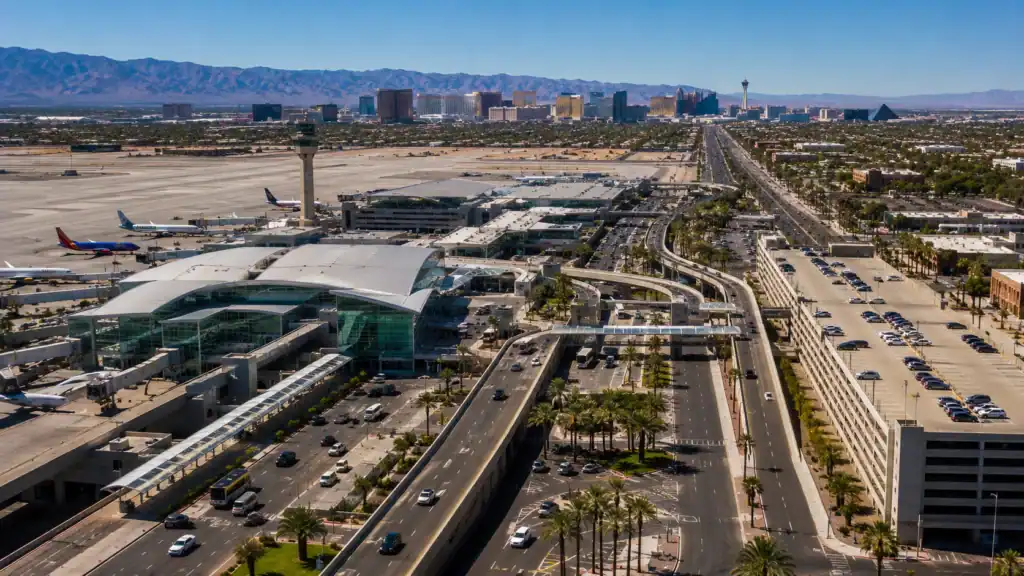
Two in three Las Vegas visitors arrive by car — not plane, reflecting the city’s position at the center of a 500-mile radius containing 40+ million people. Of the 54.99 million who flew through LAS in 2025, navigating the 3 miles to the Strip involves a choice between five transportation modes with dramatically different outcomes. Here are 32 verified statistics on how Las Vegas moves.
- ~66% of Las Vegas visitors arrive by personal vehicle; ~34% by air (LVCVA Visitor Profile 2025).
- 54,989,185 passengers at Harry Reid Airport in 2025 — 3rd highest in airport history, down 5.9% from 2024’s record (Clark County DOA, January 2026).
- 3 miles separates LAS from the center of the Las Vegas Strip — 10–20 minutes under normal conditions.
- Taxi flat rates from LAS: $21.25 (south Strip), $25.25 (mid-Strip), $29.25 (north Strip) — Nevada Transportation Authority regulated, no surge (NTA).
- Rideshare at LAS picks up on Level 2 of the parking garage — NOT at baggage claim (Harry Reid International Airport ground transportation).
- Rideshare surge pricing during major Las Vegas events reaches 4–6× base rate — a $20 base fare can surge to $80–$120+ post-event (market observation).
- PSS meets passengers inside at baggage claim with a name sign at the carousel — fixed rate, no garage walk, no surge ever (PSS service model).
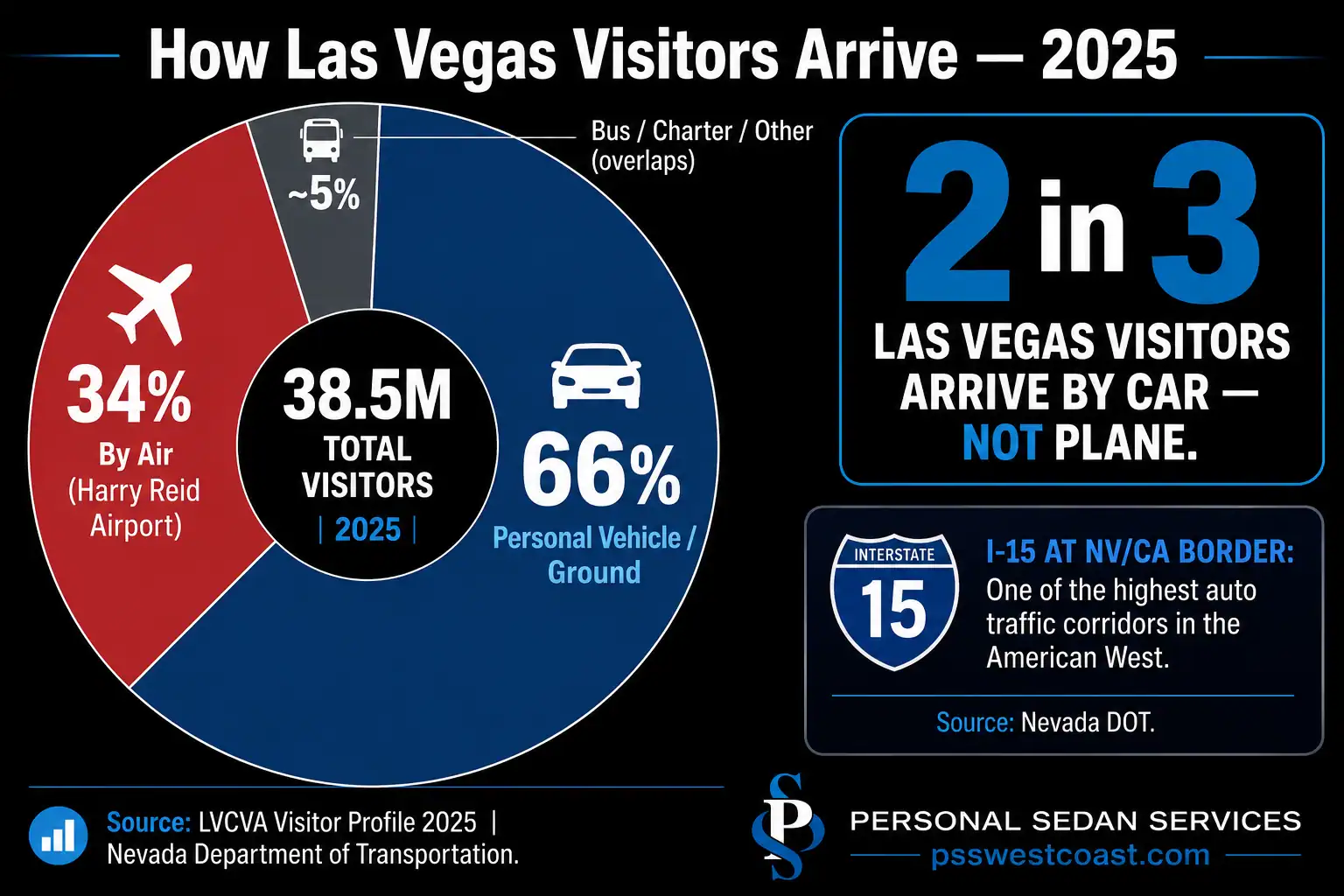
1. How Las Vegas Visitors Arrive
Las Vegas sits within a 500-mile radius of approximately 40 million people in Southern California, the Phoenix metro, Salt Lake City, and Las Vegas’s own local population. The I-15 corridor from Southern California is the primary ground access route — Nevada DOT tracks average daily auto traffic at the Nevada/California border as a leading indicator of Las Vegas tourist arrivals. In years when visitor volume declines, I-15 border crossings decline correspondingly.
Source: LVCVA — Las Vegas Visitor Profile Studies
Book LAS Airport Transfer — Meet at Baggage Claim, Fixed Rate
2. Airport Ground Transportation Statistics
Las Vegas’s 3-mile airport-to-Strip distance is unusually short. But the city experiences some of the most volatile rideshare demand surges in the U.S. — post-Raiders game (62,000+ simultaneous departures), post-Sphere concert (17,500+ simultaneous departures), convention week departure windows (tens of thousands of business travelers all leaving within the same 2-hour window). When demand spikes, supply doesn’t keep pace in real time. The airport’s fixed geography concentrates all this demand into a single 3-mile zone. Pre-booked fixed-rate service eliminates the surge variable entirely.
Sources: Las Vegas Stadium Authority (Raiders attendance); MSG Sphere Studios (Sphere capacity); LVCVA convention data. Analysis original to Personal Sedan Services.
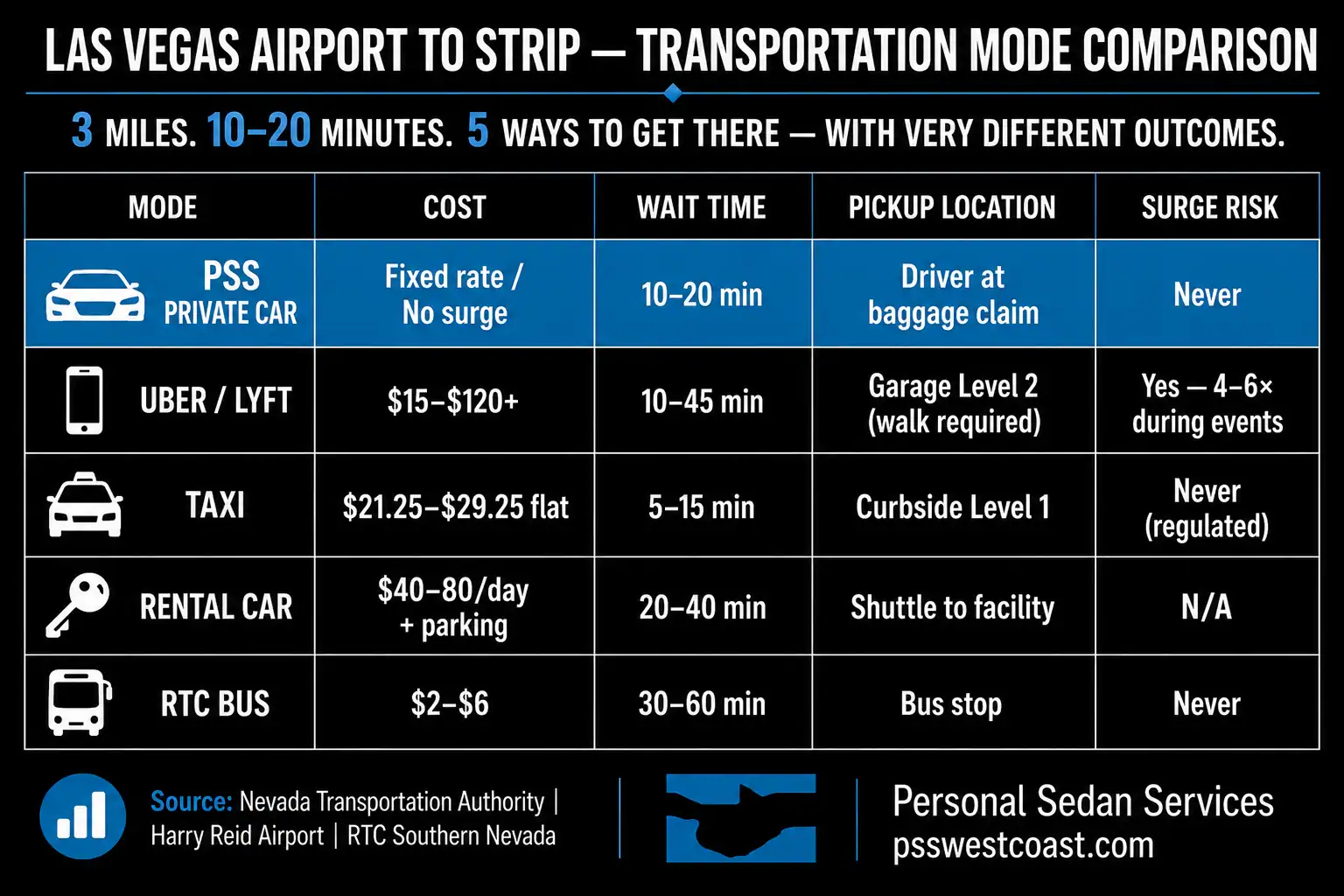
Source: Harry Reid International Airport — Ground Transportation | Nevada Transportation Authority — Regulated taxi flat-rate zones
Read: Las Vegas Airport Statistics 2026 — Passengers, Airlines & Full Data
3. Las Vegas Rideshare & Taxi Market
During the Las Vegas Grand Prix (typically November), Las Vegas Boulevard is closed to all vehicles during circuit operation periods. This eliminates normal rideshare and taxi access to mid-Strip hotels for hours at a time. Rideshare apps surge dramatically in the surrounding accessible zones. Pre-booked private car service with pre-planned routes to circuit-adjacent drop points is the only reliable option. PSS books F1 weekend transportation 2–3 months in advance — those slots fill.
Source: Regional Transportation Commission of Southern Nevada (RTC) | Nevada Transportation Authority
Book Event Transportation — F1, Raiders, Golden Knights, Sphere
Las Vegas Transportation Statistics — Summary Reference Table
| Statistic | Figure | Source | Year |
|---|---|---|---|
| Visitors arriving by personal vehicle | ~66% | LVCVA Visitor Profile | 2025 |
| Visitors arriving by air | ~34% | LVCVA Visitor Profile | 2025 |
| Visitors arriving by bus/charter | ~4–5% | LVCVA Visitor Profile | 2025 |
| LAS annual passengers | 54,989,185 | Clark County Dept. of Aviation | 2025 |
| Distance LAS to mid-Strip | ~3 miles | PSS operational data | Current |
| Drive time LAS to south Strip | 5–10 min | PSS operational data | Current |
| Drive time LAS to mid-Strip | 10–20 min | PSS operational data | Current |
| Drive time LAS to north Strip | 15–25 min | PSS operational data | Current |
| Taxi Zone 1 flat rate (south Strip) | $21.25 | Nevada Transportation Authority | Current |
| Taxi Zone 2 flat rate (mid-Strip) | $25.25 | Nevada Transportation Authority | Current |
| Taxi Zone 3 flat rate (north Strip) | $29.25 | Nevada Transportation Authority | Current |
| Rideshare pickup location at LAS | Garage Level 2 (T1 and T3) | Harry Reid International Airport | Current |
| Rideshare normal fare (LAS to mid-Strip) | $15–$30 | Rideshare market rate | 2025–2026 |
| Rideshare surge (post-major event) | $80–$120+ | Market observation | Current |
| Rideshare surge multiplier | 4–6× base rate | Market observation | Current |
| Monorail stops | 7 | Las Vegas Monorail | Current |
| Monorail single-ride fare | ~$5–$6 | Las Vegas Monorail | Current |
| Monorail hours (weekday) | 7 AM–midnight | Las Vegas Monorail | Current |
| Monorail hours (weekend) | 7 AM–2 AM | Las Vegas Monorail | Current |
| RTC Deuce bus service | 24 hours, along Strip | RTC Southern Nevada | Current |
| RTC Deuce 2-hour pass fare | ~$6 | RTC Southern Nevada | Current |
| RTC 24-hour unlimited pass | ~$8 | RTC Southern Nevada | Current |
| RTC Route 109 airport-to-Strip fare | $2–$6 | RTC Southern Nevada | Current |
Frequently Asked Questions
- LVCVA Visitor Profile Studies — Visitor arrival mode data
- Harry Reid International Airport / Clark County Department of Aviation — 2025 annual statistics; ground transportation information
- Nevada Transportation Authority — Taxi flat-rate zones and TNP regulation
- Regional Transportation Commission of Southern Nevada (RTC) — Bus fares and route schedules
- Las Vegas Monorail — Station locations, fares, hours
- Nevada Department of Transportation — I-15 traffic count data
- PSS operational data — 25+ years of LAS airport and Las Vegas transportation operations
Rideshare pricing figures are market observations based on standard and surge conditions. Surge multipliers are directional estimates — actual surge pricing is algorithmic and varies by real-time supply and demand. Taxi flat rates are current NTA-regulated figures; verify with NTA before travel.
Journalists and researchers may cite statistics from this article with attribution to Personal Sedan Services (psswestcoast.com) and a link to this page. Contact: (702) 248-7706.