


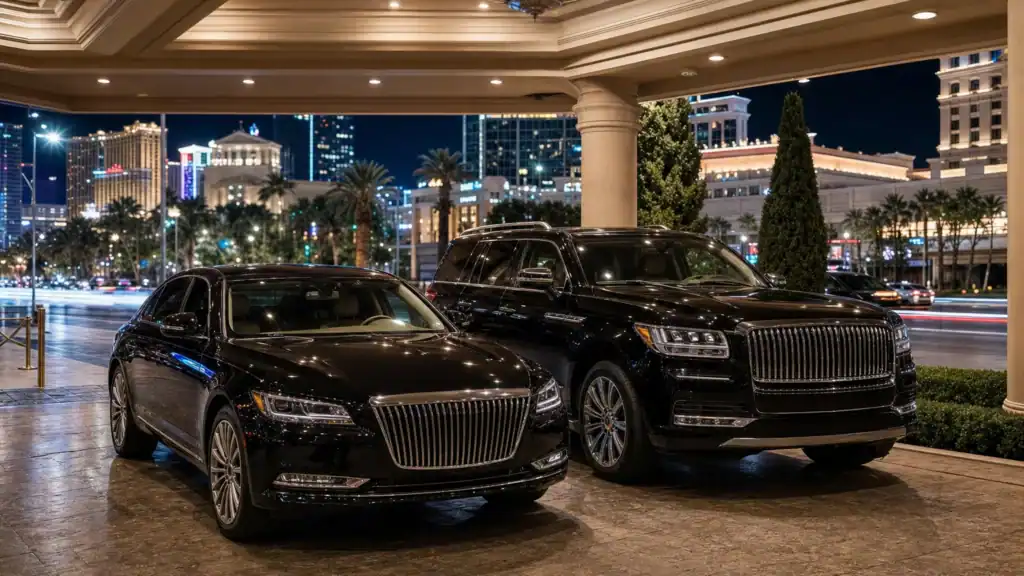
The right answer is almost never “whatever shows up.” For a Las Vegas car service, choosing between a sedan and an SUV comes down to three things: how many people are riding, how much luggage they are hauling, and the kind of arrival they want. Get it right and everyone rides in comfort with bags stowed and no one on a lap. Get it wrong and a four-person party with four checked bags, each capped at 62 linear inches and 50 pounds by most airlines, ends up wedged into a trunk built for two. This guide breaks down the trade-offs so you book the right-sized vehicle the first time.
A luxury sedan is best when:
- You are one to three passengers
- You have two or three bags, not a mountain of them
- You want the lowest rate that still feels five-star
- You are doing Strip hops, date nights, or a solo airport run
- Discreet, executive arrivals matter more than presence
A full-size SUV is best when:
- You are four to six passengers
- You are carrying several checked bags, golf clubs, or gear
- Older riders want an easier, higher step-in
- You want everyone in one vehicle, together
- You want extra presence pulling up to a venue or casino
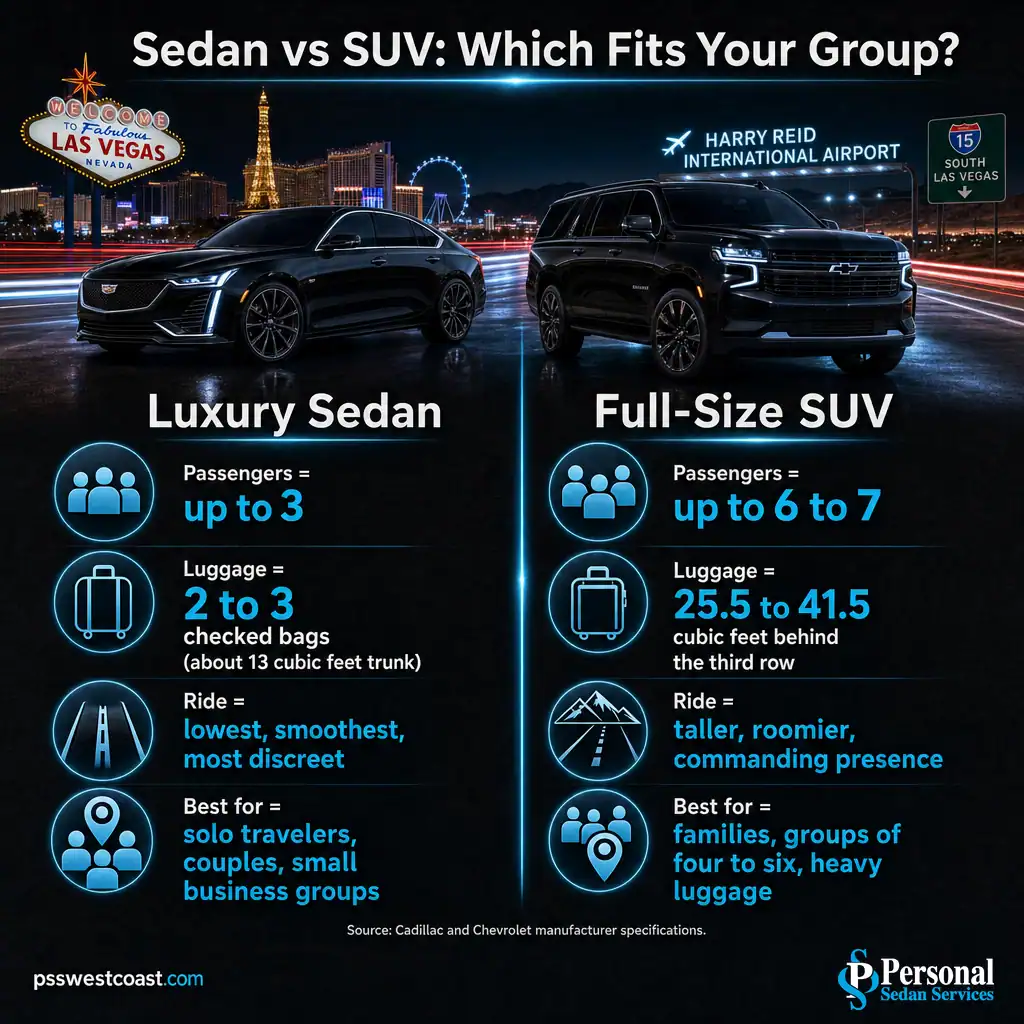
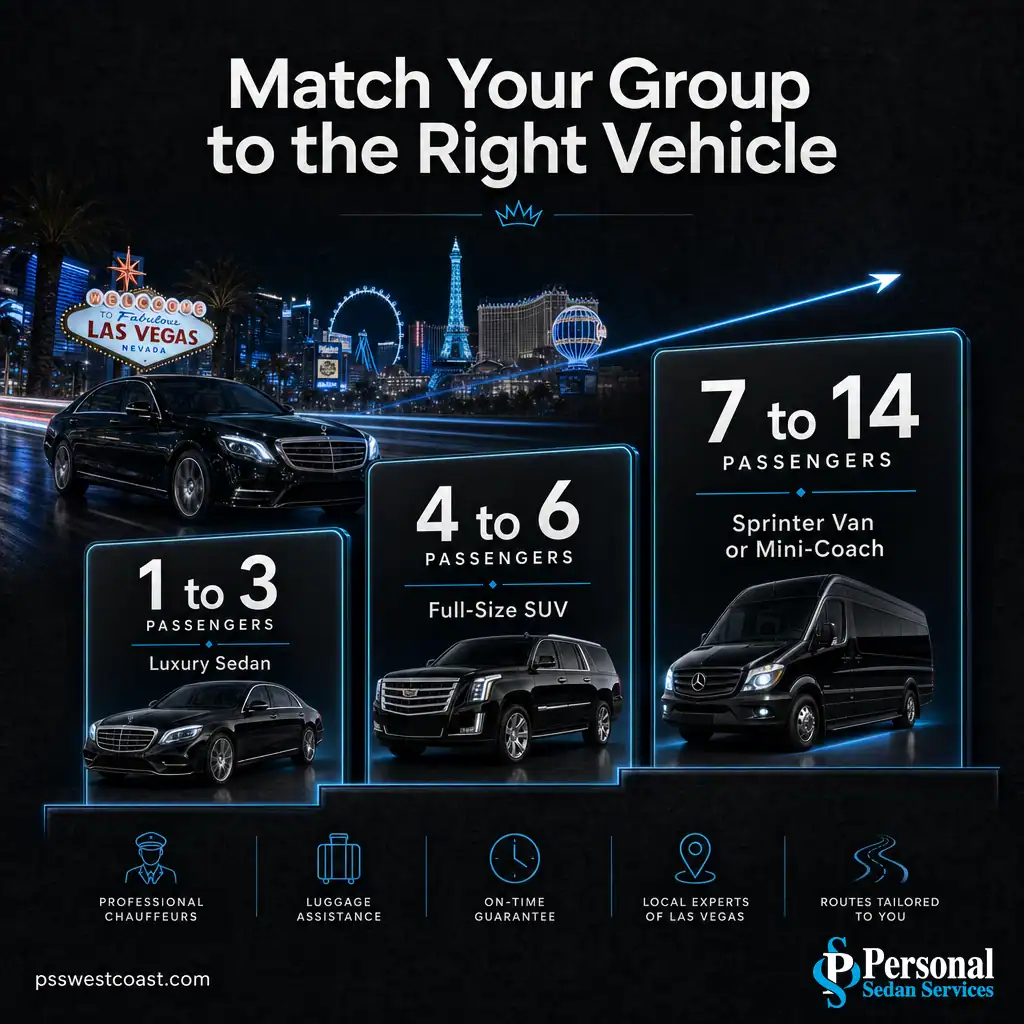
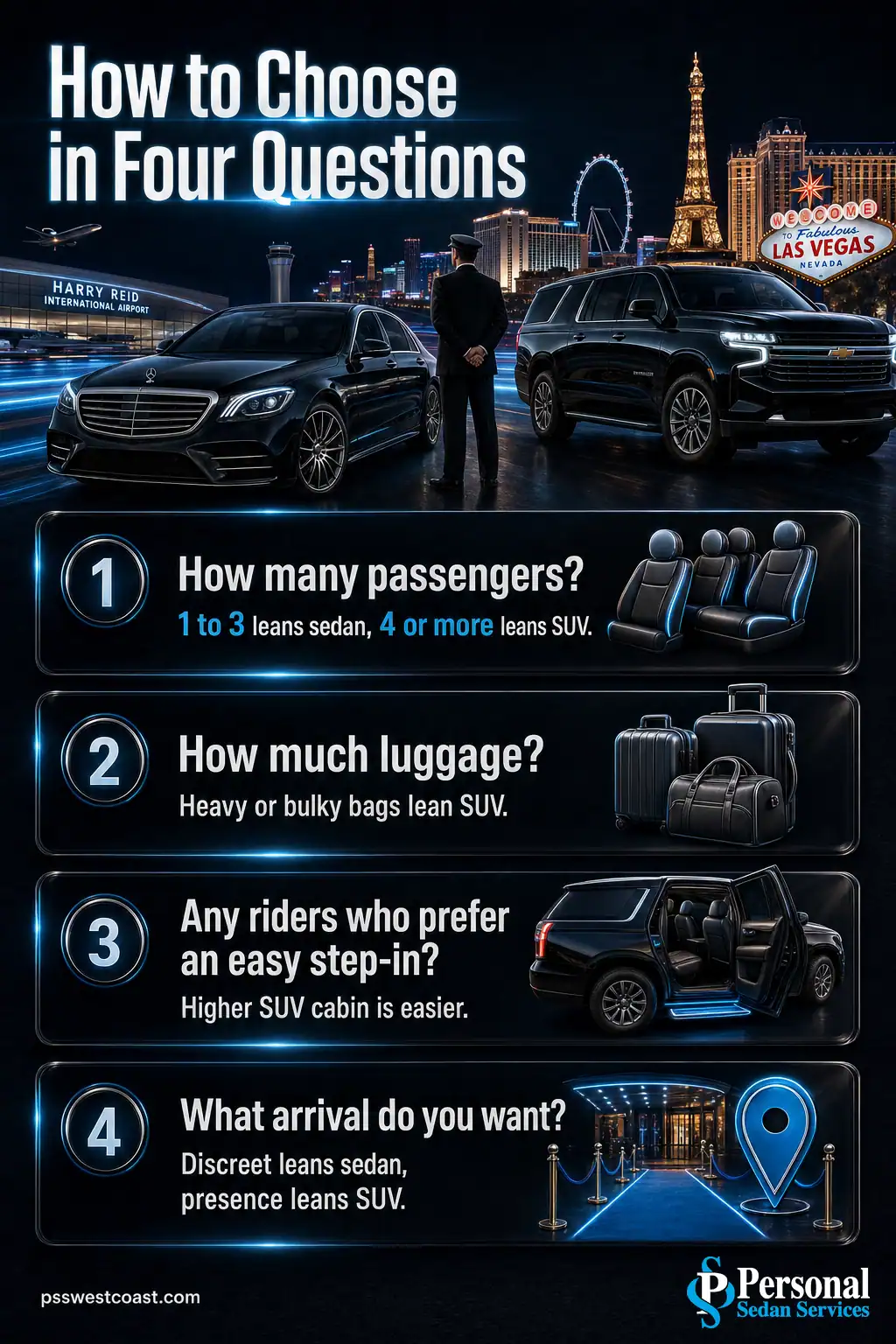
- Party size is the first filter. A chauffeured sedan seats up to three; a full-size SUV seats up to six or seven; seven or more moves up to a Sprinter or mini-coach.
- Luggage decides more bookings than people realize. A Chevrolet Suburban holds 41.5 cubic feet behind its third row and a Cadillac Escalade holds 25.5, versus roughly 12 to 14 in a full-size sedan trunk.
- The sedan is the value pick when it truly fits. Do not pay for an SUV you do not need, and do not under-book one you do.
- Las Vegas logistics reward planning. Harry Reid International moved nearly 55 million passengers in 2025, so a pre-booked, right-sized vehicle beats a curbside gamble.
- Bigger than six? Step up to a Sprinter van or mini-coach rather than forcing an SUV.
What’s in This Guide
- The Quick Answer
- Understanding the Luxury Sedan
- Understanding the Full-Size SUV
- Head to Head: Passengers and Comfort
- Head to Head: Luggage and Cargo
- Head to Head: Ride Feel and Style
- Head to Head: Cost and Value
- Best Uses Around Las Vegas
- The Full Comparison Table
- Who Should Choose a Sedan
- Who Should Choose an SUV
- What If Your Group Is Bigger?
- The Verdict
- Frequently Asked Questions
- Sources and Methodology
The Quick Answer
If you are traveling with three people or fewer and light to moderate luggage, book a sedan. If you have four or more riders, several checked bags, or passengers who prefer an easier step up into the cabin, book an SUV. That single decision covers most Las Vegas trips, and the rest of this guide is about the edge cases: the family that packs heavy, the four executives who each bring a roller bag, the golf foursome, and the group that is really a Sprinter booking in disguise.
Las Vegas is a group-travel town, which is why this choice comes up so often. The destination drew roughly 6.0 million convention attendees in 2025, on top of its leisure visitors, and those groups arrive with luggage, badges, and tight schedules. Matching the vehicle to the party is the difference between a smooth curbside pickup and a bags-on-laps compromise.
The Las Vegas valley we serve
Source: Las Vegas Convention and Visitors Authority research portal
Understanding the Luxury Sedan
A chauffeured luxury sedan is the classic black-car experience: a professional driver, a quiet leather cabin, and a low, planted ride. In the Personal Sedan Services fleet that means vehicles like the Mercedes-Benz S550, the Volvo S90, and the all-electric Tesla Model S. All three seat up to three passengers in the back and carry two to three standard checked bags in the trunk.
How it works. You are met curbside, your driver loads the trunk, and you settle into a rear cabin built for one or two people to stretch out. For a solo executive, a couple, or three colleagues heading to the same meeting, nothing beats it on comfort per dollar. It is also the most discreet option, which is why it is the default for VIP black-car arrivals and quiet corporate pickups.
Genuine pros: lowest rate of the chauffeured options, easiest to maneuver in porte-cocheres and valet lines, best fuel-and-value profile, and the smoothest, lowest ride on the highway. Genuine cons: a hard ceiling of three passengers, a trunk that fills fast with big or numerous bags, and a lower seating position that some older riders find harder to get in and out of.
Source: Personal Sedan Services fleet specifications
Understanding the Full-Size SUV
A full-size luxury SUV trades the low-slung sedan feel for space, height, and cargo room. The Personal Sedan Services SUVs include the Cadillac Escalade, the Chevrolet Suburban, and the GMC Yukon Denali. These are the workhorses of group car service: commanding presence, a tall and easy step-in, and enough room that four to six adults can travel with their luggage and no one holds a bag.
How it works. The Escalade seats up to seven passengers, and the Suburban seats up to nine in its widest configuration, according to Cadillac and Chevrolet. In real chauffeured use you rarely fill every seat, because luggage takes space, but that headroom is exactly the point: an SUV booked for four leaves room for bags, coolers, strollers, and golf bags without a second thought.
Genuine pros: far more passenger and cargo room, a higher and easier step-in, strong presence at venues, and comfortable clearance for desert-highway trips to Red Rock Canyon, Mount Charleston, or Lake Mead. Genuine cons: a higher rate than a sedan, a slightly firmer ride, and a larger footprint that is more vehicle than a solo traveler needs.
Source: Cadillac’s official Escalade specifications | Chevrolet’s official Suburban specifications
Head to Head: Passengers and Comfort
Sedan. A luxury sedan is built for one to three riders, and for that count it is genuinely more comfortable than an SUV: a lower center of gravity, a cabin sized to the occupants, and a cocooned, executive feel. Three adults fit, though the middle rear seat is the compromise seat on any longer trip.
SUV. An SUV opens up the second and third rows so four, five, or six passengers each get a real seat. No one draws the short straw in the middle for a 40-minute run to a venue, and the taller cabin makes conversation and headroom easy. For any party of four or more, the SUV wins on comfort by simple geometry.
The honest nuance: for one to three passengers the sedan is the more comfortable, more refined ride. The SUV only pulls ahead once the fourth person gets in.
Source: Cadillac Escalade seating specifications | Chevrolet Suburban seating specifications
Head to Head: Luggage and Cargo
Luggage decides more of these bookings than passenger count does, and it is the factor travelers most often underestimate. Most U.S. airlines cap a standard checked bag at 62 linear inches (length plus width plus height) and 50 pounds, so a single large bag is a genuinely bulky object. Multiply that by a family or a group and the trunk math gets tight fast.
Sedan. A full-size luxury sedan trunk holds roughly 12 to 14 cubic feet, which comfortably takes two to three checked bags plus a couple of personal items. Add a fourth big bag and someone is riding with it on the seat.
SUV. A Cadillac Escalade offers 25.5 cubic feet of cargo behind its third row and a Chevrolet Suburban offers 41.5, per the manufacturers, and both expand dramatically once a rear row is folded. That is the difference between “we made it work” and “everything fit with room to spare.”
Sources: Chevrolet and Cadillac manufacturer cargo specifications; representative full-size luxury sedan trunk volume.
Source: Chevrolet Suburban cargo specifications | Delta’s checked-baggage size and weight policy
Head to Head: Ride Feel and Style
Sedan. This is where the sedan earns its keep. A low, planted luxury sedan delivers the smoothest, most refined ride of the two, and it reads as understated and executive. For a quiet arrival at a boardroom, a fine-dining reservation, or a discreet chauffeured evening, the sedan sets exactly the right tone.
SUV. An SUV makes a different statement: height, presence, and a commanding pull-up at the entrance of a casino, nightclub, or wedding venue. The ride sits taller and firmer, which many riders prefer for visibility and for the easy step in and out. For a bachelorette group or a VIP arrival that wants to be seen, the SUV has the edge.
Myth to retire: “bigger is always better.” An SUV is not an upgrade for a solo traveler or a couple. You pay more, the ride is firmer, and you gain space you will not use. For one to three light-luggage passengers, the sedan is the better vehicle, not the budget compromise.

Head to Head: Cost and Value
All else equal, a larger vehicle carries a higher rate, so a sedan is the more economical booking whenever it genuinely fits your party. That makes the sedan the value winner on paper. But value is not just the sticker rate, it is booking the right vehicle once.
The expensive mistake is under-booking. Cramming four adults and four checked bags into a sedan does not save money if it forces a second car, a delayed pickup, or a rider holding luggage the whole way. Right-sizing a single SUV to a group of four to six is frequently cheaper and always smoother than fixing the wrong choice at the curb. Conversely, booking an SUV “just in case” for a solo airport run is money spent on space you will not use.
Because rates vary by route, timing, and vehicle, the honest move is to get a flat, all-in quote for your actual party and luggage before you decide. Personal Sedan Services quotes the fare up front so there is no surge pricing and no surprise at drop-off.
Best Uses Around Las Vegas
The city’s own logistics push the decision one way or the other depending on the trip.
Airport pickups at Harry Reid International
Harry Reid International moved nearly 55 million passengers in 2025, and the rideshare and taxi queues at Terminal 1 on a Friday afternoon show it. For a solo traveler or a couple, a sedan is the quick, economical meet-and-greet. For a family or a group arriving with checked bags and conference gear, an SUV avoids the cramped-trunk scramble. Either way, a pre-booked airport pickup with a flight-tracked driver beats a curbside gamble.
The Strip, dining, and nightlife
For date nights, dinner reservations, and executive dinners, the sedan’s discreet, refined arrival is ideal. For a group heading to a club or a show together, the SUV keeps everyone in one vehicle with room to spare.
Corporate travel and conventions
With millions of convention attendees a year, business groups are constant here. Two or three colleagues to the same meeting fits a sedan; a team of four to six with laptop bags and booth materials fits an SUV. For recurring runs, corporate car service keeps it consistent.
Weddings, golf, and day trips
Golf foursomes with clubs, wedding parties with dresses and gifts, and day trips out to Red Rock Canyon or Lake Mead all favor the SUV’s cargo room and higher clearance. A couple slipping away for an anniversary dinner favors the sedan.
Source: Harry Reid International Airport passenger statistics
The Full Comparison Table
| Criterion | Luxury Sedan | Full-Size SUV | Winner |
|---|---|---|---|
| Passengers | Up to 3 | Up to 6-7 (Escalade 7, Suburban 9 max) | SUV for 4+ |
| Luggage | 2-3 checked bags (~13 cu ft trunk) | 25.5-41.5 cu ft behind third row | SUV |
| Ride refinement | Lowest, smoothest, most refined | Taller, firmer, commanding | Sedan |
| Style | Discreet, executive | Presence, arrival impact | Tie (depends on goal) |
| Step-in ease | Lower, harder for some | Higher, easier | SUV |
| Rate | Lower | Higher | Sedan |
| Best value when it fits | 1-3 light-luggage riders | 4-6 riders or heavy luggage | Depends on party |
Who Should Choose a Sedan
- The solo business traveler. One rider, a carry-on and a laptop bag, a meeting to get to. The sedan is quicker, quieter, and the better value.
- The couple. Two people with two bags for a weekend, a date night, or an anniversary dinner want the refined, discreet ride.
- Three colleagues to the same meeting. Light luggage, same destination, no need for a third row.
- The budget-minded traveler who packs light. If it fits, the sedan is the smart-money choice, not a downgrade.
- Anyone prioritizing a low, smooth, executive ride over presence and cargo space.
Who Should Choose an SUV
- Families. Kids multiply gear fast: car seats, strollers, and extra bags. The SUV gives you room you will actually use.
- Groups of four to six. Everyone gets a real seat and their luggage rides with them, not on a lap.
- Heavy packers and gear haulers. Golf clubs, ski or hiking gear, trade-show materials, or a week’s worth of checked bags.
- Older riders or anyone who prefers an easier step up into a taller, more accessible cabin.
- VIP and group arrivals that want presence pulling up to a casino, nightclub, or wedding venue.
What If Your Group Is Bigger?
Once you pass six passengers, even a full-size SUV gets tight with luggage, and forcing the fit is exactly the mistake this guide is meant to prevent. Groups of seven to fourteen are better served by a Mercedes Sprinter van, and larger parties by a mini-coach or charter bus. For weddings, conventions, and corporate events, Personal Sedan Services can also run multiple vehicles in convoy so the whole group arrives together and on time.
If that sounds like your trip, our luxury group transportation is built for exactly this: matching the vehicle, or the fleet of vehicles, to the head count and the itinerary.
The Verdict
There is no universal winner, because the right vehicle is the one that fits your party and your luggage. Book the sedan when you are one to three passengers with light to moderate bags: it is more refined, more discreet, and the better value. Book the SUV when you are four to six passengers, when the luggage stacks up, or when an easier step-in and a stronger arrival matter. When the group runs past six, move up to a Sprinter rather than compromising.
The one rule that never changes: decide before you get to the curb. Tell your car service how many people are riding and how many bags you are bringing, and a good dispatcher will right-size the vehicle so no one is holding a suitcase on their lap in the desert heat. In a group-travel city with tens of millions of arrivals a year, that little bit of planning is what separates a five-star ride from a tight one.
Frequently Asked Questions
Should I book an SUV or a sedan for a Las Vegas car service?
How many passengers and bags fit in a sedan versus an SUV?
Is an SUV or a sedan better for a Las Vegas airport pickup?
Does an SUV cost more than a sedan for car service?
What if my group is larger than six people?
Sources and Methodology
How we compared these vehicles
Passenger and cargo figures come from the vehicle manufacturers’ published specifications for the models in the Personal Sedan Services fleet. Luggage limits reflect the standard checked-bag policy used by major U.S. airlines. Las Vegas travel figures come from the airport and the destination’s tourism authority. Where a number varies by trim or configuration, we cite the manufacturer’s stated maximum and note it as such. We did not use any invented statistics, prices, or claims.
- Cadillac Escalade (seats up to 7; 25.5 cubic feet of cargo behind the third row, up to 120.5 maximum).
- Chevrolet Suburban (seats up to 9; 41.5 cubic feet behind the third row).
- Personal Sedan Services fleet (sedan and SUV models and seating).
- Delta Air Lines checked-baggage policy (standard checked bag: 62 linear inches, 50 pounds).
- Harry Reid International Airport (nearly 55 million passengers in 2025).
- Las Vegas Convention and Visitors Authority (convention attendance).
Vehicle specifications reflect current model-year figures available at the time of writing and may vary by trim and configuration.