



A chauffeur permit is the credential that lets you legally drive people for money, and the confusing part is that “chauffeur permit” can mean three very different things depending on where you live and what you drive: a state chauffeur’s license, a city or county for-hire permit, or a commercial driver’s license with a passenger endorsement. This guide untangles all three, lays out the requirements that apply almost everywhere, walks you through getting one step by step, and shows how the rules change from state to state so you apply for the right credential the first time.
- “Chauffeur permit” is an umbrella term. The real credential is usually one of three things: a state chauffeur’s license, a local for-hire or public chauffeur permit, or a CDL with a passenger endorsement.
- You generally need one to drive passengers for hire in a commercial or livery vehicle. Driving your own car for a rideshare app usually does not require it.
- Federal rules require a CDL with a passenger (P) endorsement to drive any vehicle designed to carry 16 or more passengers, including the driver.
- Core requirements repeat almost everywhere: minimum age, a valid driver’s license, a clean driving record, a background check, and often a medical exam and a knowledge test.
- Costs range from a modest state fee (Michigan’s standard chauffeur’s license is $35) to several stacked fees for fingerprinting, background checks, and medical exams on local for-hire permits.
- Rules vary sharply by state and city. Minimum age alone ranges from 16 to 21, and some states have no separate chauffeur class at all.
- In Nevada, limousine drivers do not get a separate license class. They hold a regular license plus a permit from the Nevada Transportation Authority, must be at least 21, and carry a medical certificate valid for two years.

What’s in This Guide
- What a Chauffeur Permit Actually Is
- Who Needs a Chauffeur Permit (and Who Doesn’t)
- The Three Layers of Chauffeur Licensing
- Chauffeur Permit Requirements: The Universal Checklist
- How to Get a Chauffeur Permit, Step by Step
- How Much Does a Chauffeur Permit Cost?
- Chauffeur Licensing by State and City
- CDL and the Passenger Endorsement: When You Need More
- Renewing and Keeping Your Permit Valid
- Common Mistakes That Delay or Deny a Permit
- Driving Professionally in Las Vegas: The Nevada Path
- What to Do Next
- Related Resources
- Quick-Reference Summary Table
- Frequently Asked Questions
- Methodology and Sources
What a Chauffeur Permit Actually Is
Start with the most useful fact: there is no single, national “chauffeur permit.” The term is shorthand that different states, cities, and agencies use for different credentials. When someone says they need a chauffeur permit, they almost always mean one of three things, and sorting out which one applies to you is the whole job.
The first is a state chauffeur’s license. A number of states issue a chauffeur class of driver’s license for people whose work mainly involves driving passengers for hire or operating heavier vehicles. It is issued by the same agency that issues your regular license, usually the Department of Motor Vehicles, the Secretary of State, or the Office of Motor Vehicles. The second is a local for-hire or public chauffeur permit, issued by a city or county to people who drive taxis, limousines, black cars, or shuttles within that jurisdiction. The third is a commercial driver’s license (CDL) with a passenger endorsement, which the federal government requires for the largest passenger vehicles.
These credentials can stack. A charter-bus driver in a regulated market might hold a CDL with a passenger endorsement (federal layer), a state chauffeur’s license (state layer), and a city for-hire permit (local layer) all at once. A sedan driver in a lightly regulated area might need only a regular driver’s license plus a company background check. The job is to find out which layers apply to your vehicle, your route, and your market before you spend money on the wrong credential.
Because the terminology is inconsistent, do not assume the word “chauffeur” even appears in your required credential. Some states retired their chauffeur class years ago and fold the function into a CDL or a for-hire endorsement. Others keep a formal chauffeur’s license on the books. The safest move is to work backward from the vehicle and the service, which is exactly what the next two sections do.
Before you apply for anything, write down three facts: the exact vehicle you will drive (seating capacity and weight class), the city and state where you will pick up passengers, and whether you will be an employee of a licensed company or an independent operator. Those three facts determine every credential you need.
Source: Michigan Secretary of State, chauffeur’s license | FMCSA Entry-Level Driver Training
Who Needs a Chauffeur Permit (and Who Doesn’t)
The clearest line is the purpose of the drive. If you are transporting passengers for compensation in a vehicle that the law treats as a commercial or livery vehicle, you almost certainly need some form of chauffeur credential. If you are driving your own passengers, friends, or family in your personal car, you do not. Everything else lives between those poles, and the details decide it.
You generally need a chauffeur permit if you drive: a limousine or stretch limo, a black car or executive sedan for hire, an airport shuttle or hotel shuttle, a charter bus or motorcoach, a party bus, a taxi, or a medical or non-emergency passenger transport vehicle. These are the classic for-hire roles, and most jurisdictions regulate them.
You generally do not need a chauffeur permit if you: drive your personal vehicle for a rideshare app in most states, drive a company vehicle without passengers (a delivery van, for example, below CDL weight), or carpool and split gas with coworkers. Rideshare is the big surprise for many people. Driving a private passenger car for a transportation network company usually does not require a chauffeur’s license or a CDL, because those drivers are screened and regulated through the app and state rideshare laws rather than a traditional chauffeur program.
That 16-passenger line is the single most important threshold in passenger transport. A vehicle designed to carry 16 or more people, including the driver, requires a CDL with a passenger endorsement, full stop. Below that number, you are usually in state chauffeur’s license or local for-hire permit territory. This is why a 14-passenger luxury shuttle and a 24-passenger minibus can require completely different credentials even though they look like cousins in the parking lot.
There is a third case worth naming, because it catches people off guard: driving a company-owned passenger vehicle as an employee. If you drive a hotel’s own airport shuttle, a casino’s guest van, or a senior-living community’s resident bus, you are driving for hire in the eyes of most regulators even though no passenger hands you money directly. The compensation is your wages, and the vehicle is commercial. Whether you need a CDL still turns on the 16-passenger and weight thresholds, and whether you need a local for-hire permit still depends on your city, but do not assume an employee-driver role is exempt just because riders are not paying a fare at the curb.
Non-emergency medical transport is another area that surprises new drivers. Driving patients to and from appointments, often in a wheelchair-accessible van, is regulated passenger transport in most markets, and it frequently carries its own layer of requirements on top of a chauffeur or for-hire credential, including specialized training and additional background screening because the passengers are a vulnerable population.
If you intend to drive professionally and you are not sure which bucket you fall into, call the agency that regulates for-hire transportation in your city. Ask two questions: does my vehicle require a CDL, and does my city or state require a separate chauffeur or for-hire permit. Those two answers resolve the vast majority of cases, and getting them from the regulator directly beats guessing from a forum post that may describe a different state entirely.
Source: eCFR, 49 CFR 383.93 (endorsements)
The Three Layers of Chauffeur Licensing
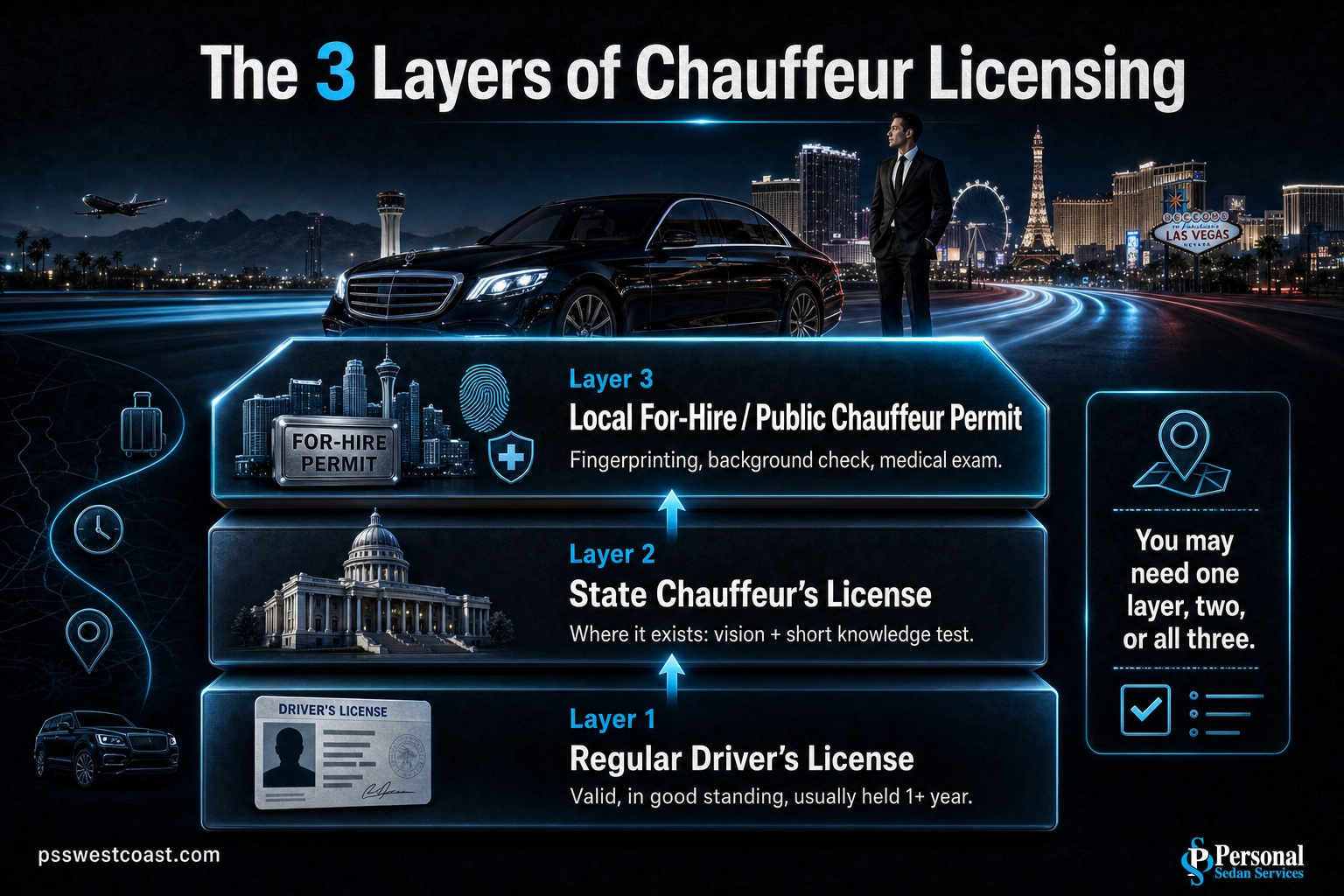
Think of chauffeur licensing as three layers that sit on top of each other. You might need one layer, two, or all three, but you work through them in the same order every time.
Layer 1: Your regular driver’s license
Everything starts with a valid, non-commercial driver’s license in good standing. You cannot get any chauffeur credential without it, and most programs require that you have held it for a minimum period (often one year) before you can drive passengers for hire. If your base license is suspended, expired, or carries recent serious violations, resolve that first. Nothing else moves until this layer is clean.
Layer 2: The state chauffeur’s license (where it exists)
Some states add a chauffeur class on top of the regular license for drivers who carry passengers for hire or operate heavier vehicles. In Michigan, for example, a chauffeur’s license is required for a person whose job mainly involves driving a vehicle rated at 10,000 pounds or more, or operating a vehicle as a passenger carrier or bus. The test for it is light: a vision screening and a short knowledge exam. In Louisiana, the Class D chauffeur’s license covers single vehicles used in commerce to transport up to 15 passengers, including the driver. Not every state has this layer, so confirm whether yours does.
Layer 3: The local for-hire or public chauffeur permit
This is the layer most new drivers underestimate. Cities and counties that regulate taxis, limousines, and shuttles often require their own permit on top of any state license. This local permit is where the serious vetting happens: fingerprinting, an FBI or state criminal background check, a medical exam, sometimes a drug test, and occasionally a local geography or rules exam. It is also where most of the cost and most of the waiting time live.
The order matters more than most applicants realize. Clear Layer 1, then Layer 2, then Layer 3, because each layer verifies the one beneath it. Applying for a local for-hire permit before your base license is clean, or before you hold the state chauffeur class your city assumes you have, is the most common way applicants waste a month and a set of fees.
Source: Michigan Secretary of State, chauffeur’s license
Chauffeur Permit Requirements: The Universal Checklist
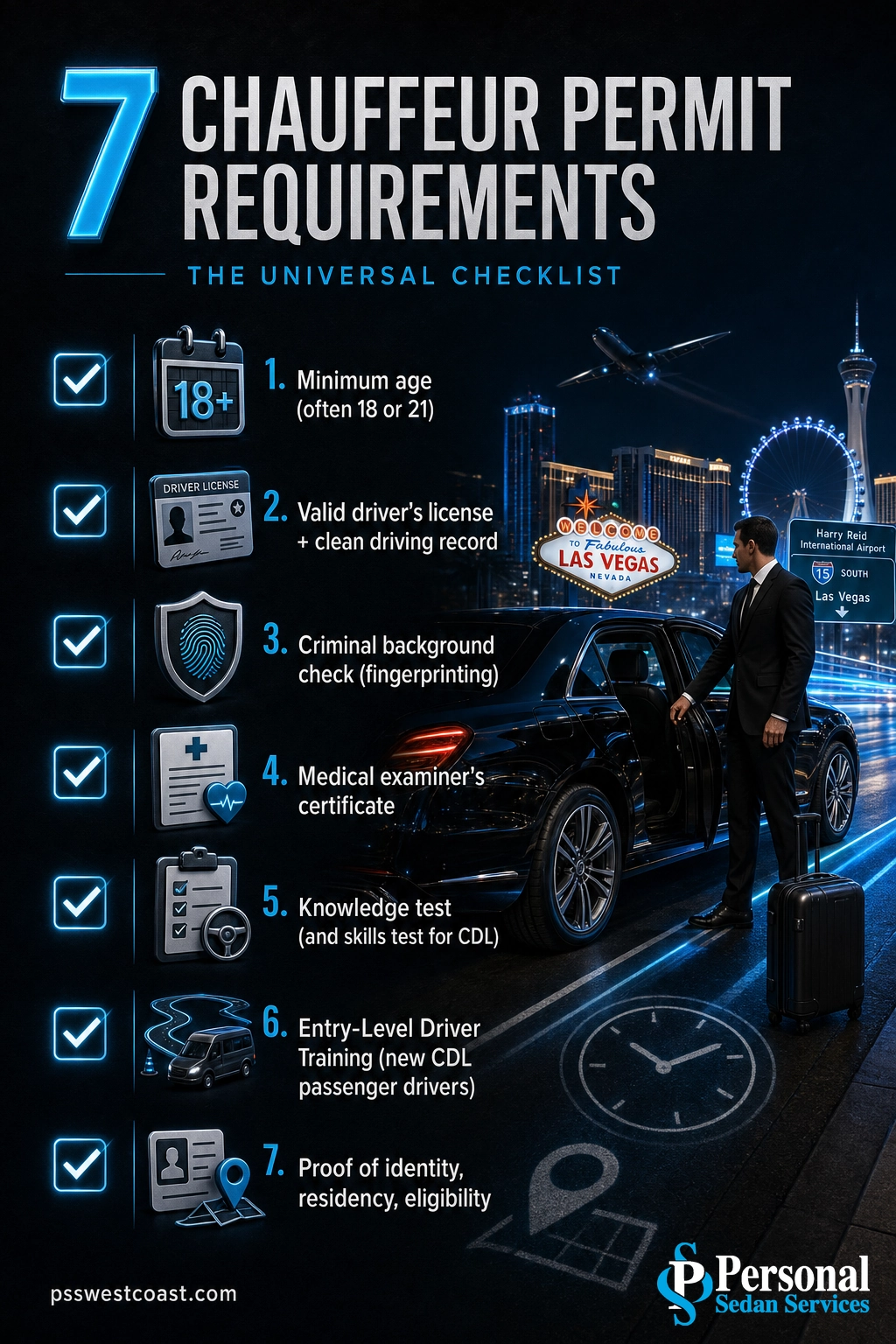
The exact rules change by jurisdiction, but the categories of requirement are remarkably consistent. Nearly every chauffeur or for-hire program asks for the same seven things in some form. Treat this as your master checklist and then confirm the specific numbers with your local agency.
1. Minimum age
Expect a floor of 18 for many state chauffeur’s licenses and 21 for most limousine and for-hire programs. Some states issue a chauffeur class as young as 16 or 17, but the vehicles and routes that pay professionally usually sit behind the higher age gates.
2. A valid driver’s license and driving history
You will need a current license, usually held for at least a year, and a driving record that meets the program’s standard. Points, recent at-fault accidents, and license suspensions can disqualify you or force a waiting period.
3. A clean enough criminal background
For-hire and public chauffeur permits almost always require fingerprinting and a criminal background check. Agencies look for felonies, violent or sexual offenses, and recent DUIs. The look-back window and the exact disqualifiers vary, so read the local list.
4. A medical examination
Drivers who need a CDL must carry a current medical examiner’s certificate under the federal physical-qualification standards. Many for-hire programs require a medical exam for smaller vehicles too, confirming vision, hearing, and general fitness to drive long shifts safely.
5. Knowledge (and sometimes skills) testing
State chauffeur’s licenses usually add a short written knowledge test on top of your regular license. CDL applicants face a fuller knowledge test and a skills test in an appropriate vehicle. Some city programs add a local rules or geography exam.
6. Entry-Level Driver Training (for new CDL passenger drivers)
If you need a CDL passenger endorsement for the first time, federal Entry-Level Driver Training applies. Since February 7, 2022, first-time passenger-endorsement applicants must complete theory and behind-the-wheel training from a provider listed on the FMCSA Training Provider Registry before taking the skills test.
7. Documentation and proof of eligibility
Bring proof of identity, legal presence or citizenship as required, proof of residency, and your Social Security number. Local permits may also require proof of employment with a licensed company or proof of insurance for an independent operator.
Do not assume a minor blemish is automatically fine. A single recent DUI, an unresolved license suspension in another state, or a gap in your medical certificate can stop an otherwise strong application. For-hire programs are stricter than standard licensing precisely because they are vouching for you to carry the public. Pull your own driving record and resolve problems before you pay application fees.
Source: FMCSA Entry-Level Driver Training | eCFR, 49 CFR 391.41 (physical qualifications)
How to Get a Chauffeur Permit, Step by Step
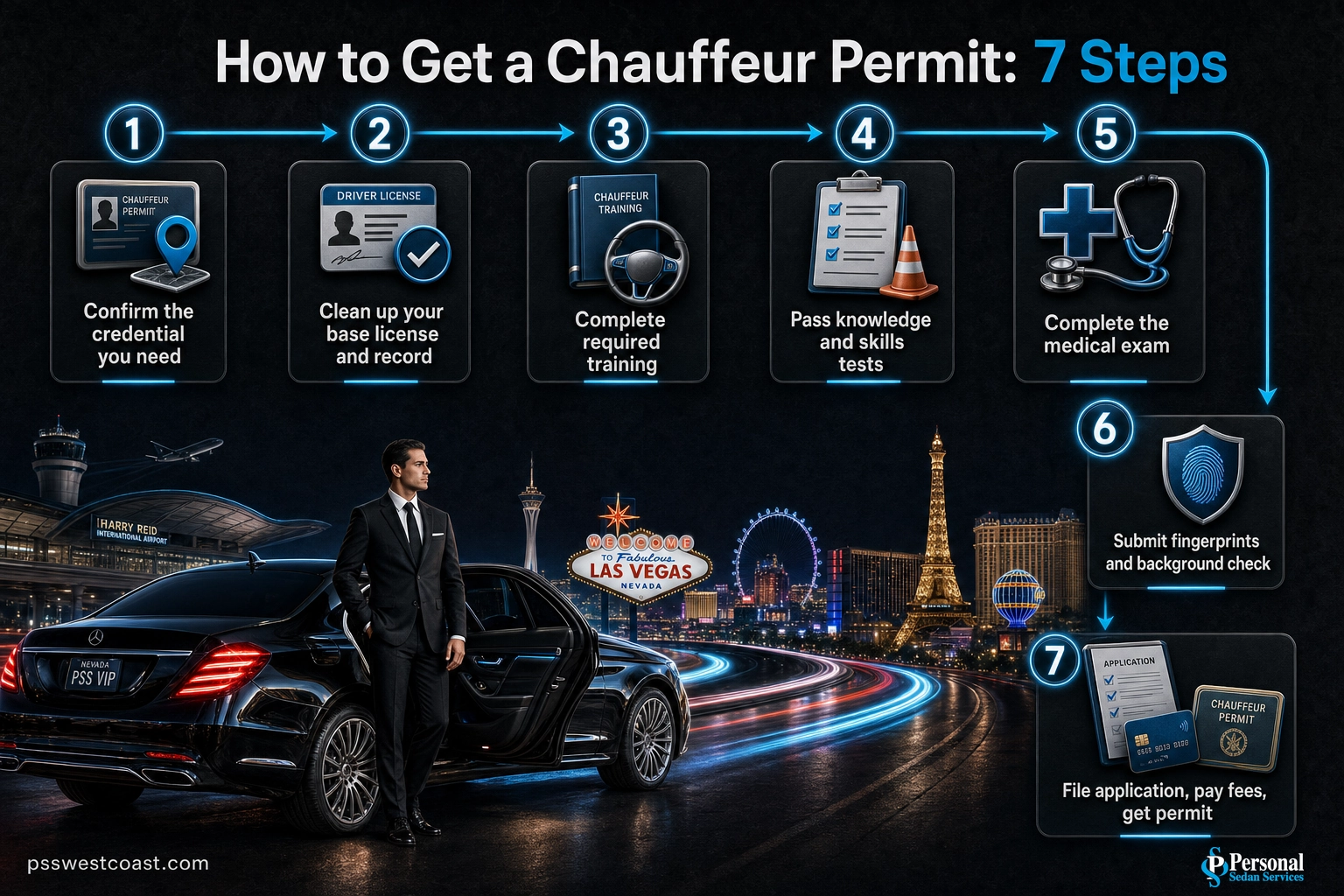
Here is the sequence that works in nearly every market. The names of the agencies change, but the path does not.
1 Confirm which credential you actually need
Use your three facts from earlier (vehicle, location, employee or independent). Call or check the website of the agency that regulates for-hire transport in your city, and the state licensing agency. Confirm whether you need a CDL, a state chauffeur’s license, a local for-hire permit, or some combination. This single step saves the most time and money.
2 Get your base license and record clean
Make sure your regular driver’s license is valid, has been held long enough, and carries a record that meets the program’s standard. Order your own driving abstract and clear anything outstanding, including issues from other states.
3 Complete any required training
If you need a first-time CDL passenger endorsement, enroll with a provider on the FMCSA Training Provider Registry and finish the theory and behind-the-wheel training. If your city requires a defensive-driving or local-rules course, take it now so the certificate is in hand when you apply.
4 Pass the knowledge and skills tests
Study the correct manual (the state chauffeur handbook, or the CDL and passenger-endorsement sections for larger vehicles) and schedule your exams. For a state chauffeur’s license this is often a vision test and a short written exam. For a CDL it includes a skills test in the right class of vehicle.
5 Complete the medical exam
If a medical examiner’s certificate is required, see a certified medical examiner, pass the physical, and keep the certificate. You will need to show it when you apply and again at renewal.
6 Submit fingerprints and the background check
For local for-hire and public chauffeur permits, book your fingerprinting appointment and submit to the criminal background check. Build in time here, because this step is usually the longest wait in the whole process.
7 File the application, pay the fees, and receive your permit
Assemble your documents, pay the application and permit fees, and submit. Once everything clears, you receive your chauffeur’s license or for-hire permit and can legally start driving passengers for compensation. Keep digital copies of every certificate for renewals.
Stack the steps that have waiting periods. Order your driving record, book fingerprinting, and schedule the medical exam early and in parallel, rather than one after another. A well-sequenced application can cut a four-week process roughly in half.
Source: FMCSA Training Provider Registry, ELDT applicability
How Much Does a Chauffeur Permit Cost?
Cost is where “it depends” earns its reputation. A state chauffeur’s license can be inexpensive, while a local for-hire permit with fingerprinting, background checks, a medical exam, and training can add up to several hundred dollars across stacked fees. Here is how to think about the pieces.
A simple state chauffeur’s license fee like Michigan’s shows the low end: the license itself is modest. The real budgeting happens when a city for-hire or public chauffeur permit enters the picture, because you are no longer paying one fee, you are paying a stack. A realistic cost worksheet for a for-hire permit looks like this.
| Cost component | What it covers | Typical notes |
|---|---|---|
| State chauffeur’s license fee | The license class itself | Often modest (Michigan: $35 standard) |
| Local for-hire or public chauffeur permit fee | City or county authorization to drive for hire | Varies widely by city; renew periodically |
| Fingerprinting and background check | Criminal history vetting | Separate vendor fee on top of the permit |
| Medical examiner’s exam | Physical qualification certificate | Paid to the certified examiner; renew on its own cycle |
| Entry-Level Driver Training (new CDL P) | Required theory and behind-the-wheel training | Only for first-time CDL passenger-endorsement drivers |
| Knowledge and skills testing | Written exam and, for CDL, a skills test | May include a vehicle rental for the road test |
| Drug test | Pre-employment or program screening | Common in for-hire and CDL programs |
The practical takeaway: do not budget for “a permit.” Budget for a bundle of credentials and screenings. Ask each agency for its full fee schedule in writing so you are not surprised by a background-check vendor fee or a medical-exam charge that is not included in the headline permit price.
Source: Michigan Secretary of State, chauffeur’s license

Chauffeur Licensing by State and City
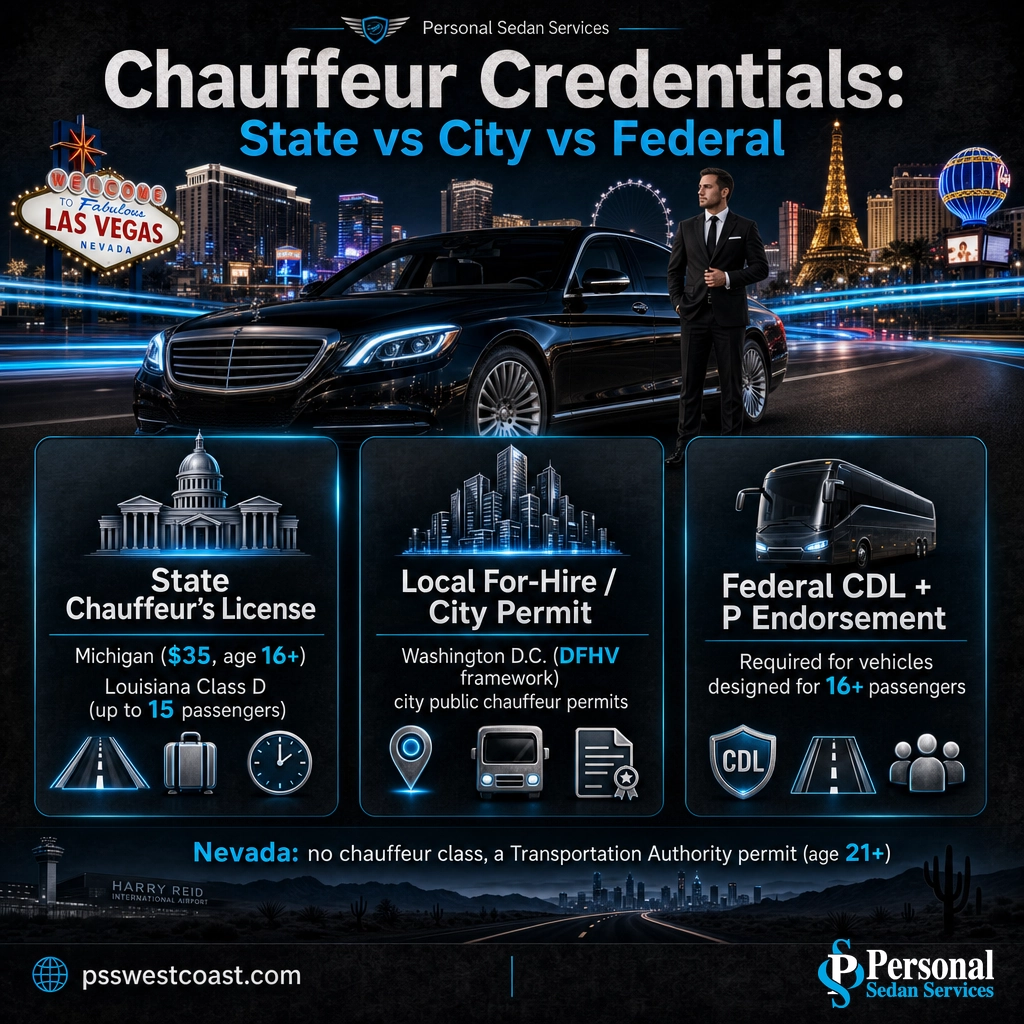
Because licensing is handled state by state, and often city by city on top of that, the same job can require different credentials in different places. A few real examples show how wide the range is. Always confirm the current rule with the official agency, because programs change.
Michigan: a formal state chauffeur’s license
Michigan keeps a true chauffeur class. It is required for someone whose job mainly involves driving a heavier vehicle (rated at 10,000 pounds or more) or operating a vehicle as a passenger carrier or bus. The requirements are light compared with a CDL: you must be at least 16 (with driver education if under 18), pass a vision test and a 15-question knowledge exam, and pay the fee. A valid CDL can take the place of the knowledge exam.
Louisiana: the Class D chauffeur’s license
Louisiana issues a Class D chauffeur’s license for single vehicles used in commerce to transport up to 15 passengers, including the driver, or to haul property, within the mid-weight range. Applicants build on a regular Class E license. It is a clear example of a state that uses the chauffeur label formally and ties it to vehicle size and purpose.
Washington, D.C.: a for-hire vehicle (DFHV) credential
In the District of Columbia, taxicab and limousine drivers operate under the for-hire vehicle framework overseen by the local for-hire regulator, with vehicle and driver documentation processed through the DC DMV. It is a city-level for-hire model rather than a statewide chauffeur class, which is common in dense urban markets.
Nevada: no separate chauffeur class, a Transportation Authority permit instead
Nevada does not issue a standalone chauffeur’s license class. Instead, a company cannot let an employee drive a limousine for hire unless the driver is at least 21, holds a valid Nevada driver’s license, and has a driver’s permit issued by the Nevada Transportation Authority. Drivers must also carry a medical examiner’s certificate. This is the model that applies in Las Vegas, and it is covered in depth in our dedicated Nevada guide below.
The pattern across jurisdictions: states fall into three rough groups. Some keep a formal chauffeur’s license class (Michigan, Louisiana). Some have no chauffeur class and regulate for-hire driving through a state or local permit plus the regular license (Nevada). And dense cities layer their own for-hire or public chauffeur permit on top of whatever the state requires (Washington, D.C.). Identify which group your market is in, and the rest of the process falls into place.
Source: Nevada Administrative Code 706.229 | DC DMV, DFHV license documents
CDL and the Passenger Endorsement: When You Need More
If your vehicle is large enough, a chauffeur’s license is not enough on its own. Federal law takes over, and you move into commercial driver’s license territory. This is a hard rule, not a local preference, so it is worth understanding clearly.
A commercial driver’s license with a passenger (P) endorsement is required to operate any vehicle designed to carry 16 or more passengers, including the driver. That covers full-size shuttle buses, motorcoaches, and charter buses. The endorsement is specific: holding a CDL alone does not let you carry a full bus of passengers, you need the P endorsement added to it.
Getting the passenger endorsement for the first time now involves a training step. Since February 7, 2022, first-time applicants for the P endorsement must complete Entry-Level Driver Training, both theory and behind-the-wheel components, through a provider on the FMCSA Training Provider Registry before they can take the skills test. Drivers who held the endorsement before that date are not required to retrain.
“A big stretch limo always needs a CDL.” Not necessarily. The federal trigger is the vehicle’s designed passenger capacity (16 or more, including the driver) or its weight rating, not how long or luxurious the vehicle looks. Many stretch limousines are built to carry fewer than 16 passengers and fall under a state chauffeur’s license or a local for-hire permit instead of a CDL. Check the vehicle’s rated capacity, not its appearance.
If you are deciding what kind of professional driving to pursue, the 16-passenger line is a genuine fork in the road. Below it, the path is a state chauffeur’s license and a local permit, which is faster and cheaper to obtain. At or above it, you are committing to the CDL process, including the written and skills tests, the medical certificate, and the training requirement. Neither is better, but they are different careers with different timelines.
Source: eCFR, 49 CFR 383.93 (endorsements) | FMCSA Entry-Level Driver Training
Renewing and Keeping Your Permit Valid
Getting the permit is the start. Keeping it valid is an ongoing obligation, and it trips up drivers who treat the credential as one and done. Three things need active maintenance.
The permit or license itself
State chauffeur’s licenses and local for-hire permits have their own expiration cycles, often every few years. Renewal usually means paying a fee and confirming your record still meets the standard. Set a reminder well before the date, because driving on an expired for-hire permit can mean fines and a gap in your authorization.
Your medical certificate
If your role requires a medical examiner’s certificate, it renews on its own schedule, separate from the license. In Nevada, for example, a limousine driver’s medical examiner’s certificate is valid for two years and must then be renewed. Miss the medical renewal and you can be sidelined even though your license is still current.
Your driving and criminal record
For-hire programs do not just check your record once. Many run periodic rechecks, and a new DUI, a serious moving violation, or a disqualifying conviction after you are licensed can suspend or revoke your permit. The clean record that got you the credential is a condition of keeping it.
Keep a simple renewal calendar with three separate dates: license or permit expiration, medical certificate expiration, and any required training refreshers. Because these cycles rarely line up, tracking them together is the easiest way to avoid an accidental lapse that pulls you off the road.
Source: Nevada Revised Statutes, Chapter 706
Common Mistakes That Delay or Deny a Permit
Most rejected or delayed applications fail for a handful of predictable reasons. Knowing them in advance is the cheapest insurance there is.
Applying for the wrong credential. The most expensive mistake is spending time and fees on a CDL when a state chauffeur’s license would have done, or on a state license when your city actually requires a local for-hire permit. Confirm the credential before you apply.
An unresolved record from another state. Background and driving checks often reach across state lines. A suspension, unpaid ticket, or conviction you forgot about elsewhere can surface and stall the application. Pull a full multi-state record first.
A gap in the medical certificate. Letting the medical examiner’s certificate lapse, or scheduling the exam too late, is a frequent cause of delay because the certificate is a prerequisite for the license step, not an afterthought.
Underestimating the background-check timeline. Fingerprinting and criminal checks are the slowest part of the process. Applicants who leave them until the end add weeks they did not plan for.
Incomplete documentation. Missing proof of residency, legal presence, insurance, or employment with a licensed company sends applicants home to gather paperwork and rebook. Assemble the full document list before the appointment.
Never try to drive passengers for hire while an application is still pending, and never borrow or improvise a credential. Operating without the correct chauffeur or for-hire authorization can mean fines, vehicle impoundment, and a mark that makes the real permit harder to get. The waiting period is frustrating, but driving around it is the one mistake that can end the career before it starts.
Source: FMCSA Training Provider Registry, ELDT applicability
Driving Professionally in Las Vegas: The Nevada Path
Las Vegas is one of the busiest luxury-transportation markets in the country, and the path to driving professionally here is a clear example of the “no separate chauffeur class” model. Nevada does not issue a standalone chauffeur’s license. Instead, a limousine or for-hire driver holds a regular Nevada driver’s license, is at least 21, passes a background check, carries a medical examiner’s certificate, and holds a driver’s permit issued by the Nevada Transportation Authority. Companies are responsible for making sure their drivers meet every requirement before they carry a single passenger.
That is a deliberately high bar, and it is a feature, not a bug. For the riders and planners who book ground transportation in Las Vegas, that bar is exactly what separates a professional chauffeured experience from a gamble on an unvetted driver. At Personal Sedan Services, every chauffeur is a licensed, background-checked professional driving a clean, well-maintained vehicle, which is why the company holds a perfect 5.0 Google rating from more than 900 reviews. When you understand what it actually takes to be permitted to drive here, you understand what you are paying for when you book a real chauffeur instead of a rideshare roll of the dice.
If you are pursuing a driving career in Nevada specifically, the exact steps, agencies, and documents are worth a dedicated read. Our companion guide, how to get a chauffeur license in Nevada, walks through the Nevada Transportation Authority permit, the medical certificate, and the background check in detail. If you are a rider rather than a driver, the practical payoff of all this licensing is simple: book transportation from a company whose drivers have cleared it.
See our professional chauffeur service in Las Vegas
Personal Sedan Services runs the full range of chauffeured vehicles, from executive sedans to limousines and group coaches, for airport transfers, corporate travel, weddings, and events across the Las Vegas valley. For corporate clients who need vetted, reliable drivers for executives and teams, the corporate car service is built around exactly the professionalism this licensing is meant to guarantee, and larger parties can book luxury group transportation with the same standard of driver.
Book a professional chauffeur: call or text (702) 248-7706
Source: Nevada Administrative Code 706.229
What to Do Next
Turn the guide into an action plan. Here is the priority order for anyone serious about getting a chauffeur permit, mapped to realistic timelines.
| Action | Priority | Timeline | Where it points |
|---|---|---|---|
| Identify the exact credential(s) your vehicle and city require | Highest | Day 1 | State licensing agency + local for-hire regulator |
| Pull your full multi-state driving and criminal record | Highest | Week 1 | State DMV / record vendor |
| Resolve any suspensions, tickets, or record issues | High | Weeks 1–2 | Relevant state agencies |
| Book fingerprinting and the background check early | High | Week 1 (results later) | Local for-hire program |
| Complete the medical examiner’s exam | High | Weeks 1–2 | Certified medical examiner |
| Finish Entry-Level Driver Training (new CDL P only) | Situational | Weeks 1–3 | FMCSA Training Provider Registry |
| Study and pass the knowledge (and skills) tests | Medium | Weeks 2–3 | Correct state or CDL manual |
| File the application, pay fees, receive the permit | Final | Weeks 2–4 | Licensing agency / for-hire program |
If you are in the Las Vegas market, do all of the above with the Nevada Transportation Authority path in mind, and read the Nevada-specific companion guide for the exact forms and offices.
Related Resources
On this site:
- How to Get a Chauffeur License in Nevada (Requirements and Steps)
- Personal Sedan Services chauffeur service
- Corporate car service in Las Vegas
- VIP black car service
- Our full fleet of chauffeured vehicles
Official sources to verify your local rules:
Quick-Reference Summary Table
One table to bookmark. Each row is a credential or requirement, what it means, the general standard, and the authority that governs it. Confirm specifics with the named agency before applying.
| Item | What it is | General standard | Authority |
|---|---|---|---|
| State chauffeur’s license | A driver’s license class for passenger-for-hire or heavier vehicles | Exists in some states; vision + short knowledge test | State DMV / Secretary of State / OMV |
| Local for-hire permit | City or county authorization to drive taxis, limos, shuttles | Fingerprinting, background check, often a medical exam | City / county for-hire regulator |
| Public chauffeur license | A city-issued license for professional for-hire drivers | Age, record, background, sometimes a local exam | City business or consumer-affairs agency |
| CDL (Class A/B/C) | Commercial driver’s license for heavy or large vehicles | Knowledge + skills tests; weight and capacity based | FMCSA / state CDL program |
| Passenger (P) endorsement | Add-on to a CDL for large passenger vehicles | Required for vehicles designed for 16+ passengers | FMCSA, 49 CFR 383.93 |
| Entry-Level Driver Training | Required training for new CDL passenger drivers | Theory + behind-the-wheel, since Feb 7, 2022 | FMCSA Training Provider Registry |
| Rideshare (TNC) driving | Driving a private car for an app | Usually no chauffeur license or CDL needed | App + state rideshare law |
| Minimum age | Age floor to be permitted | Ranges from 16 to 21 depending on credential | State / local program |
| Valid base license | Your regular driver’s license | Current, usually held 1+ year, good standing | State DMV |
| Driving record | Your history of violations and accidents | Must meet the program’s standard | State DMV / for-hire program |
| Criminal background check | Review of criminal history | Fingerprint-based; disqualifiers vary | Local for-hire program / FBI |
| Medical examiner’s certificate | Proof of physical fitness to drive | Required for CDL; common for for-hire; renews on its cycle | Certified medical examiner (49 CFR 391.41) |
| Knowledge test | Written exam on rules for the credential | Short for chauffeur’s license; fuller for CDL | State licensing agency |
| Skills (road) test | Behind-the-wheel exam | Required for CDL in the right vehicle class | State CDL program |
| Drug test | Substance screening | Common in CDL and for-hire programs | Employer / regulator |
| Proof of eligibility | Identity, residency, legal presence | Required documents vary by state | State licensing agency |
| Michigan chauffeur’s license | Example state chauffeur class | $35 standard; age 16+; vision + 15-question test | Michigan Secretary of State |
| Louisiana Class D chauffeur’s license | Example state chauffeur class | Single vehicles carrying up to 15 passengers incl. driver | Louisiana Office of Motor Vehicles |
| Nevada limousine driver’s permit | No chauffeur class; a Transportation Authority permit | Age 21+, valid NV license, permit + medical certificate | Nevada Transportation Authority |
| Washington, D.C. for-hire (DFHV) | City for-hire vehicle framework | Driver and vehicle documentation processed locally | DC for-hire regulator / DC DMV |
| Renewal cycle | Keeping the credential valid | License, medical cert, and record tracked separately | State / local program |
Frequently Asked Questions
Is a chauffeur permit the same as a chauffeur’s license?
Do you need a special license to drive for Uber or Lyft?
What is the minimum age to get a chauffeur permit?
When do you need a CDL and a passenger endorsement instead of a chauffeur’s license?
How long does it take to get a chauffeur permit?
How much does a chauffeur permit cost?
Do chauffeurs need a medical exam?
Can a DUI or a bad driving record disqualify you?
How do I become a professional chauffeur in Las Vegas?
Methodology and Sources
This guide synthesizes federal and state licensing rules for driving passengers for hire. Credential categories and requirements are drawn from primary government sources, including the Federal Motor Carrier Safety Administration (FMCSA) for commercial driver’s license and passenger-endorsement rules, the eCFR for the text of 49 CFR 383.93 and 49 CFR 391.41, and individual state agencies for examples of how chauffeur licensing varies (Michigan Secretary of State, Louisiana Office of Motor Vehicles, Nevada Administrative Code and Nevada Revised Statutes, and the District of Columbia DMV).
Because licensing is governed state by state, and often city by city on top of that, the specific ages, fees, and documents differ by jurisdiction and change over time. The figures cited here (for example, Michigan’s $35 standard chauffeur’s license fee, the 16-passenger CDL threshold, Nevada’s minimum age of 21 for limousine drivers, and the two-year validity of a Nevada medical examiner’s certificate) reflect the named sources at the time of writing. Always confirm current requirements directly with the agency that regulates for-hire transportation in your state and city before applying.
Last Updated: October 2026
