



A chauffeur license practice test is a study tool that mirrors the written knowledge exam a state gives drivers who transport people for hire. The catch most study guides never mention is that there is no single national chauffeur license, so the questions, the question count, and the passing score all depend on which state issues the credential. This guide gives you a realistic set of sample questions with answers and sources, a state-by-state breakdown of who even needs a chauffeur license, and a clear explanation of what professional drivers actually need in Nevada and Las Vegas, where the rules work differently than almost anywhere else.
- There is no national chauffeur license. States like Michigan and Louisiana issue a distinct chauffeur’s license, while many states, including Nevada, do not.
- Because each state writes its own exam, the question count and passing score vary. Study the official manual for the state where you will be licensed.
- Most written tests blend general traffic law and road signs with professional-driving topics: passenger safety, alcohol and fatigue limits, and for-hire conduct.
- An on-duty commercial or for-hire driver is prohibited from driving with an alcohol concentration of 0.04 or greater, half the 0.08 limit for private drivers.
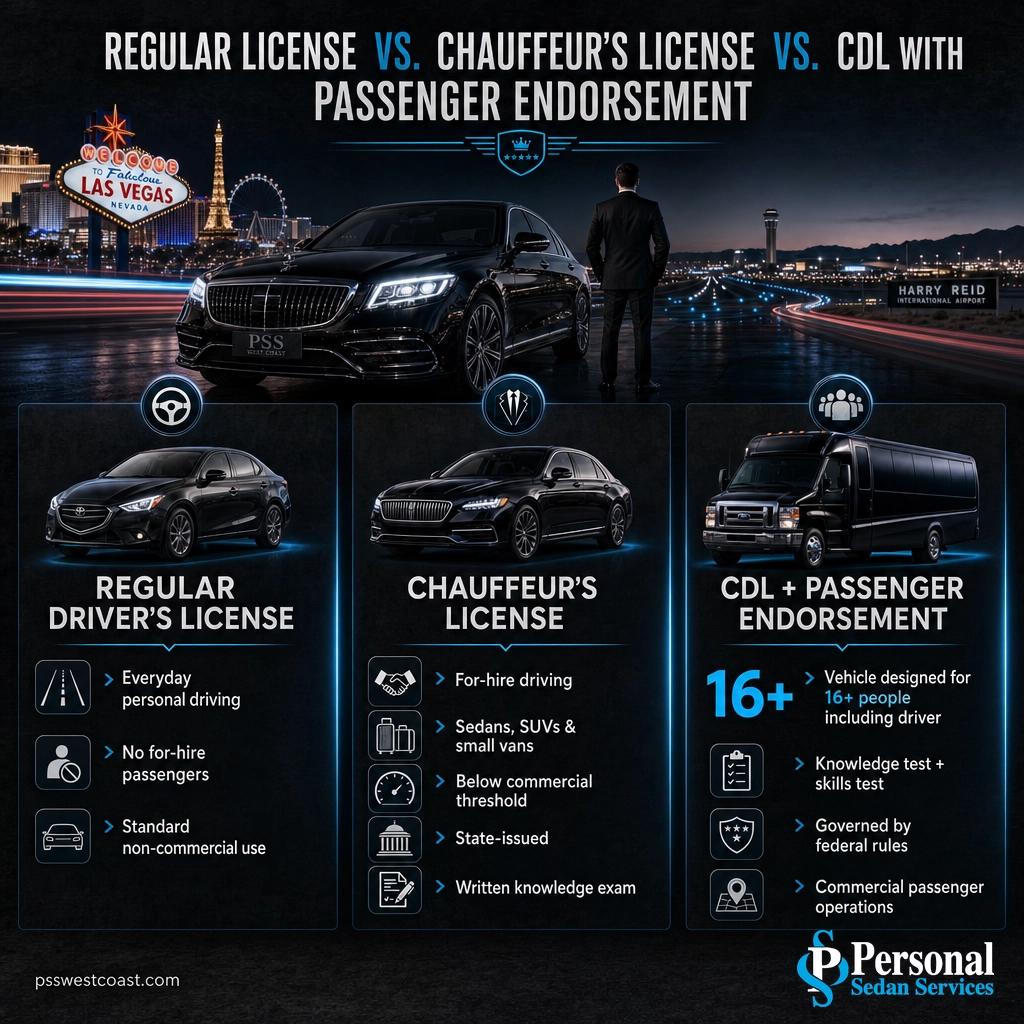
- A vehicle designed to carry 16 or more people, including the driver, requires a commercial driver’s license with a Passenger endorsement, not just a chauffeur’s license.
- Nevada issues no separate chauffeur license. A limousine driver must be 21 or older, hold a valid Nevada license, and carry a Nevada Transportation Authority driver’s permit.
- Indiana replaced its public passenger chauffeur’s license with a for-hire endorsement in 2017, a reminder to always verify current rules.
- The fastest way to pass is to study the state’s own manual, because every real exam question is written from it.

What’s in This Guide
- What a Chauffeur License Actually Is
- Which States Issue a Chauffeur License
- What’s on the Chauffeur License Written Test
- Chauffeur License Practice Test: Sample Questions and Answers
- How to Study and Pass on the First Try
- Chauffeur License vs. CDL vs. For-Hire Endorsement
- Becoming a Professional Chauffeur in Nevada and Las Vegas
- What to Do Next: Your Study Roadmap
- Related Resources
- Quick-Reference Summary Table
- Frequently Asked Questions
- Methodology and Sources
What a Chauffeur License Actually Is
A chauffeur, in licensing terms, is someone who drives passengers for pay. That is a broad definition, and it is exactly why the paperwork looks so different from one place to the next. Some states created a specific license class for professional passenger drivers decades ago and still use it. Others never had one, or retired it, and instead handle for-hire driving through an endorsement added to a regular license or through the federal commercial driver’s license system.
When people search for a “chauffeur license practice test,” they are usually preparing for a written knowledge exam that a state motor vehicle agency administers before issuing that for-hire credential. The exam confirms that a professional driver knows the rules of the road plus the extra responsibilities that come with carrying paying passengers. The content overlaps heavily with a standard driver’s test, then layers professional topics on top.
Here is the part that trips up almost every online study guide: because there is no national chauffeur license, there is no national practice test either. A set of sample questions can get you genuinely ready for the kind of material you will see, but the official exam, its length, and its passing score are decided by the state issuing your license. A Michigan applicant and a Louisiana applicant are studying from two different manuals for two different exams, even though both are called a chauffeur’s license.
Before you memorize a single practice question, answer one question yourself: which state will issue your credential, and does that state even call it a “chauffeur license”? That single answer tells you which manual to study, which agency to apply through, and whether you need a chauffeur’s license, a for-hire endorsement, or a commercial driver’s license. Getting it wrong is the most common reason applicants study the wrong material.
Throughout this guide the sample questions and explanations are written to reflect the kind of content these exams test. They are study practice, not a copy of any state’s live question bank, which is not published anyway. Use them to build confidence with the format and the professional topics, then confirm every state-specific detail in the official manual before you walk into a licensing office.
Source: Michigan Secretary of State: Chauffeur’s License
Which States Issue a Chauffeur License
Only a handful of states still issue a credential literally named a “chauffeur’s license.” Many others regulate for-hire driving through a different mechanism entirely, which is why a one-size-fits-all practice test is misleading. Below is a realistic picture of how the landscape breaks down, with the states most searchers are asking about.
Michigan is the clearest example of a true chauffeur’s license. The Michigan Secretary of State issues it to people who drive for hire or operate certain commercial vehicles that do not require a commercial driver’s license. To apply at a Secretary of State office, you bring your current Michigan driver’s license and pass a vision test and a written knowledge exam. That written exam is exactly what a Michigan-focused practice test should prepare you for.
Louisiana uses a Class D chauffeur’s license for drivers who transport people or property for hire in vehicles below the commercial driver’s license threshold. The process generally includes a written knowledge exam, a vision screening, and a background check, and the Louisiana Office of Motor Vehicles publishes a chauffeur’s manual that the test is drawn from. Applicants are typically 18 or older and already hold a regular Louisiana license.
Indiana shows why “current” matters. Indiana historically issued a public passenger chauffeur’s license, but effective January 1, 2017, the Indiana Bureau of Motor Vehicles began issuing a for-hire endorsement in place of the public passenger chauffeur’s and chauffeur’s licenses. An applicant studying an older Indiana practice test could prepare for a credential that is no longer issued, which is a costly mistake if it sends you to the wrong counter.
Then there are the states that issue no separate chauffeur license at all. Nevada is the one that matters most for anyone planning to drive professionally in Las Vegas, and it works through the Nevada Transportation Authority rather than a chauffeur’s license class. We cover Nevada in full further down, because the rules are specific and frequently misunderstood.
| State | Credential for for-hire passenger driving | Written exam? | Issuing agency |
|---|---|---|---|
| Michigan | Chauffeur’s license | Yes | Secretary of State |
| Louisiana | Class D chauffeur’s license | Yes | Office of Motor Vehicles |
| Indiana | For-hire endorsement (replaced chauffeur’s license in 2017) | Yes | Bureau of Motor Vehicles |
| Nevada | No chauffeur license; NTA driver’s permit plus a valid Nevada license | Agency process, not a DMV chauffeur exam | Nevada Transportation Authority |
| Any state, large vehicles | Commercial driver’s license with Passenger endorsement (16+ passengers) | Yes (knowledge and skills) | State DMV under federal rules |
The takeaway from this table is simple: the word “chauffeur” on a practice test does not guarantee it matches your state. Confirm the exact credential name with your licensing agency first, then choose study material that matches it.
Source: Michigan Secretary of State: Chauffeur’s License | Louisiana Office of Motor Vehicles | Indiana Bureau of Motor Vehicles
What’s on the Chauffeur License Written Test
Even though the exact exam changes by state, the subject matter is remarkably consistent. A chauffeur or for-hire written test is built in two layers. The first layer is the same general driving knowledge any licensed driver should have. The second layer is the professional material that separates a paid passenger driver from an ordinary motorist. Study both layers and you are prepared for almost any state’s version.
The general-knowledge layer covers traffic laws, road signs and signals, right-of-way rules, speed and stopping distances, lane markings, and safe responses to hazards like rain, glare, and road debris. If it would appear on a standard driver’s license exam, it can appear here too. This is the easiest layer to prepare for because the rules are consistent nationwide and well documented in every state manual.
The professional layer is where most applicants lose points, because it is the material they have never had to think about as everyday drivers. Expect questions on passenger safety and comfort, loading and unloading, the lower alcohol limit for on-duty professional drivers, fatigue and hours behind the wheel, pre-trip vehicle inspection, and how to conduct yourself with paying passengers. These are the topics that justify a separate professional credential in the first place.
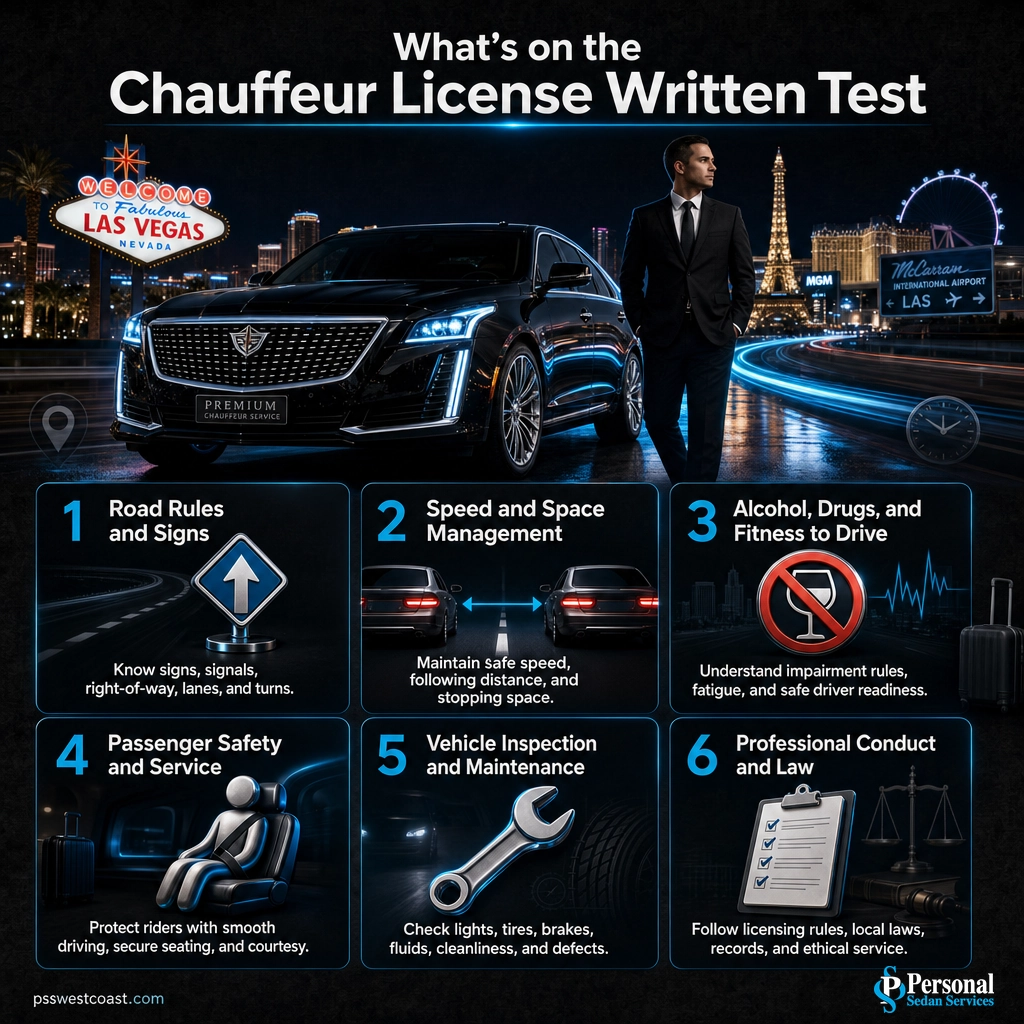
A useful way to frame your study is to split the material into six recurring categories. Almost every chauffeur or for-hire written test draws from some combination of these, even when the state uses different section titles.
| Topic area | What it covers | Why it is tested |
|---|---|---|
| Road rules and signs | Signals, signs, lane markings, right-of-way | Core safe-driving knowledge |
| Speed and space management | Following distance, stopping distance, hazards | Passenger vehicles need extra margin |
| Alcohol, drugs, and fitness to drive | On-duty limits, fatigue, medications | Paid drivers are held to a higher standard |
| Passenger safety and service | Loading, seat belts, comfort, special needs | You are responsible for people, not cargo |
| Vehicle inspection and maintenance | Pre-trip checks, tires, brakes, lights | Prevents breakdowns with passengers aboard |
| Professional conduct and law | For-hire rules, documentation, local regulations | Commercial driving has legal obligations |
Do not skip the professional-driving chapters because the general rules feel familiar. The questions that fail applicants are almost always in the professional layer, especially the lower alcohol limit and passenger-safety responsibilities. Treating the test like a standard driver’s exam is the single most common reason confident drivers fail a chauffeur or for-hire test.
Source: FMCSA: 49 CFR Part 383, Commercial Driver’s License Standards
Chauffeur License Practice Test: Sample Questions and Answers
Here is the practice test. The questions are grouped into the four areas where chauffeur and for-hire exams concentrate, and every answer includes a short explanation with a source where a specific rule applies. Work through them without looking at the answers first, then review the explanations. These are representative study questions, not a copy of any state’s live exam, so always confirm state-specific figures in your official manual.
Part 1: Road Rules and Right-of-Way
1. You arrive at a four-way stop at the same time as a vehicle on your right. Who has the right-of-way?
A. You do, because you are carrying passengers
B. The vehicle on your right
C. Whoever accelerates first
D. The larger vehicle
Answer: B. When two vehicles reach a four-way stop at the same time, the driver on the left yields to the driver on the right. Carrying passengers never changes a right-of-way rule.
2. A solid yellow line on your side of the center of a two-lane road means:
A. Passing is allowed if the road is clear
B. Passing is not allowed from your side
C. The road is one-way
D. You may only pass large trucks
Answer: B. A solid yellow line on your side prohibits passing. A broken yellow line on your side would allow passing when it is safe.
3. A school bus ahead of you stops and extends its red flashing lights and stop arm on an undivided two-lane road. You must:
A. Slow to 15 mph and pass carefully
B. Stop and remain stopped until the lights stop flashing
C. Pass only if no children are visible
D. Honk to signal you are passing
Answer: B. On an undivided road, traffic in both directions must stop for a school bus with flashing red lights and an extended stop arm, and stay stopped until it is withdrawn.
Part 2: Speed and Space Management
4. What is a safe minimum following distance for a passenger vehicle in good conditions?
A. One second
B. Two car lengths at any speed
C. At least three seconds, and more in poor conditions
D. Whatever keeps you ahead of traffic
Answer: C. The three-second rule gives you time to react. Larger and heavier vehicles, and any wet, icy, or low-visibility conditions, require noticeably more space.
5. Your vehicle begins to hydroplane on a wet road. You should:
A. Brake hard immediately
B. Accelerate to regain traction
C. Ease off the accelerator and steer straight until tires regain grip
D. Turn sharply toward the shoulder
Answer: C. Sudden braking or steering during hydroplaning can cause a skid. Ease off the gas, hold the wheel steady, and let speed drop until the tires contact the road again.
6. Compared with a standard car, a longer passenger vehicle such as a stretch limousine or van needs:
A. Less following distance because it is heavier
B. More distance to stop and wider turns
C. The same stopping distance as a sedan
D. No special consideration on the highway
Answer: B. Length and weight increase stopping distance and swing-out on turns. Professional drivers plan earlier braking and wider turning paths with passengers aboard.
Part 3: Alcohol, Fatigue, and Fitness to Drive
7. Under federal rules, what is the maximum alcohol concentration for an on-duty commercial or for-hire driver performing safety-sensitive functions?
A. 0.08
B. 0.05
C. 0.04
D. 0.10
Answer: C. Federal rule 49 CFR 382.201 prohibits driving with an alcohol concentration of 0.04 or greater while on duty, which is half the 0.08 limit that applies to private drivers.
8. You feel drowsy midway through a long transfer. The safest professional response is to:
A. Open a window and keep driving
B. Drink coffee and push through
C. Pull over safely and rest before continuing
D. Drive faster to finish sooner
Answer: C. Fatigue slows reaction time much like alcohol. A professional driver stops in a safe place and rests rather than relying on temporary fixes with passengers aboard.
On-duty alcohol concentration limit: private driver vs. professional driver
9. A prescription medication warns that it may cause drowsiness. Before driving passengers you should:
A. Take a double dose to get it over with
B. Drive only on short trips
C. Confirm with a doctor or pharmacist that it is safe to drive, and not drive if it impairs you
D. Ignore the warning if you feel fine
Answer: C. Fitness to drive includes legal medications that impair alertness. Professional drivers confirm a medication is safe before carrying passengers and do not drive while impaired.
Part 4: Passenger Safety and Professional Conduct
10. Before pulling away from a curb with passengers aboard, you should first:
A. Set the route in your navigation app
B. Check that passengers are seated and belted where required, then check mirrors and blind spots
C. Accelerate quickly to merge
D. Ask passengers to watch for traffic
Answer: B. Passenger readiness comes first, then a full mirror and blind-spot check before merging. The driver, not the passenger, is responsible for safe departure.
11. The safest place to load and unload passengers is:
A. In the travel lane to save time
B. At a curb or designated pickup area, away from moving traffic
C. Anywhere the passenger prefers
D. On a highway shoulder
Answer: B. Loading at a curb or designated zone keeps passengers out of traffic. Stopping in a travel lane or on a shoulder exposes everyone to needless risk.
12. A pre-trip inspection of a for-hire vehicle should include checking:
A. Only the fuel level
B. Tires, brakes, lights, mirrors, and signals
C. The sound system
D. Nothing, if the vehicle ran fine yesterday
Answer: B. A pre-trip inspection catches safety problems before passengers are aboard. Tires, brakes, lights, mirrors, and signals are the core items on any professional checklist.
13. A vehicle is designed to carry 20 people including the driver. To drive it for hire you generally need:
A. Only a chauffeur’s license
B. A regular driver’s license
C. A commercial driver’s license with a Passenger endorsement
D. No special credential
Answer: C. Federal rules require a commercial driver’s license with a Passenger endorsement for a vehicle designed to carry 16 or more people, including the driver. A chauffeur’s license alone does not cover it.
14. As a professional driver, your first responsibility to a paying passenger is:
A. Arriving as fast as possible
B. Their safety and lawful, courteous transport
C. Taking the shortest route regardless of conditions
D. Keeping the radio on their favorite station
Answer: B. Safety and lawful, professional service come before speed or convenience. That standard is the reason professional-driver credentials exist.
15. You are approaching an intersection as the light turns yellow and you are carrying passengers. You should:
A. Speed up to beat the light
B. Stop safely if you can do so without hard braking
C. Close your eyes and hope
D. Honk and continue
Answer: B. A yellow light means prepare to stop. If you can stop safely without a sudden, jarring brake, do so. Smooth, predictable driving is both safer and more comfortable for passengers.
Score yourself honestly. If you missed anything in Parts 3 and 4, that is your signal to spend extra time on the professional-driving chapters of your state manual before test day. Those are the questions that most often stand between a confident driver and a passing score.
Source: eCFR: 49 CFR 382.201, Alcohol Concentration | FMCSA: Commercial Driver’s License Standards
How to Study and Pass on the First Try
The single most effective study habit is also the most overlooked: read the official manual published by the agency that will issue your license. Every real exam question is written from that document, so it is the only source guaranteed to match the test. A generic online practice test is a warm-up, not a substitute, and an out-of-date one can actively mislead you.
Start by reading the general traffic-law and road-sign chapters first, since that material is familiar and builds momentum. Then slow down for the professional-driving chapters. Take notes on the specifics that differ from everyday driving, especially the lower on-duty alcohol limit, passenger-safety duties, and any for-hire rules unique to your state. These are the points most likely to appear and most likely to be missed.
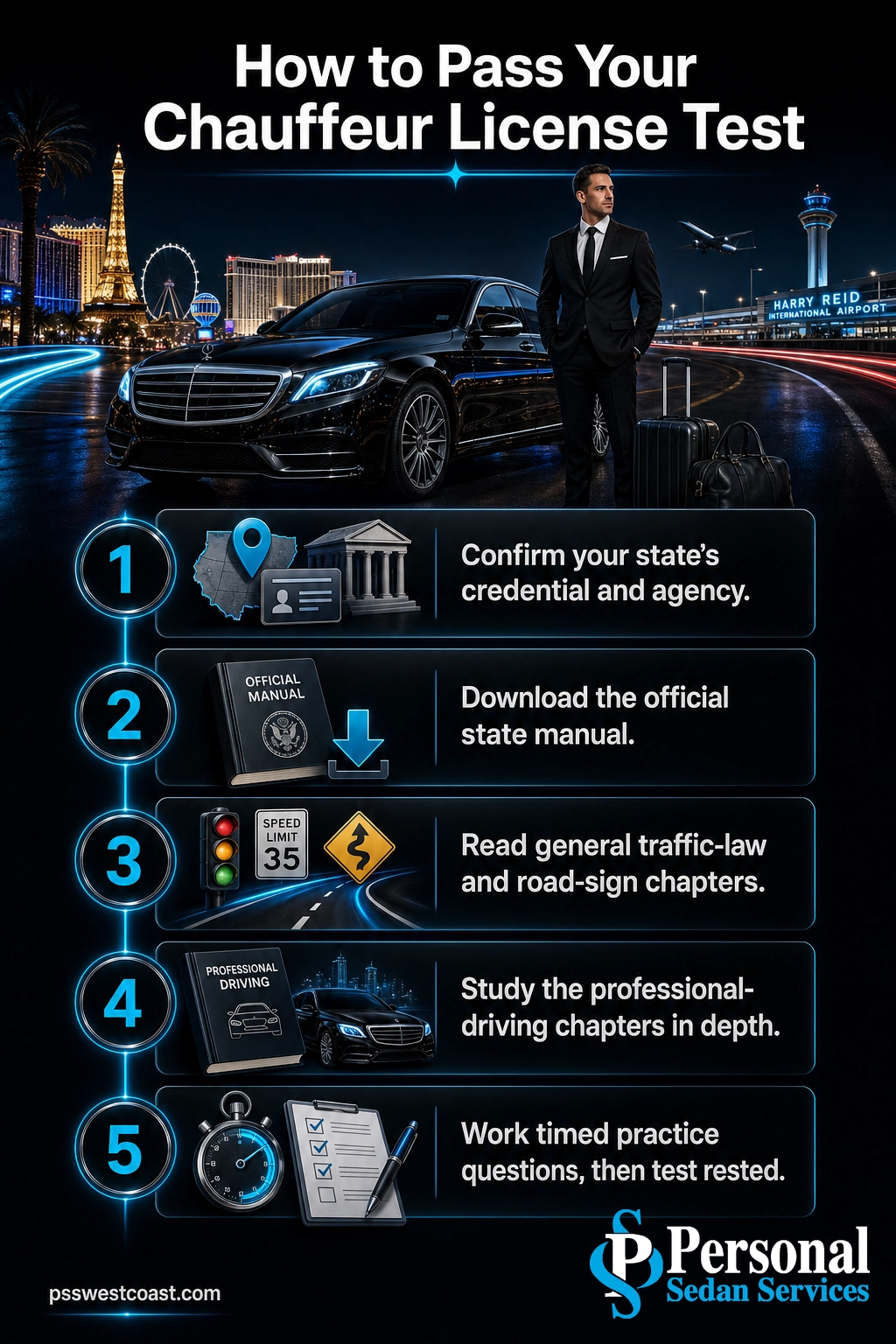
Study in short, repeated sessions rather than one long cram. Reading the professional-driving chapter three times across three days retains far more than reading it once for three hours. Finish each session with a handful of timed practice questions so the real exam format feels routine, not stressful, on test day.
A practical five-step plan works for almost everyone. First, confirm the exact credential and agency for your state. Second, download that state’s official manual. Third, read the general sections, then the professional sections, taking notes. Fourth, work practice questions like the ones above until the professional topics feel automatic. Fifth, review your weak areas the day before and arrive rested, since fatigue hurts test performance just as it hurts driving.

If you are studying in Nevada, keep reading, because your path does not run through a chauffeur’s license exam at all, and knowing that now saves you from studying the wrong material.
Source: Michigan Secretary of State: Chauffeur’s License
Chauffeur License vs. CDL vs. For-Hire Endorsement
Three credentials are easy to confuse, and choosing the wrong one wastes weeks of study. A state chauffeur’s license, a commercial driver’s license with a Passenger endorsement, and a for-hire endorsement each authorize for-hire driving, but they apply to different situations and are governed by different rules.
A chauffeur’s license is a state credential for driving for hire in passenger vehicles that fall below the commercial driver’s license size threshold. It is the right credential for a sedan, an SUV, or a small van operated for pay in a state that issues one. The written exam focuses on general driving plus professional passenger-driving topics, which is what the practice questions above prepare you for.
A commercial driver’s license with a Passenger endorsement is a federal requirement that kicks in once the vehicle is designed to carry 16 or more people, including the driver. That means large shuttle buses, mini-coaches, and motor coaches. The Passenger endorsement requires passing both a knowledge test and a skills test, and it is a bigger undertaking than a state chauffeur’s exam. No chauffeur’s license substitutes for it on a vehicle that size.
A for-hire endorsement is the mechanism some states now use instead of a standalone chauffeur’s license. Indiana is the clearest example: it replaced the public passenger chauffeur’s license with a for-hire endorsement in 2017. Functionally it serves the same purpose, authorizing for-hire driving, but it is attached to the license rather than issued as a separate card, and you apply for it under the state’s current rules.
A common misconception is that a chauffeur’s license lets you drive any for-hire passenger vehicle. It does not. The moment a vehicle is designed to carry 16 or more people, including the driver, federal law requires a commercial driver’s license with a Passenger endorsement instead. Size, not the job title, decides which credential you need.
| Credential | Best for | Who sets the rules | Exam |
|---|---|---|---|
| Chauffeur’s license | Sedans, SUVs, small vans for hire | State agency | Written knowledge exam |
| For-hire endorsement | Same for-hire driving, newer states | State agency | Written exam, added to license |
| CDL with Passenger endorsement | Vehicles designed for 16+ people | Federal rules, state administered | Knowledge and skills tests |
If your plan is to drive a sedan or SUV for a luxury car service, a chauffeur’s license or for-hire endorsement is almost certainly your path, where your state issues one. If you want to drive full-size shuttles or coaches, plan for a commercial driver’s license with a Passenger endorsement. Many professional drivers hold the smaller credential first and add the commercial license later as their career grows. You can see the range of vehicles a professional driver might operate on the Personal Sedan Services fleet page.
Source: FMCSA: 49 CFR Part 383, Commercial Driver’s License Standards | Indiana Bureau of Motor Vehicles
Explore the Personal Sedan Services Fleet
Becoming a Professional Chauffeur in Nevada and Las Vegas
If your goal is to drive professionally in Las Vegas, here is the fact that changes everything: Nevada does not issue a separate chauffeur license. Searching for a “Nevada chauffeur license practice test” leads people down the wrong road, because the credential does not exist as a DMV license class the way it does in Michigan or Louisiana. Nevada regulates for-hire passenger driving through the Nevada Transportation Authority instead.
Under Nevada Administrative Code 706.229, a limousine driver must meet three core requirements. The driver must be at least 21 years of age, must hold a valid Nevada driver’s license (or qualify as a border-state employee as defined in state law), and must possess a valid driver’s permit issued by the Nevada Transportation Authority. The Authority’s permit, not a chauffeur’s license exam, is the credential that authorizes for-hire driving in the state.
Because the Authority oversees the companies that employ drivers, the practical path in Las Vegas usually runs through a licensed operator. A reputable transportation company helps a qualified driver complete the Nevada Transportation Authority permit process, which typically involves identity and background checks alongside the valid Nevada license requirement. That is very different from studying for and passing a state chauffeur’s exam, and it is why a generic practice test does little for a Nevada applicant.
Larger vehicles still trigger the federal rules. If you plan to drive a full-size shuttle, mini-coach, or motor coach in Nevada that is designed to carry 16 or more people including the driver, you will need a commercial driver’s license with a Passenger endorsement in addition to meeting the state’s for-hire driver requirements. The vehicle size test is federal and applies in every state, Nevada included.
For a step-by-step walk through the Nevada process, read our companion guide on how to get a chauffeur license in Nevada, and for the permit side specifically, see our breakdown of the chauffeur permit requirements and how to get one. Personal Sedan Services runs a licensed, professional operation in Las Vegas with background-checked drivers, and our professional chauffeur service is built on exactly the standards these rules are designed to protect.
Source: Nevada Administrative Code 706.229 | FMCSA: Commercial Driver’s License Standards
See Our Professional Chauffeur Service in Las Vegas
What to Do Next: Your Study Roadmap
Turning all of this into a passed test is a matter of doing the right things in the right order. The roadmap below lays out the sequence, with priority and timing, so you spend your effort where it counts and never study for the wrong credential.
| Action | Priority | Timeline | Where to go |
|---|---|---|---|
| Confirm the exact credential and agency for your state | Critical | Day 1 | Your state licensing agency |
| Download the official state driver or chauffeur manual | Critical | Day 1 | State agency website |
| Read the general traffic-law and road-sign chapters | High | Days 2 to 3 | Official manual |
| Study the professional-driving chapters in depth | Critical | Days 3 to 5 | Official manual |
| Work practice questions until professional topics feel automatic | High | Days 5 to 7 | This guide plus state samples |
| Verify age, license, and permit requirements (NTA permit in Nevada) | Critical | Before applying | State agency or NTA |
| Schedule and take the exam, rested | High | Week 2 | Licensing office |
| If driving 16+ passenger vehicles, plan for a CDL with Passenger endorsement | As needed | After entry-level role | State DMV |
Follow this order and you avoid the two most expensive mistakes: studying for a credential your state no longer issues, and discovering on test day that the professional-driving material you skimmed is exactly what the exam weighted most heavily.
Related Resources
These guides and official sources go deeper on the pieces most relevant to a future professional driver, especially anyone planning to work in Las Vegas.
From Personal Sedan Services:
- How to get a chauffeur license in Nevada, the step-by-step companion to this study guide.
- Chauffeur permit requirements and how to get one, covering the Nevada Transportation Authority driver’s permit in detail.
- Professional chauffeur service in Las Vegas, the standard a licensed, background-checked driver is held to.
- The Personal Sedan Services fleet, the range of vehicles a professional driver may operate.
Official sources:
- Michigan Secretary of State: Chauffeur’s License
- Louisiana Office of Motor Vehicles
- Indiana Bureau of Motor Vehicles
- Nevada Administrative Code 706.229
- FMCSA: Commercial Driver’s License Standards
How to Get a Chauffeur License in Nevada
Quick-Reference Summary Table
Keep this table handy as you study. It gathers the key facts from the whole guide in one place, with the point each fact affects for a test-taker or future professional driver.
| Fact | Detail | Why it matters |
|---|---|---|
| National chauffeur license | Does not exist | Study the right state’s material |
| Michigan | Issues a chauffeur’s license, written exam plus vision test | True chauffeur-license state |
| Louisiana | Class D chauffeur’s license, written exam | True chauffeur-license state |
| Indiana | For-hire endorsement replaced chauffeur’s license in 2017 | Verify current rules |
| Nevada | No chauffeur license, NTA permit required | Las Vegas drivers skip the exam |
| Nevada minimum age | 21 for a limousine driver | Eligibility gate |
| Valid Nevada license | Required (or border-state employee) | Eligibility gate |
| NTA driver’s permit | Required to drive for hire in Nevada | The real Nevada credential |
| On-duty alcohol limit | 0.04, half the 0.08 private-driver limit | Common test question |
| CDL passenger threshold | Vehicle designed for 16+ people including driver | Decides chauffeur vs. CDL |
| Passenger endorsement | Requires knowledge and skills tests | Needed for large vehicles |
| Test layer one | General traffic law and road signs | Shared with standard license |
| Test layer two | Professional passenger-driving topics | Where most applicants fail |
| Four-way stop | Yield to the vehicle on your right | Right-of-way basics |
| Solid yellow line your side | No passing | Lane-marking basics |
| School bus flashing red | Stop in both directions on undivided roads | High-penalty rule |
| Following distance | Three seconds minimum, more for large vehicles | Space management |
| Hydroplaning | Ease off gas, steer straight, do not brake hard | Hazard response |
| Loading passengers | At a curb or designated zone, not a travel lane | Passenger safety |
| Best study source | The official state manual | Every real question is drawn from it |
| First responsibility | Passenger safety and lawful service | The core of professional driving |
Frequently Asked Questions
Is the chauffeur license practice test the same in every state?
How many questions are on the chauffeur license test?
What score do I need to pass the chauffeur license written test?
Do I need a chauffeur license to drive for Personal Sedan Services in Las Vegas?
Is a chauffeur license the same as a CDL?
What is the alcohol limit for a professional driver who is on duty?
How long does a chauffeur license or for-hire endorsement last?
Can I use my chauffeur license in another state?
How should I study for the chauffeur license written test?
Methodology and Sources
This guide was compiled from primary government and regulatory sources. State licensing details come from the Michigan Secretary of State, the Louisiana Office of Motor Vehicles, and the Indiana Bureau of Motor Vehicles. Nevada for-hire driver requirements are taken from Nevada Administrative Code 706.229, administered by the Nevada Transportation Authority. Federal commercial-driving rules, including the on-duty alcohol limit and the passenger-vehicle threshold, come from the Federal Motor Carrier Safety Administration and the Code of Federal Regulations (49 CFR Parts 382 and 383). The practice questions are representative study material written to reflect the topics these exams cover, not reproductions of any state’s live exam. Because licensing rules change and vary by state, confirm every state-specific detail with the official issuing agency before you apply or test.
Last Updated: October 2026
Sources: Michigan Secretary of State | Louisiana Office of Motor Vehicles | Indiana Bureau of Motor Vehicles | Nevada Administrative Code 706.229 | eCFR 49 CFR 382.201 | FMCSA 49 CFR Part 383
