


Quick answer: The Grand Canyon is not one place, so the distance from Las Vegas depends on the rim. The West Rim (home of the Skywalk) is about 125 miles, a 2 to 2.5 hour drive. The South Rim, inside Grand Canyon National Park, is about 277 miles, roughly 4.5 hours. The North Rim is about 265 miles but 4.5 to 5 hours because of the longer route.
Most people who search “how far is the Grand Canyon from Las Vegas” are really asking two questions at once: how many miles is it, and can I see it and get back in a day? The honest answer starts with a clarification. The rim closest to Las Vegas is not the postcard national park view. Knowing the difference between the three rims is the single thing that keeps travelers from a four-and-a-half-hour surprise.
- West Rim (Grand Canyon West): about 125 miles, 2 to 2.5 hours. The closest option and an easy day trip. Home of the Skywalk, on Hualapai tribal land, not part of the national park.
- South Rim (Grand Canyon National Park): about 277 miles, roughly 4.5 hours. The classic canyon views, open year-round.
- North Rim: about 265 miles but 4.5 to 5 hours. Higher, quieter, and seasonal. In 2026 it reopens May 15 with no in-park lodging after the 2025 wildfire.
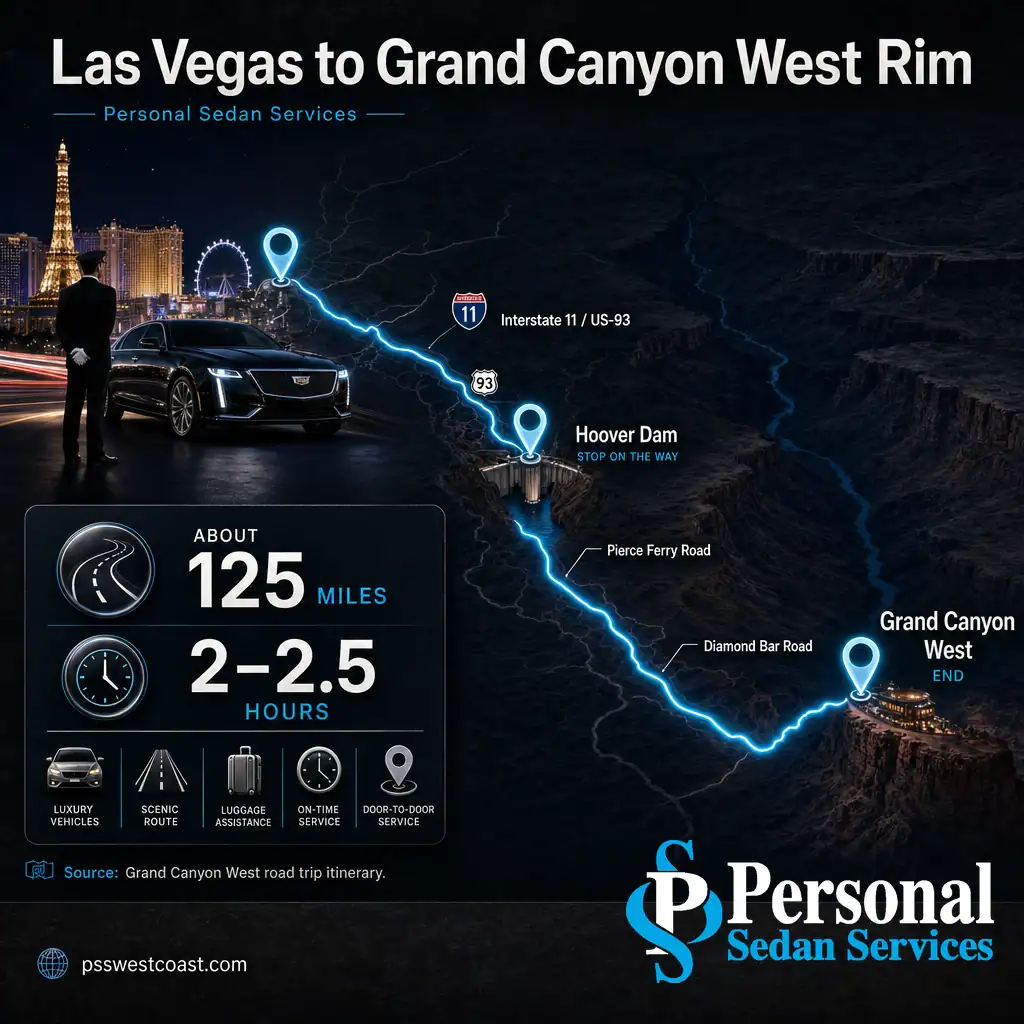
- Best route to the West Rim runs past the Hoover Dam on paved highway the whole way, including the now-paved Diamond Bar Road.
- A day trip to the West Rim is comfortable; the South Rim is better as a private chauffeured trip or an overnight so the long drive is not rushed.
What’s in This Guide
- How Far Is the Grand Canyon from Las Vegas? Three Rims Compared
- Grand Canyon West Rim: The Closest Option
- Grand Canyon South Rim: The Classic National Park Views
- Grand Canyon North Rim: The Remote Rim (And Its 2026 Status)
- The Best Route from Las Vegas to the Grand Canyon
- Drive Time Compared: How Long Each Rim Really Takes
- Drive Yourself, Take a Tour, or Hire a Private Car?
- Planning Your Grand Canyon Trip from Las Vegas
- Frequently Asked Questions
- Related Las Vegas Travel Guides
How Far Is the Grand Canyon from Las Vegas? Three Rims Compared
The Grand Canyon stretches 277 miles along the Colorado River, and you can visit it from three very different developed areas. From Las Vegas, they are not close to each other, so the “distance to the Grand Canyon” changes by more than two hours depending on which rim you choose.
| Rim | Distance from Las Vegas | Drive time (one way) | What you get | Best for |
|---|---|---|---|---|
| West Rim (Grand Canyon West) | ~125 miles | 2 to 2.5 hours | Skywalk, Eagle Point, Guano Point | Day trips, first-timers, short on time |
| South Rim (National Park) | ~277 miles | ~4.5 hours | Classic canyon panoramas, Rim Trail, Mather Point | The iconic view, longer visits |
| North Rim (National Park) | ~265 miles | 4.5 to 5 hours | High-elevation forest, fewer crowds | Solitude, summer only |
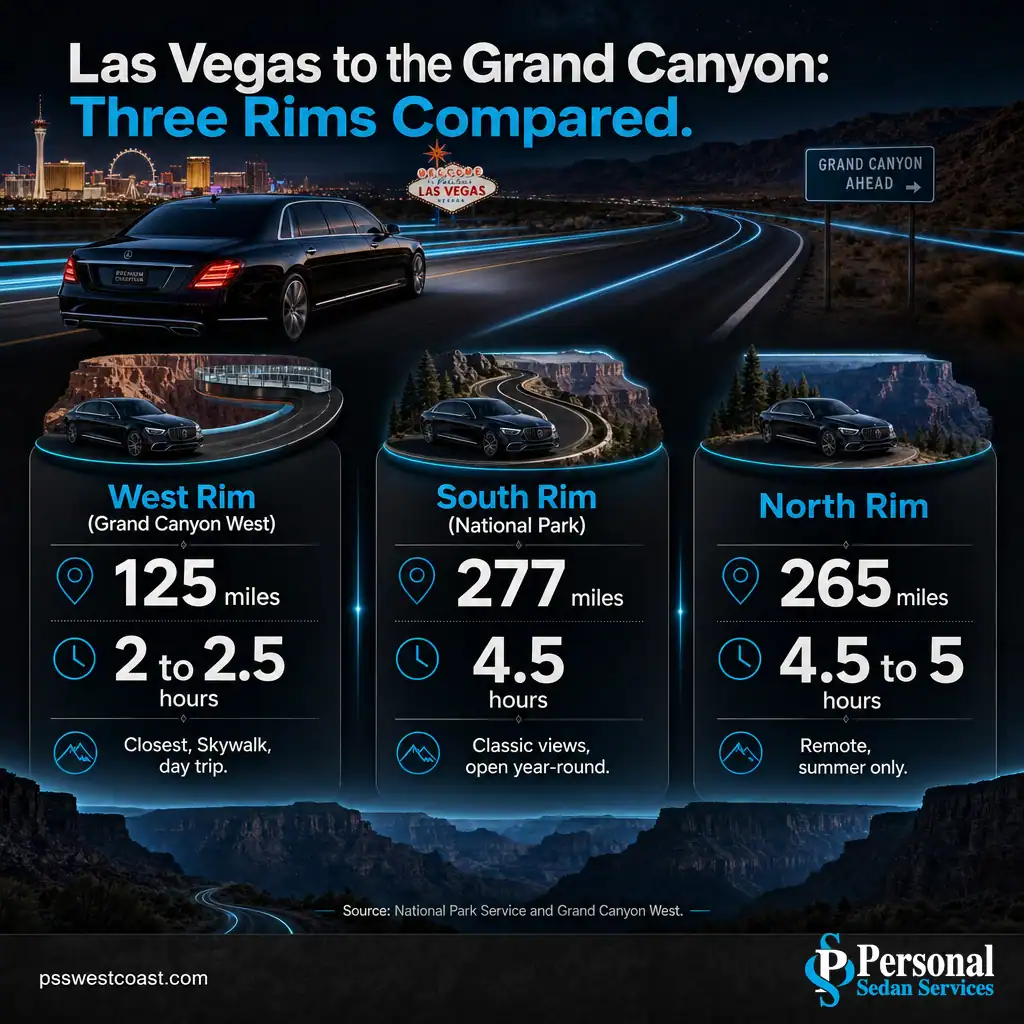
Don’t get caught out: The rim closest to Las Vegas is not the national park. Grand Canyon West is on Hualapai tribal land. If your heart is set on the famous South Rim view you have seen on postcards, plan for about 277 miles and 4.5 hours each way, not the two-hour West Rim drive.
Source: Grand Canyon National Park (NPS) | Grand Canyon West official site
Grand Canyon West Rim: The Closest Option (About 2 Hours)
If you want to stand on the edge of the Grand Canyon and be back in Las Vegas for dinner, the West Rim is your answer. At about 125 miles, the drive takes roughly two to two and a half hours, and every mile is now on paved road. This is why the vast majority of Las Vegas day trips go here.
Grand Canyon West is owned and operated by the Hualapai Tribe, whose reservation borders the western canyon. It sits outside Grand Canyon National Park, which means separate admission and a different experience from the national park rims. The headline attraction is the Skywalk, a glass-bottom, horseshoe-shaped bridge that extends out over the canyon and sits roughly 4,000 feet above the canyon floor. Two more overlooks anchor the visit: Eagle Point, named for the eagle shape in the rock face, and Guano Point, with 360-degree views and the remnants of an old mining tram.
Because the West Rim is the closest and most contained visit, it pairs naturally with the Hoover Dam, which sits directly on the route. Many visitors stop at the dam on the way out or back, turning the day into two bucket-list sights in one drive.
Source: Grand Canyon West official site
See our Las Vegas attractions transportation
Grand Canyon South Rim: The Classic National Park Views (About 4.5 Hours)
The South Rim is what most people picture when they think “Grand Canyon.” This is the developed heart of Grand Canyon National Park, with Mather Point, the Rim Trail, Grand Canyon Village, and the layered red-rock panoramas that define the park. It sits at about 7,000 feet of elevation and is open every day of the year.
From Las Vegas it is about 277 miles and roughly four and a half hours of driving. The trade-off is simple: the South Rim gives you the most iconic and expansive canyon view, but it asks for a real commitment of drive time. You pass through Kingman and the Route 66 towns of Seligman and Williams, Arizona, before turning north to the park entrance.
Because it is open year-round, the South Rim works in any season. Summer brings the biggest crowds and afternoon storms; spring and fall are the sweet spot for mild weather and thinner crowds. A same-day round trip from Las Vegas is possible but long, so many travelers build in an overnight near the park or let a chauffeur handle the driving both ways.
Source: Grand Canyon National Park directions (NPS)
Ride with a private chauffeur to the canyon
Grand Canyon North Rim: The Remote Rim (And Its 2026 Status)
The North Rim is the least-visited of the three and the most seasonal. It sits above 8,000 feet, which makes it cooler and greener, and the road in (Arizona Highway 67) closes with winter snow. On a map it looks closer to Las Vegas than the South Rim, but the drive is about 265 miles and takes four and a half to five hours because there is no direct route around the canyon.
2026 update, read before you plan: In July 2025, the lightning-sparked Dragon Bravo Fire destroyed the historic Grand Canyon Lodge and dozens of other North Rim structures. For the 2026 season the North Rim reopens on May 15, 2026 with paved roads and viewpoints such as Point Imperial and Cape Royal, but there is no in-park lodging and services are limited. If you want to stay overnight at a rim, choose the South Rim or Grand Canyon West.
For most Las Vegas travelers, the North Rim is a specialty trip for summer road-trippers who want solitude, not a quick canyon fix. If that is you, confirm current conditions on the park website before you leave, since access is still being restored after the fire.
Source: NPS 2026 North Rim summer season access | NPS North Rim status
The Best Route from Las Vegas to the Grand Canyon
The best route depends on the rim, but both main drives start the same way, heading southeast out of the valley toward the Colorado River.
To the West Rim (about 125 miles): Take Interstate 11 southeast toward the Hoover Dam and cross into Arizona on the Mike O’Callaghan-Pat Tillman Memorial Bridge. Continue on US-93, then turn onto Pierce Ferry Road and follow Diamond Bar Road to the Grand Canyon West welcome center. Diamond Bar Road was once a rough dirt washboard, but the final stretch was paved in a multi-year project, so the entire drive is now smooth pavement.
To the South Rim (about 277 miles): Follow US-93 south to Kingman, Arizona, join Interstate 40 east through Seligman and Williams, then take Arizona Highway 64 north to the park’s south entrance. It is a straightforward interstate drive for most of the way.
Fuel and service tip: Once you leave the Las Vegas valley, towns and gas stations get sparse, especially on the West Rim’s Pierce Ferry and Diamond Bar roads. Top off the tank before you go, carry water, and download your route for offline use, because cell coverage drops out in long stretches.
Source: Grand Canyon West road trip itinerary
Drive Time Compared: How Long Each Rim Really Takes
Miles tell only half the story. The West Rim is not just fewer miles, it is a fundamentally shorter day. Here is how the one-way drive times line up.
One-Way Drive Time from Las Vegas by Rim
Approximate one-way driving times. Source: Google Maps and official operator estimates.
The takeaway: a West Rim visit fits inside a normal day with time on the rim. The South and North rims are 9 or more hours of driving round trip, which is why they reward either an overnight or a chauffeured car where you can rest instead of drive.

Drive Yourself, Take a Tour, or Hire a Private Car?
There are three honest ways to get from Las Vegas to the Grand Canyon, and the right one depends on your group, your budget, and how much of the day you want to spend behind the wheel.
Drive yourself
The cheapest and most flexible option. You control the stops and the timing. The downsides are the long hours on unfamiliar desert highways, no one to enjoy the scenery with while you focus on the road, and the fatigue of a 9-plus-hour driving day to the South Rim.
Join a group bus or helicopter tour
Convenient and often packaged with the Skywalk or a canyon landing. The trade-off is a fixed schedule, shared time with strangers, and limited flexibility if you want to linger at an overlook. A full comparison of the packaged options is in our guide to Grand Canyon tours from Las Vegas.
Hire a private chauffeured car
The middle path many visitors overlook. A private chauffeur handles all the driving in a luxury sedan, SUV, or van, so your group travels together, stops where you want (including the Hoover Dam), and arrives rested. For families, couples, and small groups who want the freedom of a self-drive without the fatigue, it is the most comfortable way to see the canyon. Larger parties can spread out in a group vehicle built for the distance.
Planning Your Grand Canyon Trip from Las Vegas
A few practical notes make the difference between a great canyon day and a rushed one.
- Start early. Leave Las Vegas by 7 or 8 a.m. so you have real time on the rim and a relaxed drive home before dark.
- Match the rim to your time. Half a day free means the West Rim. A full, long day or an overnight opens up the South Rim.
- Dress for elevation. The rims are far cooler than the valley floor, and weather changes fast at 7,000 to 8,000 feet. Bring layers even in summer.
- Bring water and snacks. Services are limited between towns, and canyon air is dry.
- Check park status. For the national park rims, confirm entrance and road conditions on the NPS site, especially the North Rim while access is restored after the 2025 fire.
Doing it as a day trip? The West Rim is comfortable in a day. The South Rim is possible but demanding: about 9 hours of driving plus your time in the park. If the round trip runs past dark, a chauffeured car means no one in your group has to drive tired on remote highways at night.
Explore our luxury transportation options
Frequently Asked Questions
How far is the Grand Canyon from Las Vegas?
Can you do the Grand Canyon as a day trip from Las Vegas?
Which Grand Canyon rim is closest to Las Vegas?
Is the Grand Canyon West Rim part of Grand Canyon National Park?
Is the Grand Canyon North Rim open in 2026?
Related Las Vegas Travel Guides
- Hoover Dam distance and getting there – the stop that sits right on the West Rim route.
- Grand Canyon tours from Las Vegas – every bus, helicopter, and Skywalk package compared.
- Zion National Park drive and route – a redder canyon and a shorter drive.
- Sedona, Arizona distance and tips – red rock country beyond the canyon.
- Death Valley drive time and best time to visit – the closest national park to Las Vegas.
- Laughlin, Nevada drive and what to do – a river town day trip.
- Best day trips from Las Vegas – the full menu of drives worth taking.
Sources and Methodology
Rim locations, seasonal status, and the 2026 North Rim access details come from the U.S. National Park Service. West Rim details, ownership, and Skywalk facts come from the official Grand Canyon West site operated by the Hualapai Tribe. Driving distances and times are approximate and reflect Google Maps and official operator estimates from Las Vegas; actual times vary with traffic, weather, and stops.