


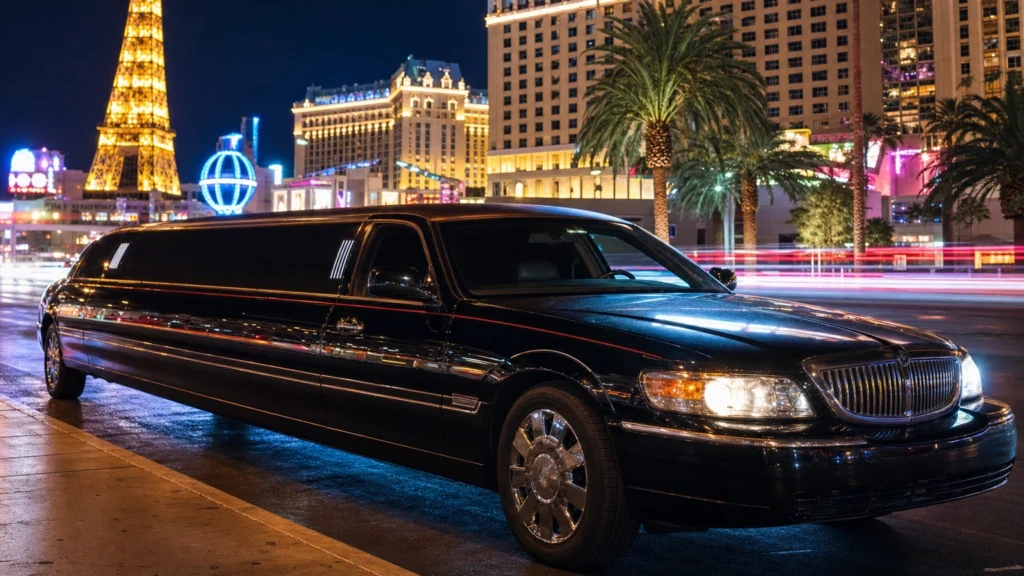
Limo tint is a 5% VLT window film. VLT stands for visible light transmission, so 5% tint lets only about 5 percent of outside light pass through the glass and blocks roughly 95 percent. It is the darkest tint commonly sold, which is why the near-black privacy glass on a limousine became the everyday name for it.
If you have ever pulled up next to a car so dark you could not see a single thing inside, you were looking at limo tint. The number behind that look is 5%, and it refers to how much light the film lets through, not how thick or expensive it is. Below is exactly what that 5% means, how it compares to every other tint level, whether you can legally run it in Las Vegas, and the simplest way to ride in true limo-tint privacy without risking a Nevada ticket.
- Limo tint = 5% VLT. The film lets about 5% of visible light through and blocks around 95%. The lower the number, the darker the glass.
- 5% is the darkest common tint. A few films go to 3%, but 5% is the standard “blackout” number the whole industry means by limo tint.
- It is mostly a rear-window product. In Nevada, front side windows must allow at least 35% light, so 5% belongs on the back glass, not up front.
- Darkness is not UV protection. A clear UV film can block more than 99% of UV rays, while a dark tint is about privacy, heat and glare.
- Night visibility is the trade-off. 5% tint is workable in daylight but cuts side and rear vision sharply after dark.
What’s in This Guide
- What “Limo Tint” Actually Means (5% VLT)
- How Window Tint Percentages Work
- Window Tint Percentages Chart: 5% vs 20% vs 35% vs 70%
- Limo Tint vs. Factory Privacy Glass
- Is Limo Tint Legal in Las Vegas? Nevada’s Tint Law
- Why People Choose Limo Tint
- The Downsides of 5% Tint
- Get the Limo-Tint Experience Without the Ticket
- Common Questions About Limo Tint
- Related Limo & Vehicle Guides
What “Limo Tint” Actually Means (5% VLT)
“Limo tint” is not a brand, a material, or a legal category. It is a nickname for one specific darkness level: 5% VLT. Visible light transmission is the single number that defines any automotive tint, and it describes the percentage of visible light the window lets through. A factory window with no film sits around 70 to 80% VLT. A 5% film lets through only a sliver of that light, so from the outside the glass reads as a flat, near-black panel.
The term stuck because the passenger cabins of stretch limousines have always used the darkest available privacy glass. When drivers wanted that same blacked-out look on a personal car, they started asking shops for “limo tint,” and the 5% number became shorthand for the darkest practical option on the menu.
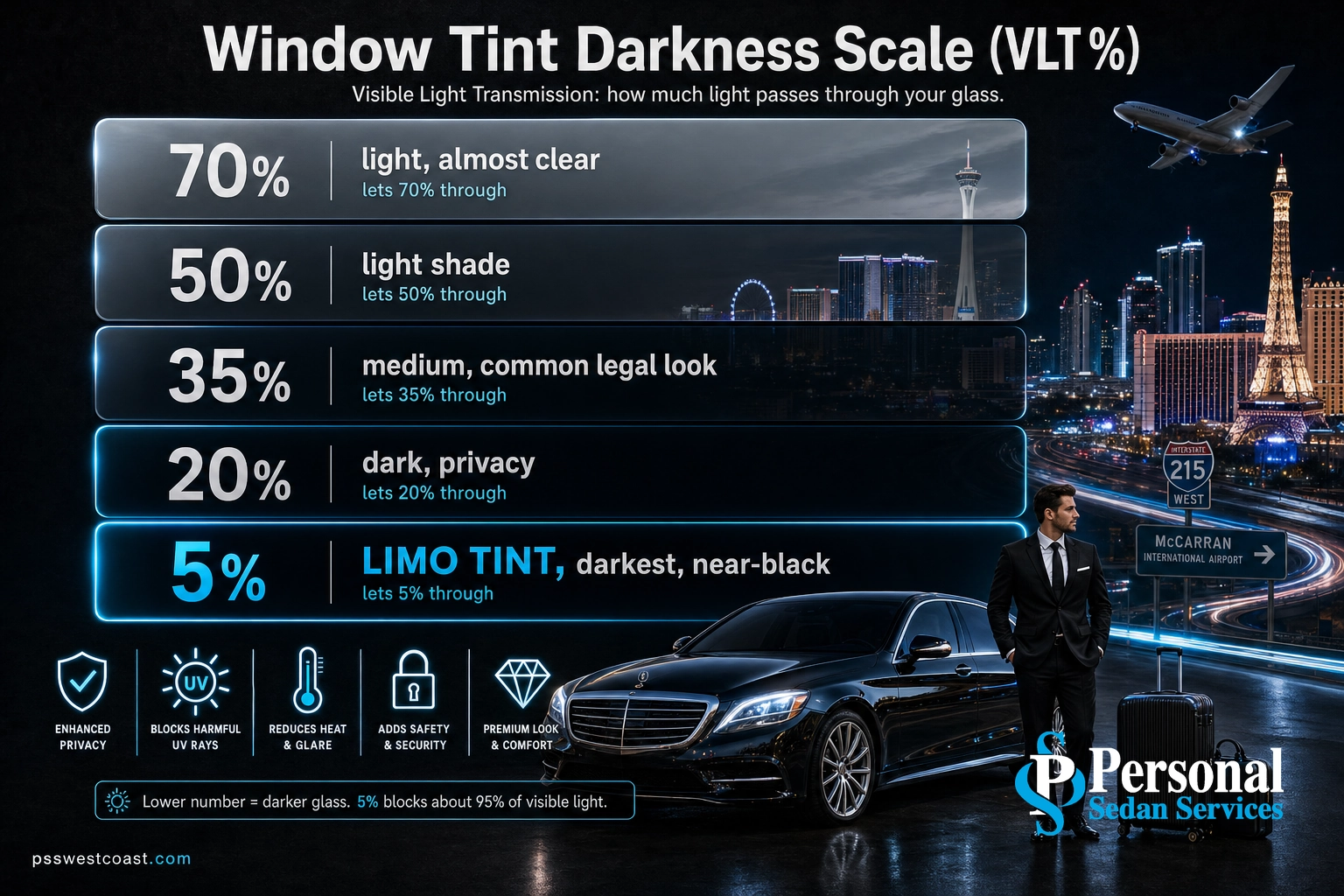
One point clears up most confusion: lower VLT means darker glass, not lighter. A 5% tint is far darker than a 35% tint, because 5 is a smaller share of light getting through. People often assume a bigger percentage is darker. It is the reverse.
Source: International Window Film Association | Skin Cancer Foundation UV window film overview
How Window Tint Percentages Work
Think of VLT like a dimmer switch for your windows. A clear pane is the switch turned almost all the way up, letting nearly all the light in. Each step down in percentage dims the glass further. The film itself does the dimming: it is a thin layer applied to the inside of the window that absorbs and reflects a set share of incoming light.
Here is how to read any tint number in three steps:
- Find the VLT percentage. It is the only figure that matters for darkness. A “20% tint” is a film rated at 20% VLT.
- Flip it to see what is blocked. Subtract from 100. A 20% film blocks 80% of visible light; a 5% film blocks about 95%.
- Remember the factory starting point. Glass already blocks some light before any film, so the darkness you see on the road is the film and the glass combined, called net VLT. That combined figure is what a police meter reads.
This is why two cars with the same “35% film” can measure differently. Tint law is written against net VLT, the final reading through film and glass together, not the number printed on the roll.
Source: International Window Film Association
Window Tint Percentages Chart: 5% vs 20% vs 35% vs 70%
Seeing the levels side by side makes the scale obvious. These are the darkness levels you will be quoted at almost any shop, from barely-there to full blackout.
| VLT % | How dark | What you see from outside | Typical use |
|---|---|---|---|
| 70% | Very light | Clear view inside; looks almost untinted | Clear UV and heat film, windshield strips |
| 50% | Light | Occupants fully visible, slight shade | Glare and heat reduction |
| 35% | Medium | Occupants visible but shaded | The common “legal” look on many front windows |
| 20% | Dark | Shapes visible in bright light only | Privacy-minded daily drivers |
| 5% | Limo tint (darkest) | Near-black, almost nothing visible inside | Rear windows, limousines, privacy builds |
A handful of specialty films go to 3% VLT, but they are rare and even harder to see out of. For practical purposes, 5% is the floor, and it is what nearly everyone means by the darkest tint you can get.
Limo Tint vs. Factory Privacy Glass
The most common mix-up is between 5% aftermarket limo tint and the dark “privacy glass” that comes standard on many SUVs and vans. They look similar but are not the same thing.
| Feature | 5% limo tint (aftermarket film) | Factory privacy glass |
|---|---|---|
| What it is | A film applied to the inside of the glass | Dye baked into the glass at the factory |
| Typical darkness | About 5% VLT | Usually around 15 to 26% VLT |
| Where it appears | Any window a shop applies it to | Rear side and back windows only |
| UV and heat | Depends on the film’s technology | Limited; mostly cosmetic darkening |
So a factory “limo-looking” SUV is usually not running true 5% tint. It is darker glass from the factory, and owners often add film on top for genuine blackout privacy and better heat control.
Is Limo Tint Legal in Las Vegas? Nevada’s Tint Law
This is the question that trips people up most, and the honest answer is: it depends entirely on which window. Nevada’s window tint rules live in state statute NRS 484D.440, and they treat the front and back of your vehicle very differently.
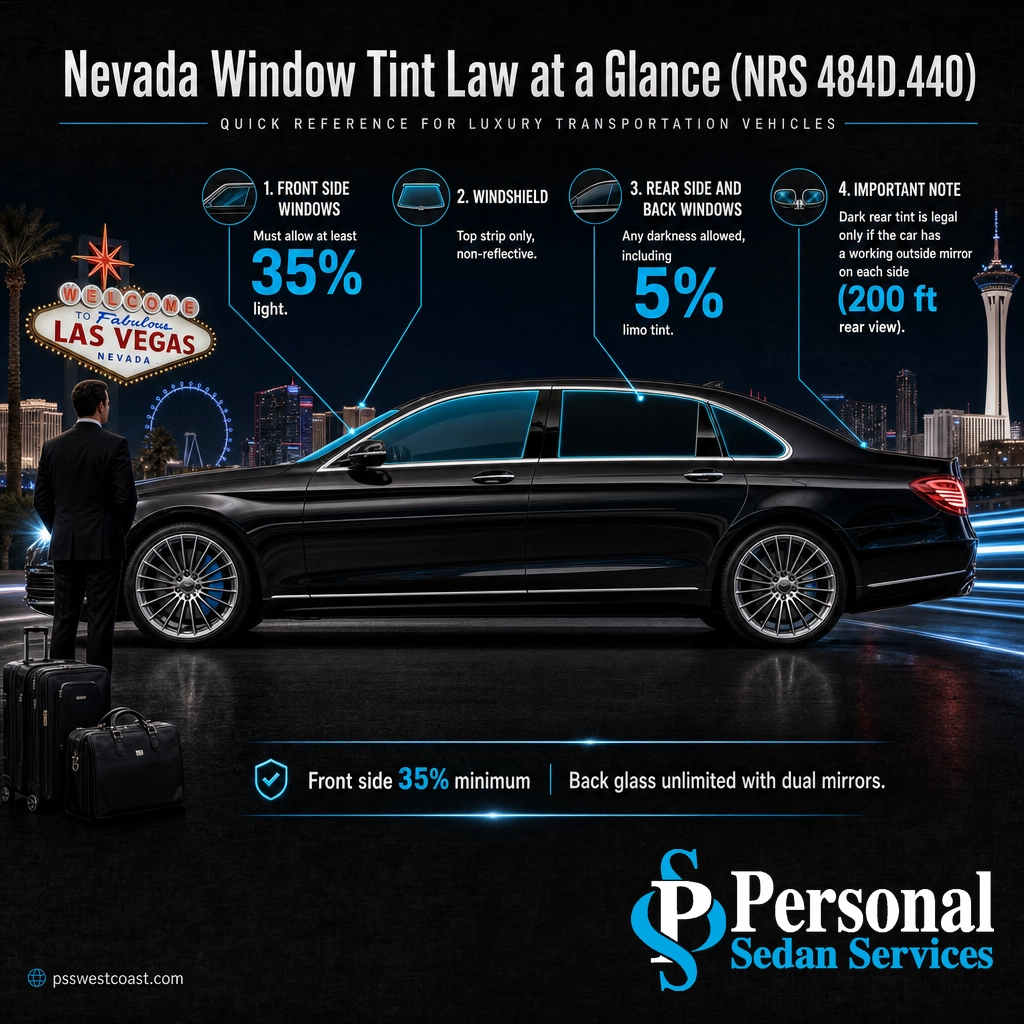
On the window to the immediate right or left of the driver, Nevada requires a total light transmission of at least 35%, with a measurement tolerance of 7%. A 5% film is nowhere near that, so running limo tint on your front side windows is a citation waiting to happen. The windshield is even more restricted: only the topmost strip may carry non-reflective tint, and it may not be red or amber.
The back of the car is where limo tint lives legally. Nevada sets no darkness limit on the rear side windows or the back window, on one condition.
Under the statute, you may tint the rear glass as dark as you want, including 5%, as long as the vehicle has an outside mirror on each side that reflects a view of the highway for at least 200 feet to the rear. In plain terms: if your back windows are blacked out, your side mirrors are doing the legal work your rear window no longer can.
Myth: “Limo tint is legal everywhere because limos use it.” Limousines run dark glass only in the passenger area behind the chauffeur, who keeps a clear forward and side view. On a regular car, 5% on the front windows is illegal in Nevada and most other states. The limo exemption you are picturing does not transfer to your daily driver.
One more detail worth knowing: Nevada offers a medical exemption. A licensed physician can document a need for added sun protection, and the driver files that statement with the Nevada DMV to receive a permit that stays in the vehicle. Tint laws also vary sharply across state lines, so a build that is legal on your SUV’s rear glass in Nevada could draw a ticket the moment you cross into another state.
Source: Nevada Revised Statutes NRS 484D.440 | Nevada DMV official site
Why People Choose Limo Tint
Dark tint is not only about looks. The reasons people reach for 5% are practical, especially in a sun-hammered desert city like Las Vegas where cars bake in triple-digit heat for months.
- Privacy. This is the headline benefit. At 5% VLT, outsiders simply cannot see who or what is inside, which is exactly why limousines and executive vehicles use it.
- Heat and glare. Darker film cuts the visible glare that tires your eyes on a bright Strip afternoon and can reduce the heat load that makes a parked car feel like an oven.
- Interior protection. Reducing sun exposure slows the fading and cracking of leather, dashboards and trim.
Here is the catch most people miss: darkness and sun protection are two different things. The darkness of a film does not determine how much ultraviolet radiation it blocks. That depends on the film’s UV technology, not its VLT number.
The Skin Cancer Foundation notes that the side, back and sunroof glass on most vehicles is tempered and does not block UVA rays well, leaving skin exposed on long drives. A quality UV film, including a clear one, can block more than 99% of UVA and UVB. The lesson: if sun protection is your goal, choose a film for its UV rating, not for how black it looks.
Source: Skin Cancer Foundation UV window film overview
The Downsides of 5% Tint
Before you blackout the back of your car, weigh the real trade-offs of going this dark.
- Night visibility. This is the big one. In daylight, 5% is manageable. After dark it blocks so much light that checking a blind spot or backing out of a parking space becomes genuinely harder, which is a safety issue, not just an inconvenience.
- Legal exposure. On any window other than the rear glass in Nevada, 5% invites a fix-it ticket and a re-inspection.
- Resale and rules. Some buyers, rental fleets and HOA or commercial policies push back on blackout tint.
Many drivers who want the limo look without the squint settle on a darker-but-livable level like 20% on the rear and a legal 35% up front. That gives privacy and a sleek look while keeping night vision usable.
Get the Limo-Tint Experience Without the Ticket
If what you actually want is the limo-tint experience, total privacy, a cool cabin, and the feeling of riding behind blacked-out glass, there is a simpler path than filming your own car and gambling with Nevada’s inspection meter. Ride in a vehicle that was built for it.
Personal Sedan Services runs a fleet of genuine limousines, executive SUVs and black cars with professional privacy glass on the passenger compartment, exactly the setup the term “limo tint” was coined to describe. You get the darkness and discretion where it is legal and intended, with a licensed chauffeur handling the driving and the forward visibility. No film shop, no permit, no citation risk.
Whether it is a night out on the Strip, a corporate arrival, or an airport run, our chauffeured rides deliver the private, five-star cabin that aftermarket tint only imitates.
Book a Las Vegas limousine service
See the full limousine and SUV fleet
Prefer a dedicated driver for the evening? Our professional chauffeur team can be booked by the hour across the Las Vegas valley.
Common Questions About Limo Tint
What percentage is limo tint?
Is 5% limo tint legal in Nevada?
What is the difference between 5% and 20% tint?
Can you see out of 5% limo tint at night?
Do limousines actually use 5% tint?
Related Limo & Vehicle Guides
- VLT (visible light transmission): the percentage of visible light a window lets through, the number that defines every tint level.
- Net VLT: the combined darkness of film and glass together, which is what a police meter actually measures.
- Factory privacy glass: dye baked into SUV and van rear glass at the factory, usually lighter than true 5% film. See our Las Vegas limousine service for vehicles built with proper privacy cabins.
- Ceramic tint: a premium film that blocks heat and UV without needing to be dark.
- Privacy partition: the raised divider between chauffeur and passengers in a stretch limo, the original source of the limo-tint idea. Browse the limousine guides for more.
Methodology & Sources
Darkness levels and VLT definitions in this guide reflect standard automotive window-film terminology from the International Window Film Association. Nevada legal requirements are drawn directly from the state statute NRS 484D.440 as published by Nevada Public Law, and should be confirmed against the current statute and the Nevada DMV before any tint purchase, because tint laws change and are enforced on net VLT. Ultraviolet protection figures are from the Skin Cancer Foundation. No darkness percentage, legal figure, or UV figure in this article was estimated or invented; each reflects the cited source.
Primary sources: Nevada Revised Statutes NRS 484D.440 | Skin Cancer Foundation | International Window Film Association | Nevada DMV
