


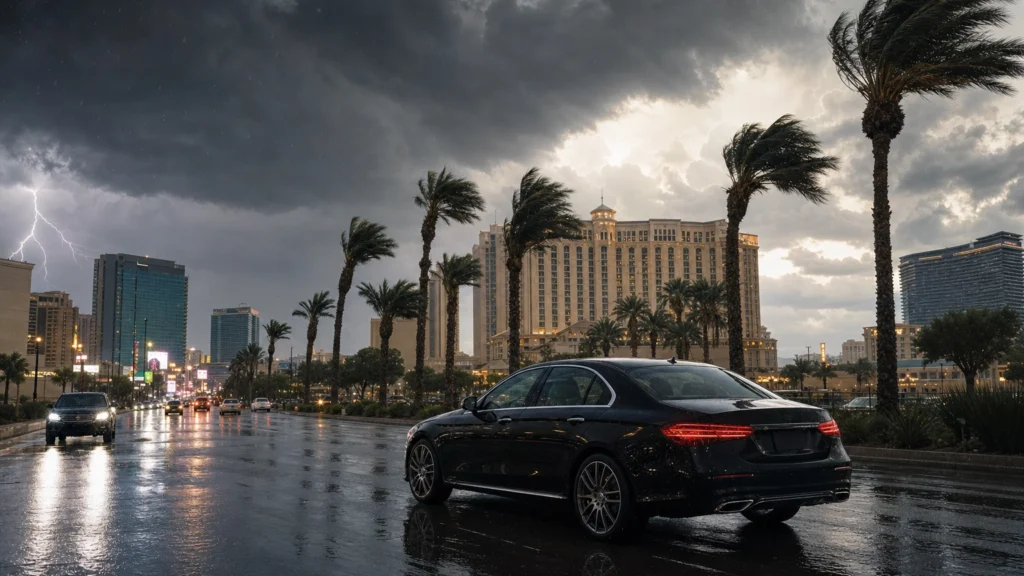
When is monsoon season in Las Vegas? Officially, June 15 through September 30 every year, as defined by the National Weather Service. In practice, the storms concentrate in July and August, bringing scattered afternoon thunderstorms, dust storms, and the valley’s main flash-flood risk. A normal monsoon drops only about an inch of rain, but it arrives in sudden, sometimes dangerous bursts.
Las Vegas has a reputation as a place where it never rains, and most of the year that is nearly true. But for roughly three and a half months every summer, the desert flips a switch. The North American monsoon pulls tropical moisture up into Southern Nevada, and the city that averages barely four inches of rain a year suddenly gets towering thunderheads, blowing dust, lightning, and flash floods that can turn a dry wash into a raging channel in minutes. This guide explains exactly when monsoon season runs, what the monsoon actually is, how much rain to expect, the real hazards to respect, and how to plan a trip or a drive around it.
- The dates: monsoon season officially runs June 15 to September 30 in Southern Nevada, a fixed window set by the National Weather Service.
- When it really hits: July and August are the peak. June and late September are usually quiet; the heart of the storm season is mid-summer.
- How much rain: a normal monsoon brings only about 1.05 inches, roughly a quarter of the city’s entire 4.2-inch annual total, in a handful of scattered storms.
- It is unpredictable: some years are nearly rainless “non-soons,” others top 3 inches. You cannot count on rain, and you cannot count on staying dry.
- The real danger is flash flooding: desert ground sheds water fast, washes fill in minutes, and water can move around 30 mph. Dust storms, lightning, and sudden winds add to the risk.
- Turn around, don’t drown: most flash-flood deaths happen when drivers cross flooded roads; as little as a foot of water can float a vehicle.
- It is still a great time to visit: storms are brief and the city is built indoors and air-conditioned. Watch the forecast, avoid flooded roads, and let a professional handle the driving on stormy days.

What’s in This Guide
- When Is Monsoon Season in Las Vegas?
- What Is the Monsoon, Exactly?
- How Much Rain Does the Monsoon Actually Bring?
- Monsoon vs. the Rest of the Las Vegas Year
- The Real Hazards: Flash Floods, Dust Storms, and Lightning
- How to Stay Safe During Monsoon Season
- How the Monsoon Affects a Las Vegas Trip
- Getting Around Las Vegas During Monsoon Storms
- Las Vegas Monsoon Season at a Glance
- Frequently Asked Questions
- Related Las Vegas Travel Guides
When Is Monsoon Season in Las Vegas?
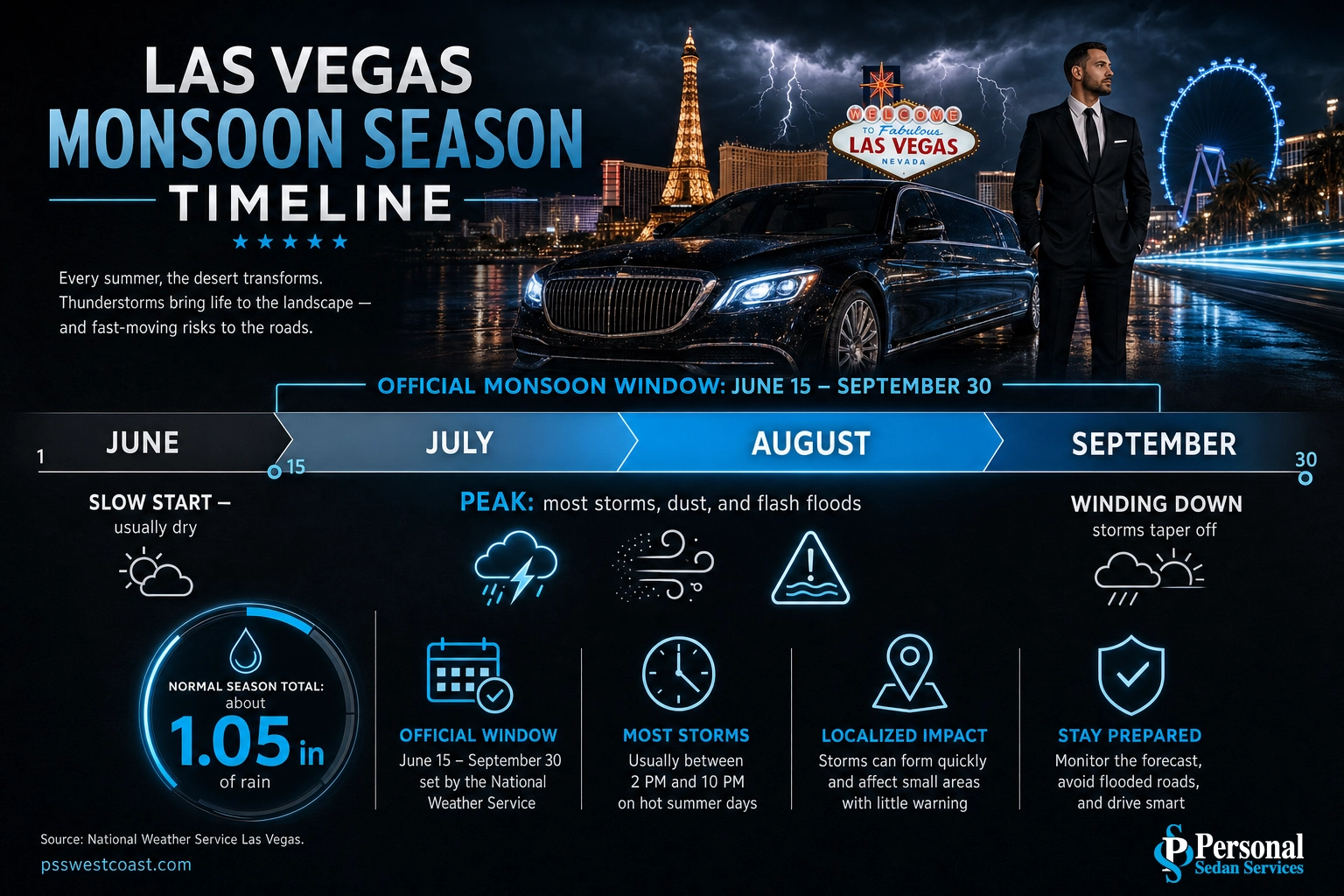
The short, official answer is clean: monsoon season in Southern Nevada runs from June 15 through September 30. The National Weather Service uses that same fixed calendar window across the Southwest, so Las Vegas, Phoenix, and Tucson all share the exact same monsoon start and end dates.
It was not always a fixed date. For years, forecasters declared the monsoon “officially here” only after the air had stayed humid enough for long enough, specifically after three straight days with an average dewpoint of 55 degrees. That made for a different start date every year and a lot of confusion. In 2008 the Weather Service dropped the dewpoint rule and switched to the simple, predictable June 15 to September 30 window that is still used today.
Here is the catch, and it matters for planning: the official dates and the actual storms are two different things. The season is bracketed June 15 to September 30, but moisture rarely shows up on day one. In most years the first half of June stays bone-dry, the storms build through July, peak in July and August, and taper off in September. So if you are trying to picture when Las Vegas actually gets stormy, think mid-summer, not mid-June.
Source: National Weather Service Las Vegas | National Weather Service monsoon information
What Is the Monsoon, Exactly?
“Monsoon” throws a lot of people off, because it sounds like a single storm or a hurricane. It is neither. A monsoon is a seasonal shift in wind direction that changes the whole weather pattern for months. The word comes from an Arabic term for season, and the Southwest version is formally called the North American monsoon.
Here is the plain-English version of how it works:
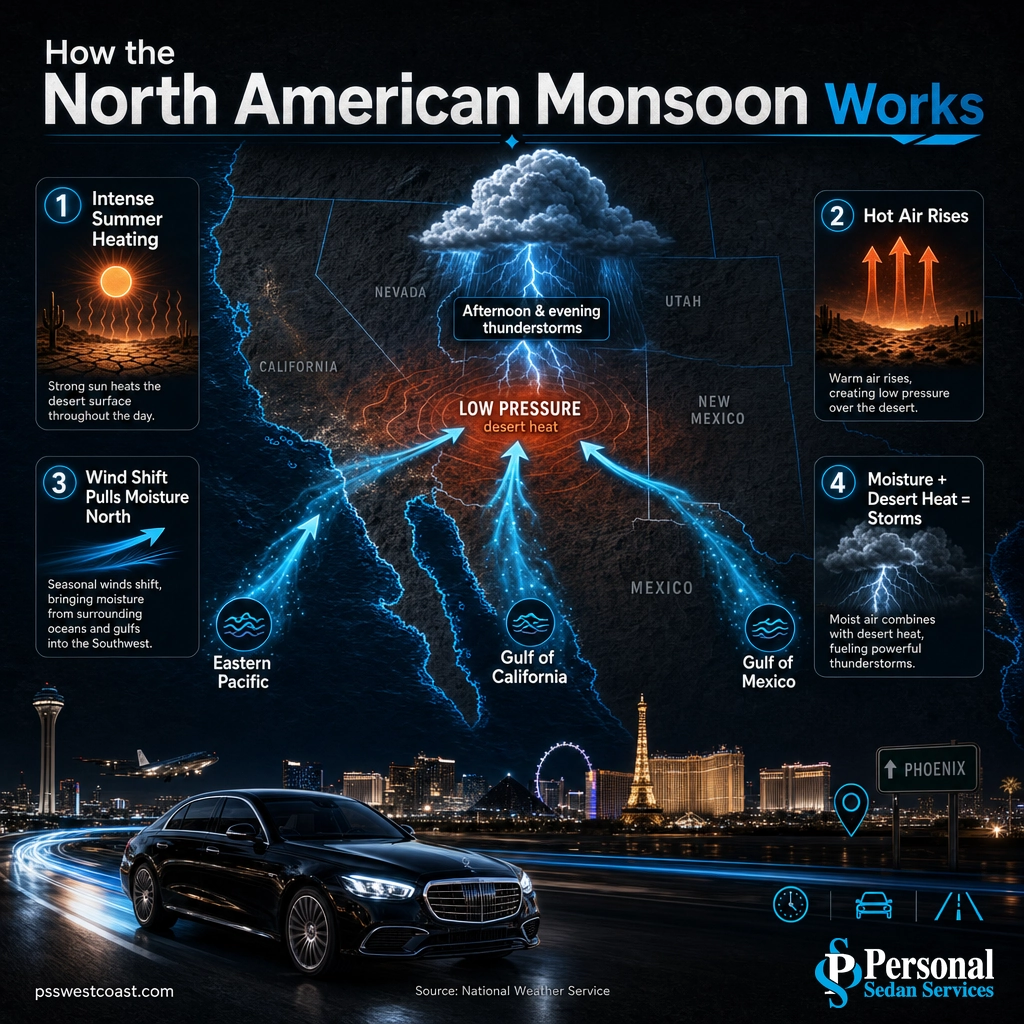
- The desert bakes. Through late spring and early summer, the Southwest heats up relentlessly, and by June the ground and air are extremely hot.
- Hot air rises, creating low pressure. That intense surface heating builds a low-pressure zone over the region and shifts the prevailing wind.
- The wind flips and pulls in moisture. Instead of dry air from the west, the circulation draws humid, tropical air northward from the Gulf of California, the eastern Pacific, and the Gulf of Mexico.
- Storms fire up. That moisture, combined with the desert heat, fuels tall thunderstorms, especially in the afternoons and evenings when the day’s heat peaks.
Think of it like a seasonal sea breeze on a massive scale: the overheated desert acts like a vacuum that sucks in moist air from distant bodies of water, and that moisture is what turns a cloudless June sky into a July afternoon full of thunderheads. When the sun angle drops and the desert cools in the fall, the pattern reverses and the dry air returns.
Why the humidity jumps. The monsoon is the one time of year Las Vegas loses its famous “dry heat.” As that tropical moisture pours in, dewpoints climb, the air feels sticky, and a 105-degree afternoon can feel even more oppressive than usual. That humidity bump is the tell-tale sign the monsoon has arrived, and it is exactly what forecasters used to track with the old dewpoint rule.
Source: National Weather Service: the North American monsoon
How Much Rain Does the Monsoon Actually Bring?
Less than most people expect, and far less reliably. A normal monsoon season brings Las Vegas about 1.05 inches of rain, according to National Weather Service records. That is not a lot, but in a city whose entire year averages only about 4.2 inches, it is a meaningful chunk of the total.
Personal Sedan Services analysis: at a normal monsoon total of 1.05 inches against an annual average of roughly 4.2 inches, the summer monsoon delivers close to a quarter of all the rain Las Vegas gets in an entire year (1.05 ÷ 4.2 ≈ 25 percent), and it does it in just a handful of storms over a few weeks. Calculation and interpretation original to Personal Sedan Services, combining NWS monsoon and annual precipitation normals.
The bigger story is how wildly the monsoon varies from one year to the next. Locals only half-jokingly call a dry year a “non-soon.” Some seasons produce almost nothing, with long stretches of the summer passing without a drop of measurable rain. Other years the storms line up and dump several inches. The table below shows how far the swing can go.
| Measure | Rainfall | Notes |
|---|---|---|
| Normal monsoon season | ~1.05 in | The long-term average for the June 15 to September 30 window |
| A wet year (2012) | ~3.63 in | Among the wettest recent monsoons on record |
| 2023 season | ~2.55 in | One of the wettest on record at the time, well above normal |
| A “non-soon” year | Near zero | Some seasons pass with barely measurable rain |
| Annual average (all year) | ~4.2 in | For context: the monsoon is roughly a quarter of the yearly total |
What this means for a visitor is simple: do not plan your trip around the monsoon either way. You cannot count on rain to cool things off, and you cannot count on a dry week either. Most summer afternoons stay hot and sunny, and the storms, when they come, are usually brief and scattered. For the full picture of just how rarely it rains here across the whole year, see our guide to how often it rains in Las Vegas, and for the heat side of the summer, how hot Las Vegas actually gets month by month.
Source: National Weather Service Las Vegas | NWS Las Vegas climate normals
Monsoon vs. the Rest of the Las Vegas Year
The single most common confusion is thinking of Las Vegas as having one steady climate. It does not. The monsoon summer is a completely different animal from the rest of the year, and understanding the contrast is the fastest way to set expectations.
| Monsoon Season (Jun 15–Sep 30) | The Rest of the Year | |
|---|---|---|
| Humidity | Rises sharply; the air feels sticky | Very low; the classic bone-dry desert |
| Rain pattern | Sudden, heavy, localized downpours | Rare; a little gentle winter rain at most |
| Main hazard | Flash floods, dust storms, lightning | Extreme heat (summer) or cold nights (winter) |
| Sky | Afternoon thunderheads, dramatic skies | Mostly clear; about 210 sunny days a year |
| Timing of storms | Afternoon and evening, peaking Jul–Aug | N/A |
Even at its wettest, Las Vegas is still a desert. The monsoon does not make the city green or rainy in the way a coastal climate is; it just concentrates most of the year’s limited rain into a few violent bursts. If you want the other extreme of the local climate, our guide to whether it snows in Las Vegas covers the winter side, and which desert Las Vegas sits in explains the Mojave setting that drives all of it.
The Real Hazards: Flash Floods, Dust Storms, and Lightning
Monsoon storms are short, but they are not harmless. The desert is uniquely bad at absorbing a sudden downpour, and that turns a quick storm into a genuine safety event. These are the four hazards to know.
Flash flooding (the big one)
This is the headline danger. Desert soil is hard and sun-baked, so instead of soaking in, rain runs straight off into the valley’s network of washes, channels, and low streets. A storm that drops an inch in an hour over the mountains can send a wall of water racing miles downstream into areas that are completely dry and sunny. The Clark County Regional Flood Control District warns that water in those channels can move at around 30 mph, and that as little as a foot of water can float and carry away a vehicle.
The valley has spent decades engineering around this risk, building out roughly 722 miles of channels and storm drains plus more than 110 detention basins to catch and slow the runoff. That infrastructure dramatically reduces the danger, but officials are blunt that it cannot erase it: during an intense storm, flash flooding is still deadly, and the system is designed to manage water, not to make it safe to drive through.
Dust storms (haboobs)
Before the rain, you often get the dust. Strong outflow winds from a collapsing thunderstorm can kick up a towering wall of dust, sometimes called a haboob, that drops visibility to near zero in seconds. These are especially dangerous on open highways around the valley, where a clear drive can turn blinding almost instantly.
Lightning
Monsoon thunderstorms produce frequent cloud-to-ground lightning. It is the reason resort pools and dayclubs clear the water the moment a storm rolls in, and it is a real risk for anyone hiking, golfing, or out at an open-air venue. When you hear thunder, the storm is already close enough to be dangerous.
Sudden strong winds
Even storms that produce little rain can pack powerful microburst winds. Monsoon gusts have downed trees and power lines and knocked out electricity to thousands of valley homes during the worst events. Those same winds are what whip up the dust and can make driving treacherous.
A sunny sky is not an all-clear. The most dangerous thing about desert flash floods is that the water often arrives where it is not raining. A storm miles away in the mountains can flood a wash or an underpass in bright sunshine downstream. Never judge flood risk by the sky directly overhead, and never enter a wash, channel, or flooded roadway during monsoon season, even if it looks calm.
Source: National Weather Service Las Vegas | Clark County Regional Flood Control District

How to Stay Safe During Monsoon Season
The good news is that monsoon safety comes down to a few simple habits. Locals live with this every summer, and the rules are easy to follow once you know them.
Turn around, don’t drown
This is the one rule that matters most. The Clark County Regional Flood Control District and the National Weather Service both hammer the same message: most flash-flood deaths happen when drivers try to cross a flooded road. If you come to water over the roadway, do not guess at how deep it is. Turn around and find another route. It is nearly impossible to judge depth or current from behind the wheel, and a foot of moving water can carry your vehicle away.
Stay out of washes and channels
The dry washes and concrete channels that crisscross the valley are not shortcuts or hangout spots during monsoon season. They exist precisely to carry flash-flood water, and they can go from dry to deadly in minutes. Keep yourself, kids, and pets well away from them, and never park or set up near one when storms are in the forecast.
Watch the forecast and the sky
Check the daily forecast in July and August, and take a flash-flood watch or warning seriously. If you are outdoors and see building thunderheads, hear thunder, or see a wall of dust approaching, move indoors or into a sturdy vehicle. Storms here build fast but usually pass within an hour or two, so waiting one out is almost always the right call.
Have an indoor plan B
The easiest monsoon strategy of all: keep a flexible, mostly indoor plan for stormy afternoons. Casinos, shows, restaurants, spas, and shopping are all climate-controlled and completely storm-proof, so a passing thunderstorm costs you nothing if your afternoon was indoors anyway. Save the outdoor pool time, hikes, and open-air events for the clear mornings.
Source: National Weather Service: Turn Around, Don’t Drown | Clark County Regional Flood Control District flood safety
How the Monsoon Affects a Las Vegas Trip
None of this should scare you off a summer visit. Millions of people come to Las Vegas in July and August and have a great time, because the city is almost entirely built indoors and the storms are brief. But the monsoon does touch a trip in a few specific ways worth planning for.
Flights and arrivals. The heaviest monsoon storms can briefly delay or ground flights at Harry Reid International Airport, and strong winds and lightning occasionally pause ramp operations. If you are flying in during July or August, build a little buffer into your schedule and expect the occasional weather delay.
The Strip and the roads. Intense downpours have famously sent water cascading through the floors of Strip casinos and flooded underpasses and major intersections across the valley. These events are short-lived but can snarl traffic, close roads, and make driving genuinely hazardous for an hour or two. Rideshare pricing also tends to surge exactly when a storm hits and everyone wants a ride at once.
Outdoor plans. Pools and dayclubs clear out for lightning, hikes around Red Rock and the trails near Las Vegas become dangerous in flash-flood terrain, and open-air events can be paused or evacuated. Keep outdoor activities to the clear mornings and have the indoor backup ready.
Book a ride to Las Vegas attractions, rain or shine
Getting Around Las Vegas During Monsoon Storms
This is where the weather stops being trivia and starts shaping your day. The worst time to be behind an unfamiliar wheel in Las Vegas is during a monsoon downpour: flooded intersections, near-zero visibility in blowing dust, and roads you do not know. It is exactly the situation the “turn around, don’t drown” rule exists for, and it is a lot easier to follow from the back seat of a professional’s car than from a rental you are nervously navigating yourself.
Personal Sedan Services is Las Vegas’s top-rated luxury transportation, with a perfect 5.0 Google rating from more than 900 reviews. Our licensed, background-checked chauffeurs drive this valley every day of the monsoon, they know which underpasses flood and which routes stay clear, and every vehicle is clean, cooled, and ready. On a stormy afternoon, that means you are not the one judging whether a flooded road is safe to cross.
Two moments matter most, and both are easy to solve:
- Arrival. Landing into a monsoon storm and then standing in a long, surging rideshare line outside the terminal is a rough welcome. A pre-booked Las Vegas airport shuttle means a cooled vehicle and a driver who tracks your flight are waiting the moment you land, storm or not.
- Groups and events. Keeping a wedding party, a corporate group, or a bachelor or bachelorette weekend together and dry through a sudden storm is far simpler in one climate-controlled vehicle than scattered across rideshares in surge pricing. Our group transportation handles exactly that.
Whether it is a single sedan for two or a full bus for a group, taking the weather out of your transportation is one of the simplest upgrades to a summer Las Vegas trip. Let a professional read the roads and the storm so you do not have to.
Ride safely around Las Vegas in any weather
Ride with a professional Las Vegas chauffeur
Las Vegas Monsoon Season at a Glance
Here is the whole picture in one place, combining the official dates, the typical rainfall, the peak timing, and the hazards so you can scan it fast.
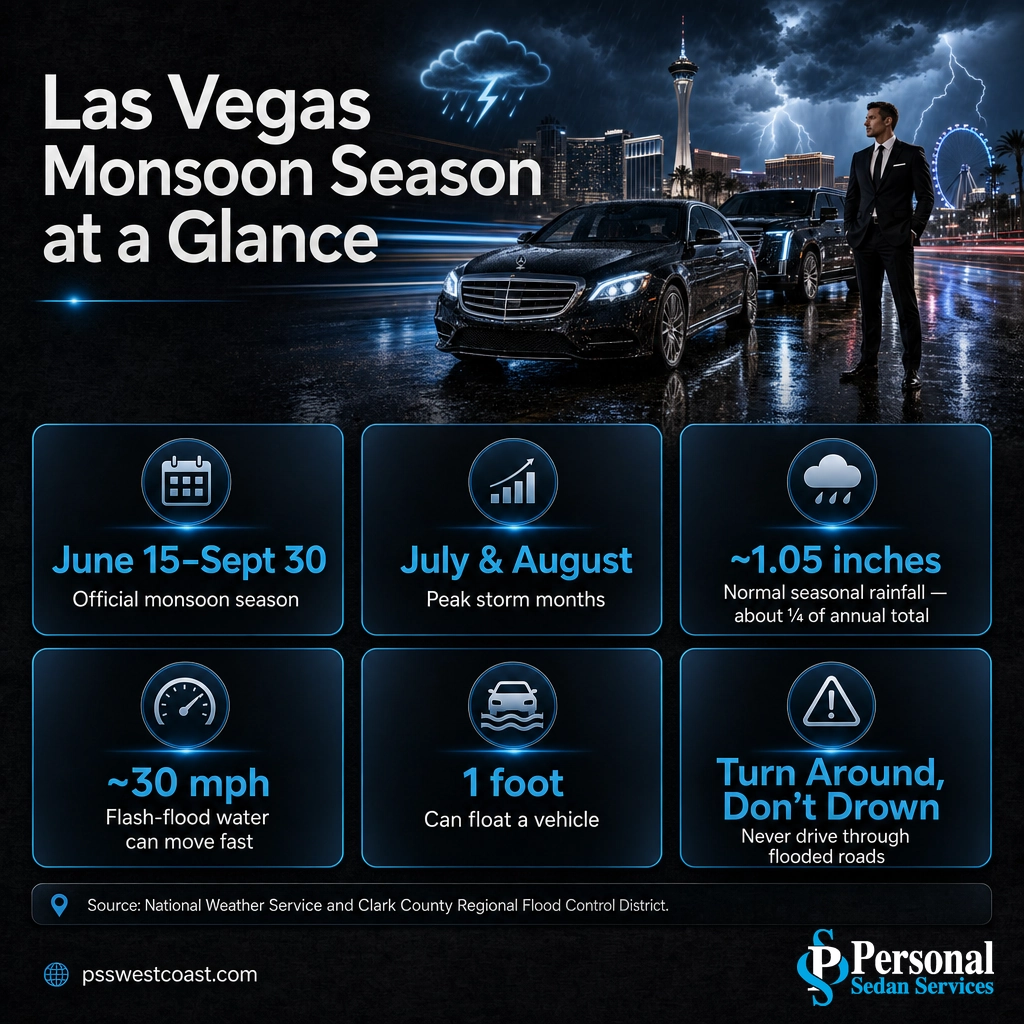
| Question | The Answer |
|---|---|
| Official season | June 15 through September 30 every year |
| Peak storm months | July and August |
| When it starts for real | Usually early to mid-July, not mid-June |
| Normal rainfall | About 1.05 inches, roughly a quarter of the annual total |
| Year-to-year range | Near zero in a “non-soon” to 3-plus inches in a wet year |
| Storm timing | Mostly afternoon and evening thunderstorms |
| Top hazard | Flash flooding; then dust storms, lightning, and high winds |
| Humidity | Noticeably higher than the usual dry desert air |
| Should you still visit? | Yes, storms are brief; just watch the forecast and avoid flooded roads |
Source: National Weather Service Las Vegas | Clark County Regional Flood Control District
Frequently Asked Questions
When is monsoon season in Las Vegas?
What months have the most monsoon storms in Las Vegas?
How much rain does the Las Vegas monsoon bring?
Does it actually rain a lot during monsoon season in Las Vegas?
Is monsoon season dangerous in Las Vegas?
Can you still visit Las Vegas during monsoon season?
Do monsoon storms flood the Las Vegas Strip?
What should I do if I hit a flooded road in Las Vegas?
Related Las Vegas Travel Guides
- How often does it rain in Las Vegas? – just how dry the city really is across the whole year.
- How hot does it get in Las Vegas? – the month-by-month temperature guide to the summer heat the monsoon rides in on.
- Does it snow in Las Vegas? – the winter flip side of the local climate.
- What desert is Las Vegas in? – the Mojave setting that drives the heat and the monsoon.
- The best time to visit Las Vegas – weather, crowds, and prices weighed together, month by month.
Book an air-conditioned airport pickup
Sources and Methodology
Monsoon season dates (June 15 through September 30) and the shift away from the earlier dewpoint-based start definition come from the National Weather Service, which sets the same fixed window across the Southwest. The normal monsoon rainfall figure of about 1.05 inches and the roughly 4.2-inch annual precipitation average are from National Weather Service Las Vegas climate records; the “roughly a quarter of annual rainfall” figure is Personal Sedan Services’ own calculation from those two normals (1.05 ÷ 4.2). Year-specific rainfall figures (a wet 2012 near 3.63 inches, a wet 2023 near 2.55 inches, and dry “non-soon” seasons) come from National Weather Service data reported by Las Vegas news outlets. Flash-flood hazard figures, including water speeds of about 30 mph in channels, the one-foot-of-water vehicle threshold, and 27 flood deaths in the valley since 1990, come from the Clark County Regional Flood Control District. Safety guidance is from the National Weather Service and the Regional Flood Control District. Last Updated: October 2026.
