



No, Las Vegas is not dying. The city just posted its first real tourism slump since the pandemic, and the “Vegas is dead” headlines followed fast. But the full 2025 and 2026 data tells a more grounded story: visitation slipped 7.5% while the airport had its third-busiest year on record, casinos set another revenue record, and the metro area kept growing. Below, we fact-check the seven claims driving the panic, one verdict at a time.
- Tourism dipped, it did not collapse. Las Vegas drew 38.5 million visitors in 2025, down 7.5% from 41.7 million in 2024, its first decline since the COVID era but still one of the most-visited cities in the United States.
- The airport had a near-record year. Harry Reid International moved nearly 55 million passengers in 2025, its third-highest total ever, following two record-setting years.
- Casinos are not struggling. Nevada gaming revenue hit a record $15.8 billion in 2025, a fifth straight record; the Strip held flat at $8.81 billion.
- People keep arriving to stay. The metro area adds roughly 50,000 residents a year, and Clark County is projected to reach about 2.5 million by 2031.
- Affordability is the real issue. The honest weak spot is price, not popularity, and it is the one thing the “dying” narrative gets partly right.
What’s in This Guide
- Why There’s So Much Confusion About Las Vegas Right Now
- Claim 1: “Nobody Is Visiting Las Vegas Anymore”
- Claim 2: “The Airport Is a Ghost Town”
- Claim 3: “The Casinos Are Collapsing”
- Claim 4: “Conventions and Business Travel Are Dead”
- Claim 5: “Everyone Is Moving Out of Las Vegas”
- Claim 6: “Las Vegas Has Priced Itself Out of Reach”
- Claim 7: “The 2025 Slump Means Permanent Decline”
- What You Should Actually Believe About Las Vegas
- Frequently Asked Questions
- Sources and Methodology
Why There’s So Much Confusion About Las Vegas Right Now
For most of the past decade, Las Vegas set records. Visitor counts climbed, the airport kept breaking its own numbers, and new stadiums, arenas, and attractions opened one after another. So when 2025 broke the streak, the contrast was jarring, and the internet noticed.
The confusion comes from three things happening at once. First, 2025 genuinely was down: fewer tourists came than in 2024. Second, some highly visible businesses closed, including poker rooms and a handful of restaurants, and closures make for dramatic photos and videos. Third, the numbers that fell got far more attention than the numbers that held steady or hit new highs. A 7.5% drop in visitation is real, but “record casino revenue” and “third-busiest airport year ever” do not make catchy thumbnails.
The truth is that Las Vegas is a massive, complicated tourism economy, and different measures moved in different directions in 2025. Steve Hill, president and CEO of the Las Vegas Convention and Visitors Authority (LVCVA), summed up the year plainly: “Las Vegas operates at a scale that few destinations can match, and 2025 required us to remain nimble as conditions evolved.” That is a slowdown to manage, not a death spiral. Let’s take the loudest claims one at a time.
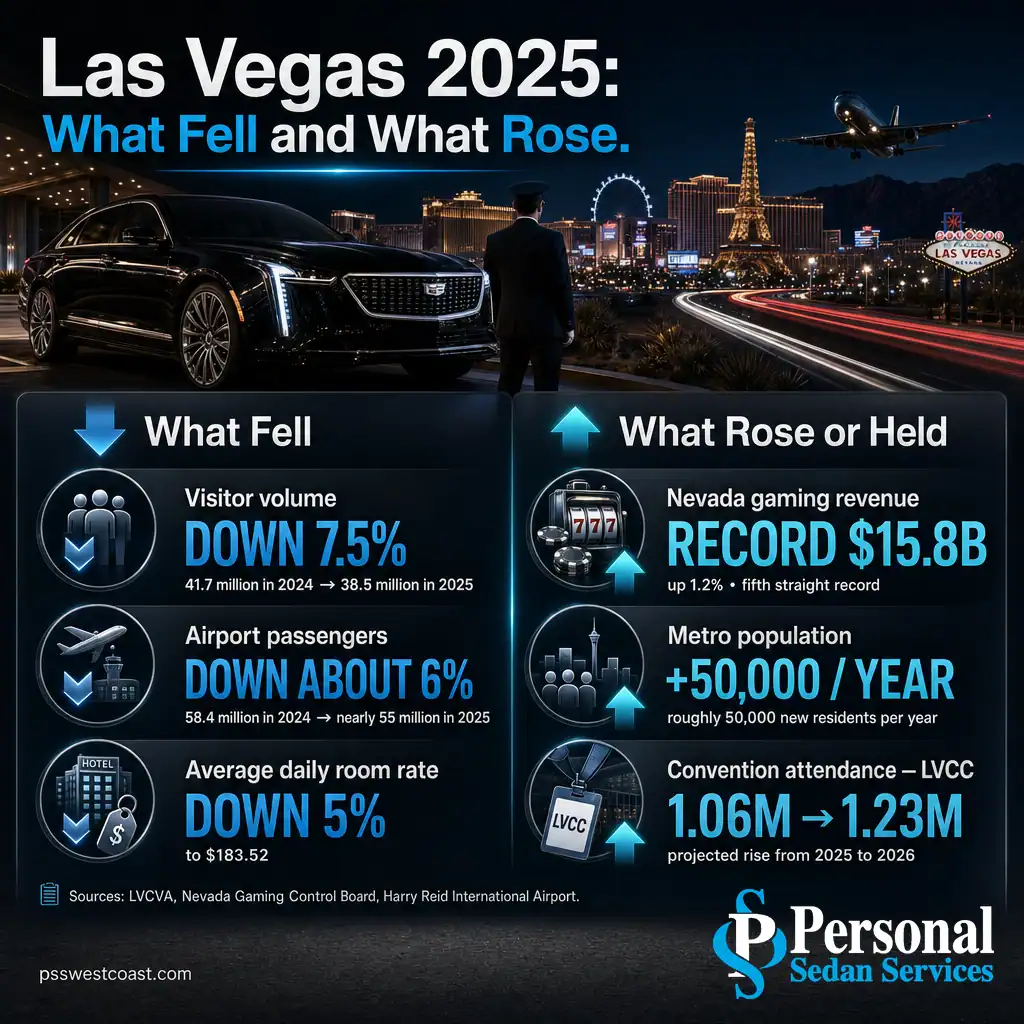
Source: LVCVA 2025 year-end visitor release
Claim 1: “Nobody Is Visiting Las Vegas Anymore”
Verdict: PARTIALLY TRUE, but badly overstated. Visitation fell in 2025, yet 38.5 million people still came. That is a dip from a record, not an empty city.
Las Vegas welcomed 38.5 million visitors in 2025, down 7.5% from 41.7 million in 2024. December alone was down 9.2%. That is a genuine, measurable decline, and it was the first non-pandemic drop in years, so the concern is not imaginary.
But scale matters. Even after the dip, Las Vegas hosted more visitors in 2025 than the entire population of Texas, and it remained one of the most-visited destinations in the country. Hotel occupancy finished at 80.3%, meaning four of every five rooms were filled on an average night. A city that fills 80% of its enormous room inventory is softer than it was, not deserted.
Source: LVCVA year-end visitor statistics. A 7.5% decline from the prior year.
Where did the visitors go? The LVCVA cited cautious consumer spending and international travel headwinds, and industry reporting added reduced airline seat capacity and softer inbound Canadian travel to the list. Those are demand-and-supply pressures that ease when airlines add flights and consumer confidence recovers. For the deeper breakdown of who visits and why, our full 2026 Las Vegas tourism numbers walk through the visitor-profile data in detail.
Source: LVCVA year-end visitor statistics | LVCVA visitor statistics research
Claim 2: “The Airport Is a Ghost Town”
Verdict: FALSE. Harry Reid International just had one of the busiest years in its history.
Harry Reid International Airport served nearly 55 million passengers in 2025. That was the third-highest annual total the airport has ever recorded, and it came right after two consecutive all-time records. The airport also kept direct service to more than 170 markets.
Passenger counts did slip roughly 6% from 2024’s 58.4 million, mirroring the tourism dip, and late-year months were softest. But “down from an all-time record to the third-best year ever” is not a ghost town by any honest definition. Anyone who has landed at Terminal 1 on a Friday afternoon knows the baggage claim and rideshare queues are still very much alive. That crush at arrivals is exactly why many travelers pre-book a driver instead of gambling on a long taxi line or a surge-priced app that meets you at baggage claim at a rate quoted in advance.
Source: Harry Reid International Airport newsroom
Claim 3: “The Casinos Are Collapsing”
Verdict: FALSE. Nevada casinos set another all-time revenue record in 2025.
This is the claim the data most directly contradicts. Nevada’s casinos won a record $15.8 billion from gamblers in 2025, up 1.2% over the prior record set in 2024. It was the fifth straight year of record statewide gaming revenue. On the Las Vegas Strip itself, gaming revenue held essentially flat at $8.81 billion.
Read those two facts together and the picture is clear: casinos earned as much money from fewer people. That is not the signature of a dying industry; it is an industry getting more revenue per visitor. It also explains part of the affordability complaint we tackle further down, because “more money from fewer guests” is exactly what higher prices feel like from the traveler’s seat. Away from the Strip, several markets actually grew: downtown Las Vegas gaming revenue rose over 2%, and North Las Vegas climbed nearly 5%.
Source: Nevada Gaming Control Board gaming revenue reports
Claim 4: “Conventions and Business Travel Are Dead”
Verdict: FALSE. Convention business is climbing back toward a post-pandemic record.
Las Vegas hosted about 6.0 million convention attendees across the destination in 2025. At the Las Vegas Convention Center specifically, 2026 is projected to be even bigger: the campus expects to host roughly 48 conventions drawing about 1.23 million attendees, up from about 1.06 million in 2025, which would be a post-pandemic record.
Source: Las Vegas Convention Center / LVCVA projections.
The kickoff was CES, the giant tech show, which drew 148,392 attendees in January 2026, up year over year. It was also the first CES staged in the newly finished Las Vegas Convention Center after a $600 million renovation connecting the North and South halls. A city investing that kind of money into convention space, and filling it, is planning for growth, not managing a funeral. Groups arriving for these shows are a core reason we built out group and executive transportation around the convention calendar.
You can dig into the show-by-show figures in our Las Vegas convention statistics breakdown.
Source: LVCVA research and statistics

Claim 5: “Everyone Is Moving Out of Las Vegas”
Verdict: FALSE. The metro area is still one of the faster-growing in the country.
Tourism volume and population are two different things, and only one of them fell in 2025. The Las Vegas metro area keeps growing, adding on the order of 50,000 residents a year. Clark County, home to the entire valley, sits near 2.4 million residents and is projected by University of Nevada, Las Vegas researchers to reach about 2.5 million by 2031 and keep climbing after that.
People move to a place for jobs, housing, and lifestyle, not for last quarter’s tourism report. Nevada’s lack of a state income tax, comparatively affordable housing versus coastal California, and a steady flow of new jobs continue to pull in retirees, remote workers, and young professionals. A shrinking city does not add tens of thousands of residents every year. If you want the housing and demographic detail, see our Las Vegas population and real estate figures, and residents who would rather not rely on rideshare use our local car service for everyday trips.
Source: UNLV Center for Business and Economic Research population forecasts
Claim 6: “Las Vegas Has Priced Itself Out of Reach”
Verdict: IT DEPENDS, and this is the claim with real teeth. Price is the honest weak spot, even though 2025 was cheaper than 2024 on the room rate alone.
Here is where the critics have a point. The average daily room rate in Las Vegas was $183.52 in 2025, and that headline number leaves out resort fees, parking charges, and on-Strip food and drink prices that many longtime visitors say have climbed faster than the value. Revenue per available room, a measure that blends rate and occupancy, was $147.30. When casinos pull record revenue from fewer guests, travelers feel that as “everything costs more.”
The nuance the panic misses: the average room rate actually fell 5% in 2025 as hotels competed for softer demand. In other words, the affordability pressure is real over a multi-year view, but 2025 specifically got cheaper on the room rate as the market cooled. Smart travelers can use that. Softer demand tends to mean more availability and more negotiating room, and controlling predictable costs, like a flat-rate ride instead of a surging app fare, is one of the easiest ways to keep a Vegas trip on budget.
Source: LVCVA hotel performance data
Claim 7: “The 2025 Slump Means Permanent Decline”
Verdict: FALSE. The investment pipeline points up, not down.
A single down year after a run of records is a correction, not a trajectory. And the forward calendar is unusually full. Las Vegas extended its Formula 1 Grand Prix partnership through 2030, keeping one of the world’s biggest annual sporting spectacles on the Strip. A new $2 billion Major League Baseball ballpark for the Athletics is under construction on the former Tropicana site and is on track to open in 2028. The Sphere continues to draw crowds to a venue that did not exist a few years ago.
On top of the permanent projects, 2026 brings unusual event demand. The LVCVA expects visitation tied to the FIFA World Cup across North America, and Las Vegas is hosting major World Cup fan events and watch parties even though it is not a match host city. The country’s 250th-anniversary celebrations add another draw. Cities in decline do not sign decade-long sports contracts or pour billions into new stadiums.

Source: Formula 1 Las Vegas Grand Prix | Las Vegas Review-Journal Athletics ballpark coverage
What You Should Actually Believe About Las Vegas
Put the verdicts together and the honest summary is short. Las Vegas had a down year for tourism in 2025 after a string of records, and affordability is a legitimate, ongoing concern. Everything else in the “Vegas is dying” story falls apart on contact with the data: the airport had its third-busiest year ever, casinos set a fifth straight revenue record, conventions are climbing back toward a record, the population keeps growing, and billions of dollars in new attractions are on the way.
So the useful question is not “is Las Vegas dying?” It is “is Las Vegas softer and more expensive than it was at its peak?” The answer to that is yes, and that is actually good news for a savvy traveler in 2026: more room availability, more competitive rates, and a city working hard to win visitors back. If you are planning a trip or you live here and want a licensed, background-checked driver instead of a rideshare gamble, we can help you skip the friction.
Explore Our Las Vegas Car Service
Source: LVCVA visitor statistics
Frequently Asked Questions
Is Las Vegas actually dying?
Why did Las Vegas tourism drop in 2025?
Is Las Vegas too expensive now?
Are people still moving to Las Vegas?
Did casinos make less money in 2025?
Is it still worth visiting Las Vegas in 2026?
Sources and Methodology
How we checked these claims
Every figure in this article comes from a primary source: the government agency, tourism authority, or official operator that produced the data. We did not rely on secondary write-ups or aggregators for any statistic. Where a claim was nuanced, we labeled the verdict as partially true or “it depends” rather than forcing a yes or no.
- LVCVA, 2025 year-end visitor statistics (visitor volume 38.5M, occupancy 80.3%, ADR $183.52, RevPAR $147.30, convention attendance).
- Harry Reid International Airport (nearly 55M passengers, third-highest year, 170-plus markets).
- Nevada Gaming Control Board (record $15.8B statewide gaming revenue; Strip $8.81B).
- UNLV Center for Business and Economic Research (Clark County population forecasts).
- LVCVA research portal (convention attendance, 2026 projections).
- Formula 1 (Las Vegas Grand Prix through 2030).
Figures reflect full-year 2025 results and 2026 projections available at the time of writing. Tourism and gaming data are updated monthly by the LVCVA and the Nevada Gaming Control Board.