


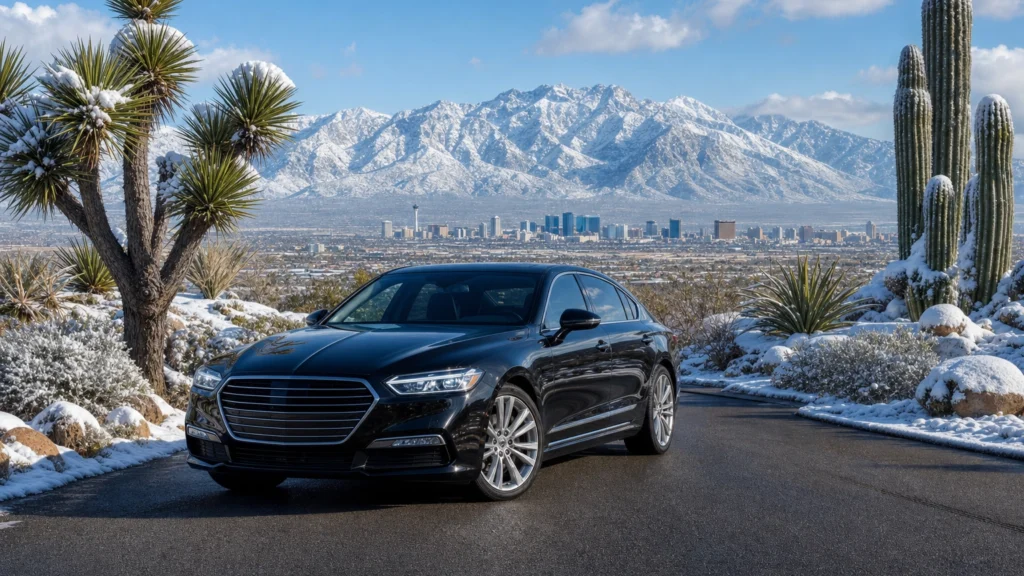
Does it snow in Las Vegas? Yes, but only rarely. The valley floor averages about 0.3 inches of snow a year and records measurable snow only about 0.2 days annually. Most winters bring none at all. For dependable snow, the mountains just northwest of the city get about 160 inches a season.
If you are picturing a white Christmas on the Strip, adjust your expectations. Las Vegas sits in the Mojave Desert, and snow on the valley floor is one of the rarest weather events the city gets, closer to a once-every-few-years novelty than a winter routine. Yet snow is very much a part of the region: drive 45 minutes northwest and you reach a ski resort that averages more than 13 feet of it. Here is exactly what to expect, how often it really happens, when it has happened, and where to find real snow when the desert stays dry.
- The short answer: yes, it snows in Las Vegas, but the valley averages only about 0.3 inches a year and most winters see none.
- How often: measurable snow falls at the airport roughly 0.2 days per year on average, and accumulating snow is about a once-a-decade event.
- When: December through February, the coldest stretch, when average lows dip near 40 degrees. Daytime highs still hover in the upper 50s.
- The records: 7.4 inches fell on January 31, 1979, and 3.6 inches on December 17, 2008; about a foot fell in December 1909, the heaviest ever recorded.
- Where the snow really is: Mount Charleston and Lee Canyon, above 8,500 feet and about 35 miles northwest, average roughly 160 inches a winter and have a working ski area.
- Visiting in winter: pack layers, expect cold nights, and know the city is not built for snow. On the rare icy morning, a professional chauffeur is safer than driving yourself or chasing a rideshare.
What’s in This Guide
- Does It Snow in Las Vegas?
- How Often Does It Snow in Las Vegas?
- When Does It Snow, and How Cold Does It Get?
- Has It Ever Really Snowed in Las Vegas?
- Valley Snow vs. Mountain Snow: Where to Actually Find It
- What to Expect if You Visit in Winter
- Getting Around Las Vegas in Winter
- Frequently Asked Questions
- Related Las Vegas Travel Guides
Does It Snow in Las Vegas?
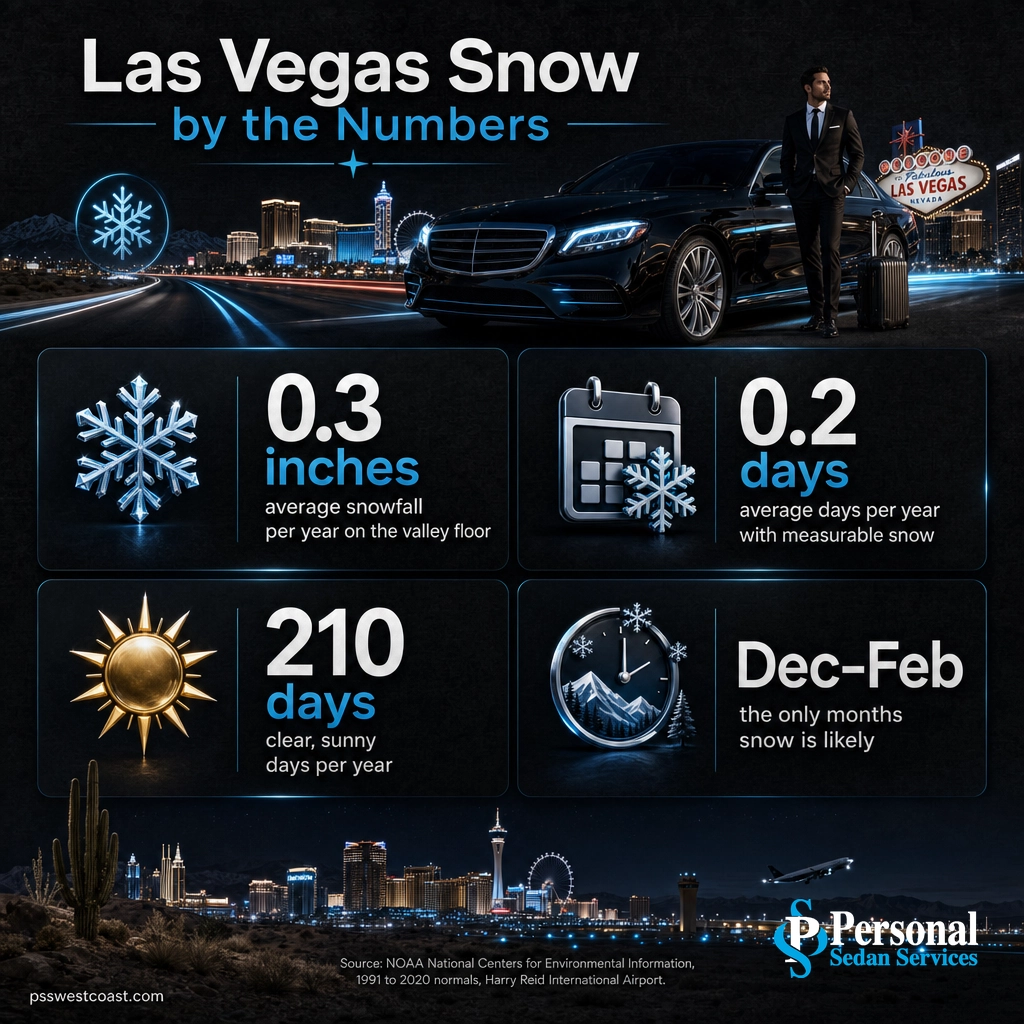
Yes, it snows in Las Vegas, but it is genuinely rare on the valley floor. According to the 1991 to 2020 climate normals for Harry Reid International Airport, the city averages just 0.3 inches of snow per year and records measurable snow on only about 0.2 days annually. In plain terms, most winters produce no snow at all, and when flakes do appear they are usually light flurries that melt on contact with the warm desert ground.
The reason is elevation and climate. The Las Vegas valley sits around 2,000 feet in the Mojave Desert, one of the sunniest places in the country, with roughly 210 clear days and about 4.2 inches of total precipitation a year. Winters are cool rather than cold. Snow needs both moisture and temperatures at or below freezing at the same time, and in Las Vegas those two conditions rarely line up on the valley floor.
So the honest answer to “does it snow in Las Vegas” is that it can, and it occasionally does, but you should not plan a trip around seeing it. If snow is the goal, the mountains just outside the city are the near-certain bet, and we cover those below.
Source: National Weather Service Las Vegas climate records | NOAA U.S. Climate Normals
How Often Does It Snow in Las Vegas?
The clearest way to answer “how often” is with the airport’s long-term record. Measurable snow is logged on an average of just 0.2 days per year, which works out to about one snowy day every five winters. A faint, non-accumulating dusting is a little more common than that, and a snowfall heavy enough to actually coat the ground with more than an inch is closer to a once-a-decade event.
That pattern is why any Las Vegas snow makes the local news. When flurries drifted across the valley in recent winters, it was novel enough that people pulled over to film it. The takeaway for a visitor is simple: in any given winter week, the odds of seeing snow on the Strip are very low. It is a lucky break, not an itinerary item.
Flurries vs. accumulation: There is a big difference between snow that falls and snow that sticks. Las Vegas sees the occasional flurry more often than the record of measurable days suggests, because light snow that melts before it can be measured is common in a marginal desert winter. Snow that accumulates, closes schools, and blankets the palm trees is the rare event people remember for years.
Source: National Weather Service Las Vegas climate records
When Does It Snow, and How Cold Does It Get?
If Las Vegas is going to see snow, it happens in the heart of winter, roughly December through February. Those are the only months cold enough for the rare alignment of moisture and freezing air. December and January are the coldest, and they are also when the valley’s few historical snow events have clustered.
Even so, “cold” in Las Vegas is mild by most standards. The 1991 to 2020 normals put the December average high at about 57 degrees and the average low near 40, with January averaging a 58-degree high and a 40-degree low. Daytime rarely stays below freezing, which is exactly why snow that falls overnight is usually gone by mid-morning.
Las Vegas Winter Temperatures, Average High and Low (Harry Reid Airport)
Approximate 1991 to 2020 average temperatures. Freezing is 32 degrees, so daytime almost never stays cold enough for snow. Source: National Weather Service.
Nighttime is a different story. Winter lows dip into the 30s and occasionally below freezing, so a clear January night in the valley can be genuinely cold even when the afternoon was pleasant. Visitors who picture Las Vegas as warm year-round are often surprised by how much the temperature drops after dark in winter.
Source: National Weather Service 1991 to 2020 normals for Las Vegas
Has It Ever Really Snowed in Las Vegas?
It has, and a handful of storms are still talked about. While the yearly average is near zero, the desert occasionally delivers a memorable snow day. The National Weather Service and long-running local records point to a few standouts.
| Date | Snowfall | Why it stands out |
|---|---|---|
| December 1909 | ~12 inches | The heaviest snow in Las Vegas records, sometimes called the “daddy” of the city’s snowstorms |
| January 1949 | 16.7 inches (month total) | The snowiest single month ever recorded in the valley |
| January 31, 1979 | 7.4 inches | The heaviest modern single-day snowfall on record |
| December 17, 2008 | 3.6 inches | A record for December and the most the valley had seen since 1979 |
The December 2008 storm is the one most current residents remember. Snow fell across the valley two days in a row, coated the Strip and the suburbs, and briefly halted flights at the airport. Higher-elevation neighborhoods on the west side picked up several inches more than the official airport total. Events like that are spectacular precisely because they are so uncommon.
Source: NWS analysis of the December 2008 Las Vegas snow event | Las Vegas Review-Journal historical snowfall records
Valley Snow vs. Mountain Snow: Where to Actually Find It
The single most useful thing to understand about snow in Las Vegas is the gap between the valley and the mountains that ring it. People often say “it snows in Las Vegas” and mean the peaks you can see from the Strip. Those two places could not be more different in winter.
| Las Vegas Valley | Mount Charleston / Lee Canyon | |
|---|---|---|
| Elevation | ~2,000 ft | 8,500 to 11,900 ft |
| Average snowfall | ~0.3 inches / year | ~160 inches / year |
| Reliable snow? | No, rare novelty | Yes, every winter |
| From the Strip | You are already here | ~35 miles, about 45 minutes |
| What you can do | Occasionally photograph a dusting | Ski, snowboard, sled, snowshoe |
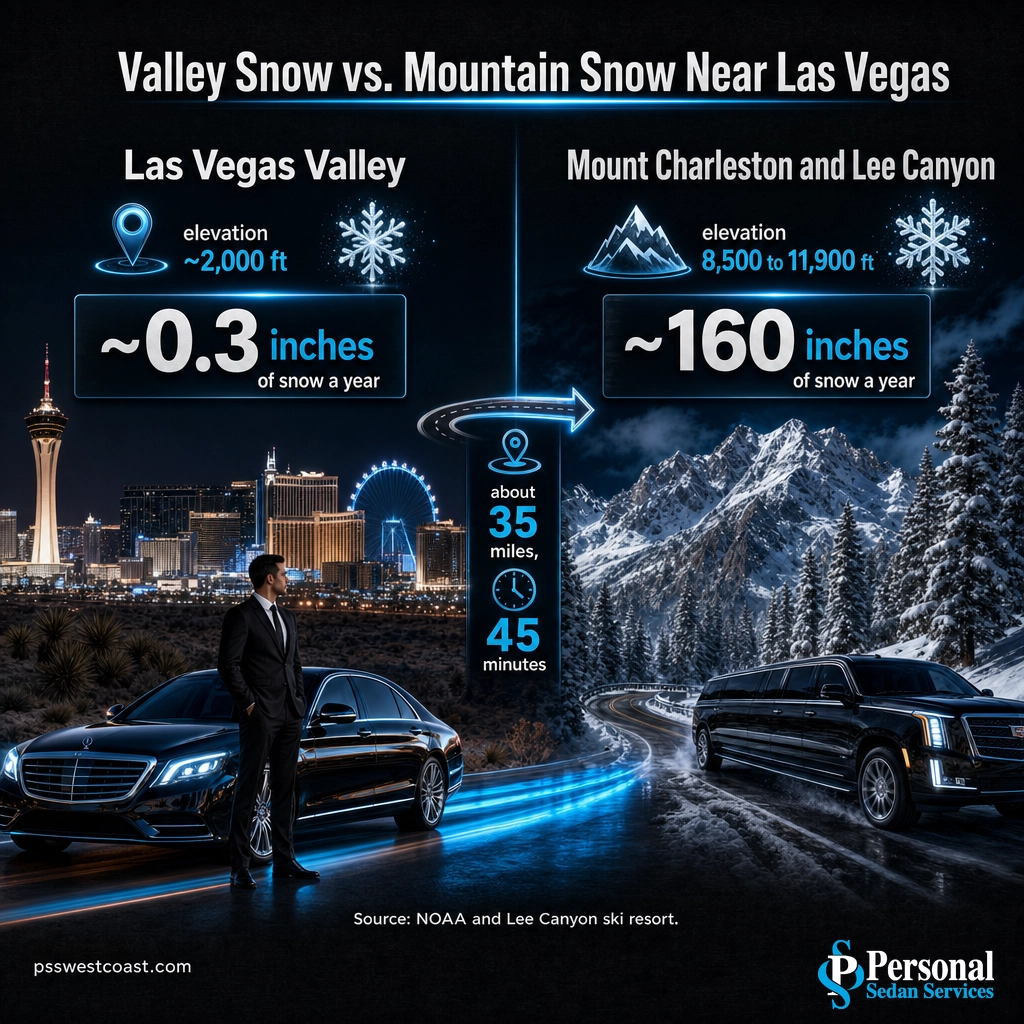
Just northwest of the city, the Spring Mountains rise nearly two vertical miles above the desert floor. At their heart is Charleston Peak at 11,916 feet, the eighth-highest summit in Nevada, and tucked below it is Lee Canyon, southern Nevada’s only ski and snowboard resort. Its base sits at 8,510 feet and its top lift reaches 11,289 feet, high enough that it averages roughly 160 inches of snow a season and runs lifts through the winter. It is about 35 miles from the Strip, a drive of roughly 45 minutes up US-95 and State Route 156.
This is the “what to actually expect” that most visitors miss. You are extremely unlikely to see snow fall on your hotel, but if you want to touch snow, throw a snowball, or ski for a morning, it is a short drive away and nearly guaranteed from December into spring. Mount Charleston is also 20 to 30 degrees cooler than the valley, a genuine escape in any season.
Book a ride to see the snow at Mount Charleston
Source: Lee Canyon resort elevation and snowfall data | Travel Nevada guide to Lee Canyon
What to Expect if You Visit in Winter
Winter is one of the best times to visit Las Vegas: thinner crowds, lower hotel rates, and comfortable, sunny afternoons in the upper 50s. Snow on the Strip is not part of the plan, but a few realities are worth knowing before you pack.
- Pack layers, not just resort wear. Afternoons are mild, but evenings and early mornings drop into the 30s and 40s. A warm jacket makes outdoor dinners, pool-deck lounges, and late walks between casinos far more pleasant.
- The city is not built for snow. Las Vegas has almost no snow-clearing equipment because it almost never needs it. On the rare morning that ice or snow does hit, roads get slick fast and local drivers have little practice with it.
- Watch for flight delays. The 2008 storm briefly grounded flights, and even a light desert freeze can slow operations at Harry Reid International. If a rare cold snap is forecast, build in buffer time.
- Mountain trips need mountain prep. Heading up to Mount Charleston means real winter conditions. Chains or four-wheel drive can be required on the canyon roads after a storm, and conditions change quickly with elevation.
Do not treat rare Las Vegas snow like a normal snow day. Because the city sees measurable snow only about once every few years, drivers, roads, and rideshare fleets are all caught off guard when it happens. The 2008 event snarled traffic across the valley for exactly this reason. If you are here during a rare freeze or heading up to the mountains for the snow, do not assume conditions are as manageable as they look, and do not count on a rideshare app that may go into surge or stop serving the area entirely.
Source: National Weather Service Las Vegas climate records

Getting Around Las Vegas in Winter
For most winter visits, getting around is easy and the weather is a non-issue. Where a professional car service earns its keep is in the two situations this article has been building toward: the rare icy morning in the valley, and the day you want to go find real snow in the mountains.
On the uncommon day the valley freezes, a licensed, background-checked chauffeur in a full-size, well-maintained vehicle is simply safer than driving an unfamiliar rental on slick roads or waiting out a surge on a rideshare app. Personal Sedan Services is Las Vegas’s top-rated luxury transportation, with a perfect 5.0 Google rating from more than 900 reviews, and our drivers know the valley’s roads and the mountain canyons in every season.
And when you want the snow the desert will not give you, a private car turns a mountain trip into the easy part of the day. Skip the winter-driving stress on the canyon roads up to Mount Charleston and Lee Canyon, keep your group together, and arrive ready to ski, sled, or just play in the snow. For a day in the city or a run up the mountain, a reliable local ride takes the weather out of the equation.
Explore our luxury transportation options
Frequently Asked Questions
Does it snow in Las Vegas?
How often does it snow in Las Vegas?
When is it most likely to snow in Las Vegas?
What is the most snow ever recorded in Las Vegas?
Where can I find reliable snow near Las Vegas?
Related Las Vegas Travel Guides
- Best day trips from Las Vegas – the full menu of drives worth taking, including the run up to Mount Charleston.
- How far is Death Valley from Las Vegas? – the closest national park, and the desert’s opposite extreme of heat.
- How far is Zion National Park from Las Vegas? – red-rock canyons on a slightly longer winter-friendly drive.
- How far is the Grand Canyon from Las Vegas? – the classic bucket-list drive, three rims compared.
See our Las Vegas attractions transportation
Sources and Methodology
Snowfall averages, temperature normals, and clear-day counts are the 1991 to 2020 U.S. Climate Normals for Harry Reid International Airport (formerly McCarran), from NOAA’s National Centers for Environmental Information and the National Weather Service Las Vegas office. Average annual snowfall is 0.3 inches with about 0.2 measurable-snow days per year; December and January average highs near 57 to 58 degrees and lows near 40 degrees. Historical snow events, including the December 2008 (3.6 inches), January 1979 (7.4 inches), January 1949 (16.7 inches for the month), and December 1909 (about 12 inches) figures, come from the National Weather Service and long-running local records compiled by the Las Vegas Review-Journal. Lee Canyon and Mount Charleston elevation and snowfall figures come from the resort and Travel Nevada. Distances and drive times are approximate.