



How often does it rain in Las Vegas? Rarely. The city averages about 4.18 inches of rain a year, falling across roughly 27 days with measurable precipitation, which makes it one of the driest major cities in the United States. February is the wettest month, and brief summer monsoon storms bring much of the rest.
If you are packing for a Las Vegas trip and wondering whether to bring a rain jacket, you can almost certainly leave it at home. Las Vegas sits in the Mojave Desert and gets less rain than nearly any other large city in the country, with blue skies the overwhelming default. When rain does arrive it tends to come in two very different forms: gentle winter storms that drift in off the Pacific, and sharp summer monsoon thunderstorms that can flood a road in minutes. Here is exactly how often it rains, which months are wettest, why the valley is so dry, and what any of it means for your visit.
- The short answer: Las Vegas averages about 4.18 inches of rain a year on only about 27 days with measurable precipitation, one of the driest records of any major U.S. city.
- Most days are dry: rain heavy enough to notice is uncommon. The valley averages roughly 11 days a year with a tenth of an inch or more, and only about 2 to 3 days with half an inch or more.
- Wettest month: February, at about 0.80 inches. December through March is the wetter half of the year. The driest month is June, at just 0.04 inches.
- Two rainy seasons: gentle winter storms from the Pacific, and the summer monsoon (roughly July through September) that delivers short, intense thunderstorms.
- The real risk is flash flooding: a monsoon downpour can turn a dry wash or a dip in the road into fast-moving water within minutes, so the danger is rarely the rain itself but the roads.
- Getting around: on the rare stormy afternoon, roads flood and rideshare apps surge or stop serving the area. A licensed, professional chauffeur is the safer, more reliable way to keep moving.

What’s in This Guide
- How Often Does It Rain in Las Vegas?
- Las Vegas Rainfall by Month
- Why Is Las Vegas So Dry?
- The Two Rainy Seasons: Winter Storms vs. Summer Monsoon
- Monsoon Season and Flash Flooding: The Real Risk
- What to Expect if You Visit, and the Best Time to Go
- Getting Around Las Vegas When It Rains
- Frequently Asked Questions
- Related Las Vegas Travel Guides
How Often Does It Rain in Las Vegas?
It rains in Las Vegas on only about 27 days a year. According to the 1991 to 2020 climate normals for Harry Reid International Airport, the valley averages just 4.18 inches of total precipitation annually, and the long-term record shows measurable rain on an average of roughly 26 to 27 days per year. Many of those days produce only a trace, which is why the valley enjoys around 210 clear days a year and sunshine is the rule rather than the exception.
To put that in perspective, a single rainy city in the Pacific Northwest can pick up more rain in one month than Las Vegas gets in an entire year. The desert’s four-plus inches arrive in small, scattered doses, and genuinely wet days are uncommon. The valley averages only about 11 days a year with a tenth of an inch or more of rain, and just 2 to 3 days with half an inch or more. Rain heavy enough to change your plans is the exception, not the pattern.
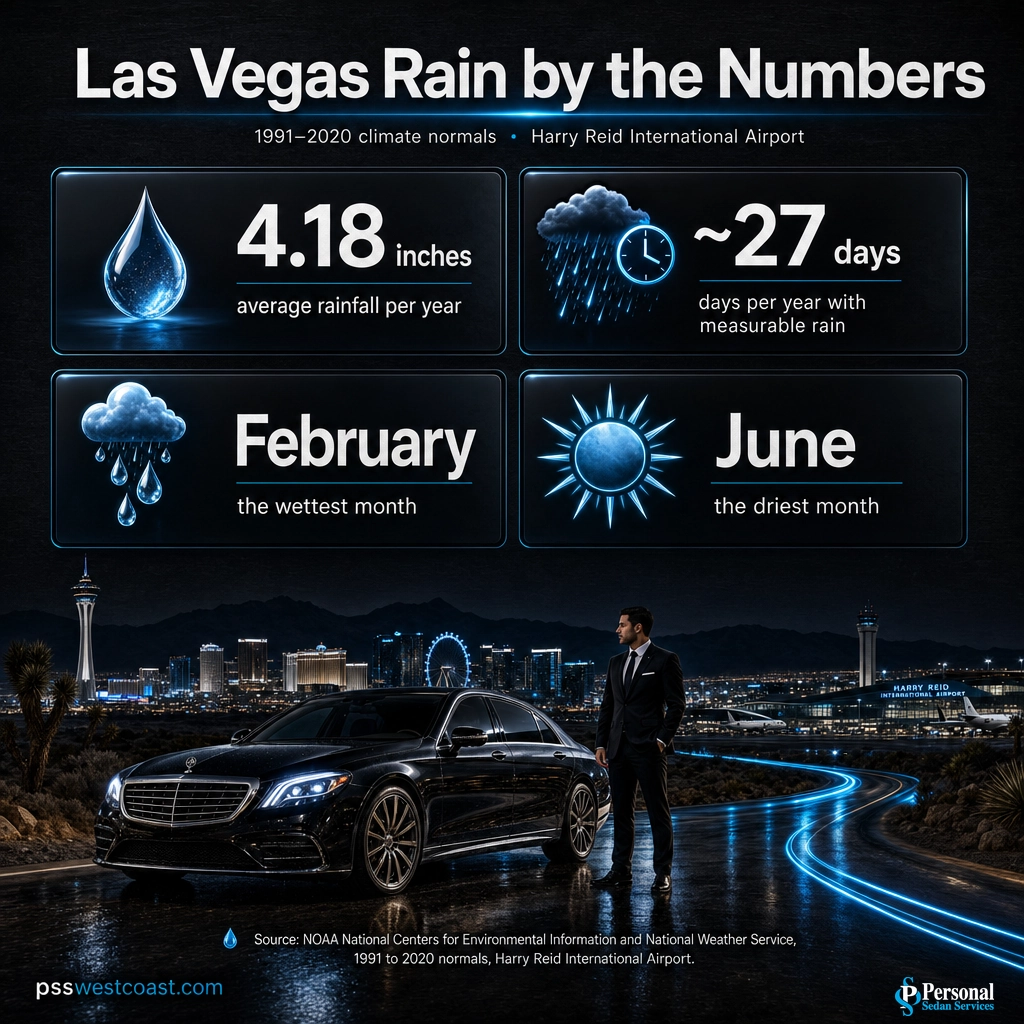
So the honest answer to “how often does it rain in Las Vegas” is: not often, and rarely for long. Measurable rain shows up on fewer than three days in a typical month, and a stretch of several dry weeks is completely normal. The practical takeaway for a visitor is that a washed-out day is unlikely in any season, with one seasonal exception we cover below.
Source: National Weather Service Las Vegas climate records | NOAA U.S. Climate Normals
Las Vegas Rainfall by Month
Rain in Las Vegas is not spread evenly across the calendar. The wetter half of the year runs from late fall through early spring, peaks in February, then nearly shuts off in early summer before the monsoon adds a small second bump in July and August. The table below shows the full month-by-month picture from the official climate normals.
| Month | Avg. precipitation | Avg. days with measurable rain |
|---|---|---|
| January | 0.56 in | 3.1 |
| February | 0.80 in | 4.0 |
| March | 0.42 in | 2.9 |
| April | 0.20 in | 1.6 |
| May | 0.07 in | 1.2 |
| June | 0.04 in | 0.6 |
| July | 0.38 in | 2.5 |
| August | 0.32 in | 2.6 |
| September | 0.32 in | 1.6 |
| October | 0.32 in | 1.7 |
| November | 0.30 in | 1.7 |
| December | 0.45 in | 3.0 |
| Annual | 4.18 in | ~26.5 |
Precipitation totals are the 1991 to 2020 normals; the measurable-rain-day counts use the National Weather Service’s 1981 to 2010 normals (days with 0.01 inch or more), which is why the two columns come from slightly different periods. February stands out as both the wettest month and the one with the most rainy days, while June is the driest month of all.
Average Rainfall by Month: Wettest to Driest (Las Vegas)
Selected months showing the range from wettest (February) to driest (June), with the July monsoon bump. Source: NWS Las Vegas / NOAA 1991 to 2020 normals.
Source: National Weather Service Las Vegas climate book
Why Is Las Vegas So Dry?
Las Vegas is dry for the same reasons the whole region is a desert: where it sits, how high it is, and what stands between it and the ocean. Understanding that explains not just how little it rains, but why the rain that does fall behaves the way it does.
The valley floor sits around 2,000 feet of elevation in the Mojave Desert, well inland from the Pacific. Moisture coming off the ocean has to cross the Sierra Nevada and other California ranges first. As that air is forced up and over the mountains it cools, drops its moisture on the western slopes, and arrives in southern Nevada wrung out and dry. This “rain shadow” effect is the single biggest reason Las Vegas stays so arid. By the time a winter storm reaches the valley, most of its rain is already gone.
Think of it like a sponge being squeezed on the way over the mountains: California’s west-facing slopes get the water, and Las Vegas gets what little is left. The desert sun does the rest, so even a decent rain often evaporates quickly off hot pavement and sandy ground. That same dryness is what makes the occasional heavy storm so dramatic, because the hard desert surface cannot absorb a sudden downpour fast enough.
Trace vs. measurable rain: There is a real difference between rain that falls and rain that counts. Las Vegas records a “trace” of precipitation on roughly 47 days a year, but measurable rain (0.01 inch or more) on only about 27. Many desert sprinkles never add up to a hundredth of an inch, which is why the sky can spit a little without it ever registering as a true rainy day.
Source: National Weather Service Las Vegas climate records
The Two Rainy Seasons: Winter Storms vs. Summer Monsoon
The most useful thing to understand about rain in Las Vegas is that it comes in two completely different forms, in two different seasons. Treating them as one “rainy season” is the most common mistake visitors make, because a February drizzle and a July monsoon storm could not be more different.
| Winter Storms | Summer Monsoon | |
|---|---|---|
| When | November to March, peaking in February | Roughly July to September |
| Source | Pacific storm systems and atmospheric rivers | North American Monsoon moisture from the south |
| Character | Gentle, widespread, can last hours or a day | Brief, intense, localized thunderstorms |
| Main hazard | Occasional slick roads, rare cold rain | Flash flooding, lightning, dust storms |
| How much | The majority of the annual total | Short bursts that can drop a lot fast |
Winter rain is the quiet kind. From late fall into early spring, Pacific systems occasionally reach the valley and bring a soft, steady rain, sometimes over most of a day. These storms account for the bulk of the yearly total, and February is their peak. They are mild, predictable, and rarely disruptive beyond a wet commute.
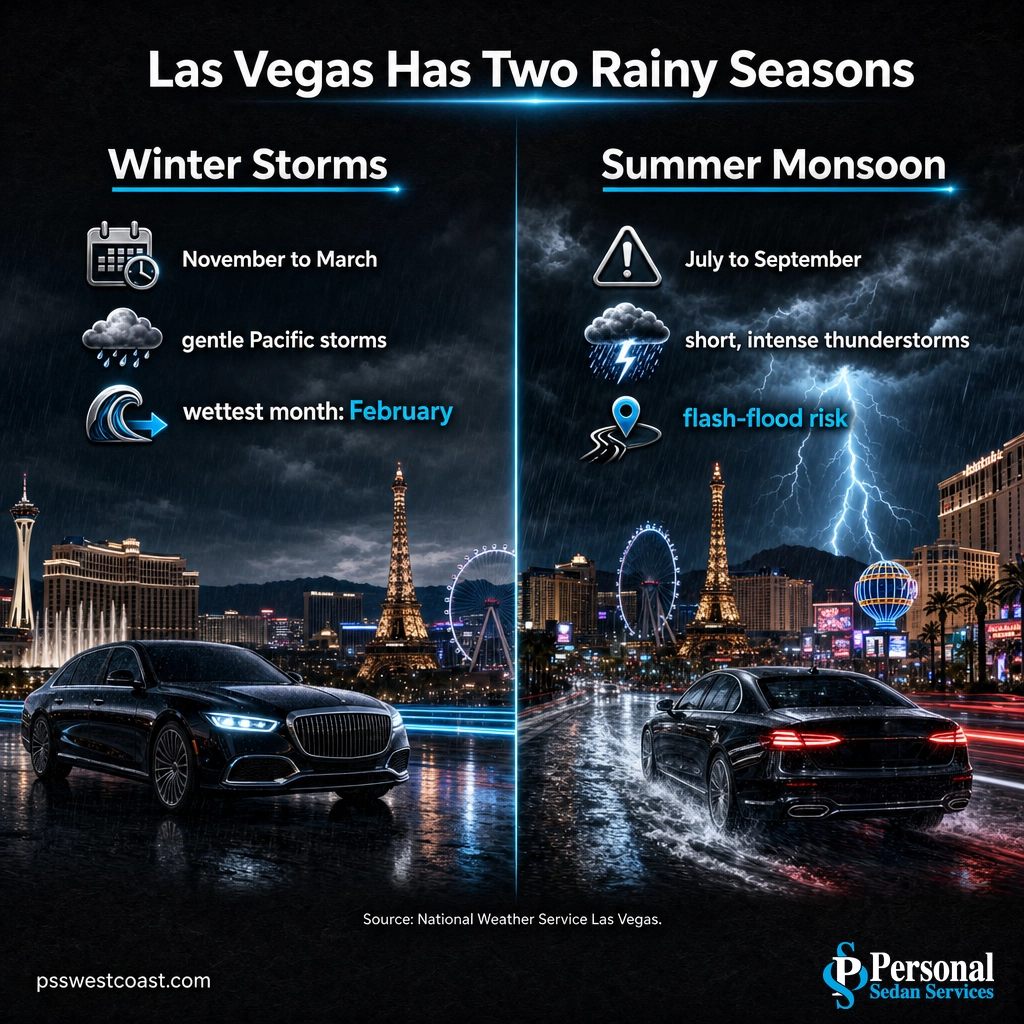
The summer monsoon is the loud kind. From about July through September, moisture pushes north into the Southwest and fuels sudden afternoon thunderstorms. A monsoon storm can be spectacular and violent: heavy rain, lightning, gusty winds, and blowing dust, often over in under an hour. It may dump more rain in twenty minutes than the valley normally sees in a month, and it may hit one part of town while another stays bone dry. That intensity, not the total, is what makes the monsoon the season to respect.
Source: National Weather Service Las Vegas monsoon information
Monsoon Season and Flash Flooding: The Real Risk
Here is the part that catches visitors off guard: in a desert, the danger from rain is almost never the rain itself. It is the water that has nowhere to go. When a monsoon storm drops an inch of rain in half an hour onto hard, dry ground, that water races across the surface, pours into normally dry washes, and collects in low spots and road underpasses. This is flash flooding, and in the Las Vegas valley it can develop in minutes.
Clark County has spent decades building an extensive network of channels, washes, and detention basins to move that water safely out of the valley, and the system has made the area far safer than it once was. But engineering cannot catch every storm, and the greatest danger is behind the wheel. The National Weather Service reports that most flood-related deaths happen in vehicles, when a driver underestimates moving water and tries to cross it.
Turn around, don’t drown. If you are in Las Vegas during a monsoon storm, never drive through a flooded wash, dip, or underpass, no matter how shallow it looks. Six inches of moving water can knock an adult off their feet, and a foot can sweep a car away. Flooded desert water is fast, full of debris, and deeper than it appears. The storm usually passes within an hour, so the safest move is almost always to wait it out, not to push through it.
Source: National Weather Service: Turn Around, Don’t Drown | Clark County Regional Flood Control District

What to Expect if You Visit, and the Best Time to Go
For almost any Las Vegas trip, rain is a non-issue. With measurable rain on only about 27 days a year, the odds of your specific days being rained out are low in every season. Still, a few seasonal realities are worth knowing before you pack.
- Pack for sun, not storms. Sunscreen, sunglasses, and layers for cool desert evenings will serve you far better than an umbrella. If you want to hedge, a light packable rain shell is plenty.
- Spring and fall are the sweet spot. April through May and October into November bring warm, dry, comfortable days and very little rain, which is why they are the most pleasant months to visit.
- Watch the sky on summer afternoons. In July and August, a clear morning can turn into a monsoon thunderstorm by mid-afternoon. Plan outdoor activities earlier in the day and keep your evening flexible.
- Winter rain is mild but real. December through March can bring the occasional gray, drizzly day. Pair that with chilly nights in the 30s and 40s and you will want a warm layer after dark.
- A storm can briefly snarl travel. Heavy monsoon rain has slowed operations at the airport and flooded valley roads for short stretches. If a storm is in the forecast, build in a little buffer.
The bottom line: Las Vegas is one of the safest bets in the country for dry, sunny weather, and most visitors never see a drop. The only season that calls for a little planning is the summer monsoon, and even then the storms are usually brief.
Source: National Weather Service Las Vegas climate records
Getting Around Las Vegas When It Rains
On a normal dry day, getting around Las Vegas is easy and the weather never enters the equation. The handful of days a year when it does matter are exactly the ones where a professional car service earns its keep, and they are almost all monsoon afternoons.
When a sudden storm floods roads and underpasses, two things tend to happen at once: traffic snarls, and rideshare apps surge in price or stop serving flooded areas entirely, right when you most need a ride. A licensed, background-checked chauffeur who knows which routes flood and which stay clear is a safer, calmer way to move through the valley than an unfamiliar rental or an app that may cancel on you. Personal Sedan Services is Las Vegas’s top-rated luxury transportation, with a perfect 5.0 Google rating from more than 900 reviews, and our drivers handle the valley’s roads in every season.
The same goes for arrivals. Landing at Harry Reid International during a monsoon downpour is a lot less stressful when a professional is tracking your flight and meeting you curbside instead of leaving you to wait out a surge. For a storm-day arrival or a day of running around the valley, a reliable local ride or a Las Vegas airport pickup takes the weather out of your hands.
Explore our luxury transportation options
Frequently Asked Questions
How often does it rain in Las Vegas?
What is the rainiest month in Las Vegas?
When is monsoon season in Las Vegas?
Does it rain a lot in Las Vegas in the summer?
Should I expect rain on a Las Vegas trip?
Related Las Vegas Travel Guides
- Does it snow in Las Vegas? – the winter companion to this guide, with the records and where to find real snow nearby.
- Cost of living in Las Vegas – a real monthly budget breakdown for anyone thinking about more than a visit.
- Best day trips from Las Vegas – the drives worth taking, most of them best enjoyed on a dry, sunny day.
- How far is Death Valley from Las Vegas? – the desert’s hottest, driest extreme, a short drive from the valley.
See our Las Vegas attractions transportation
Sources and Methodology
Precipitation figures are the 1991 to 2020 U.S. Climate Normals for Harry Reid International Airport (formerly McCarran), from NOAA’s National Centers for Environmental Information and the National Weather Service Las Vegas office: 4.18 inches of average annual precipitation, with February the wettest month (0.80 inches) and June the driest (0.04 inches). Average numbers of days with measurable precipitation (0.01 inch or more) use the National Weather Service’s 1981 to 2010 normals, which total about 26.5 days a year, alongside roughly 47 days with a trace or more, about 11 days with 0.10 inch or more, and about 2 to 3 days with 0.50 inch or more. Monsoon timing and flash-flood guidance come from the National Weather Service; flood-safety figures (six inches of moving water, one foot carrying a small car) are from the National Weather Service, and regional flood-control context is from the Clark County Regional Flood Control District.
