


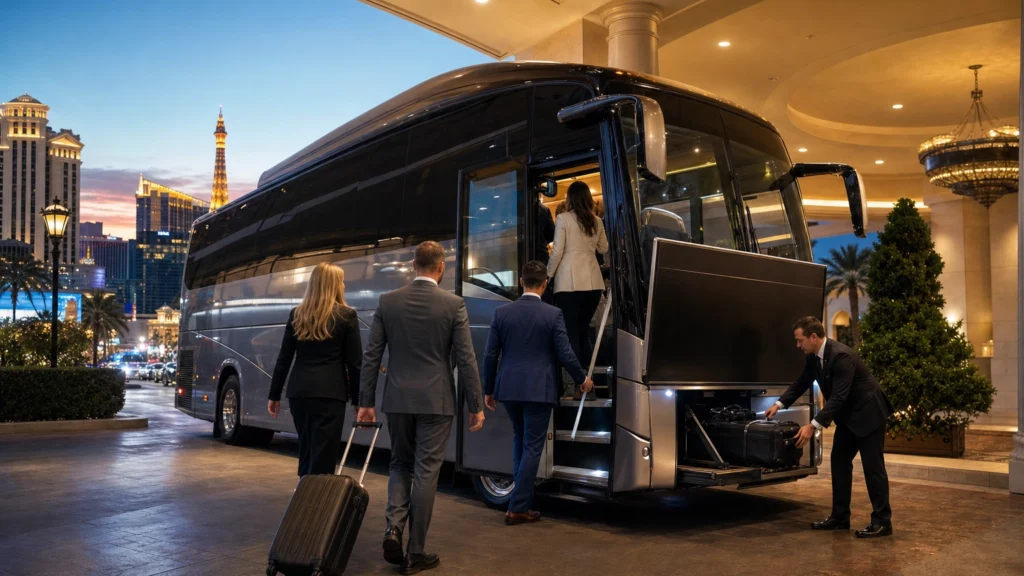
A full-size charter bus, which the industry calls a motorcoach, seats 54 to 56 passengers, and up to 60 in a high-density layout. But “charter bus” is an umbrella term, and the right answer depends entirely on the vehicle: a passenger van holds up to 15, a shuttle bus or minibus holds roughly 20 to 30, a mini coach holds about 28 to 38, and a double-decker coach seats up to 81. This guide breaks down charter bus capacity by size, explains exactly what moves the seat count up or down, and helps you match your group to the right vehicle, whether you are moving a wedding party across the Las Vegas valley or a 200-person convention group from Harry Reid airport to the Strip.
- Full-size motorcoach: 54 to 56 seats standard, up to 60 in a high-density layout.
- Smaller charter vehicles: passenger van up to 15, shuttle bus or minibus about 20 to 30, mini coach about 28 to 38.
- Double-decker coach: up to 81 seats, the largest single charter vehicle on the road.
- Seat count changes with length, legroom, and whether the bus has a restroom, a galley, or a wheelchair-securement position.
- Every new motorcoach built since November 28, 2016 has a lap-and-shoulder belt at every seat, per federal rule FMVSS No. 208.
- Size up, not down: plan for luggage and comfort, and step to two vehicles or a double-decker above roughly 56 passengers.

What’s in This Guide
- Charter Bus Seating at a Glance
- Charter Bus Capacity by Size: The Six Vehicle Types
- What Determines How Many Seats a Charter Bus Has
- Full-Size Motorcoach Capacity, Explained
- Smaller Than a Coach: Vans, Shuttles and Minibuses
- Bigger Than a Coach: Double-Deckers and Multi-Bus Groups
- Seats vs. Comfort: Luggage, Legroom and Amenities
- How Many People Should You Put on a Charter Bus?
- Charter Bus Dimensions and Why They Matter in Las Vegas
- Safety and Accessibility Standards That Affect Seating
- Charter Bus vs. Party Bus vs. Limo: Why the Numbers Differ
- How to Match Your Group Size to the Right Vehicle
- Real Las Vegas Scenarios: Sizing Common Group Trips
- What to Do Next: Your Booking Roadmap
- Related Resources
- Charter Bus Capacity Summary Table
- Frequently Asked Questions
- Methodology and Sources
Charter Bus Seating at a Glance
When people ask “how many seats are on a charter bus,” they are almost always picturing the big highway coach: the tall, sleek bus with tinted windows and luggage bays underneath. That vehicle, the motorcoach, is the anchor of the category, and it seats 54 to 56 passengers in a standard layout. The MCI J4500, one of the most common coaches on American roads, lists a standard seating capacity of 56 and an optimal capacity of up to 60 on a 45-foot-7-inch body.
But a charter company does not run one kind of bus. “Charter” simply means you hire the whole vehicle with a professional driver for your own group and itinerary, rather than buying individual tickets. That hire can be a 15-seat van or an 81-seat double-decker, and everything in between. So the honest short answer is a range, and the right number for your trip depends on your headcount, your luggage, and how far you are going.
Here is the full category at a glance, smallest to largest, before we go deep on each one:
| Charter vehicle | Typical seated capacity | Best for |
|---|---|---|
| Passenger / Sprinter van | Up to 15 | Small groups, airport runs, executive travel |
| Shuttle bus / minibus | ~20 to 30 | Hotel shuttles, mid-size groups, short hops |
| Mini coach | ~28 to 38 | Tours, corporate outings, wedding guests |
| Full-size motorcoach | 54 to 56 (up to 60) | Large groups, long distance, conventions |
| Double-decker coach | Up to 81 | Very large single groups, sightseeing |
Source: MCI J-Series specifications
Charter Bus Capacity by Size: The Six Vehicle Types
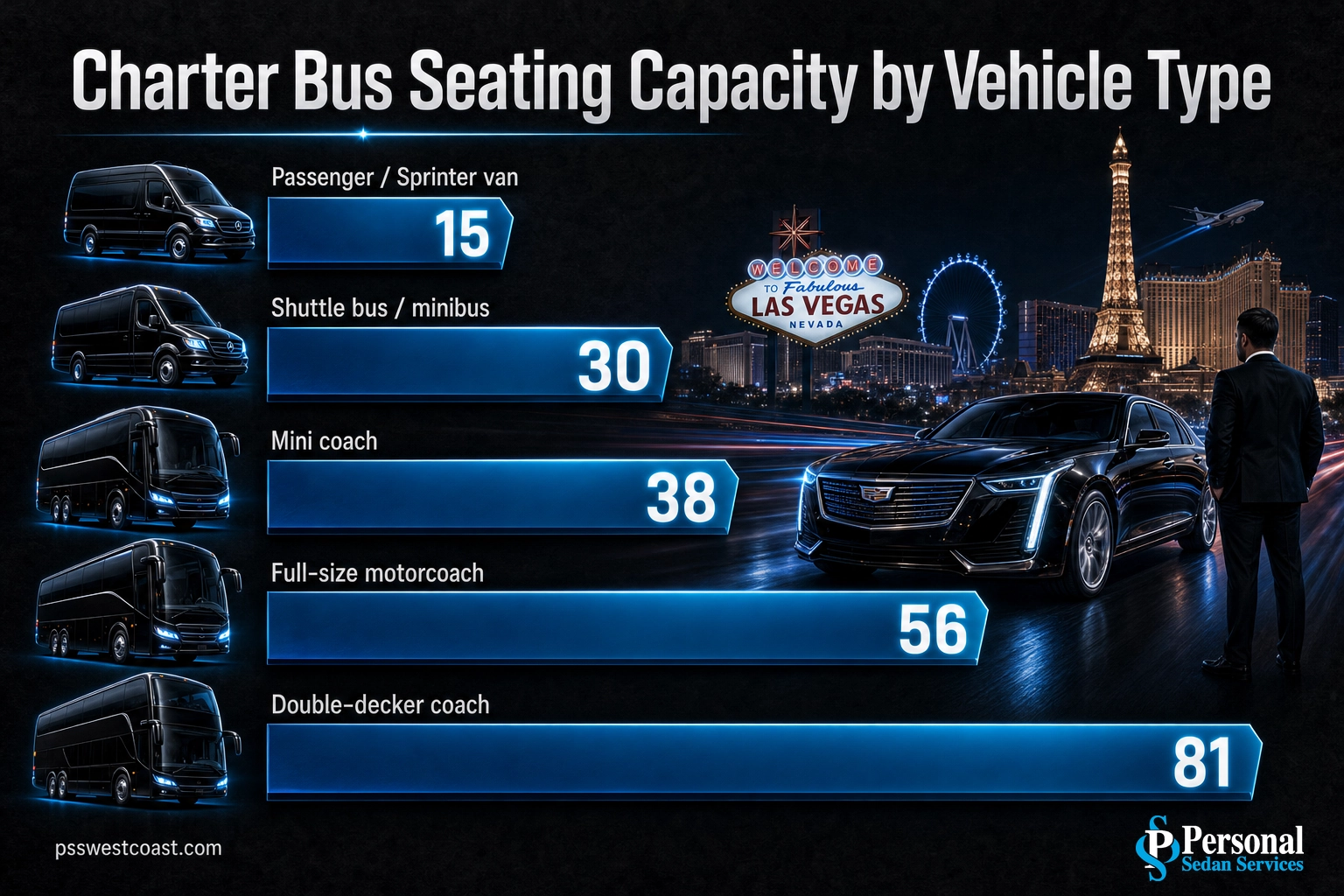
Charter fleets are built around a ladder of vehicle sizes. Each rung is a different body, a different seat count, and a different set of tradeoffs. Understanding the ladder is the fastest way to stop guessing and start sizing your group correctly. Here is each vehicle type, the seats it carries, and when it is the right call.
Charter Bus Seating Capacity by Vehicle Type (maximum seated)
1. Passenger van (up to 15)
The smallest “charter” vehicle is the high-roof passenger van. The Mercedes-Benz Sprinter, the benchmark in this class, is offered in 12-passenger and 15-passenger factory configurations, so it carries up to 15 occupants including the driver. In practice, charter operators usually run the executive version with fewer, roomier captain’s chairs for comfort. A van is the right tool for a family, a small wedding party, an airport pickup, or a corporate team that wants to travel together without stepping up to a full bus.
2. Shuttle bus and minibus (about 20 to 30)
Step up from a van and you reach the shuttle bus, a boxy, body-on-chassis bus often built on a Ford E-450 or similar platform. These seat roughly 20 to 30 passengers depending on the build, and they are the workhorses of hotel transfers, convention shuttles, and short group hops around town. They are easier to maneuver on city streets than a full coach, load quickly, and are ideal when your group is too big for a van but does not need highway-coach comfort for a long ride.
3. Mini coach (about 28 to 38)
A mini coach splits the difference between a shuttle bus and a full motorcoach. It is built to a coach standard, with a higher floor, luggage space, and more comfortable seating, but on a shorter body that seats roughly 28 to 38. For a mid-size tour, a corporate day trip, or a wedding guest shuttle, a mini coach often hits the sweet spot: coach comfort without paying for 20 empty seats.
4. Full-size motorcoach (54 to 56, up to 60)
This is the classic charter bus. A 45-foot single-deck motorcoach seats 54 to 56 forward-facing passengers in reclining seats, with climate control, overhead storage, large luggage bays underneath, and often a restroom. It is purpose-built for long distances and large groups, and it is the vehicle most people mean when they say “charter bus.” We cover it in depth in its own section below.
5. Double-decker coach (up to 81)
When a single group is larger than a standard coach can hold, the double-decker steps in. The Van Hool TDX25 Astromega, the most common double-decker in North American charter service, seats up to 81 passengers by stacking a second deck of seating over the first. It is the highest-capacity single charter vehicle you can book.
6. Specialty vehicles (party buses and limo buses)
Party buses and limo buses are also charter vehicles, but they are built for socializing rather than maximum seating, so their capacity follows different rules. We compare them to a standard coach later in this guide.
Source: MCI J-Series specifications | Van Hool TDX25 Astromega
Explore the full Personal Sedan Services fleet
What Determines How Many Seats a Charter Bus Has
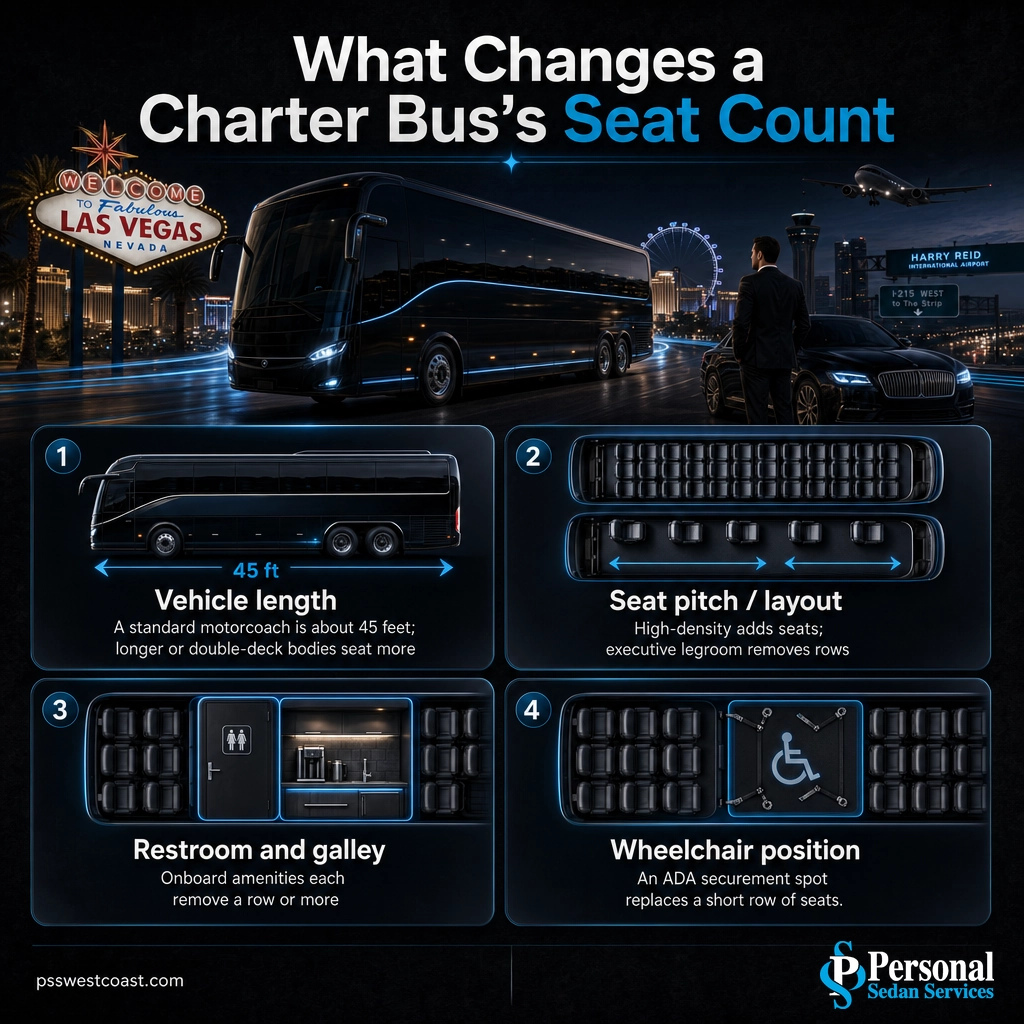
Two coaches that look identical in a parking lot can list different seat counts, and the reason is that seat count is a design choice, not a fixed property of the body. Operators configure each bus around the kind of work it does. Four factors move the number up or down.
Length of the vehicle
The single biggest lever is length. A standard American motorcoach runs around 45 feet, which is where the 54-to-56-seat figure comes from. Shorter bodies seat fewer passengers; longer or double-deck bodies seat more. Length also drives maneuverability, which matters on tight Las Vegas porte-cocheres and parking structures, so the biggest bus is not always the most practical one.
Seat pitch and layout
Seat pitch is the distance between one seat and the same point on the seat ahead, and it is the comfort dial. A high-density layout packs seats closer together to reach the maximum count (this is how a J4500 gets from 56 to 60). An executive or tour layout spreads them out for legroom, which removes rows. The same coach can legitimately be a 60-seater or a 49-seater depending on how the operator spec’d it.
Restroom and galley
Amenities cost seats. An onboard restroom typically occupies the space of a row or more at the rear of the coach, and a galley or beverage service station removes more. A coach built for long-haul comfort with a restroom will seat fewer passengers than the same body configured as a maximum-capacity day-trip bus.
Wheelchair-securement positions
An accessible coach reserves floor space to secure a wheelchair, and each securement position usually replaces a short row of fixed seats. That is a feature, not a flaw, but it does mean an accessible configuration carries slightly fewer seated passengers than a non-accessible one of the same length.
Source: MCI J-Series specifications
Full-Size Motorcoach Capacity, Explained
The full-size motorcoach deserves its own section, because it is both the most-asked-about vehicle and the one with the widest range of “correct” answers. The headline number is 54 to 56 seats, but the ceiling and the floor are worth understanding before you book.
On the high end, a high-density single-deck coach reaches about 60 seats. The MCI J4500 lists 56 standard seats and up to 60 optimal seats. On the manufacturer side, Volvo’s North American spec sheet for the Volvo 9700 coach lists 54 passengers in its standard layout, with specific units built out to 56. Personal Sedan Services runs a Volvo 9700 charter bus in its own fleet, which is exactly this class of vehicle.
On the low end, the same body might be configured as a 49-seat or 46-seat coach once you add generous legroom, a restroom, and a galley. That is common on luxury and long-distance tour coaches, where comfort over many hours matters more than squeezing in the last six passengers. So when an operator quotes you a “56-passenger coach,” it is worth confirming the actual layout, because the seat count and the comfort level move together.
Why does the full-size coach exist at all, when two shuttle buses could carry the same 56 people? Efficiency. The American Bus Association notes that a single motorcoach can take dozens of passenger cars off the highway, replacing up to 56 vehicles, which is one reason motorcoaches are among the most fuel-efficient ways to move a crowd per passenger mile. For a convention group or a long route, one coach is simpler, cheaper, and greener than a convoy of smaller vehicles.
If you are weighing the cost of a full coach against smaller vehicles, our companion guide to charter bus rental pricing walks through what drives the final number.
Source: MCI J-Series specifications | Volvo 9700 specifications | American Bus Association
Book luxury group transportation in Las Vegas
Smaller Than a Coach: Vans, Shuttles and Minibuses
Most group trips do not actually need a 56-seat coach. Groups of 8 to 35 are far more common, and for those, the smaller rungs of the ladder are the smarter booking. Right-sizing down saves money and often improves the experience, because a half-empty coach feels less lively than a full van.
The 7-to-15 range: the Sprinter van
For 7 to 15 riders, a passenger van is ideal. The Mercedes-Benz Sprinter seats up to 15, and in an executive build it offers leather captain’s chairs, climate control, and room for luggage. Personal Sedan Services runs both a Mercedes Jet Sprinter Van and an executive Sprinter for exactly this group size. If your group is even smaller, say 4 to 6, an SUV may be the better fit, which we break down in our SUV versus sedan comparison.
The 16-to-30 range: shuttle buses and minibuses
Once you pass 15, you move to a shuttle bus or minibus seating roughly 20 to 30. This is the right vehicle for a hotel-to-venue shuttle, a mid-size corporate group, or a wedding guest transfer. It loads fast, handles city traffic, and carries enough people to consolidate a group that would otherwise need three vans. Personal Sedan Services operates a Mercedes shuttle bus and a Ford E-450 shuttle bus in this class.
The 28-to-38 range: the mini coach
For 28 to 38 passengers who want coach comfort on a shorter body, the mini coach is the answer. It brings the higher floor, luggage capacity, and nicer seating of a full coach without the full 45-foot footprint. The Ford E-450 executive mini coach in the Personal Sedan Services fleet is built for this tier.
Source: Mercedes-Benz Sprinter passenger van
See corporate and group car service options

Bigger Than a Coach: Double-Deckers and Multi-Bus Groups
What happens when your group is larger than a single coach can hold? You have two options, and both are routine for an experienced operator.
Option 1: the double-decker coach
The double-decker coach stacks a second deck of seating over the first, pushing capacity to as much as 81 passengers in a single vehicle. The Van Hool TDX25 Astromega is the standard-bearer in North American charter service. A double-decker is ideal for a single large group that wants to stay together, and the upper deck’s elevated, panoramic views make it a favorite for sightseeing. The tradeoff is that double-deckers are tall (around 13 feet) and need clearance, so routes and drop-off points have to be checked in advance.
Option 2: run more than one vehicle
For most large groups, the simplest answer is a convoy: two or more coaches, or a mix of coaches and smaller vehicles. A 120-person convention group might travel on two full coaches; a 200-person group on four. Multiple vehicles add flexibility, because you can stage pickups, split VIPs into a Sprinter, and keep departments or wedding families together. The coordination is the hard part, and it is precisely what destination management exists to handle.
Source: Van Hool TDX25 Astromega
Seats vs. Comfort: Luggage, Legroom and Amenities
Seat count is only half of the capacity question. The other half is what those seats come with, because a bus that technically seats your whole group may not comfortably carry them plus their luggage for a long ride. Three comfort factors deserve attention before you commit to a headcount.
Luggage capacity
A full-size motorcoach carries its luggage in sealed bays under the passenger deck, which is why it can move 56 people and their bags on a multi-day trip. Smaller shuttle buses and minibuses often have limited undercarriage space and rely on a rear luggage area or overhead racks, which fill up fast. For an airport transfer or a trip where everyone has a suitcase, confirm luggage space, not just seat count. A good planning figure is one to two bags per person.
Legroom and seat type
As covered earlier, a high-density layout trades legroom for seats. For a 20-minute hotel shuttle, tight pitch is fine. For a four-hour run from Las Vegas to Southern California, legroom and reclining seats matter, and an executive layout with fewer seats is worth the trade. Match the layout to the trip length, not just the headcount.
Onboard amenities
Restrooms, Wi-Fi, power outlets, and climate zones all improve a long ride, and some (the restroom especially) reduce seat count. If your trip is long enough that a restroom matters, plan for a coach configured with one, and accept that it will seat a few fewer passengers than a maximum-density version of the same bus.
Source: MCI J-Series specifications
How Many People Should You Put on a Charter Bus?
There is a difference between how many people a charter bus can hold and how many it should hold for a given trip, and understanding that gap is what separates a smooth group experience from a cramped one. The seat count on the spec sheet is the maximum. The comfortable number for your trip is usually a little lower.
Think of it the way airlines think about load factor. A 56-seat coach filled to all 56 seats, with 56 carry-ons and 56 checked bags, on a four-hour run is technically within capacity but tight on storage and personal space. The same coach carrying 44 to 48 passengers feels spacious: there is room to spread out, stash a jacket on the next seat, and move around at a rest stop. For short hops, running at full capacity is fine. For long distances or premium experiences, leaving a cushion of empty seats is a deliberate comfort choice.
Group composition matters too. A youth group or a corporate team traveling light can fill a coach closer to its maximum. A wedding party in formalwear, a group with lots of luggage, or a tour with onboard activity wants more breathing room. And if your headcount might grow (RSVPs have a way of climbing), booking the next size up protects you from the worst outcome: a group that shows up larger than the bus.
The one capacity rule that is never flexible is the legal one: you cannot seat more passengers than the vehicle is rated and belted for. If your group is 58 and the coach seats 56, that is not a “squeeze two more on” situation. It is a two-vehicle trip, or a double-decker. A reputable operator will tell you that directly rather than overload a bus.
Source: MCI J-Series specifications | NHTSA Federal Motor Vehicle Safety Standards
Charter Bus Dimensions and Why They Matter in Las Vegas
Capacity is not just about how many seats fit inside the bus. It is also about whether the bus fits where you need it to go, and in Las Vegas that is a real constraint. The vehicle’s length and height determine which hotel entrances, parking structures, and event drop-offs it can actually use.
Length
A full-size motorcoach runs about 45 feet long, which is why it tops out near 56 seats. That length is no problem on the highway or a wide resort driveway, but it limits tight turns and some older porte-cocheres. A mini coach or shuttle bus, on a shorter body, reaches entrances a full coach cannot, which is sometimes the deciding factor between the two even when the headcount would fit either.
Height
Standard single-deck coaches clear most covered entrances. Double-deckers do not: at roughly 13 feet tall (about 18 inches taller than a standard motorcoach), they need verified overhead clearance and often cannot enter parking structures or covered valet areas at all. That extra 25 seats of capacity comes with a routing cost, so a double-decker only makes sense when the whole route has been checked for clearance.
This is where local operating knowledge earns its keep. Knowing in advance that a particular casino’s valet will not take a 45-foot coach, or that a convention center has a dedicated bus lane, or that a wedding venue’s driveway needs a shorter shuttle, is the difference between a drop-off at the door and a long walk from a remote lot. The right-capacity vehicle is only right if it can reach every stop on your itinerary.
Source: MCI J-Series specifications | Van Hool TDX25 Astromega
Safety and Accessibility Standards That Affect Seating
Federal standards shape what a charter bus seat is and who can ride, and a couple of them directly affect capacity and comfort. Knowing them helps you ask the right questions of any operator.
What legally makes a bus a “motorcoach”
The National Highway Traffic Safety Administration defines an over-the-road bus (the regulatory term for a motorcoach) as a bus with an elevated passenger deck located over a baggage compartment, which is exactly the shape of the big highway coach. The federal seat-belt rule applies to these over-the-road buses and to most other new buses rated above 26,000 pounds, excluding transit and school buses.
Seat belts on every seat
Since November 28, 2016, federal rule FMVSS No. 208 has required a lap-and-shoulder belt at every passenger seating position on all new over-the-road buses, according to the National Highway Traffic Safety Administration. That is a meaningful safety upgrade, but it applies to vehicles built on or after that date, so older coaches still in service may not have belts at every seat. If belts matter for your group (youth groups and corporate risk policies often require them), ask the operator about the model year.
Accessibility and the 48-hour rule
Under the Americans with Disabilities Act (49 CFR 37.189), a charter or tour bus operator may require up to 48 hours of advance notice to provide a lift-equipped, wheelchair-accessible bus. If any member of your group needs an accessible vehicle, request it when you book, not the day before. As noted earlier, a wheelchair-securement position typically replaces a row of seats, so factor that into your headcount on an accessible coach.
Source: NHTSA Federal Motor Vehicle Safety Standards | FMCSA ADA requirements for over-the-road bus companies
Charter Bus vs. Party Bus vs. Limo: Why the Numbers Differ
People often compare a charter bus to a party bus or a stretch limo and expect the seat counts to line up by size. They do not, because these vehicles are built for different jobs, and the seating layout follows the purpose.
A charter bus (motorcoach) is built for maximum forward-facing seating and long-distance travel, so it carries the most people per foot: up to 56-plus. A party bus is built for socializing, with perimeter lounge seating, open floor space, and entertainment, so it carries fewer passengers for a comparable length. A stretch limousine is built for a small VIP group in luxury, so its capacity is small by design.
| Vehicle | Seating style | Typical capacity | Built for |
|---|---|---|---|
| Charter bus / motorcoach | Forward-facing rows | 54 to 56 (up to 60) | Large groups, distance, luggage |
| Party bus | Perimeter lounge | Fewer than a coach of equal length | Socializing, celebrations |
| Stretch limousine | Wrap-around bench | Small VIP group | Luxury, special occasions |
If your group’s priority is the ride itself rather than moving a crowd efficiently, the capacity math changes. We break those vehicles down in detail in our guides to how many people fit in a party bus and limo passenger capacity.
Source: Van Hool coach range
How to Match Your Group Size to the Right Vehicle
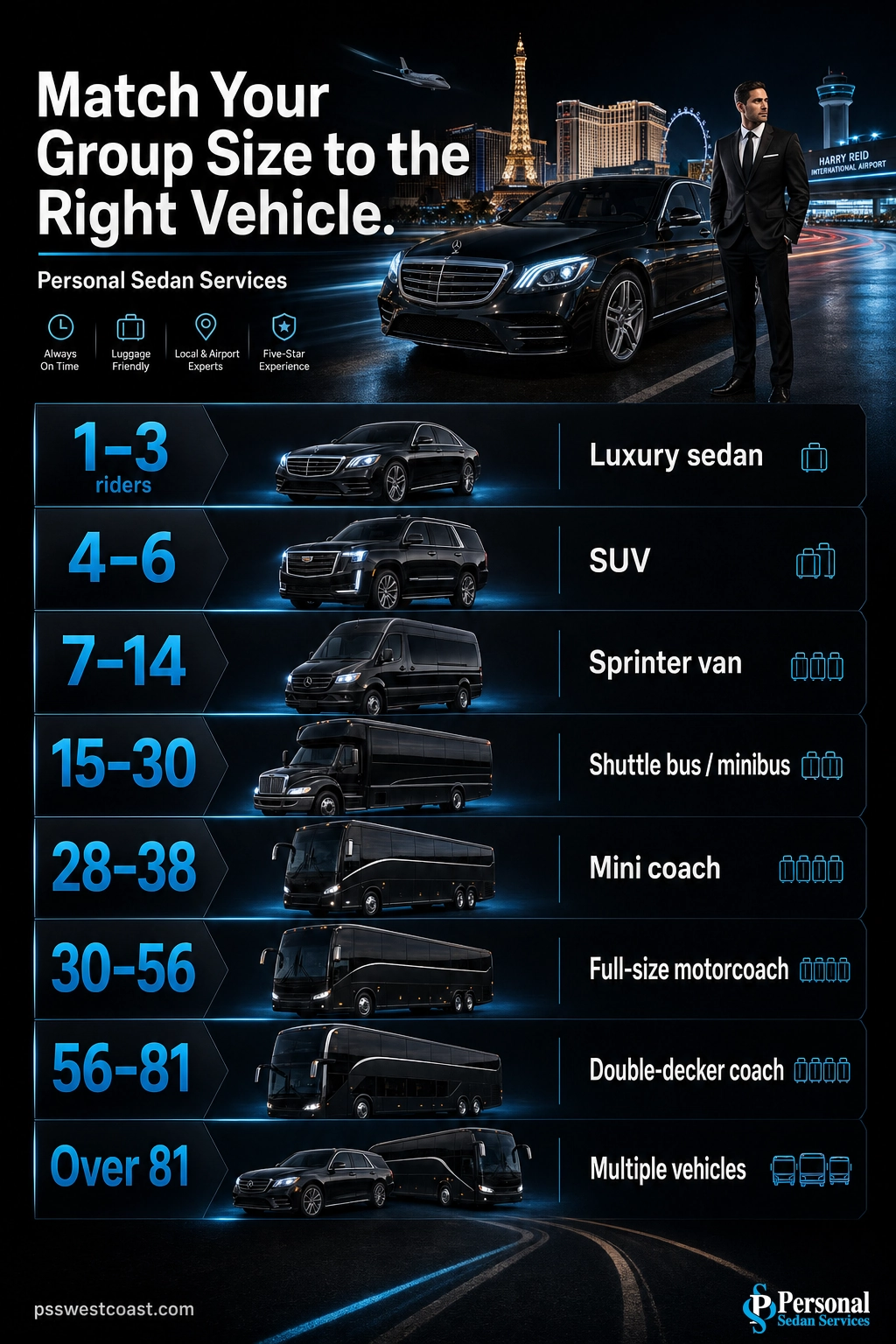
Put all of the above together and sizing a group becomes a simple lookup. Start with your real headcount, add a small buffer for comfort and luggage, and pick the smallest vehicle that still leaves breathing room. Here is the decision guide.
| Your group size | Right vehicle | Why |
|---|---|---|
| 1 to 3 | Luxury sedan | Fast, private, most economical for a few riders |
| 4 to 6 | SUV | Room for people plus airport luggage |
| 7 to 14 | Sprinter van | One vehicle, conversation-friendly, executive comfort |
| 15 to 30 | Shuttle bus / minibus | Consolidates a mid-size group, easy city loading |
| 28 to 38 | Mini coach | Coach comfort and luggage on a shorter body |
| 30 to 56 | Full-size motorcoach | Distance, luggage bays, climate, restroom option |
| 56 to 81 | Double-decker coach | Keeps one large group in a single vehicle |
| Over 81 | Multiple vehicles | Convoy of coaches, staged and coordinated |
The Las Vegas wrinkle is logistics. Group trips here rarely move in a straight line: airport pickups stagger across the day, the Strip’s porte-cocheres and parking structures limit where a 45-foot or 13-foot-tall vehicle can go, and event schedules (conventions, red-carpet arrivals, big-game weekends) demand precise timing. The right vehicle is the one that fits both your headcount and the actual route, which is why local operating knowledge matters as much as the seat count.
Source: MCI J-Series specifications
Real Las Vegas Scenarios: Sizing Common Group Trips
The decision guide above is the rule. Here is how it plays out on the group trips we see most often in Las Vegas, so you can find the one closest to yours and start from a realistic vehicle.
The wedding guest shuttle (40 to 90 guests)
Weddings almost always mean a shuttle between the hotel block and the venue, running on a loop. For 40 to 56 guests, a single full-size motorcoach covers it in one run. Above 56, you either add a second coach, step to a double-decker, or run a shuttle on a tighter loop with multiple trips. Luggage is usually light (guests are local to their hotel), so you can plan closer to the vehicle’s maximum, with the shuttle timed to the ceremony and the reception.
The convention or corporate group (50 to 300 attendees)
Convention groups are the classic multi-coach job. A 120-person group typically moves on two full coaches; a 300-person group on five or six, staged so each loads and departs on schedule. Here the priority is coordination, not just seat count: pickups stagger across the day, and the convention center’s bus lanes and the resort’s loading zones dictate timing. This is squarely a destination-management operation, planned stop by stop.
The bachelor or bachelorette group (10 to 30)
These groups want to travel together and keep the energy up between stops. For 10 to 14, a Sprinter van works; for 15 to 30, a shuttle bus or minibus. If the priority shifts from transport to the party itself, the math changes toward a party bus, which trades seat count for lounge seating (see the related party bus capacity guide below for that tradeoff).
The airport group transfer (any size)
Airport runs are where luggage dominates the math. Every passenger has at least one bag, often two, so a vehicle with real undercarriage bay space is worth more than one with extra seats. A full coach’s luggage bays make it the clean choice for a large arriving group, while a Sprinter or shuttle handles smaller parties. Stagger pickups to match flight arrivals rather than making everyone wait for the last plane.
Source: MCI J-Series specifications
Plan your Las Vegas event transportation
What to Do Next: Your Booking Roadmap
Here is how to turn a headcount into a confirmed, correctly sized charter booking.
| Action | Priority | Timeline | Relevant service |
|---|---|---|---|
| Confirm your real headcount and add a comfort buffer | High | First | Group transportation |
| Account for luggage (1 to 2 bags per person) | High | Before sizing | Group transportation |
| Map your route and all drop-off points (clearance, access) | High | Before booking | Destination management |
| Request accessibility or seat belts in writing if needed | High | At least 48 hours ahead | Group transportation |
| Pick the smallest vehicle that leaves breathing room | Medium | At booking | Fleet selection |
| Lock the booking and the schedule | Medium | Early for peak dates | Event transportation |
Book your Las Vegas group transportation
Related Resources
Keep planning with these companion guides from Personal Sedan Services:
Authoritative outside sources on bus specifications and standards:
Charter Bus Capacity Summary Table
Everything in this guide in one reference table, from the smallest charter vehicle to the largest and the factors that move the numbers.
| Item | Capacity / detail |
|---|---|
| Passenger / Sprinter van | Up to 15 occupants |
| Sprinter van (12-passenger config) | 12 passengers |
| Sprinter van (15-passenger config) | 15 passengers |
| Shuttle bus / minibus | ~20 to 30 passengers |
| Mini coach | ~28 to 38 passengers |
| Full-size motorcoach (standard) | 54 to 56 passengers |
| Full-size motorcoach (high-density) | Up to 60 passengers |
| MCI J4500 (standard) | 56 seats |
| MCI J4500 (optimal) | Up to 60 seats |
| MCI J4500 length | 45 ft 7 in |
| Volvo 9700 (U.S. standard) | 54 passengers |
| Luxury / long-haul coach (with restroom and legroom) | ~46 to 49 passengers |
| Double-decker coach (Van Hool TDX25) | Up to 81 passengers |
| Party bus | Fewer than a coach of equal length (lounge seating) |
| Stretch limousine | Small VIP group |
| Biggest seat-count factor | Vehicle length |
| Comfort dial | Seat pitch / layout |
| Restroom or galley | Removes one or more rows |
| Wheelchair position | Replaces a short row of seats |
| Seat belts required (new motorcoaches) | Since Nov. 28, 2016 (FMVSS No. 208) |
| Federal seat-belt weight threshold | Buses rated above 26,000 lb |
| ADA accessible-bus advance notice | Up to 48 hours |
| One motorcoach replaces | Up to 56 passenger cars (ABA) |
| Luggage planning figure | 1 to 2 bags per passenger |
Frequently Asked Questions
How many seats are on a charter bus?
What is the maximum capacity of a standard charter bus?
Why do charter bus seat counts vary so much?
Do charter buses have seat belts?
How many passengers fit on a charter bus with luggage?
Are charter buses wheelchair accessible?
What size charter bus do I need for my group?
Is a charter bus bigger than a party bus?
Methodology and Sources
Seating figures in this guide come from manufacturer specifications and U.S. federal sources, not from secondary aggregators. Full-size coach capacity is drawn from the MCI J-Series specification (56 standard seats, up to 60 optimal, 45-foot-7-inch length) and the Volvo 9700 U.S. specification (54 passengers standard). Double-decker capacity is from the Van Hool TDX25 Astromega. Passenger-van capacity reflects the Mercedes-Benz Sprinter’s 12- and 15-passenger factory configurations. Safety and accessibility points are drawn from the National Highway Traffic Safety Administration (FMVSS No. 208 seat-belt rule, effective November 28, 2016, and the over-the-road bus definition) and the U.S. Department of Transportation / FMCSA (ADA requirements, 49 CFR 37.189). The highway-efficiency figure is from the American Bus Association. Shuttle, minibus, and mini-coach ranges reflect common industry build-outs and vary by chassis and configuration, so always confirm the exact seat count of a specific vehicle with the operator before booking.
Last Updated: October 2026
