


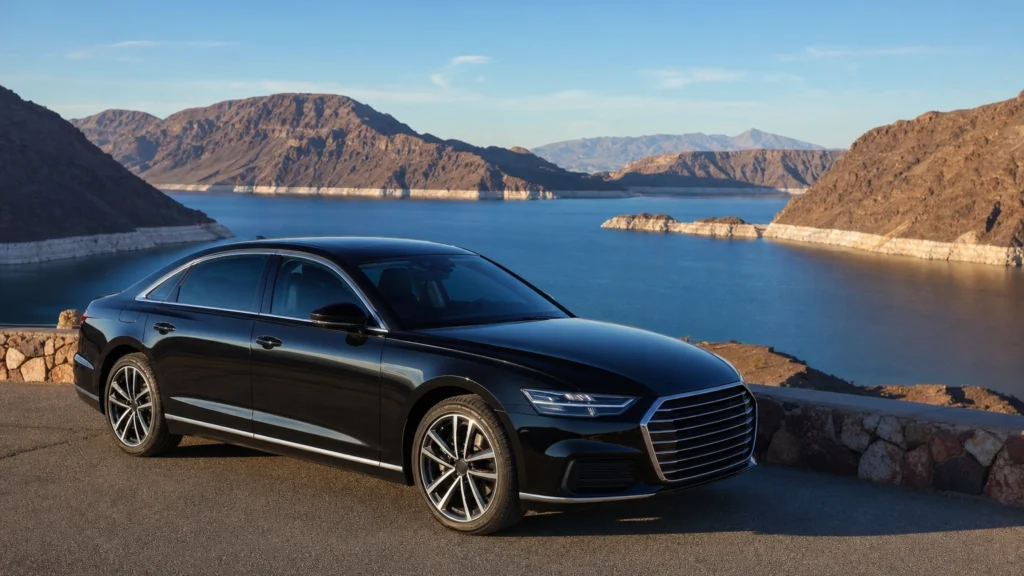
Where does Las Vegas get its water? About 90 percent comes from the Colorado River, stored in Lake Mead behind Hoover Dam, and roughly 10 percent from a local groundwater aquifer. Nevada’s river share is just 300,000 acre-feet a year, the smallest of the seven Colorado River states, which is why conservation and recycling run the city.
It is one of the great contradictions of the American West: a city of fountains, pools, and canals sits in the Mojave Desert, one of the driest places in North America, and gets less than four and a half inches of rain a year. So where does all the water come from? The short answer is a lake 25 miles southeast of the Strip and a river that starts as snow in the Rocky Mountains. The longer answer, how Las Vegas stretches the smallest water allotment of any state on the Colorado River to serve more than two million residents and tens of millions of visitors, is one of the most impressive engineering and conservation stories in the country. Here is exactly where the water comes from, how it reaches your tap, and whether the desert city is really at risk of running dry.
- The main source: about 90 percent of Southern Nevada’s water is Colorado River water stored in Lake Mead, the largest reservoir in the United States.
- The rest: roughly 10 percent is pumped from a groundwater aquifer deep beneath the Las Vegas Valley.
- A tiny share: Nevada is entitled to just 300,000 acre-feet of Colorado River water a year, the smallest allocation of the seven basin states.
- The secret weapon: nearly all water used indoors is treated and returned to Lake Mead, earning return-flow credits that effectively stretch the 300,000-acre-foot share.
- Conservation works: per-capita water use has fallen by roughly half since 2002, so the valley uses less river water now than it did two decades ago even as the population boomed.
- Drought-proofed intake: the Third Straw and Low Lake Level Pumping Station let Las Vegas keep drawing water even if Lake Mead drops below the level Hoover Dam can release.

What’s in This Guide
- Where Does Las Vegas Get Its Water?
- How the Water Travels From Lake Mead to Your Tap
- Nevada’s Colorado River Share: The Smallest Slice
- Colorado River vs. Groundwater: The Two Sources Compared
- The Recycling Secret: Why Las Vegas Does Not Run Dry
- Will Las Vegas Run Out of Water?
- Is Las Vegas Tap Water Safe to Drink?
- Getting Around Las Vegas the Easy Way
- Frequently Asked Questions
- Related Las Vegas Travel Guides
Where Does Las Vegas Get Its Water?
Las Vegas gets about 90 percent of its water from the Colorado River, which is stored in Lake Mead, the reservoir created by Hoover Dam just southeast of the city. The other roughly 10 percent is pumped from a groundwater aquifer deep beneath the Las Vegas Valley. The Southern Nevada Water Authority manages the regional supply, and the Las Vegas Valley Water District delivers it to most homes and businesses.
That 90-10 split is the single most important fact about water in Las Vegas. The city is not floating on a hidden desert spring or a secret underground river, a myth that circulates online. Nearly all of its water starts as snow in the Rocky Mountains of Colorado, Wyoming, and Utah, melts into the Colorado River, flows more than a thousand miles downstream, and comes to rest in Lake Mead before being pumped up into the valley.
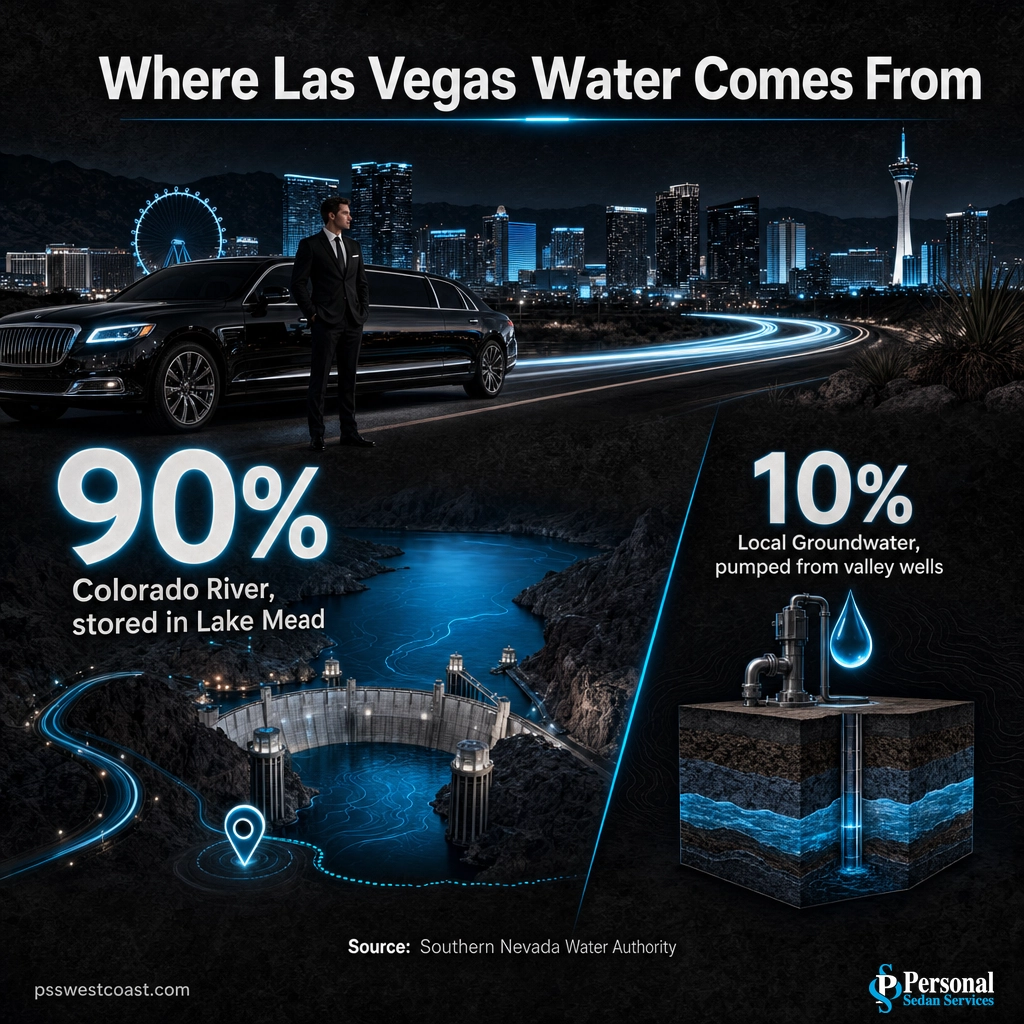
Because the river supplies the overwhelming majority of the water, the health of the Colorado River and the level of Lake Mead are not abstract environmental topics in Las Vegas. They are the city’s lifeline, and they shape everything from landscaping rules to the design of the pipes that pull water out of the lake.
Source: Southern Nevada Water Authority water resources | EPA WaterSense Nevada fact sheet
How the Water Travels From Lake Mead to Your Tap
Getting water from a desert reservoir up into a valley of more than two million people takes serious infrastructure. Lake Mead is the largest reservoir in the United States by volume, held back by Hoover Dam, and it sits lower than the Las Vegas Valley, so the water has to be pumped uphill every step of the way.
The water enters the system through intake structures on the floor of Lake Mead, travels to treatment facilities where it is filtered and disinfected to federal drinking-water standards, and is then pumped through a network of pipes and reservoirs to homes, hotels, and businesses across the valley. The whole journey from lake to tap happens continuously, day and night.
The Third Straw: drought-proofing the supply
As a 20-plus-year drought on the Colorado River pushed Lake Mead to record lows, the original intakes that pulled water from the lake risked being left high and dry. In response, the Southern Nevada Water Authority built a third intake, nicknamed the Third Straw, officially Intake No. 3. Brought into service in 2015, its opening sits near the very bottom of the reservoir, around 860 feet of elevation, so it can keep drawing clean water even as the surface drops.
The companion project, the Low Lake Level Pumping Station, was completed in 2020 and became fully operational in 2022. Its submersible pumps can move water even if Lake Mead falls below the level at which Hoover Dam can release water downstream, a point often called dead pool. Together the two projects, which cost roughly 1.5 billion dollars, mean Las Vegas can keep its taps running almost no matter how low the lake gets.
Why build a straw at the bottom of the lake? Think of Lake Mead as a giant glass and the intakes as straws. The old straws sat higher up the glass, so a falling water line threatened to leave them sucking air. The Third Straw reaches the very bottom, and the deep pumping station can lift that water out even when almost nothing is left above it. It is the single biggest reason a shrinking Lake Mead does not translate directly into empty taps in Las Vegas.
Source: Southern Nevada Water Authority water facilities | Engineering News-Record on the Low Lake Level Pumping Station
Nevada’s Colorado River Share: The Smallest Slice
Here is the fact that surprises most people: Nevada has the smallest Colorado River allocation of any of the seven states that share it. The river’s water was divided up almost a century ago, under the 1922 Colorado River Compact and the 1928 Boulder Canyon Project Act, long before Las Vegas became a major city. At the time, Nevada was a sparsely populated state and negotiated for only 300,000 acre-feet a year.
An acre-foot is roughly 326,000 gallons, about enough to supply two to three Las Vegas households for a year under current conservation habits. California, by comparison, holds 4.4 million acre-feet and Arizona 2.8 million. So the fastest-growing major metro on the river built itself on the thinnest slice of it.
Lower Colorado River Basin Annual Allocations (acre-feet)
Basic annual apportionments for the three Lower Basin states under the Law of the River. Nevada’s share is the smallest. Source: U.S. Bureau of Reclamation.
During the current drought, federal shortage rules have trimmed even that modest share. In recent years Nevada’s usable allocation has been reduced to around 279,000 acre-feet, a cut of roughly 7 percent, with contributions to prop up Lake Mead increasing as the lake level falls. Living within such a small allotment is exactly why Southern Nevada has become a national model for squeezing the most out of every drop.
Source: U.S. Bureau of Reclamation: Law of the River | Southern Nevada Water Authority Colorado River resources
Colorado River vs. Groundwater: The Two Sources Compared
The two sources that feed Las Vegas could not be more different. The Colorado River is a shared, interstate, surface-water supply governed by decades of law and treaty. Local groundwater is a homegrown resource pumped from beneath the valley itself. Here is how they stack up.
| Colorado River (Lake Mead) | Local Groundwater | |
|---|---|---|
| Share of supply | About 90 percent | About 10 percent |
| Where it starts | Rocky Mountain snowmelt, stored in Lake Mead | An aquifer deep beneath the Las Vegas Valley |
| How it is accessed | Intakes on the floor of Lake Mead, then pumped uphill | Wells across Clark County |
| Limits | 300,000 acre-feet a year, trimmed in drought | State-permitted pumping, recharged slowly |
| Main risk | Long-term drought lowering Lake Mead | Over-pumping faster than nature refills it |
Groundwater was actually the valley’s original water source. Artesian springs once bubbled up in the desert, which is how the area got its name: Las Vegas means “the meadows” in Spanish. Those springs were tapped out and the aquifer drew down decades ago, which is why the region pivoted to the Colorado River and now treats the local groundwater as a carefully managed reserve rather than the main supply.
Source: U.S. Geological Survey on aquifers and groundwater | Las Vegas Valley Water District water sources
The Recycling Secret: Why Las Vegas Does Not Run Dry
If Nevada only gets 300,000 acre-feet a year, how does a city this size keep growing? The answer is the most clever part of the whole system: return-flow credits. Nearly every drop of water used indoors in Las Vegas, from showers, sinks, dishwashers, and toilets, is collected, sent to treatment plants, cleaned to a high standard, and returned to Lake Mead through the Las Vegas Wash.
For every gallon of treated water Southern Nevada sends back to the lake, it earns the right to take another gallon out. That means indoor water use is effectively a loop, and it does not count against the 300,000-acre-foot limit. The Southern Nevada Water Authority has said that without these return-flow credits, the valley would have outgrown its Colorado River share back in 1993.
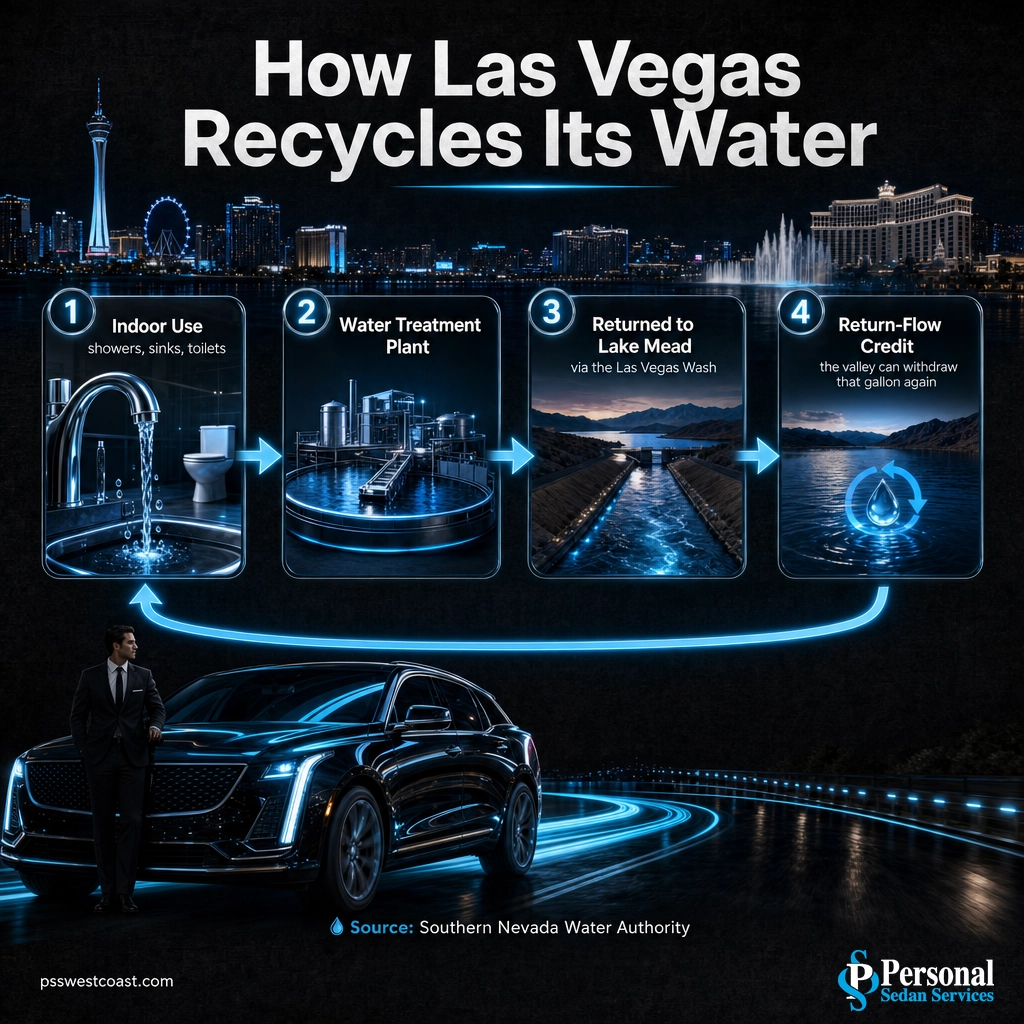
This is why the region’s conservation campaigns focus so heavily on outdoor water. Water poured on a lawn evaporates or soaks into the ground and can never be recovered or recycled, so it is water the valley truly loses. That single insight drives the famous turf-removal rebate program, the limits on grass in new developments, and the restrictions on decorative fountains and watering days.
Myth: Las Vegas wastes water on fountains and pools. The reality is nearly the opposite. The city’s indoor water is almost entirely recycled, and the iconic Bellagio fountains run on a private well separate from the drinking-water supply. Southern Nevada has cut its total Colorado River use even as its population surged, something few desert cities can claim. The real water hog is outdoor grass, which is exactly what the region’s conservation rules target.
Source: Southern Nevada Water Authority conservation program | Las Vegas Valley Water District conservation

Will Las Vegas Run Out of Water?
This is the question behind most searches about Las Vegas water, and the honest answer is that running out is not what the data projects. The Colorado River is genuinely stressed, and Lake Mead has fallen to historic lows during the drought, dropping to around 1,040 feet of elevation in the summer of 2022, its lowest since the lake was first filled in the 1930s. But two things protect Las Vegas specifically.
First, the engineering: the Third Straw and the Low Lake Level Pumping Station mean the city can physically keep pulling water even from a severely depleted lake. Second, and more importantly, the conservation. Per-capita water use in Southern Nevada has fallen by roughly half since 2002, from about 211 gallons per person per day to under 90, even as the population grew by hundreds of thousands of people.
Southern Nevada Per-Capita Water Use (gallons per person, per day)
Per-capita use has fallen by roughly half since 2002 even as the population grew. Source: Southern Nevada Water Authority data.
The result is striking: the valley uses less Colorado River water today than it did two decades ago, despite being home to far more people. Conservation, recycling, and smarter infrastructure have decoupled growth from water use, which is the opposite of what most people assume about Las Vegas. That does not make the city immune to a worsening river, and the long-term planning is serious, but the near-term picture is one of resilience, not imminent collapse.
Source: Southern Nevada Water Authority on conservation and growth | U.S. Bureau of Reclamation Lake Mead elevation records
Is Las Vegas Tap Water Safe to Drink?
Yes. The water delivered across the Las Vegas Valley meets or exceeds every standard under the federal Safe Drinking Water Act, according to the annual water-quality reports published by the Las Vegas Valley Water District. The Colorado River water is filtered, disinfected, and continuously tested before it ever reaches a tap, and visitors can drink it straight from the faucet throughout the city and the hotels.
The one honest caveat is hardness. Las Vegas water is hard, meaning it carries a high mineral content, measured in recent reports at roughly 300 parts per million. That is a cosmetic and plumbing issue, not a safety one: it leaves spots on glassware, scale in kettles, and can feel drying, which is why many homes use a water softener. The water itself is safe to drink.
For visitors: you do not need to buy bottled water to stay safe in Las Vegas. Tap and hotel water is fully drinkable. If you notice it tastes slightly different, that is the mineral hardness, not a quality problem. In the desert heat, the bigger risk is not drinking enough, so keep a bottle handy and refill it.
Source: Las Vegas Valley Water District water-quality reports | EPA Safe Drinking Water Act standards
Getting Around Las Vegas the Easy Way
Understanding where the water comes from is part of understanding the city itself, and the most memorable way to see the source is up close. Lake Mead and Hoover Dam sit about 30 to 45 minutes from the Strip, and the drive out to the reservoir that keeps Las Vegas alive is one of the most popular half-day trips from the city.
That is where a professional car service earns its place. Instead of navigating an unfamiliar route, parking in the desert heat, or waiting out a rideshare surge in a remote area, you can be dropped at the dam overlook and picked back up on your schedule. Personal Sedan Services is Las Vegas’s top-rated luxury transportation, with a perfect 5.0 Google rating from more than 900 reviews, and our licensed, background-checked chauffeurs know the valley and the routes out to Lake Mead in every season.
Whether you are arriving at Harry Reid International and want a smooth ride to your hotel, planning a day trip out to the lake, or simply want a reliable local ride around town without the rideshare hassle, we handle the logistics so you can enjoy the city.
Reserve your Harry Reid airport pickup
Explore our luxury transportation options
Frequently Asked Questions
Where does Las Vegas get its water?
How much Colorado River water is Nevada allowed to use?
Will Las Vegas run out of water?
Is Las Vegas tap water safe to drink?
What is the Third Straw in Lake Mead?
Related Las Vegas Travel Guides
- How far is Hoover Dam from Las Vegas? – the dam that created Lake Mead, and the easiest way to see the source of the city’s water.
- Does it snow in Las Vegas? – the other half of the desert-climate question, and where to find real snow nearby.
- Cost of living in Las Vegas – a real monthly budget breakdown, including what utilities actually run.
- Best day trips from Las Vegas – the full menu of drives worth taking, Lake Mead and Hoover Dam among them.
See our Las Vegas attractions transportation
Sources and Methodology
The 90 percent Colorado River figure and the roughly 10 percent groundwater share come from the Southern Nevada Water Authority and are corroborated by the EPA WaterSense Nevada fact sheet. Nevada’s 300,000-acre-foot annual Colorado River apportionment, the smallest of the seven basin states, is set by the 1922 Colorado River Compact and the 1928 Boulder Canyon Project Act, as documented by the U.S. Bureau of Reclamation’s Law of the River; California (4.4 million acre-feet) and Arizona (2.8 million) hold the other Lower Basin shares. Recent drought-era reductions to roughly 279,000 acre-feet reflect federal shortage rules. Return-flow credits, the near-total recycling of indoor water via the Las Vegas Wash, and the fact that the valley would have exceeded its share in 1993 without them come from the Southern Nevada Water Authority. Per-capita use figures (about 211 gallons per person per day in 2002 falling to under 90 in recent years) are based on Southern Nevada Water Authority data. Lake Mead’s 2022 low of about 1,040 feet of elevation is from U.S. Bureau of Reclamation records. The Third Straw (Intake No. 3, in service 2015) and the Low Lake Level Pumping Station (completed 2020) are documented by the Southern Nevada Water Authority and Engineering News-Record. Drinking-water safety and hardness figures are from Las Vegas Valley Water District water-quality reports under the federal Safe Drinking Water Act. Distances and drive times are approximate.
