


Who founded Las Vegas? No single person did. The Southern Paiute lived at its spring-fed meadows for centuries, scout Rafael Rivera reached the valley in 1829, and Mormon settlers built a fort in 1855. But the modern city was founded on May 15, 1905, when the railroad auctioned off its downtown townsite.
It is one of the most-searched questions about the city, and the honest answer surprises most people: Las Vegas has no single founder. The place was shaped in layers, by Native people who settled its desert springs, by a teenage scout who gave it its name, by missionaries, ranchers, and finally by a railroad that turned a watering stop into a city almost overnight. If you picture a lone pioneer planting a flag, the real story is more interesting. Here is who actually built Las Vegas, in order, with the dates that matter.
- The short answer: no one person founded Las Vegas. The modern city was founded on May 15, 1905, by a railroad land auction, not by a single pioneer.
- The first people: Native peoples lived in the valley for thousands of years, and the Southern Paiute were here long before any settler, drawn by the artesian springs.
- The name: “Las Vegas” is Spanish for “the meadows,” given by travelers on the Old Spanish Trail; scout Rafael Rivera reached the valley with a trading party in 1829.
- The first settlement: Mormon missionaries built an adobe fort in 1855, the oldest non-Native building in Nevada, which you can still visit downtown.
- The real “founders”: rancher Helen J. Stewart sold the land in 1902, and Senator William A. Clark’s railroad auctioned about 1,200 lots on May 15, 1905, creating the city. It incorporated on March 16, 1911.
- See it yourself: the Old Las Vegas Mormon Fort, the Springs Preserve, and Fremont Street are all a short, chauffeured ride apart in and around downtown.

What’s in This Guide
- The Short Answer: Who Really Founded Las Vegas?
- The First People: The Paiute and the Meadows
- 1829: Rafael Rivera and the Naming of “The Meadows”
- 1844: John C. Frémont Puts the Valley on the Map
- 1855: The Mormon Fort and the First Settlement
- The Ranch Years: Octavius Gass and Helen J. Stewart
- 1905: The Railroad, Senator Clark, and the Birth of the City
- 1911: Las Vegas Becomes a City
- A Timeline of Who Built Las Vegas
- See Where Las Vegas Was Founded for Yourself
- Frequently Asked Questions
- Related Las Vegas City Guides
The Short Answer: Who Really Founded Las Vegas?
There is no “founder of Las Vegas” the way Philadelphia has William Penn or Georgia has James Oglethorpe. The city grew out of a desert valley that Native peoples had used for thousands of years, and the modern city traces to a single event with no one hero behind it: a land auction held by a railroad on May 15, 1905.
That is why the question has so many competing answers online. Depending on what you mean by “founded,” the credit goes to different people. If you mean the first inhabitants, it is the Southern Paiute. If you mean the first European to see the valley, it is a young scout named Rafael Rivera. If you mean the first permanent settlement, it is a group of Mormon missionaries. And if you mean the official birth of the city, it is the railroad and the businessmen behind it. All of those answers are correct for a different question.
The reason Las Vegas feels “founder-less” is that it was never really settled the slow way. It jumped almost directly from a cattle ranch beside a spring to a planned railroad town sold off in a single weekend. The people usually named as founders, Helen Stewart and William Clark, were a rancher who sold the land and a senator who bought it, not pioneers who carved out a community over generations.
Source: Encyclopaedia Britannica, History of Las Vegas | History of Las Vegas reference overview
The First People: The Paiute and the Meadows
Long before any map used the words “Las Vegas,” the valley was home to Native peoples. Archaeological evidence places human presence in the region going back many thousands of years, and by the time of European contact the Southern Paiute, who call themselves the Nuwuvi, lived across southern Nevada, including the Las Vegas Valley.
What drew people here was water. In the middle of the Mojave Desert, the valley held artesian springs that pushed cool groundwater to the surface and fed green meadows and mesquite. Those springs, in the area now protected as the Springs Preserve’s historic water site, are the single reason there is a city here at all. Every later chapter, the trail, the fort, the ranch, the railroad, happened because this spot had reliable water when nothing around it did.
The Paiute presence is not just prehistory. The Las Vegas Paiute Tribe remains in the valley today, and their long tenure is the first and most important answer to “who was here first.” Any honest account of who founded Las Vegas has to start with the people who lived at the meadows for generations before a single settler arrived.
Source: Springs Preserve, Las Vegas historic water site
1829: Rafael Rivera and the Naming of “The Meadows”
The name came from Spanish-speaking travelers. In the winter of 1829, a trading caravan led by the merchant Antonio Armijo was working its way from New Mexico toward Los Angeles along what became the Old Spanish Trail. A young scout in the party, Rafael Rivera, rode ahead to look for water and is generally credited as the first person of European descent to enter the Las Vegas Valley.
The travelers found the spring-fed meadows and recorded the name that stuck: “Las Vegas,” Spanish for “the meadows.” It was a practical name for a practical discovery, a green, watered rest stop on a brutal desert route. For the next two decades the valley served exactly that purpose, a known watering place for caravans and, later, wagon trains headed to California.
What “Las Vegas” actually means: it is not a glamorous phrase. “Vegas” means meadows or fertile lowland plains in Spanish, and the valley earned the name honestly. The irony that one of the driest cities in America is named for its grass is a favorite local fact.
Source: Encyclopaedia Britannica, History of Las Vegas
1844: John C. Frémont Puts the Valley on the Map
The next figure in the story is one whose name you will recognize from a street downtown. On May 3, 1844, the American explorer and Army officer John C. Frémont camped at the Las Vegas springs while mapping the region for the U.S. government, at a time when this land was still part of Mexico. His published reports and maps circulated widely and helped fix the valley in the national imagination as a dependable stop on the way west.
Frémont did not settle or found anything here, but his survey mattered. It is why the historic Fremont Street in downtown Las Vegas, the original heart of the city and home to its first paved road and first traffic light, carries his name today. When people ask who “put Las Vegas on the map,” in this case it is close to literal.
Source: Encyclopaedia Britannica, History of Las Vegas
1855: The Mormon Fort and the First Settlement
The first attempt to actually settle Las Vegas came in 1855. A party of Mormon missionaries from Utah, led by William Bringhurst, arrived to build a waystation along the Mormon Corridor between Salt Lake City and California, and to work with the local Paiute. They built an adobe fort roughly 150 feet square beside the creek that drained the springs.
The mission was short-lived. Facing summer heat, crop failures, and internal disagreements, the missionaries abandoned the fort within a few years, around 1857. But a piece of that adobe wall survived, and it is now the Old Las Vegas Mormon Fort State Historic Park, the oldest non-Native structure in the state of Nevada. It is one of the only places in the city where you can literally touch the 1850s.
Source: Nevada State Parks, Old Las Vegas Mormon Fort
The Ranch Years: Octavius Gass and Helen J. Stewart
After the missionaries left, the fort and its land passed through private hands and became a working ranch. In the 1860s, Octavius Decatur Gass took over the site, repaired the old fort buildings, and ran it as the Las Vegas Rancho, raising crops and livestock and serving travelers. Over time he fell into debt, and in 1881 the property passed to Archibald Stewart, who held a lien on it.
Archibald Stewart was killed in 1884, and that is where one of the most important figures in the city’s history steps forward. His widow, Helen J. Stewart, took over and ran the ranch for nearly two decades, expanding it to about 1,800 acres and becoming a respected local leader often remembered as the “First Lady of Las Vegas.” She is the person who held the land through the years that mattered.
In 1902, Helen Stewart sold most of the ranch to the railroad. That sale, more than any single act, set the founding of the city in motion: it put the valley’s water and its best land into the hands of a company that was about to build a town.
Source: Online Nevada Encyclopedia, Nevada Humanities | History of Las Vegas reference overview
1905: The Railroad, Senator Clark, and the Birth of the City
This is the moment most historians point to when they date the founding of Las Vegas. The buyer of Helen Stewart’s land was the San Pedro, Los Angeles and Salt Lake Railroad, a line being built to connect Salt Lake City with Southern California. Its majority owner was William Andrews Clark, a copper magnate and former U.S. Senator from Montana, which is why Clark County still carries his name.
The railroad needed a division point roughly halfway along its route, a place with water where crews could service trains. The Las Vegas springs were perfect. The company surveyed a townsite next to its tracks and, on May 15, 1905, held a land auction. Over two days it offered about 1,200 lots across roughly 110 acres of what is now downtown Las Vegas. That auction is the event the city treats as its birthday.
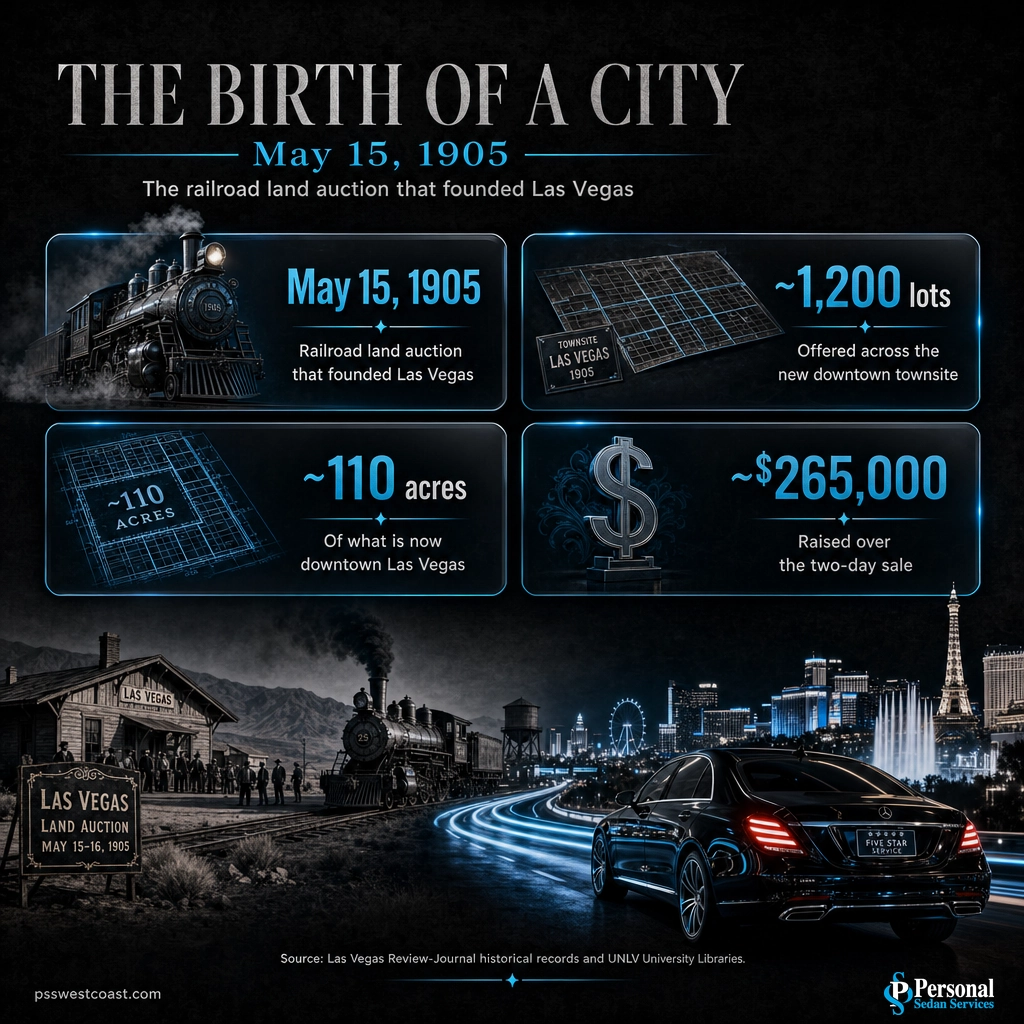
Demand was strong. The two-day sale brought in roughly $265,000, a large sum for the time, as buyers and speculators bet on the new railroad town. The grid they bought, bounded by streets like Stewart Avenue, Main Street, and Fremont Street, became the original core of the city. Within weeks a tent-and-timber town was taking shape where there had been a ranch.
Myth: the mob founded Las Vegas. It is a great story, but it is wrong. Las Vegas was founded in 1905 by a railroad, and it had been a working city for roughly four decades before organized-crime money helped finance Strip resorts like the Flamingo in the 1940s. The mob shaped the casino era, but it did not found the city. The founders were a rancher, a senator, and a land auction.
Source: Encyclopaedia Britannica, History of Las Vegas | Las Vegas founding reference

1911: Las Vegas Becomes a City
Founding and incorporation are two different things, and the gap between them is why you sometimes see different “birth years” for Las Vegas. The 1905 auction created the town, but it was not yet a legally incorporated city. That came a few years later.
In 1909 the Nevada legislature carved Clark County out of the southern end of Lincoln County and named it for Senator Clark, with Las Vegas as its seat. Then, on March 16, 1911, Las Vegas adopted its first charter and was incorporated as a city, electing Peter Buol as its first mayor. From a desert spring to a railroad auction to a chartered city, the whole arc took barely six years.
Source: City of Las Vegas, official history
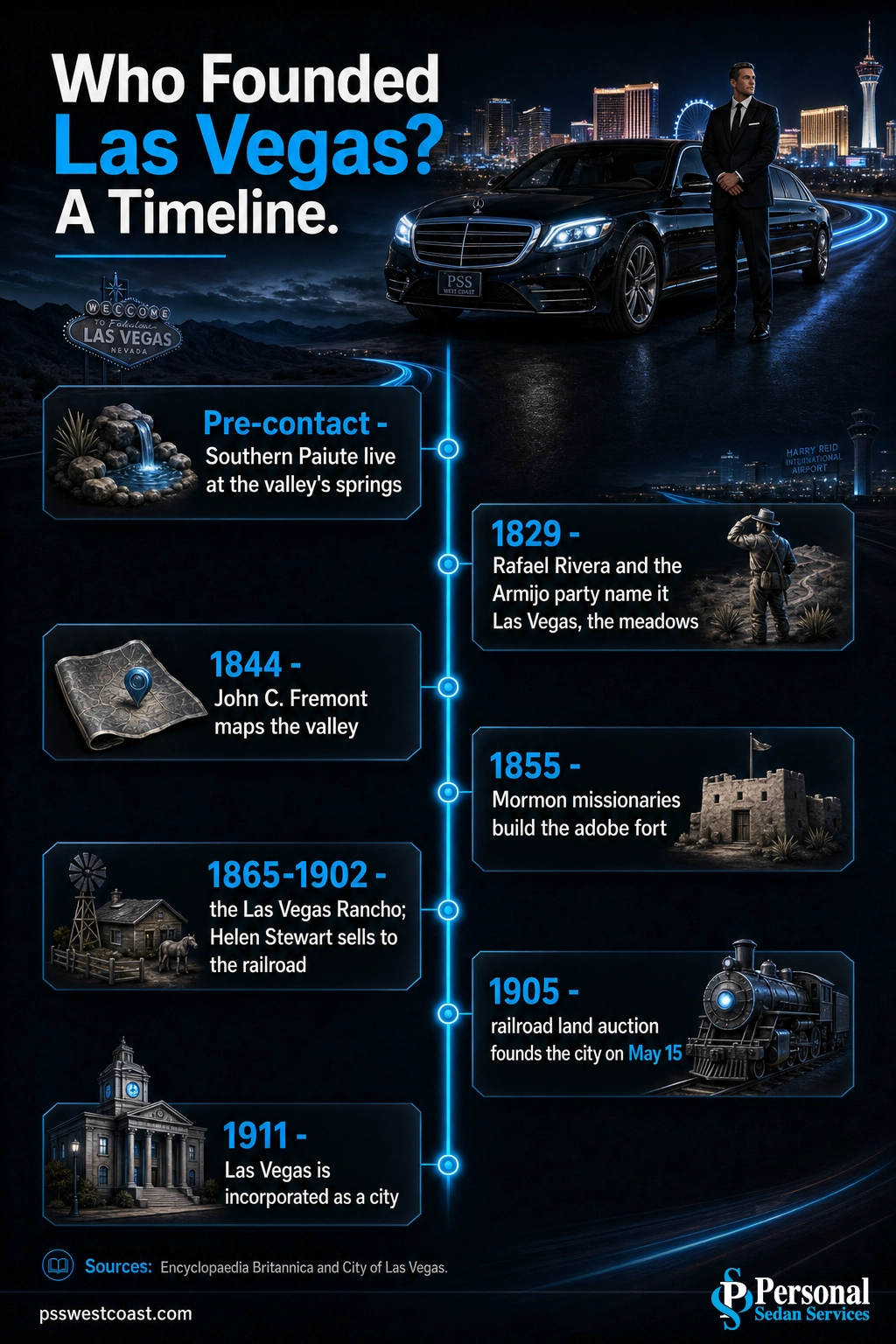
A Timeline of Who Built Las Vegas
Because the credit is spread across so many people and dates, the clearest way to see “who founded Las Vegas” is to lay it out in order. Each step added something the next one needed.
| Year | Who | What they did |
|---|---|---|
| Pre-contact | Southern Paiute (Nuwuvi) | Lived at the valley’s springs for generations, the first inhabitants |
| 1829 | Rafael Rivera / Antonio Armijo party | First Europeans to reach the valley; it is named “Las Vegas,” the meadows |
| 1844 | John C. Frémont | Camps at the springs and maps the area for the U.S.; Fremont Street is named for him |
| 1855 | Mormon missionaries (William Bringhurst) | Build the adobe fort, the first non-Native settlement |
| 1865 to 1881 | Octavius Gass | Runs the site as the Las Vegas Rancho |
| 1884 to 1902 | Helen J. Stewart | Runs and expands the ranch to ~1,800 acres, then sells it to the railroad |
| 1905 | William A. Clark / the railroad | Auctions the downtown townsite on May 15, officially founding the city |
| 1911 | Peter Buol and the first city government | Las Vegas is incorporated as a city on March 16 |
Read top to bottom, the answer to the question becomes obvious: Las Vegas was not founded by a person. It was assembled, by the Paiute who lived at its water, the travelers who named it, the settlers who first built here, the rancher who held the land, and the railroad that finally turned it into a city.
Source: Encyclopaedia Britannica, History of Las Vegas | City of Las Vegas, official history
See Where Las Vegas Was Founded for Yourself
The best part of this history is that so much of it is still standing, and all of it sits within a few minutes of downtown. You do not need a time machine to see where Las Vegas began, just a plan and a ride. Three stops tell the whole founding story:
- The Old Las Vegas Mormon Fort on Washington Avenue, where you can see the surviving 1855 adobe wall, the oldest non-Native building in Nevada, on the very site of the springs.
- The Springs Preserve, built around the historic water source that made the whole city possible, with museums that walk through the valley’s natural and human history.
- Fremont Street, the original downtown core laid out in that 1905 auction, named for the explorer who mapped the valley in 1844.
These sites are clustered in and around downtown, a part of the city where parking is tight and a rideshare app can leave you waiting. This is exactly the kind of day a professional car service is built for. Personal Sedan Services is Las Vegas’s top-rated luxury transportation, with a perfect 5.0 Google rating from more than 900 reviews, and our chauffeurs know downtown and its history as well as the Strip. For a self-guided history tour, a wedding, a convention day, or a night out, a reliable local ride keeps your group together and the logistics off your plate.
Book attractions transportation to the historic sites
Whether you are tracing the founding of the city or just getting from the airport to your hotel, let a licensed, background-checked chauffeur handle the driving while you take in the view. Explore the full range of chauffeured luxury transportation and ride the way the city’s high rollers always have.
Frequently Asked Questions
Who founded Las Vegas?
When was Las Vegas founded?
What does the name Las Vegas mean?
Who were the first people to live in Las Vegas?
Did the mob found Las Vegas?
Related Las Vegas City Guides
- How long is the Las Vegas Strip? – the modern center of the city, measured end to end with a map and walk times.
- Is Las Vegas dying? – what the current tourism, gaming, and population data actually say about the city’s future.
- Cost of living in Las Vegas – a category-by-category monthly budget for life in the valley today.
- Does it snow in Las Vegas? – the desert-city weather question, answered with real climate records.
- Best day trips from Las Vegas – where to go beyond the city, from the Old Spanish Trail country to the national parks.
See our Las Vegas attractions transportation
Sources and Methodology
This history draws on standard references for the founding of Las Vegas. The naming of the valley in 1829 by travelers on the Old Spanish Trail, John C. Frémont’s 1844 visit, the 1855 Mormon mission, the railroad era, and the May 15, 1905 land auction follow Encyclopaedia Britannica’s History of Las Vegas and widely published historical accounts. The May 15, 1905 founding date, the roughly 1,200 lots offered across about 110 acres of downtown, and the approximately $265,000 raised over the two-day sale reflect Las Vegas Review-Journal historical records and University of Nevada, Las Vegas (UNLV) library materials. The Old Las Vegas Mormon Fort details come from the Nevada Division of State Parks. Helen J. Stewart and the Las Vegas Rancho follow the Online Nevada Encyclopedia (Nevada Humanities). The March 16, 1911 incorporation and first mayor Peter Buol follow the City of Las Vegas. Clark County was created in 1909 from Lincoln County. Dates of incorporation and county formation vary slightly across older sources; the dates used here are the ones most commonly documented.
