


Who invented Las Vegas? No one person did. The city was created by a succession of visionaries: hotelier Thomas Hull, who opened the first Strip resort in 1941; Billy Wilkerson, who conceived the Flamingo’s luxury-casino model in 1946; and later builders like Jay Sarno, Kirk Kerkorian, and Steve Wynn, who turned a desert railroad town into Sin City.
There is a difference between who founded the city of Las Vegas and who invented the place the world actually pictures: the neon, the casinos, the around-the-clock resorts, Sin City. The city was founded in 1905 by a railroad land auction, with no single hero behind it. But the Las Vegas of the imagination was invented later, on purpose, by a handful of hoteliers, dreamers, and gamblers who looked at an empty desert highway and saw a resort capital. This is the story of the people who built Sin City, in order, and why the most famous name attached to it is mostly a myth.
- The short answer: no single person invented Las Vegas. It was built in layers by a series of hotel and casino visionaries over roughly 50 years.
- The key law: Nevada legalized most gambling on March 19, 1931, the legal foundation that made the whole resort industry possible.
- The first resort: hotelier Thomas Hull opened El Rancho Vegas in 1941, the first resort on what became the Strip, and the template everyone copied.
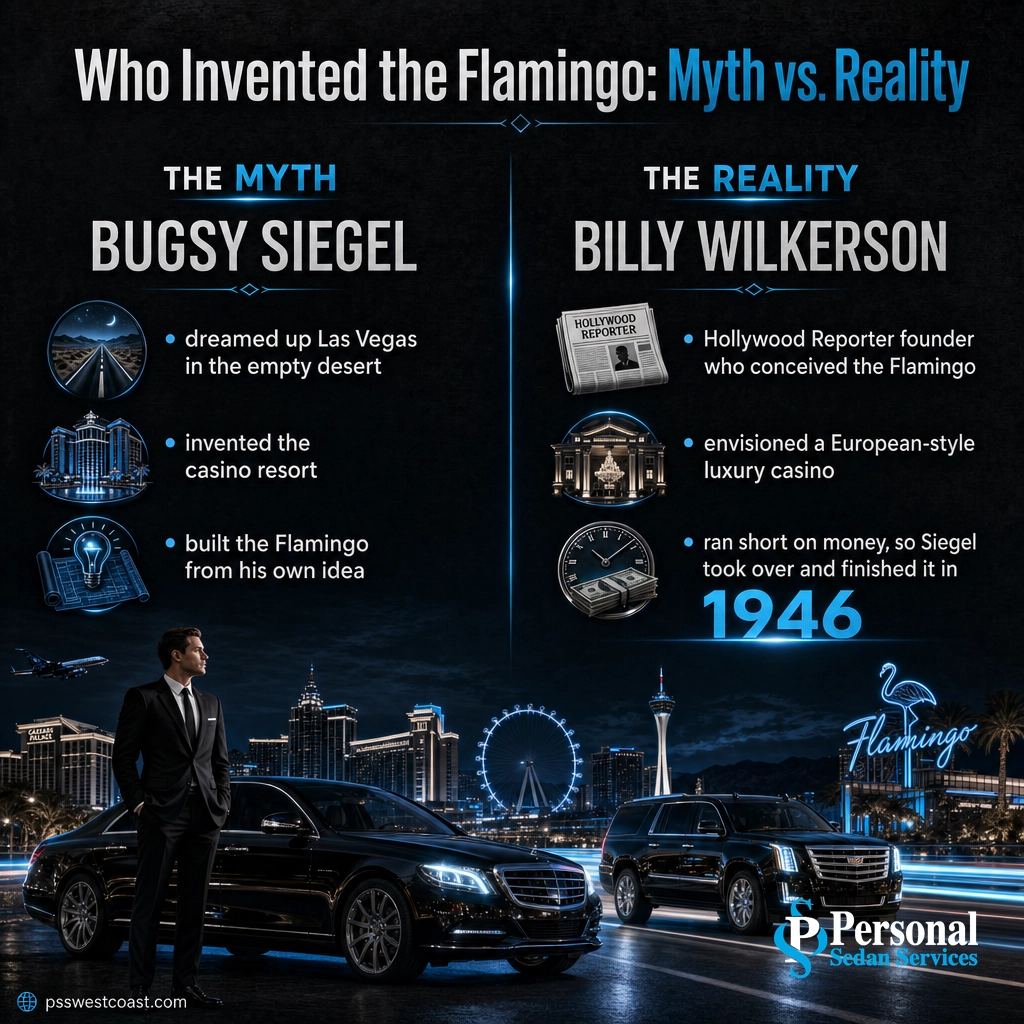
- The real inventor of the model: Hollywood Reporter founder Billy Wilkerson conceived the Flamingo as a luxury casino-resort. Bugsy Siegel took it over and finished it in 1946.
- The myth: Bugsy Siegel did not invent Las Vegas. He built one famous casino on someone else’s idea, decades after the resort era had already started.
- The modern Strip: Jay Sarno (Caesars Palace, 1966), Howard Hughes, Kirk Kerkorian, and Steve Wynn (The Mirage, 1989) turned the Strip into the megaresort capital it is today.

What’s in This Guide
- The Short Answer: Who Really Invented Las Vegas?
- Founded vs. Invented: Two Different Questions
- 1931: The Law That Made Sin City Possible
- Thomas Hull and the Birth of the Strip (1941)
- Billy Wilkerson: The Man Who Really Invented the Vegas Resort
- Bugsy Siegel and the Flamingo: Myth vs. Reality
- Who Gets the Credit: Myth vs. History
- Sarno, Hughes, and Kerkorian: Building the Modern Strip
- Steve Wynn and the Reinvention of Las Vegas (1989)
- The People Who Built Sin City: A Timeline
- See Las Vegas History for Yourself
- Frequently Asked Questions
- Related Las Vegas City Guides
The Short Answer: Who Really Invented Las Vegas?
Ask ten people who invented Las Vegas and you will get Bugsy Siegel almost every time. It is a great story, and it is wrong. Las Vegas was not invented by one man, and it certainly was not invented by a gangster with a single casino. It was invented the way a product is invented: by several people, over decades, each one improving on the idea of the one before.
If you had to name a single inventor of the Vegas we know, the strongest claim belongs to a Hollywood publisher named Billy Wilkerson, who is literally the subject of a biography titled The Man Who Invented Las Vegas. But the honest answer is that the modern city had many authors. A hotelier named Thomas Hull proved a desert resort could work. Wilkerson imagined what a true luxury casino should feel like. Jay Sarno gave it theme and spectacle. Kirk Kerkorian supersized it. And Steve Wynn reinvented it again. The myth of a lone mobster erases all of them.
The reason the Bugsy Siegel myth is so sticky is that it makes a messy, 50-year business story into a single dramatic scene. Real estate developers, hotel operators, and corporate financiers built Las Vegas. “A mobster dreamed it up in the desert” is a movie. The truth is less cinematic and far more interesting: Vegas was invented by businessmen who understood that legal gambling plus luxury plus relentless marketing was a formula no other American city could match.
Source: The Mob Museum, Wilkerson’s idea, Bugsy’s baby | PBS American Experience, Benjamin “Bugsy” Siegel
Founded vs. Invented: Two Different Questions
The confusion starts with the word itself. “Founded” and “invented” sound like the same thing, but for Las Vegas they point to two completely different moments in history, roughly 40 years apart.
The city was founded in 1905, when a railroad auctioned off a downtown townsite and a tent-and-timber town appeared beside the tracks. That is a story about water, trains, and a land sale, and it had no single founder either. If that is the history you are after, we cover it in detail in our guide to who founded Las Vegas and the people behind the city.
Las Vegas was invented, as an idea, much later. For its first three decades the town was a dusty railroad and mining supply stop, best known as the gateway to the Hoover Dam construction boom of the 1930s. The casinos, the resorts, and the nickname Sin City came after. Someone had to decide that a hot, remote desert junction should become a glittering entertainment capital, and then persuade people to build it. That act of invention is what this guide is about.
Source: Encyclopaedia Britannica, History of Las Vegas
1931: The Law That Made Sin City Possible
No single invention mattered more than a change in the law. On March 19, 1931, Nevada Governor Fred Balzar signed a bill that legalized most forms of casino gambling statewide. That same year, construction began on the Hoover Dam just southeast of the city, bringing thousands of workers and their paychecks into the valley.
Legal gambling did not instantly create the Strip. For most of the 1930s the action was downtown, on Fremont Street, in modest clubs and casinos. But the 1931 law is the hinge the entire city turns on. Without legal gambling there is no reason for any of the later inventors to build anything. Every resort that followed, from the Flamingo to the Bellagio, exists because Nevada chose to make legal what the rest of the country had banned.
Source: Nevada Resort Association, History of Gaming in Nevada | UNLV, how 1931 changed the gaming world
Thomas Hull and the Birth of the Strip (1941)
The man who proved the modern Las Vegas resort could work was not a gangster. He was a California hotel operator named Thomas Hull. In 1941 Hull opened El Rancho Vegas, and in doing so he invented the Strip without quite meaning to.
Hull’s insight was about location. Instead of building downtown, he bought land out on Highway 91 south of the city, beyond the city limits, where taxes were lower and space was cheap. El Rancho Vegas opened to the public on April 3, 1941, a low-slung Western-themed resort with a hotel, a casino, a showroom, a restaurant, and, crucially, a swimming pool facing the highway to catch the eye of drivers coming in from Los Angeles. That combination of rooms, gambling, dining, and a pool, all on one roadside property, became the template for every resort that followed.
Within a year a second resort, the Hotel Last Frontier, opened nearby, and the stretch of Highway 91 that would later be nicknamed the Strip was born. Hull showed that out-of-town visitors would drive into the desert and stay the night if you gave them a reason. Everyone who came after him was refining his idea, not replacing it.
Source: UNLV University Libraries, El Rancho Vegas history | El Rancho Vegas reference overview
Billy Wilkerson: The Man Who Really Invented the Vegas Resort
If Thomas Hull invented the roadside resort, Billy Wilkerson invented the idea of Las Vegas as a place of genuine glamour. Wilkerson was not a gangster or a gambler by trade. He was the founder and publisher of The Hollywood Reporter and the owner of some of Los Angeles’s most fashionable nightspots, including Ciro’s and the Trocadero. He understood luxury, celebrity, and nightlife better than anyone in the desert did.
Wilkerson’s vision for the Flamingo, the land for which he began acquiring in 1945, was radical for its time. Instead of the Western, dude-ranch look of the early Strip, he wanted a sophisticated, European-style resort: fine dining, a luxury hotel, a glamorous casino, the feel of a Beverly Hills club dropped into Nevada. That concept, the Vegas resort as elegant escape rather than cowboy roadhouse, is the single most influential idea in the city’s history. It is why his son’s biography of him is titled The Man Who Invented Las Vegas.
Why most people have never heard of him: Wilkerson’s problem was money. He kept running short of the capital the Flamingo needed, and his search for investors is exactly how organized-crime money, and Bugsy Siegel, entered the picture. The man with the vision lost control of it before it opened, and history handed the credit to the man who finished it.
Source: Online Nevada Encyclopedia, Billy Wilkerson | The Mob Museum, Wilkerson’s idea, Bugsy’s baby

Bugsy Siegel and the Flamingo: Myth vs. Reality
Here is where the legend takes over, so it is worth getting the facts straight. Benjamin “Bugsy” Siegel was a Los Angeles mobster who put organized-crime money into Wilkerson’s struggling Flamingo project, then pushed Wilkerson aside and took the project over in mid-1946. Siegel saw the resort through its chaotic, over-budget construction. The Flamingo’s casino opened on December 26, 1946, with the hotel following in early 1947.
Siegel is a real and important figure. He is just not the inventor of Las Vegas. He took over an existing idea, on an existing resort strip, in a city that had legal gambling for 15 years and resorts for five. Construction costs ballooned to roughly $6 million, the opening was a flop, and Siegel was murdered in Beverly Hills in June 1947, less than a year later. The myth that he dreamed up Las Vegas in the empty desert is almost entirely a Hollywood invention.
Myth: Bugsy Siegel invented Las Vegas and built it from nothing in the desert. He did not. The Strip already existed (Thomas Hull’s El Rancho opened in 1941), gambling had been legal since 1931, and the Flamingo itself was Billy Wilkerson’s concept. Siegel took over a half-built resort and finished it in 1946. He was a real part of the casino era, but he invented neither the city nor the resort model the movies credit him with.
Source: History.com, Bugsy Siegel opens the Flamingo | PBS American Experience, Benjamin “Bugsy” Siegel
Who Gets the Credit: Myth vs. History
The single most confused point in the whole story is the Flamingo: who imagined it, and who built it. Here is the myth most people believe, lined up against what the record actually shows.
| The question | The popular myth | What history shows |
|---|---|---|
| Who invented Las Vegas? | Bugsy Siegel, alone, in the desert | A series of builders over 50 years: Hull, Wilkerson, Sarno, Kerkorian, Wynn |
| Who built the first Strip resort? | The mob | Hotelier Thomas Hull, El Rancho Vegas, 1941 |
| Whose idea was the Flamingo? | Bugsy Siegel’s | Billy Wilkerson’s, the Hollywood Reporter founder |
| What made it all legal? | The mob “ran” Vegas | Nevada legalized gambling in 1931, years before the Flamingo |
| Who built modern Las Vegas? | Still the gangsters | Corporate builders: Hughes, Kerkorian, and Steve Wynn |
Source: The Mob Museum, Wilkerson’s idea, Bugsy’s baby | Online Nevada Encyclopedia, Billy Wilkerson
Sarno, Hughes, and Kerkorian: Building the Modern Strip
The Flamingo era gets the headlines, but the Las Vegas most visitors recognize today was invented in the 1960s and 1970s by three very different men.
Jay Sarno was the dreamer. A compulsive gambler and relentless promoter, Sarno conceived and built Caesars Palace, which opened in 1966 with full Roman-empire theming: toga-clad staff, marble, fountains, and a sense of fantasy no previous casino had attempted. He followed it with Circus Circus in 1968. Sarno invented the themed resort, the idea that a casino should be an immersive experience, which later made possible everything from the pirate battles of Treasure Island to the canals of The Venetian.
Howard Hughes was the legitimizer. The reclusive billionaire arrived in late 1966, moved into the Desert Inn, and when asked to leave simply bought the place in 1967. He went on to buy a string of casinos, and because he was a respected corporate figure rather than a mobster, his buying spree helped push organized crime out and signaled to Wall Street that Las Vegas was a legitimate corporate investment.
Kirk Kerkorian was the builder of scale. He opened the International Hotel in 1969, at the time the largest hotel in the world, and the original MGM Grand in 1973, then built an even bigger MGM Grand in 1993. Kerkorian invented the Las Vegas idea of the record-breaking megahotel, each one larger than the last, that still drives the Strip’s arms race today.
Source: Encyclopaedia Britannica, History of Las Vegas | PBS American Experience, Las Vegas
Steve Wynn and the Reinvention of Las Vegas (1989)
If any one person reinvented Las Vegas for the modern age, it was Steve Wynn. When Wynn opened The Mirage in 1989, the Strip had grown tired, and a casino financed largely by high-yield bonds was a gamble in itself. The Mirage changed everything. With its erupting volcano, tropical atrium, dolphin habitat, and white tigers, it proved that a resort could draw people for the spectacle first and the gambling second.
The Mirage launched the megaresort boom of the 1990s and 2000s, Treasure Island, the Bellagio, and the wave of themed giants that defines the Strip skyline today. Wynn did not invent the Las Vegas resort, Hull and Wilkerson did that, but he reinvented it for a mass-market, family-and-conventions, entertainment-capital era. Of everyone on this list, his fingerprints are the most visible on the Strip you see now.
Source: Nevada Resort Association, History of Gaming in Nevada | Encyclopaedia Britannica, History of Las Vegas
The People Who Built Sin City: A Timeline
Lay the names out in order and the real answer to “who invented Las Vegas” becomes clear. No one person did. Each builder added the piece the next one needed.
| Year | Who | What they invented |
|---|---|---|
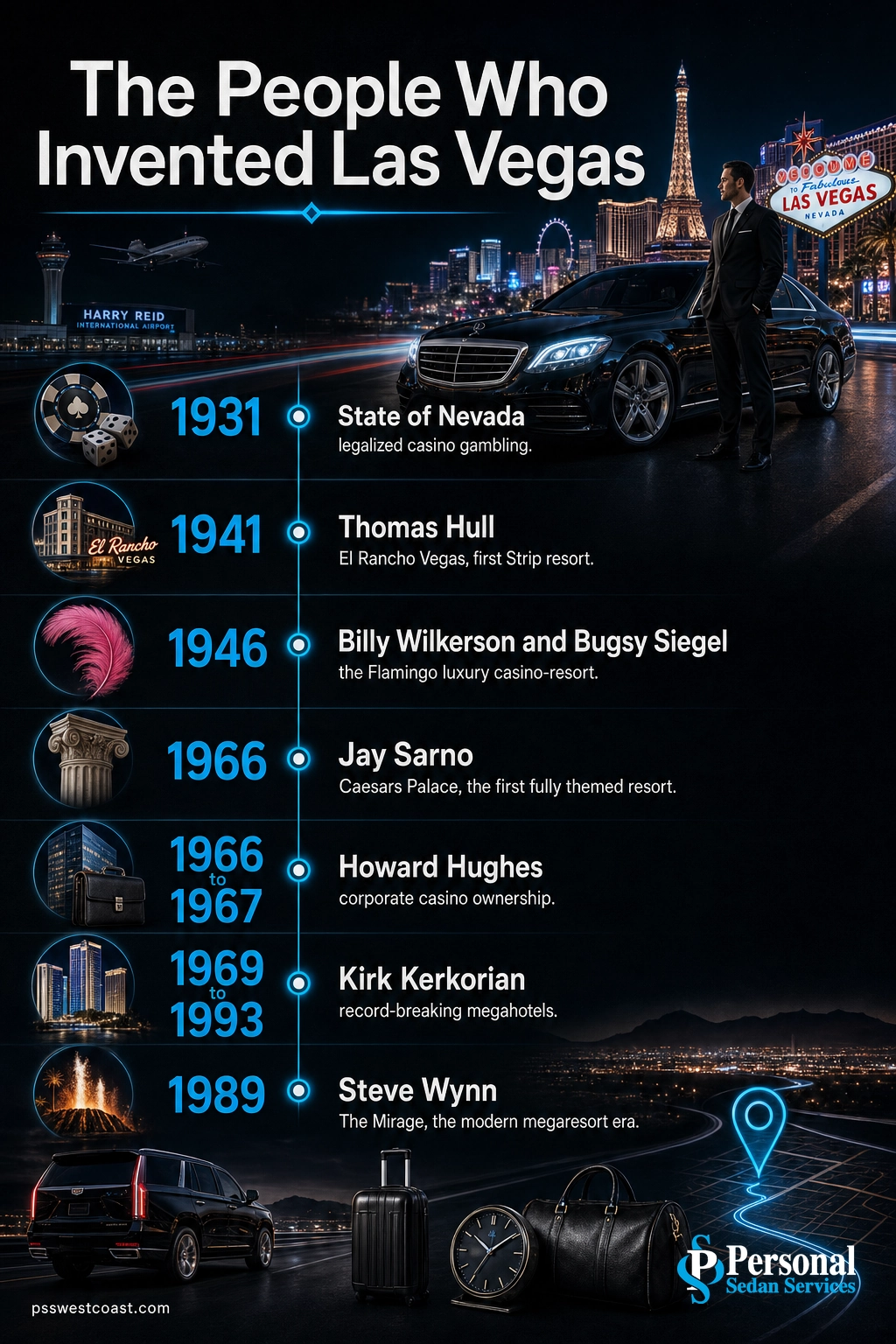
| 1931 | State of Nevada (Gov. Fred Balzar) | Legalized casino gambling, the legal foundation for everything after |
| 1941 | Thomas Hull | El Rancho Vegas, the first resort on the Strip and the all-in-one template |
| 1946 | Billy Wilkerson (then Bugsy Siegel) | The Flamingo: the luxury casino-resort concept, completed by Siegel |
| 1966 | Jay Sarno | Caesars Palace, inventing the fully themed immersive resort |
| 1966 to 1967 | Howard Hughes | Corporate casino ownership, helping push out the mob |
| 1969 to 1993 | Kirk Kerkorian | The record-breaking megahotel (International, MGM Grand) |
| 1989 | Steve Wynn | The Mirage, launching the modern spectacle-driven megaresort era |
Source: Encyclopaedia Britannica, History of Las Vegas | Nevada Resort Association, History of Gaming in Nevada
See Las Vegas History for Yourself
The best part of this story is how much of it you can still stand in front of. The Flamingo still operates on the Strip. Caesars Palace and the Mirage site are a short ride away. And two museums tell the whole tale: The Mob Museum downtown, which lays out the Siegel era honestly, and The Neon Museum, where the old resort signs are preserved in a boneyard you can walk through.
These stops are spread across downtown and the Strip, in a city where parking is tight and a rideshare app can leave you waiting at the curb. A history-of-Vegas day is exactly what a professional car service is built for. Personal Sedan Services is Las Vegas’s top-rated luxury transportation, with a perfect 5.0 Google rating from more than 900 reviews, and our licensed, background-checked chauffeurs know the Strip and downtown inside out. Let us handle the driving and the logistics while you take in the places where Sin City was invented.
Book attractions transportation to the historic sites
Whether you are tracing the people who built the Strip or just getting your group from the airport to the hotel in style, ride the way the city’s high rollers always have. Explore the full range of chauffeured luxury transportation, or book a reliable local ride for a self-guided tour of Las Vegas history.
Frequently Asked Questions
Who invented Las Vegas?
Did Bugsy Siegel invent Las Vegas?
Who built the first casino resort on the Las Vegas Strip?
Who created the modern Las Vegas megaresort?
Why is Las Vegas called Sin City?
Related Las Vegas City Guides
- Where is the “Welcome to Las Vegas” sign? – the city’s most photographed landmark, and the story of who put it there.
- How long is the Las Vegas Strip? – the resort corridor these builders created, measured end to end with a map and walk times.
- Cost of living in Las Vegas – what life actually costs in the city those resorts built.
- Is Las Vegas dying? – what today’s tourism and gaming data say about the future of Sin City.
- Best day trips from Las Vegas – where to go beyond the Strip once you have seen the history.
Explore the PSS luxury fleet for your Vegas tour
Sources and Methodology
This guide draws on standard references for the development of Las Vegas as a resort city. The March 19, 1931 legalization of casino gambling by Governor Fred Balzar follows the Nevada Resort Association’s History of Gaming in Nevada and University of Nevada, Las Vegas (UNLV) materials. The April 3, 1941 opening of Thomas Hull’s El Rancho Vegas, the first resort on the Strip, follows UNLV University Libraries Special Collections. Billy Wilkerson’s role as the originator of the Flamingo concept, and Bugsy Siegel’s 1946 takeover and completion of the resort at a cost of roughly $6 million, follow The Mob Museum, the Online Nevada Encyclopedia (Nevada Humanities), PBS American Experience, and History.com. The December 26, 1946 Flamingo casino opening follows The Mob Museum and History.com. Jay Sarno’s Caesars Palace (1966), Howard Hughes’s 1966 to 1967 casino purchases, Kirk Kerkorian’s hotels, and Steve Wynn’s 1989 Mirage follow Encyclopaedia Britannica, PBS American Experience, and the Nevada Resort Association. Where accounts differ, such as the exact details of Wilkerson’s dealings with Siegel, the most widely documented version is used.
- The Mob Museum: Flamingo Las Vegas, Wilkerson’s idea, Bugsy’s baby
- Online Nevada Encyclopedia: Billy Wilkerson
- PBS American Experience: Benjamin “Bugsy” Siegel
- Nevada Resort Association: History of Gaming in Nevada
- UNLV University Libraries: El Rancho Vegas
- Encyclopaedia Britannica: History of Las Vegas
