



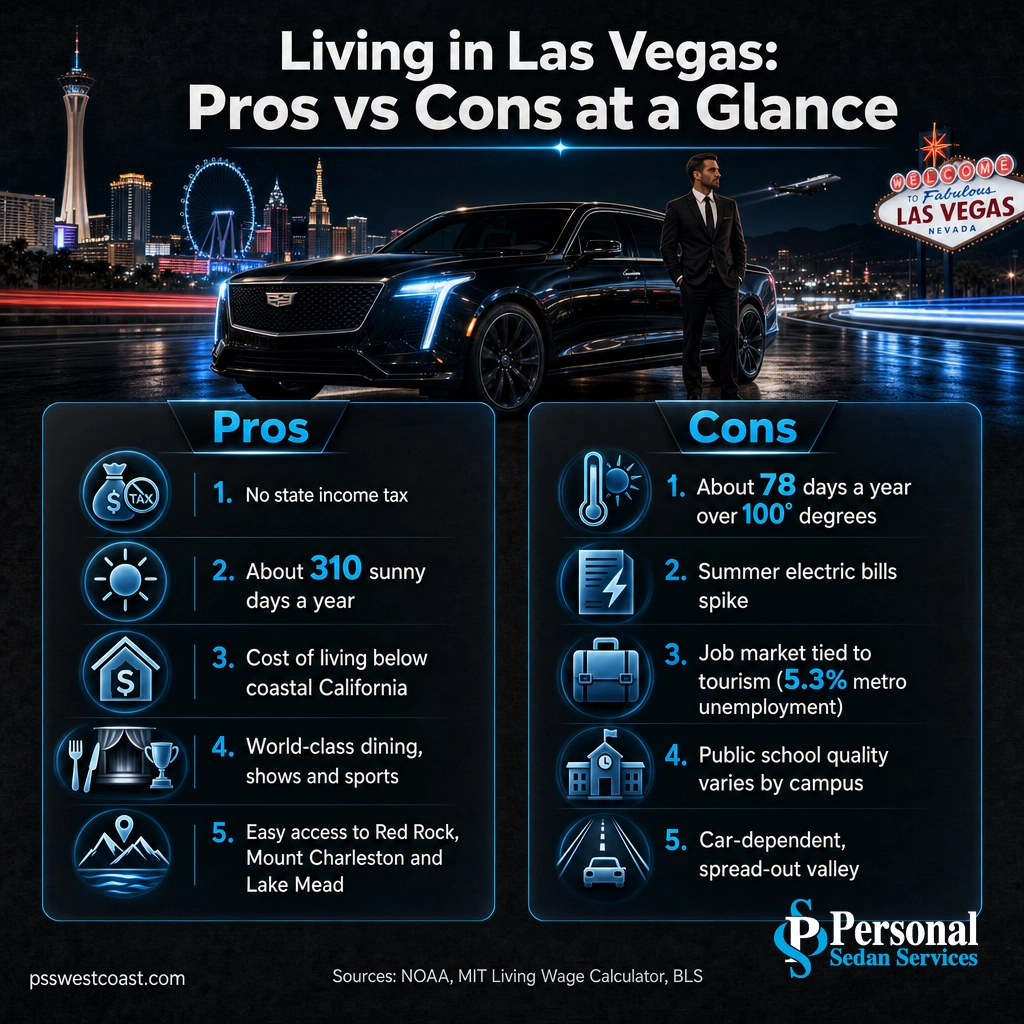
Is Las Vegas a good place to live? For a lot of people the answer is yes, and the reasons are concrete: no state income tax, about 310 days of sunshine a year, a cost of living below the big coastal California cities, and an entertainment, dining, and outdoor scene most metros cannot match. The honest trade-offs are just as concrete: a summer that delivers roughly 78 days a year over 100 degrees, a job market still tied to tourism, and a public school system that many families end up supplementing. This guide lays out the real pros and cons with 2026 data, so you can decide whether the valley fits your life instead of a brochure version of it.
- The tax draw is real. Nevada has no state income tax, no local income tax, and no estate or inheritance tax, which is the single biggest financial reason people relocate here.
- Cost of living beats coastal California, not the whole country. A single adult needs about $3,570 a month for the basics, per the MIT Living Wage Calculator for Clark County; the median single-family home ran about $475,000 in 2026.
- The heat is the thing to plan for. Las Vegas averages about 78 days a year at or above 100 degrees and 137 days at or above 90, with late-July highs near 105 (NOAA climate normals).
- Sunshine is the payoff. Roughly 310 clear-to-sunny days a year and mild, snow-free winters, with just 4.2 inches of annual rain.
- The job market leans on tourism. Metro unemployment was about 5.3% in May 2026, among the higher rates of large U.S. metros, though the economy is slowly diversifying into health care, logistics, and tech.
- Crime is trending down. Valley crime fell in 2024 and again through 2025 per Metro Police data, but safety varies sharply by neighborhood.
- Schools need homework. The Clark County School District is the nation’s fifth-largest at about 280,000 students; families research specific schools, magnets, charters, and zoning.
- It is a car town. The valley sprawls, so plan on driving, though many residents skip a second car and use a flat-rate local ride service for airport runs and nights out.

What’s in This Guide
- Is Las Vegas a Good Place to Live? The Short Answer
- The Pros of Living in Las Vegas
- The Cons of Living in Las Vegas
- Cost of Living: What It Really Takes
- Taxes: Nevada’s Biggest Draw
- The Job Market and Economy
- Weather and Climate: The Heat Is Real
- Safety and Crime
- Neighborhoods: Where to Live in the Valley
- Schools, Family Life, and Healthcare
- Getting Around: The Car Question
- Common Myths About Living in Las Vegas
- Who Should (and Shouldn’t) Move Here
- Moving to Las Vegas: What to Do Next
- Las Vegas Living at a Glance
- Related Resources
- Frequently Asked Questions
- Sources and Methodology
Is Las Vegas a Good Place to Live? The Short Answer
Las Vegas is a genuinely good place to live for people who value disposable income, sunshine, and lifestyle, and who can plan around heat and a tourism-weighted economy. The city has quietly turned into one of the fastest-growing major metros in the country precisely because the math works for a specific kind of mover: someone leaving a higher-tax, higher-cost state who wants more house, a lighter tax bill, and warm weather without giving up big-city amenities.
What trips people up is treating Las Vegas as a monolith. The Strip is a two-mile entertainment district that most residents visit a few times a year, not a place anyone actually lives. Real life happens in master-planned suburbs like Summerlin and Henderson, in older central-valley neighborhoods, and in fast-growing areas like the southwest and Skye Canyon, each with a very different price, commute, and feel. Your answer to “is it a good place to live” depends far more on which part of the valley you land in, and on your household, than on the city’s reputation.
The region is still growing, just more slowly than during its boom years. The University of Nevada, Las Vegas Center for Business and Economic Research projects Clark County will add roughly 40,000 residents in 2026, a growth rate around 1.6% that is expected to ease toward 0.6% by the end of the decade. That slowdown is not decline, it is a maturing metro: the kind that keeps attracting new residents while its explosive early growth settles into something steadier. For the fuller debate on whether the city is on the way up or down, our data-driven look at whether the Las Vegas growth story is slowing or reversing puts the numbers in context.
So the short answer is a qualified yes. If you are weighing a move, the rest of this guide is the long answer: every major pro, every real con, and the specific numbers that decide whether Las Vegas is a good place for you to live.
Source: UNLV CBER 2026 population forecast
The Pros of Living in Las Vegas
Start with the case for moving, because it is strong and it is the reason the U-Hauls keep arriving. The pros cluster around three things: money, climate, and lifestyle. None of them is marketing fluff; each shows up in the data and in residents’ monthly budgets.
No state income tax, and a light overall tax load
Nevada is one of a handful of states with no personal state income tax and no local income tax, and it levies no estate or inheritance tax either. For a household earning a solid income, keeping the 5% to 13% that a state like California would take out of every paycheck is a real, recurring raise, not a one-time perk. Property taxes are low too, with an effective rate among the lowest in the country and a 3% annual cap on how fast a primary residence’s tax bill can rise. We break the full tax picture down below, including the one offset (sales tax) that keeps Nevada from being a total free ride.
A cost of living below coastal California
Las Vegas is not the cheapest city in America, but against the metros most transplants are leaving, it is a bargain. A homeowner selling a Los Angeles or San Diego house near a million dollars can buy comfortably in Las Vegas for roughly half, then bank the income-tax savings on top. Rent, groceries, and healthcare all land at or near the national middle, which feels like relief to anyone coming from the coast. The honest caveat, covered in the cost section, is that Las Vegas is close to the national average overall, so the “cheap” feeling is mostly a California-comparison effect.
Sunshine almost every day
If you are tired of gray winters, this is the selling point. Las Vegas gets about 310 clear-to-sunny days a year and sees measurable rain on only about 26 days, totaling a mere 4.2 inches, per NOAA climate normals. Winters are mild and essentially snow-free in the valley, so the outdoor season runs most of the year. The trade-off, of course, is the summer, which gets its own section, but for three-quarters of the calendar the weather is a genuine amenity rather than something to endure.
World-class entertainment, dining, and the outdoors
Living here means the concerts, residencies, restaurants, and sports that tourists fly in for are a short drive away, often at off-Strip, resident-friendly prices. Las Vegas now has NFL (the Raiders), NHL (the Golden Knights), and a packed events calendar, plus a dining scene that runs from celebrity-chef rooms to some of the best cheap eats in the country. Outside the neon, Red Rock Canyon, Mount Charleston, Lake Mead, and a ring of national parks put hiking, skiing, and water recreation within an easy day trip. Few cities pack this much to do into one valley.
Explore Our Las Vegas Car Service
Source: Current Results Las Vegas weather averages (NOAA NCEI) | Nevada Department of Taxation
The Cons of Living in Las Vegas
Now the honest other side. These are the things that make Las Vegas a poor fit for some people, and the ones that first-year residents most often wish they had weighed harder. None of them is a dealbreaker on its own, but together they are the reality check every rosy relocation guide skips.
The summer heat is relentless
This is the number one adjustment. From roughly May through September the desert bakes, and air conditioning runs almost around the clock. It is a dry heat, which many people find more tolerable than humid heat, but 110-degree afternoons are still 110 degrees. The practical cost shows up on the NV Energy bill, which spikes in July and August even though Las Vegas electricity is cheap per unit. Budget for the peak, not the yearly average, and the summer becomes manageable rather than shocking.
A job market tied to tourism
Las Vegas was built on gaming, hospitality, and conventions, and that concentration is a double-edged sword. It means abundant service-industry work, but it also means the metro’s unemployment rate runs above the national average and is sensitive to travel downturns, as the pandemic made painfully clear. The economy is diversifying, but if your field is narrow, confirm it has a real local base before you move rather than assuming a big city means plentiful jobs in every sector.
Public schools are a common concern
The Clark County School District is enormous, the fifth-largest in the United States, and that scale brings funding, staffing, and consistency challenges. Plenty of excellent schools, magnets, and academies exist within it, but quality varies widely by campus, so families cannot rely on a blanket district reputation. For many movers with school-age kids, researching specific schools and zoning (or planning on charter or private options) is the single most important pre-move task.
Housing has climbed
The days of dirt-cheap Las Vegas housing are over. Home prices ran to record highs in recent years, and while 2026 brought some rental softening, buying now costs far more than it did a decade ago. It is still cheaper than the coast, but a transplant expecting 2012 prices will be surprised. Housing is the line that most determines whether Las Vegas feels affordable to you, which is exactly why it leads the cost section below.
Don’t move for the Strip, and don’t move without visiting in July. Two first-year regrets show up again and again. The first is treating the Strip as daily life; residents rarely go, and the real question is which suburb fits you. The second is underestimating the summer. If you can, visit in July before you commit, so the heat is a known quantity and not a surprise you signed a lease around.
Cost of Living: What It Really Takes
The cost of living is where “is Las Vegas a good place to live” gets answered in dollars. The clean way to think about it: some Las Vegas costs sit clearly below the national average, a few sit clearly above, and housing is the tie-breaker that decides which side of the line your own budget lands on.
A grounded baseline comes from the MIT Living Wage Calculator, an academic model that builds a bare-bones budget for each household type in a specific county. For Clark County, it puts a single adult’s no-frills cost of living at about $3,570 a month, roughly $50,300 a year before taxes. That covers rent, food, transportation, healthcare, and the basics, but nothing extra. Scale up to a family of four with both parents working and the after-tax number climbs toward $9,000 a month, with the jump driven almost entirely by childcare rather than rent.
After-tax monthly living costs; nearly $2,340 of the family total is childcare. Source: MIT Living Wage Calculator, Clark County NV (Feb 2026), annual figures converted to monthly.
Housing is the largest line in almost every budget. The average Las Vegas apartment rented for about $1,460 a month in mid-2026 per RentCafe, closely matching the Census median gross rent, while broader trackers that fold in single-family rentals land nearer $1,940. On the buy side, the median existing single-family home in the valley sold for around $475,000 in 2026 per Las Vegas REALTORS. Those numbers feel like relief next to coastal California and like sticker shock next to the city’s own past, which is why we built a full category-by-category breakdown you can budget against.
For the complete month-by-month picture, including utilities, groceries, childcare, and the income you actually need, see our deep dive on the real monthly cost of living in Las Vegas. The short version: Las Vegas is affordable relative to the coast and roughly average nationally, and your housing choice moves the needle more than the city does.
Reserve Everyday Local Transportation
Source: MIT Living Wage Calculator, Clark County, Nevada | RentCafe Las Vegas rent trends
Taxes: Nevada’s Biggest Draw
Taxes are the reason a lot of people move to Las Vegas in the first place, and the reason the cost of living can feel lower than the raw prices suggest. The picture is genuinely favorable, especially for higher earners and homeowners, but it is worth seeing the whole thing before you assume Nevada is a flat-out cheap state.
On the plus side, Nevada charges no personal state income tax and no local income tax. It also has no estate or inheritance tax. Property tax is the other pleasant surprise: the effective rate on owner-occupied homes is among the lowest in the country, and the state caps how much a primary residence’s tax bill can rise each year at 3%. For a relocating household, that combination quietly lifts every take-home paycheck and keeps the ownership cost of a home predictable.
The offset is sales tax. The combined rate in Las Vegas and the rest of Clark County is 8.375%, made up of the 4.6% state rate plus 3.775% in county and local add-ons, higher than many states charge. Groceries and prescription drugs are exempt, which softens the blow on essentials, but it is the one line where Nevada leans on residents to make up for the missing income tax.
| Tax | Las Vegas / Clark County | How it compares |
|---|---|---|
| State income tax | 0% | None; the major relocation draw |
| Local income tax | 0% | None |
| Estate / inheritance tax | 0% | None |
| Combined sales tax | 8.375% | Above average; groceries and Rx exempt |
| Effective property tax rate | ~0.44% to 0.55% | Among the lowest in the U.S. |
| Property tax cap | 3% per year (primary home) | Limits how fast your bill can rise |
For a household moving from California, the tax swing alone can be worth tens of thousands of dollars a year. Keeping the 9% to 13% a high earner would owe California, plus a lower property-tax rate and a mid-priced home, is the core of the Las Vegas relocation math, and it compounds every single year you stay. Just file your home as a primary residence so the 3% cap applies.
Source: Nevada Department of Taxation, Clark County sales tax rate | Tax Foundation property tax data
The Job Market and Economy
If taxes are the reason to move, the job market is the reason to do your homework first. Las Vegas was built on gaming, hospitality, and conventions, and that visitor economy is still the metro’s engine. The jobs that serve those visitors, in resorts, restaurants, retail, and events, remain the largest slice of local employment.
The flip side of that concentration is volatility. The metro’s unemployment rate was about 5.3% in May 2026, down from a year earlier but still among the higher rates of large U.S. metros, a direct consequence of leaning on an industry that hires and sheds workers with the travel cycle. For job seekers, the lesson is not “there are no jobs,” it is “confirm your specific field has a real local base,” because a tourism-weighted economy is deep in some sectors and thin in others.
The encouraging trend is diversification. The Nevada Governor’s Office of Economic Development points to expected hiring growth in health care, transportation and logistics, and technology as the region works to broaden its base beyond tourism and hospitality. Distribution and fulfillment operations have expanded around the valley thanks to its location and interstate access, and the health-care sector is growing to serve a bigger, older population. The casino floor is no longer the only career ladder in town, even if it is still the tallest.
If you work remotely, Las Vegas is close to an ideal base: you keep your out-of-market salary, pay no state income tax on it, and sit two short flights from either coast out of a major international airport. A large and growing share of the valley’s newest residents are remote workers doing exactly this.
Source: USAFacts Las Vegas metro unemployment (BLS data) | Nevada Governor’s Office of Economic Development

Weather and Climate: The Heat Is Real
No topic decides the Las Vegas fit more than the weather, and it cuts both ways. The sunshine is a daily amenity for most of the year; the summer is a genuine test. Both deserve honest numbers rather than either the brochure or the horror story.
Start with the heat, because it is the adjustment. Las Vegas averages about 78 days a year at or above 100 degrees and about 137 days at or above 90, per NOAA climate normals, with the average temperature peaking in late July at daily highs around 105. The saving grace is dryness, which makes the heat more bearable than the same number in a humid climate, but there is no sugarcoating a long run of triple-digit afternoons. From June through September, outdoor life shifts to early mornings, evenings, and anywhere with a pool or air conditioning.
1991-2020 climate normals for Las Vegas (McCarran/Harry Reid station). Source: NOAA National Centers for Environmental Information, via Current Results.
Now the payoff. The same desert that bakes in July gives you roughly 310 clear-to-sunny days a year and a winter that barely registers: mild, dry, and essentially snow-free in the valley, with just 4.2 inches of rain across the entire year. Spring and fall are close to perfect. For a month-by-month read on what each season actually feels like, our best-time-to-visit guide (linked in Related Resources below) breaks it down, and if you are wondering about the rare white winter, we cover how often it actually snows in the valley.
Source: Current Results Las Vegas weather averages (NOAA NCEI)

Safety and Crime
Safety is a reasonable question for any large metro, and the Las Vegas answer is encouraging at the trend level and highly local at the neighborhood level. Both parts matter, so take them together.
The trend is down. Through the first eight months of 2025, total reported crime in the Las Vegas valley fell to 84,890 incidents from 95,473 over the same span in 2024, per Las Vegas Metropolitan Police Department data, a decline of roughly 11%. That continues a 2024 in which the FBI recorded a 7.3% drop in valley violent crime, steeper than the national decline that year. Crime is not vanishing, but the direction has been favorable for multiple years running.
The local part is where it gets practical. Like any big city, Las Vegas has safe and less-safe pockets, and the gap is wide. Master-planned suburbs such as Summerlin, Henderson’s Green Valley, and the northwest around Centennial Hills consistently post the lowest crime rates and are where most relocating families gravitate. Parts of the central valley, the near-downtown core, and the immediate Strip corridor run higher, as tourist districts in any city do. The smart move for a mover is to evaluate crime at the neighborhood and even street level rather than by the metro headline. For a fuller treatment, see our guide on whether Las Vegas is safe and which areas are safest.
Tourist-district crime is not resident-neighborhood crime. A lot of the scary Las Vegas crime statistics people cite are concentrated in the small, dense Strip and downtown entertainment zones, where millions of visitors pass through. The suburban neighborhoods where residents actually live post very different, and much lower, numbers. Don’t let a citywide figure stand in for the street you would live on.
Source: KSNV News 3: Las Vegas Metro Police 2025 crime data

Neighborhoods: Where to Live in the Valley
The valley is big, and where you live inside it changes your price, your commute, your schools, and your day-to-day feel more than any citywide statistic. Here is the quick geography that every new resident eventually learns, so you can shortlist two or three areas and price them specifically.
The valley this covers: the Las Vegas metro (Clark County), including the city of Las Vegas, Henderson, North Las Vegas, Summerlin, the southwest, Enterprise, and Paradise. The Strip itself sits in unincorporated Paradise, not in a residential neighborhood.
| Area | Known for | Who it suits |
|---|---|---|
| Summerlin | Master-planned, parks, trails, well-regarded schools, Red Rock access | Families and higher-end buyers wanting amenities and newer homes |
| Henderson / Green Valley | Safe, suburban, strong schools, its own downtown (Water Street), Lake Las Vegas | Families and professionals wanting a quieter, polished suburb |
| Centennial Hills / Northwest | Newer subdivisions, good value, family-friendly, growing amenities | Value-focused families and first-time buyers |
| Southwest / Mountain’s Edge | Fast-growing, new construction, easy airport and Strip access | New-build buyers and commuters who want a central location |
| Central valley / Downtown | Older, most affordable housing, walkable arts district, close to the core | Renters, urbanists, and budget-conscious movers |
| North Las Vegas | Newer homes at lower price points; longer drive to the Strip and airport | Buyers prioritizing price-per-square-foot |
Two practical notes. First, because the valley sprawls, your commute is a real cost in both time and fuel; a home near your work or near a quick freeway on-ramp can be worth more than a slightly bigger house across town. Second, even property-tax rates vary by area because of overlapping school and improvement districts, so two same-priced homes can carry different bills. The takeaway is the same as the cost section: shortlist a few areas and price your specific housing and commute rather than trusting a single valley-wide figure. We serve every corner of the Las Vegas metro area, from the central valley out to Summerlin and Henderson.
Book a Ride Anywhere in the Valley
Schools, Family Life, and Healthcare
For anyone moving with children or planning to, this section matters more than the tax rate. Family life in Las Vegas is good in most respects, with abundant parks, youth sports, and family entertainment, but two areas, schools and healthcare access, deserve real attention.
Schools
Nearly every family’s first question is about the schools, and the honest answer is “research the specific school, not the district.” The Clark County School District is the fifth-largest in the country, serving roughly 280,000 students across the valley, and it faces the funding, staffing, and consistency challenges that come with that scale, plus declining enrollment that pressures its budget. Within it are genuinely excellent campuses, sought-after magnet and career-and-technical academies, and strong programs, alongside weaker schools. Quality tracks closely with neighborhood, which is one more reason to pick your area carefully.
Families also have real alternatives. Nevada has a growing charter-school sector, Clark County runs competitive magnet programs, and the valley has a solid roster of private and parochial schools. Many relocating families use one of these routes, or they zone into a strong public cluster deliberately. The point is that good education is available here; it just requires more homework than in a smaller, more uniform district.
Healthcare
Healthcare costs track a little below the national average, which is a quiet win for the budget. The nuance is access: Las Vegas has historically run below the national average on physicians per capita, so wait times for some specialists can be longer than in a comparably sized metro with more medical infrastructure. That gap is narrowing as the health-care sector grows, but new residents, especially seniors and anyone managing ongoing care, should line up providers early. For residents who would rather not drive themselves to regular appointments, a scheduled senior and medical appointment car service keeps that part of life predictable.
Senior & Medical Appointment Rides
Getting Around: The Car Question
Las Vegas is a car town, and understanding that upfront saves money and frustration. The valley is spread across a wide desert basin, the summer heat makes walking impractical for much of the year, and while the RTC bus system and the resort-corridor monorail exist, transit does not reach most neighborhoods quickly. For the vast majority of residents, a personal vehicle is the default.
That makes transportation one of the larger and most overlooked budget lines, and it is where a smart new resident can save real money. The MIT model estimates about $759 a month for a single adult once a car payment, insurance, fuel, and maintenance are combined, and Nevada auto insurance premiums run above the national average. A second car, in particular, stacks a payment, a second policy, and maintenance on top of each other for a vehicle that often sits idle.
Here is the angle a lot of transplants miss. Households that skip the rarely-used second car and mix in a flat-rate, pre-booked ride for airport runs, event nights, and appointments frequently come out ahead of both a second vehicle and surge-priced rideshare, which spikes exactly when you need it most (weekend nights, event days, airport rushes). For a full comparison of every way to move around the city, see our rundown of getting around Las Vegas, every option compared. And for move-in day itself, a reserved pickup from Harry Reid International beats a taxi line or a climbing app fare when you are tired and hauling boxes.
For airport trips especially, a reserved, set-rate pickup is the predictable choice on an unpredictable day. Our Las Vegas airport transportation quotes the fare up front, so arrival day is one thing you don’t have to worry about.
Book an Airport Pickup for Move-In Day
Source: MIT Living Wage Calculator, Clark County, Nevada
Common Myths About Living in Las Vegas
A handful of outdated or exaggerated ideas keep people from seeing the city clearly. Here are the ones worth correcting before you decide.
“Living in Las Vegas means living on the Strip.” Residents rarely set foot on the Strip. Daily life happens in ordinary suburbs with grocery stores, schools, parks, and HOAs, a 15 to 30 minute drive from the casinos. The Strip is a place you take out-of-town guests, not where anyone actually lives.
“Las Vegas is running out of water.” Water is a real long-term issue for the entire Colorado River basin, but Las Vegas is one of the more aggressive conservers in it. Southern Nevada recycles nearly all of the water used indoors and returns it to Lake Mead for reuse credits, per the Southern Nevada Water Authority, and the region cut its per-capita water use sharply through turf-removal rules and conservation even while the population grew. It is a managed challenge, not an imminent shutoff.
“There’s nothing to do unless you gamble or party.” Beyond the casinos, the valley offers hiking at Red Rock Canyon, skiing and cooler air at Mount Charleston, boating on Lake Mead, pro sports, a serious dining scene, and a day-trip ring of national parks. Plenty of residents never touch a slot machine, and much of everyday life here happens well away from the neon.
Source: Southern Nevada Water Authority conservation and water reuse
Who Should (and Shouldn’t) Move Here
Pull the pros and cons together and Las Vegas sorts into clear fits and clear mismatches. Use this as a gut check against your own situation.
| Las Vegas is a strong fit if you… | Think twice if you… |
|---|---|
| Want to keep more of a solid income (no state income tax) | Need a specific non-tourism industry with a thin local base |
| Work remotely or can bring your job with you | Rely entirely on one assigned neighborhood public school, sight unseen |
| Are relocating from a higher-cost coastal metro | Struggle badly in extreme heat, even dry heat |
| Love sunshine, dining, entertainment, and the outdoors | Want a walkable, transit-first, car-free lifestyle |
| Are a retiree or senior wanting mild winters and low taxes | Expect bargain-basement 2012-era home prices today |
| Want more house per dollar than California offers | Need a lush, green, four-season climate |
The cleanest way to decide is to separate the fixed facts from the personal ones. The taxes, the sunshine, the cost-versus-California gap, and the entertainment are fixed advantages that apply to everyone. The heat tolerance, the school needs, and the industry fit are personal, and they are what actually determine whether Las Vegas is a good place for you to live. Score yourself honestly on the three personal ones and the answer usually becomes obvious.
Moving to Las Vegas: What to Do Next
If the valley looks workable for you, here is a practical order of operations for the move, with what to prioritize and roughly when.
| Action | Priority | Timeline | Why it matters |
|---|---|---|---|
| Shortlist two or three neighborhoods and price them specifically | High | 2 to 3 months out | Biggest driver of cost, schools, and commute |
| If you have kids, research specific schools, magnets, and zoning | High | 2 to 3 months out | Quality varies by campus, not just district |
| Confirm your industry has a real local base, or bring your job | High | Before committing | Tourism-weighted economy is uneven by sector |
| Run your real cost-of-living numbers for your household size | Medium | 1 to 2 months out | Determines the income you need |
| Budget for peak summer electric bills, not the annual average | Medium | Before your first summer | Utilities spike June through September |
| Decide whether you truly need a second car or a flat-rate ride option | Medium | First 1 to 2 months | Transportation is a large, trimmable line |
| Arrange a set-rate airport pickup for arrival day | Low | Move week | One predictable cost on a chaotic day |
On arrival, the small logistics are where a moving budget quietly leaks through taxi lines and surge fares. A pre-booked, licensed driver from the airport to your new address is one fixed, reliable cost on a hectic day, and it is the kind of everyday dependability residents keep using long after the boxes are unpacked.
Ride With a Professional Chauffeur
Las Vegas Living at a Glance
One reference table for the whole picture. Figures are 2026 metro-wide estimates from the primary sources cited throughout this guide.
| Factor | Las Vegas (2026) | Verdict |
|---|---|---|
| State income tax | 0% | Major pro |
| Local income tax | 0% | Pro |
| Estate / inheritance tax | 0% | Pro |
| Combined sales tax | 8.375% | Minor con |
| Effective property tax rate | ~0.44% to 0.55% | Pro |
| Single adult cost of living | ~$3,570 / mo | Average nationally, cheap vs coast |
| Family of four cost of living | ~$8,960 / mo (after tax) | Childcare is the swing line |
| Median single-family home | ~$475,000 | Up a lot, still below coast |
| Average apartment rent | ~$1,460 / mo | Softened slightly in 2026 |
| Median household income (city) | ~$73,900 | Context for comfort |
| Metro unemployment | ~5.3% (May 2026) | Con; tourism-sensitive |
| Days at or above 100°F | ~78 / year | Major con (summer) |
| Days at or above 90°F | ~137 / year | Con |
| Clear-to-sunny days | ~310 / year | Major pro |
| Annual rainfall | 4.2 inches | Pro (dry, sunny) |
| Snow in the valley | Rare / trace | Pro for sun-seekers |
| Valley crime trend | Down ~11% through Aug 2025 | Improving |
| Public school district | CCSD, ~280,000 students | Research by campus |
| Transit coverage | Limited; car town | Con for car-free life |
| Population growth (county) | ~1.6% in 2026 (~40,000) | Still growing |
| Economy | Tourism-led, diversifying | Mixed |
Related Resources
Go deeper on the decisions behind your move. The cost-of-living, safety, growth, and getting-around guides linked throughout this article round out the picture; these add the demographic, housing, and seasonal context:
- Las Vegas population and real estate statistics: home prices, inventory, and who is moving to the valley.
- Las Vegas tourism statistics: the visitor economy that shapes local jobs and prices.
- The best time to visit Las Vegas: a month-by-month read on the weather and seasons.
Primary data sources:
Frequently Asked Questions
Is Las Vegas a good place to live in 2026?
What are the biggest pros of living in Las Vegas?
What are the biggest cons of living in Las Vegas?
How much money do you need to live comfortably in Las Vegas?
Is Las Vegas safe to live in?
What is the job market like in Las Vegas?
How bad is the heat in Las Vegas really?
Are the schools in Las Vegas good?
Is Las Vegas running out of water?
Do you need a car to live in Las Vegas?
Sources and Methodology
How we built this guide
This guide unions what the top living-in-Las-Vegas resources cover and grounds every hard figure in a primary source. Cost-of-living and income figures come from the MIT Living Wage Calculator for Clark County, Nevada (data updated February 2026); annual figures were converted to monthly by dividing by 12. Weather figures are NOAA National Centers for Environmental Information 1991-2020 climate normals for the Las Vegas station. Population figures are from the UNLV Center for Business and Economic Research 2026 forecast. Crime figures are Las Vegas Metropolitan Police Department statistics as reported for 2024 and 2025. Unemployment is U.S. Bureau of Labor Statistics data for the Las Vegas-Henderson-North Las Vegas metro area. School figures are Clark County School District enrollment data. We did not use aggregator estimates for any hard figure; directional comparisons (such as “below coastal California”) are labeled as such.
- MIT Living Wage Calculator, Clark County, NV (cost of living, income needed, by household type).
- NOAA NCEI climate normals, Las Vegas (via Current Results) (days over 90/100, sunshine, rainfall).
- UNLV CBER 2026 population forecast (growth rate, projected gains).
- USAFacts / U.S. Bureau of Labor Statistics (metro unemployment rate).
- KSNV News 3, citing Las Vegas Metropolitan Police Department (2025 crime totals).
- Nevada Department of Taxation (sales tax, no income tax) and Tax Foundation (property tax).
- Southern Nevada Water Authority (water conservation and reuse).
Figures reflect 2026 data available at the time of writing. Housing, rent, utility, and labor numbers update regularly, so treat these as current benchmarks rather than fixed values. Last Updated: October 2026.
