


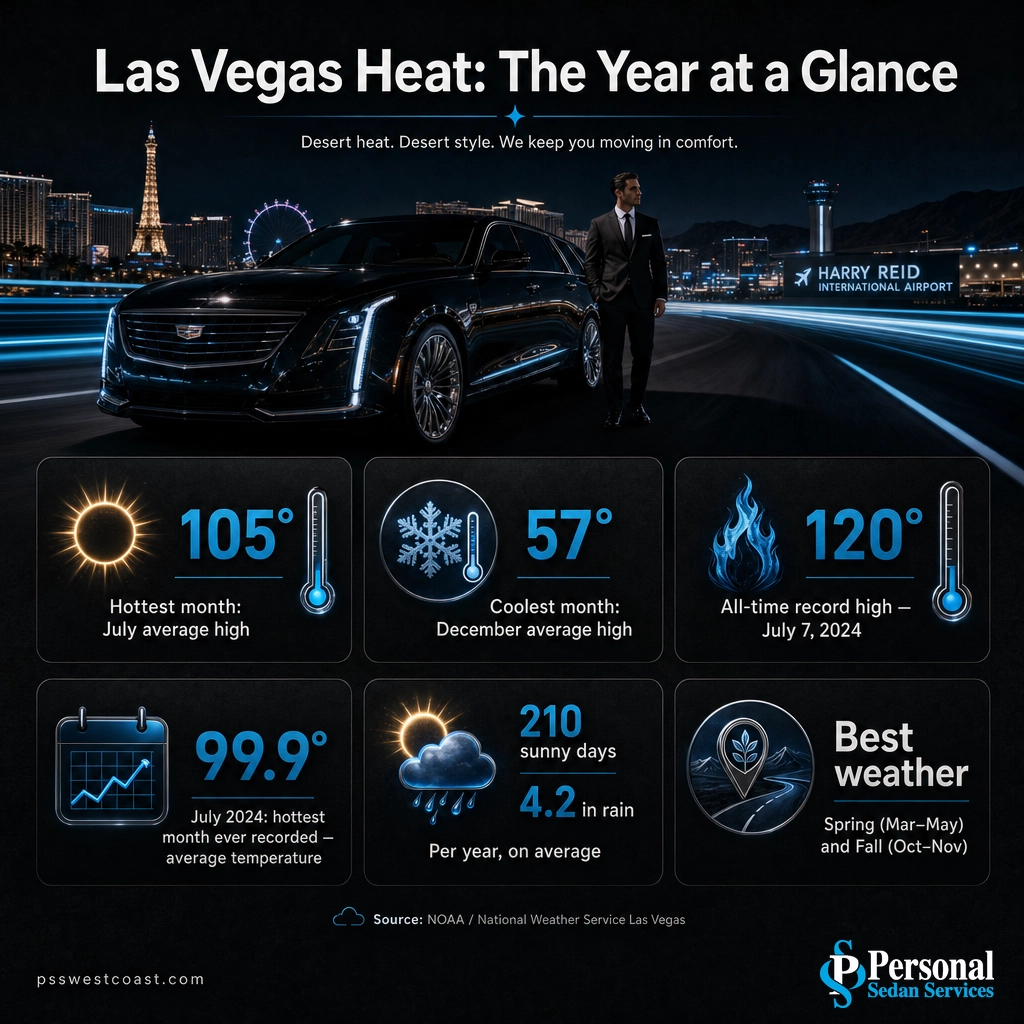
How hot does it get in Las Vegas? In summer, very hot: July averages a 105-degree high and the city hit an all-time record 120 degrees on July 7, 2024. Across the year, monthly average highs run from about 57 degrees in December to 105 in July, with roughly 210 sunny days and very little rain. The most comfortable months are spring (March to May) and fall (October to November).
Las Vegas is famous for its heat, and the reputation is earned: this is one of the hottest major cities in the United States, sitting in the heart of the Mojave Desert at about 2,000 feet of elevation. Summer afternoons regularly climb past 100 degrees, and in July 2024 the city set an all-time record of 120 degrees. But “how hot is it in Las Vegas” has a very different answer depending on the month. This guide walks through the temperature in Las Vegas month by month using the official 1991 to 2020 climate normals, breaks the year into seasons, explains the famous “dry heat,” tells you the genuinely best time to visit for comfortable weather, and covers how to handle the heat safely once you are here.
- The short answer: Las Vegas summers are extreme. July averages a 105-degree high, June and August sit near 99 to 103, and triple-digit afternoons are the norm from June through early September.
- Hottest month: July, averaging about 105 degrees. July 2024 was the hottest month ever recorded in the city, averaging 99.9 degrees day and night.
- Record heat: 120 degrees on July 7, 2024, the highest temperature ever measured at the airport, breaking a 117-degree mark reached five previous times.
- Winter is mild, not warm: December and January highs sit near 57 to 59 degrees, but nights drop to about 40 and can freeze. Pack layers.
- The sweet spot: spring (March to May) and fall (October to November) deliver warm, dry 70s and 80s with pleasant evenings, the best weather of the year.
- It is a dry heat, but still dangerous: low humidity makes 105 degrees more bearable than a humid city, yet it dehydrates you faster, and extreme heat is a real health risk.
- Getting around matters: the Strip is four miles long and feels much shorter on a map. In summer heat, an air-conditioned chauffeured ride beats walking or waiting curbside for a rideshare.

What’s in This Guide
- How Hot Does It Really Get in Las Vegas?
- Las Vegas Temperature by Month
- Las Vegas Weather by Season
- The Hottest Months: June, July, and August
- Why Is Las Vegas So Hot?
- How Las Vegas Heat Compares to Phoenix and Death Valley
- Is It Really a Dry Heat? What That Actually Means
- How Cold Does It Get? Winter and the Day-Night Swing
- The Best Time to Visit Based on Weather
- How to Handle the Las Vegas Heat
- How the Heat Shapes Popular Las Vegas Activities
- Getting Around Las Vegas in the Heat
- Plan Your Trip by the Weather
- Las Vegas Weather by Month: Quick Reference
- Frequently Asked Questions
- Related Las Vegas Travel Guides
How Hot Does It Really Get in Las Vegas?
Las Vegas is hot, and in summer it is genuinely extreme. Averaged across the whole year, the city’s daily high is about 81 degrees and its daily low about 60, according to the 1991 to 2020 U.S. Climate Normals for Harry Reid International Airport. That annual average hides the real story, though, because Las Vegas has one of the widest seasonal swings of any major American city: a December afternoon in the upper 50s and a July afternoon near 105 are both normal in the same town.
The driver is the desert setting. The valley sits at roughly 2,000 feet in the Mojave Desert, one of the sunniest and driest places in the country. The city records around 210 sunny days a year and only about 4.2 inches of total precipitation, so there is almost no cloud cover or moisture to moderate the temperature. Sunshine pours in nearly every day, the ground bakes, and in summer the heat builds relentlessly through the afternoon.
When people ask “how hot is it in Las Vegas,” they are almost always picturing the summer. From June through early September, triple-digit highs are routine, and the hottest afternoons push past 110. The rest of the year is far more forgiving, with spring and fall sitting in the comfortable 70s and 80s and winter cooling to mild days and chilly nights. Here is the full picture, month by month.
Source: National Weather Service Las Vegas 1991 to 2020 climate normals | NOAA U.S. Climate Normals
Las Vegas Temperature by Month
The most useful way to understand the climate is the monthly average high and low. The figures below are the official 1991 to 2020 normals measured at the airport, rounded to whole degrees. They represent a typical month, so individual days can run well above or below these numbers, especially the hottest July afternoons and the coldest January nights.
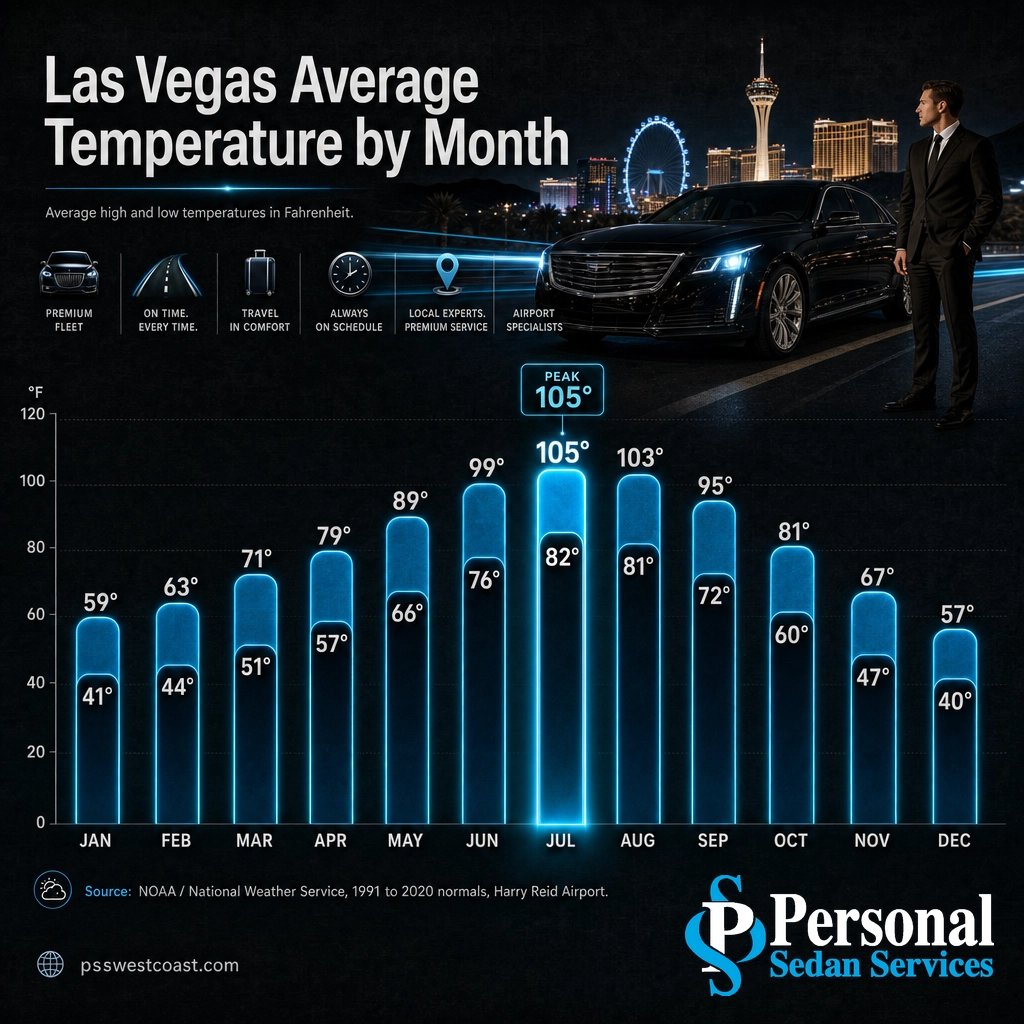
Reading down the year, the pattern is clear. Temperatures climb steadily from the December and January low point, accelerate hard through late spring, peak in July, then fall off through autumn. May is the pivot into summer, when highs jump into the upper 80s, and October is the mirror on the way out, when the first genuinely comfortable afternoons return.
Average High Temperature by Season (Harry Reid Airport, 1991 to 2020 Normals)
Seasonal average daytime highs. Summer runs roughly 20 degrees hotter than spring or fall and more than 40 degrees above winter. Source: National Weather Service Las Vegas.
What the seasonal view makes obvious is how much of the year is actually pleasant. Nine of the twelve months have average highs below 100 degrees, and four of them (March, April, October, and November) land in that ideal 67-to-81-degree window. The brutal stretch is real but short: it is essentially mid-June through early September. The full month-by-month breakdown with travel notes is in the quick-reference table near the end of this guide.
Source: National Weather Service Las Vegas 1991 to 2020 normals
Las Vegas Weather by Season
Grouping the months into seasons is the fastest way to set expectations for a trip. Each season in Las Vegas has a distinct personality, and the difference between them is dramatic.
Spring (March to May)
Spring is arguably the best weather of the year. March opens with 71-degree highs and cool 51-degree nights, April warms into the high 70s, and May climbs into the upper 80s as summer approaches. Days are warm and sunny, evenings are crisp, and the humidity is low. This is prime time for pool decks, patio dining, and outdoor events before the real heat sets in. Late May is the warning shot, with afternoons regularly touching 90 and the first triple-digit days possible.
Summer (June to August)
Summer is the headline. Average highs are 99 in June, 105 in July, and 103 in August, and afternoons frequently exceed 110. This is extreme heat by any standard. The upside is that it is dependable and dry: pool season is in full swing, dayclubs run all weekend, and the sunshine is relentless. The downside is that midday outdoor activity becomes genuinely risky without planning, and the pavement and car interiors get dangerously hot. We cover the summer in detail in the next section.
Fall (September to November)
Fall is the sleeper-great season. September is still hot at 95 degrees on average, but it cools quickly: October drops to a lovely 81-degree high, and November settles into the comfortable upper 60s. Nights turn crisp, crowds thin after the summer rush, and the weather rivals spring for comfort. Late October and all of November are excellent for anyone who wants warm, dry days without the summer extreme.
Winter (December to February)
Winter is mild in the daytime and genuinely cold at night. December and January highs sit near 57 to 59 degrees, February warms back toward 63, and the sun still shines most days. But average lows hover around 40 degrees and can dip below freezing, so the gap between a pleasant afternoon and a cold evening is large. It is the quietest, most affordable season, and real snow is rare on the valley floor, a point we return to in the winter section below.
The desert setting explains the swing. Clear skies and dry air let heat escape fast after sunset, which is why Las Vegas can have a 40-degree spread between a warm afternoon and a cold night, especially in spring, fall, and winter. It is also why summer nights, when the ground has stored so much heat, barely cool off at all.
Source: National Weather Service Las Vegas 1991 to 2020 normals
The Hottest Months: June, July, and August
If your trip falls in summer, this is the section that matters most. The three summer months are in a category of their own, and they are getting hotter. July is the single hottest month, averaging a 105-degree high and an 82-degree low, which means the temperature often does not drop below the mid-80s even overnight. August runs a close second at 103, and June, while slightly cooler at 99, already delivers plenty of triple-digit afternoons.
Average High in the Three Summer Months (Harry Reid Airport, 1991 to 2020 Normals)
All three summer months average triple-digit highs, and individual afternoons routinely push past 110. Source: National Weather Service Las Vegas.
Recent summers have rewritten the record books. On July 7, 2024, Harry Reid International Airport reached 120 degrees, the highest temperature ever recorded in Las Vegas. That broke the long-standing all-time record of 117 degrees, a mark that had been tied five separate times (most recently in July 2021) before 2024 pushed it three degrees higher. The entire month of July 2024 averaged 99.9 degrees across every day and night combined, making it the hottest calendar month in the city’s recorded history, well above the previous record set just the summer before.
Late summer also brings the North American monsoon. From roughly July through September, surges of moisture can trigger afternoon thunderstorms, brief heavy downpours, dust storms, and a bump in humidity. These storms are scattered and short, but they can cause flash flooding in washes and underpasses and can briefly disrupt flights and traffic. Most summer days stay bone-dry and sunny; the monsoon is the exception that occasionally interrupts it.
None of this should scare you off a summer trip. Millions of people visit Las Vegas in July and August and have a great time, because the city is built around the heat: nearly everything indoors is heavily air-conditioned, the pools are the main event, and the nightlife runs late when it is finally bearable outside. The key is respecting the heat and planning around it, which is what the rest of this guide helps you do.
Source: NWS Las Vegas climate normals | Las Vegas Review-Journal report on the 120-degree record
Why Is Las Vegas So Hot?
The heat is not an accident of a few bad summers. It is built into where and how the city sits, and understanding why makes the monthly numbers above make sense.
First, the location. Las Vegas lies in the Mojave Desert, the hottest and driest desert in North America, at a latitude that puts it under a strong summer high-pressure ridge. For months at a time in summer, that ridge parks over the Southwest, suppressing clouds and storms and letting the sun bake the ground day after day. With almost no cloud cover and only about 4.2 inches of rain a year, there is nothing to blunt the sunshine.
Second, the dry air itself amplifies the daytime heat. In a humid climate, moisture in the air absorbs some of the sun’s energy and moderates the temperature. In the desert, that moisture is missing, so a larger share of the sun’s energy goes straight into heating the air and the ground. The same dryness is why nights cool off so sharply outside of summer: without humidity to hold the heat, it radiates back to space quickly after sunset.
Third, the valley acts like a bowl. Las Vegas sits at about 2,000 feet, ringed by higher mountains, and the surrounding terrain can trap and recirculate hot air. On top of that, the metro area has grown enormously, and all that asphalt, concrete, and building mass soaks up heat during the day and releases it at night. This urban heat island effect is a big reason the city’s overnight lows have warmed over the decades, and why the valley floor stays hotter after dark than the open desert around it.
Finally, the trend is warming. The record books tell the story: the all-time high of 120 degrees and the hottest-month-ever mark both landed in July 2024, and the previous monthly record had been set only the summer before. Las Vegas has always been hot in summer, but the most extreme readings are clustering in the most recent years, which is why heat planning matters more now than it did a generation ago.
Source: National Weather Service Las Vegas | NWS heat and climate information
How Las Vegas Heat Compares to Phoenix and Death Valley
Las Vegas is hot, but it has company. Two of the hottest places in North America sit nearby, and comparing them puts the city’s summer in perspective. Phoenix, about a five-hour drive southeast, runs a notch hotter than Las Vegas in high summer. Death Valley, roughly two hours west, is in a league of its own as the hottest place on Earth.
| Location | July Avg High | All-Time Record High | Notes |
|---|---|---|---|
| Las Vegas, NV | ~105°F | 120°F (July 7, 2024) | Hot but manageable with planning; the city is built for it |
| Phoenix, AZ | ~106°F | 122°F (June 26, 1990) | Slightly hotter in high summer; first major U.S. city to average 100+ for a month |
| Death Valley, CA | 120°F and up | 134°F (July 10, 1913) | The hottest place on Earth; a day-trip extreme, not a place to stay |
The Phoenix comparison is the useful one for most travelers, because the two cities trade heat waves all summer and feel broadly similar: triple-digit afternoons, dry air, and life organized around air conditioning. Phoenix’s 1991 to 2020 normal July high of about 106 degrees edges just past Las Vegas, and in 2024 it famously became the first major U.S. city to average more than 100 degrees across an entire month.
Death Valley is the eye-opener. Just across the California line, Furnace Creek regularly tops 120 degrees in summer and holds the highest air temperature ever reliably recorded on the planet, 134 degrees on July 10, 1913. It is a bucket-list drive from Las Vegas precisely because of that extreme, best done as a cool-season visit or a carefully planned summer day trip. If the desert’s heat fascinates you, our guide to how far Death Valley is from Las Vegas covers the drive and the safest way to see it.
The takeaway: Las Vegas is genuinely one of the hottest cities in the country, running neck and neck with Phoenix, and it borders the hottest spot on the globe. That is the company it keeps, and it is why respecting the heat is not optional in summer.
Source: National Weather Service Phoenix | National Park Service: Death Valley weather and climate
Is It Really a Dry Heat? What That Actually Means
You will hear it constantly: “it’s a dry heat.” It is true, and it genuinely matters, but it is also widely misunderstood. Las Vegas sits in the Mojave Desert, where humidity is very low for most of the year. Low humidity means sweat evaporates quickly off your skin, and that evaporation is how your body cools itself, so 105 degrees in dry Las Vegas does feel less suffocating than 95 degrees in a humid Gulf Coast city.
That is the real benefit. But “dry heat” is not a free pass, and treating it like one is how visitors get into trouble.
Do not let the dry heat fool you. Because your sweat evaporates instantly, you often will not feel wet or notice how much fluid you are losing, so dehydration sneaks up fast. 105 to 120 degrees is dangerous heat no matter how it feels, and heat exhaustion and heat stroke are real risks on the hottest days. The dry air also parches skin, lips, and sinuses quickly. Treat any triple-digit afternoon with respect: drink water constantly, not just when you feel thirsty, and limit direct midday sun exposure.
The humidity is not always low, either. During the July-to-September monsoon, moisture surges in and the air can feel sticky and oppressive for days at a time, closer to a humid-climate summer than the classic bone-dry desert. On those days the “dry heat is easier” logic goes out the window, and the heat index can feel even worse than the thermometer reads.
The bottom line on dry heat: it is real and it does make the same temperature more tolerable than a humid climate, but it changes none of the safety math. Extreme heat is extreme heat. The dry air actually makes hydration more important, not less, because you lose water without realizing it.
Source: National Weather Service heat safety guidance
How Cold Does It Get? Winter and the Day-Night Swing
The flip side of “how hot does it get” is that Las Vegas surprises a lot of visitors with how cool it can be. People picture the desert as warm year-round and pack accordingly, then shiver through a January evening. Winter days are mild and sunny, but the nights are genuinely cold.
December is the coolest month, with an average high of 57 degrees and a low near 40. January is nearly identical at 59 and 41, and February warms slightly to 63 and 44. Daytime in winter is pleasant for walking and sightseeing in a jacket, but once the sun drops, the dry desert air lets the temperature fall fast. Overnight lows regularly reach the 30s, and hard freezes happen a few times each winter.
That day-to-night swing is one of the most important things to understand about the Las Vegas climate, and it is not limited to winter. In spring and fall, a 79-degree afternoon can be followed by a 55-degree evening. The practical lesson is the same in every season except peak summer: dress in layers. A short-sleeve afternoon on the Strip can become a cold, breezy walk between casinos just a few hours later.
For a winter trip, the practical advice is simple: plan for mild, sunny afternoons and genuinely cold evenings. A warm layer makes outdoor dinners, late walks between casinos, and pool-deck lounging far more comfortable, and the holiday stretch around New Year’s draws big crowds despite the chill. The payoff for braving the cooler nights is real: thinner daytime crowds at attractions, the lowest hotel rates of the year, and crisp, clear skies ideal for sightseeing. It is a very different Las Vegas from the summer furnace, and for many travelers a more comfortable one.
Snow on the valley floor is rare, averaging only about a third of an inch a year, though the mountains that ring the city get plenty of it. If a white Las Vegas is on your mind, our companion guide covers exactly how often it snows in Las Vegas and where to find reliable snow nearby.
Source: National Weather Service Las Vegas 1991 to 2020 normals
The Best Time to Visit Based on Weather
If comfortable weather is your priority, the answer is clear: come in spring or fall. March through May and October through November deliver the ideal combination of warm, sunny days and cool, pleasant evenings, steering between the summer furnace and the chilly winter nights.
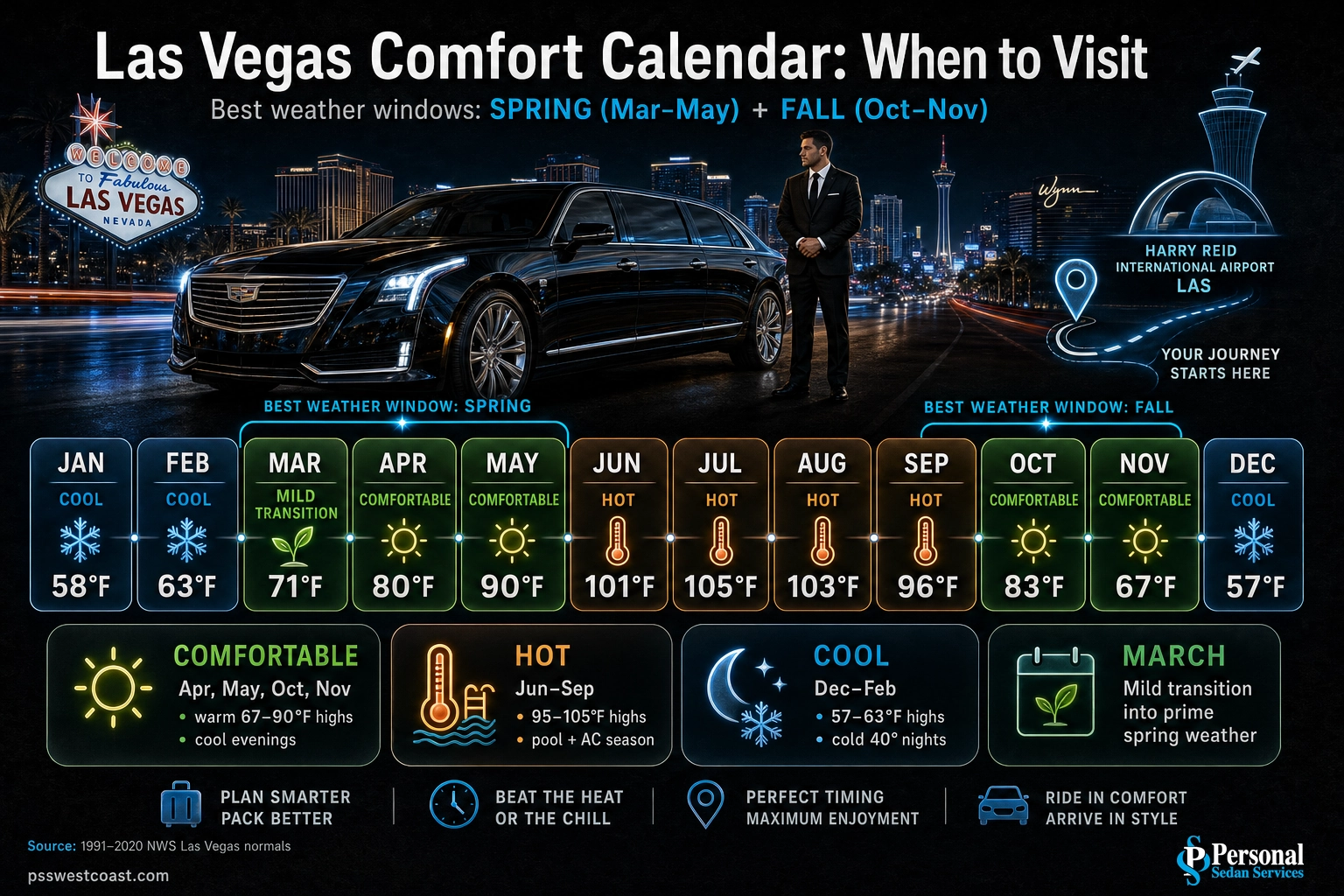
Here is how the year stacks up purely on weather comfort:
- Best overall (warm and comfortable): April, May, October, and parts of September and November. Highs in the 70s and 80s, dry air, cool evenings. This is peak comfort.
- Great if you love heat and pools: June, July, and August. Expect 99 to 110-plus degrees. The payoff is full pool and dayclub season under guaranteed sun.
- Mild but pack a jacket: December, January, and February. Pleasant 57-to-63-degree afternoons, cold nights near 40, thin crowds, and the lowest hotel rates of the year.
- The shoulders to watch: late May tips into triple digits, and early September is still genuinely hot. March and late October are the safest bets for near-perfect conditions.
Weather is only one input, of course. Convention schedules, major events, holidays, and room rates all shift the “best” time depending on what you want out of the trip. For the full picture that weighs crowds, prices, and events alongside the climate, see our dedicated best time to visit Las Vegas month-by-month guide. If you are weighing a move rather than a visit, our Las Vegas cost of living breakdown factors the climate (and those summer cooling bills) into a real monthly budget.
Book a ride to Las Vegas attractions in any season
Source: National Weather Service Las Vegas 1991 to 2020 normals

How to Handle the Las Vegas Heat
Whether you are visiting in July or just want to be ready, a few habits make the difference between enjoying the heat and being flattened by it. The desert rewards preparation and punishes the people who treat 110 degrees like a warm day at the beach.
Hydrate constantly, long before you feel thirsty
This is the single most important rule. In dry desert heat, your sweat evaporates instantly, so you lose water fast without feeling sweaty or thirsty. Carry a water bottle everywhere, drink steadily all day, and go easy on alcohol and caffeine in the afternoon heat, since both accelerate dehydration. If you are out at the pool or walking outdoors, aim to drink well beyond what thirst suggests.
Time your outdoor activity
Do the outdoor things early or late. Morning (before 10 a.m.) and evening (after about 6 p.m.) are far more comfortable for walking the Strip, visiting the hiking trails around the valley, or seeing outdoor attractions. The hottest, most dangerous stretch is roughly noon to 5 p.m., when the pavement radiates stored heat on top of the air temperature. Reserve that window for pools, indoor attractions, and air-conditioned spaces.
Dress and pack for the desert
Light, loose, light-colored, breathable clothing helps. So do a hat, high-SPF sunscreen reapplied often, UV-blocking sunglasses, and lip balm, because the sun and dry air are intense. In every season except peak summer, add a layer for the cold evenings. Comfortable, closed shoes matter too, since Strip distances are long and hot sidewalks are unforgiving.
Watch for heat illness, and never leave anyone or any pet in a parked car. Dizziness, nausea, headache, a rapid pulse, confusion, or a sudden stop in sweating are warning signs of heat exhaustion or heat stroke, which is a medical emergency in this kind of heat. Car interiors can reach lethal temperatures within minutes on a 110-degree afternoon. If someone shows serious symptoms, get them cool and call for help immediately.
Let the pools and the mountains be your escape
Las Vegas is built for its own heat. The pools and dayclubs are not a side activity in summer, they are the main one, so plan afternoons around the water, not the sidewalk. And when you want a true temperature break, the mountains just outside town run 20 to 30 degrees cooler. A drive up to higher elevation or a cooler day trip is one of the best moves a summer visitor can make; our guide to the best day trips from Las Vegas has the options.
Source: National Weather Service heat safety | CDC guidance on extreme heat and health
How the Heat Shapes Popular Las Vegas Activities
The temperature does not just sit in the background; it dictates how and when you do almost everything here. A little timing turns the heat from a problem into a non-issue, and knowing the pattern ahead of time saves a trip from being spent hiding indoors.
Pools and dayclubs
Summer is pool season for a reason. When the afternoon hits 105, the smartest place to be is in the water, which is exactly why Las Vegas built an entire industry around dayclubs and resort pools. From May through September they are the main event, not a side activity. Most pools run roughly March through October, with the biggest scene in the peak heat. Plan hot afternoons around the water and save the sightseeing for cooler hours; our guide to the best pool parties in Las Vegas covers where to go.
Golf and hiking
Outdoor sports flip the calendar. Golf is far more pleasant from October through May, and summer tee times are best booked at dawn, when courses often discount the midday heat anyway. The same goes for the stunning trails around the valley: Red Rock Canyon and the other hikes near Las Vegas are genuinely dangerous in summer midday and wonderful in the cooler months or at sunrise. If you love the golf courses around Las Vegas, aim for the shoulder seasons and early mornings.
Dining, shows, and nightlife
Indoor entertainment is heat-proof year-round, which is part of what makes Las Vegas a reliable summer destination. Casinos, showrooms, restaurants, and spas are all heavily air-conditioned, so the headline shows and dining never depend on the weather. Where the heat shows up is in the in-between moments: the walk to the restaurant, the outdoor patio, the rooftop bar. In summer, those are best enjoyed after sunset, when the temperature finally eases (a little) and the famous neon comes alive. A leisurely Las Vegas brunch is an easy, cool-hours win.
Outdoor events and weddings
Season matters most for anything scheduled outdoors. Outdoor weddings, festivals, and ceremonies are far more comfortable in spring and fall, and a summer outdoor event needs real heat planning: shade, water stations, and timing around the cooler ends of the day. For groups attending any summer event, keeping everyone cool between venues is half the battle, which is where reliable climate-controlled transportation earns its keep.
Source: National Weather Service Las Vegas
Getting Around Las Vegas in the Heat
Here is where the weather stops being trivia and starts shaping your day. The biggest heat mistake visitors make is underestimating distance. The Las Vegas Strip is about four miles long, and the resorts look deceptively close together on a map. Walking from one end to the other, or even between two “neighboring” mega-resorts, can mean a half-mile or more of exposed sidewalk, pedestrian bridges, and casino detours, all in direct afternoon sun.
In 70-degree spring weather, that walk is pleasant. In 105-degree July heat, it is draining and, for some visitors, genuinely unsafe. This is why an air-conditioned ride is not a luxury in a Las Vegas summer so much as a practical tool. A chilled car waiting at the curb turns the brutal part of the day (getting from A to B) into the easy part.
Personal Sedan Services is Las Vegas’s top-rated luxury transportation, with a perfect 5.0 Google rating from more than 900 reviews. Our licensed, background-checked chauffeurs know the valley in every season, and every vehicle is clean, cooled, and ready, which is exactly what you want when you step out of a hotel lobby into a 110-degree afternoon. A reliable local ride around Las Vegas means you never wait on a hot curb, never fight rideshare surge pricing during a heat event, and never cut an outing short because the walk back looked too long.
The heat matters most at two specific moments, and both are easy to solve:
- Arrival. Stepping off a plane into summer heat and then standing in a long rideshare or taxi line outside the terminal is a rough welcome. A pre-booked Las Vegas airport shuttle means a cooled vehicle is waiting the moment you land, no line, no surge.
- Groups and events. Keeping a group together and comfortable in extreme heat (a wedding party, a corporate event, a bachelor or bachelorette weekend) is far easier in a single climate-controlled vehicle than scattering across rideshares. Our group transportation handles exactly that.
Whatever the month, taking the weather out of your transportation is one of the simplest upgrades to a Las Vegas trip, from a single sedan to a full party bus for the group.
Explore our luxury transportation options
Plan Your Trip by the Weather
Here is a simple action plan that turns everything above into decisions, based on when you are coming and what the weather will demand.
| Action | Priority | Timeline | Relevant Service |
|---|---|---|---|
| Choose travel dates for comfort (aim for March to May or October to November) | High | When booking | Trip planning |
| If visiting June to August, plan the day around pools and indoor spaces; outdoors only early or late | High | Before and during trip | Attractions transport |
| Pack for the day-night swing: sun protection plus an evening layer | High | Before trip | Packing |
| Pre-book an air-conditioned airport pickup so a cooled vehicle waits on arrival | High | Before trip | Airport shuttle |
| Use a chauffeured ride instead of long Strip walks in summer heat | Medium | During trip | Local transportation |
| Keep groups together and cool for events in extreme heat | Medium | During trip | Group transportation |
| Escape the summer heat with a cooler mountain or day-trip excursion | Low | During trip | Attractions transport |
Ride with a professional Las Vegas chauffeur
Las Vegas Weather by Month: Quick Reference
This table combines the official 1991 to 2020 temperature normals with practical travel notes and the seasonal and record figures, so you can scan the whole year at a glance.
| Month / Period | Avg High | Avg Low | What to Expect |
|---|---|---|---|
| January | 59°F | 41°F | Coolest stretch; crisp sunny days, cold nights |
| February | 63°F | 44°F | Mild and pleasant, low crowds |
| March | 71°F | 51°F | Spring begins; excellent for outdoors |
| April | 79°F | 57°F | Warm days, cool nights; peak comfort |
| May | 89°F | 66°F | Heating up fast; first 100-degree days possible |
| June | 99°F | 76°F | Triple digits arrive; pool season opens |
| July | 105°F | 82°F | Hottest month; extreme afternoon heat |
| August | 103°F | 81°F | Still brutal; monsoon storms possible |
| September | 95°F | 72°F | Cooling slowly; great by late month |
| October | 81°F | 60°F | Second-best month; warm and dry |
| November | 67°F | 47°F | Crisp, comfortable, quiet |
| December | 57°F | 40°F | Coolest month; chilly nights, lowest rates |
| Winter (Dec-Feb) | 60°F | 42°F | Mild days, cold nights, pack layers |
| Spring (Mar-May) | 80°F | 58°F | The weather sweet spot |
| Summer (Jun-Aug) | 102°F | 80°F | Dangerous midday heat; pools and AC |
| Fall (Sep-Nov) | 81°F | 60°F | Warm, dry, comfortable, thinner crowds |
| Annual average | 81°F | 60°F | About 210 sunny days, roughly 4.2 inches of rain |
| Hottest month on record | July 2024 | Averaged 99.9°F day and night | |
| All-time record high | 120°F | July 7, 2024, breaking the old 117-degree mark | |
| Best weather months | Mar-May, Oct-Nov | Warm days, cool evenings, low humidity | |
Source: National Weather Service Las Vegas 1991 to 2020 normals | NOAA U.S. Climate Normals
Frequently Asked Questions
How hot does it get in Las Vegas in the summer?
What is the hottest month in Las Vegas?
What was the hottest temperature ever recorded in Las Vegas?
Is Las Vegas heat really a dry heat?
How cold does Las Vegas get in winter?
What is the best time to visit Las Vegas for comfortable weather?
Does it cool down at night in Las Vegas in the summer?
Is it safe to walk the Las Vegas Strip in summer?
Related Las Vegas Travel Guides
- The best time to visit Las Vegas: a month-by-month guide – weather, crowds, prices, and events weighed together.
- Does it snow in Las Vegas? – the other side of the climate, and where to find real snow nearby.
- The best pool parties in Las Vegas – how to spend the hottest afternoons the right way.
- The best day trips from Las Vegas – cooler escapes when you need a break from the heat.
- Cost of living in Las Vegas – a real monthly budget, summer cooling bills included.
Book an air-conditioned airport pickup
Sources and Methodology
Monthly average high and low temperatures are the 1991 to 2020 U.S. Climate Normals for Harry Reid International Airport (formerly McCarran), published by NOAA’s National Centers for Environmental Information and the National Weather Service Las Vegas office, rounded to whole degrees for readability. Annual figures (an 81-degree average high, a 60-degree average low, roughly 210 sunny days, and about 4.2 inches of precipitation) and the roughly 2,000-foot valley elevation come from the same NOAA and NWS records. The all-time record high of 120 degrees on July 7, 2024, the previous 117-degree record, and July 2024 as the hottest month on record at an average of 99.9 degrees come from the National Weather Service Las Vegas and local reporting by the Las Vegas Review-Journal. Heat-safety guidance is from the National Weather Service and the CDC. Last Updated: October 2026.
